
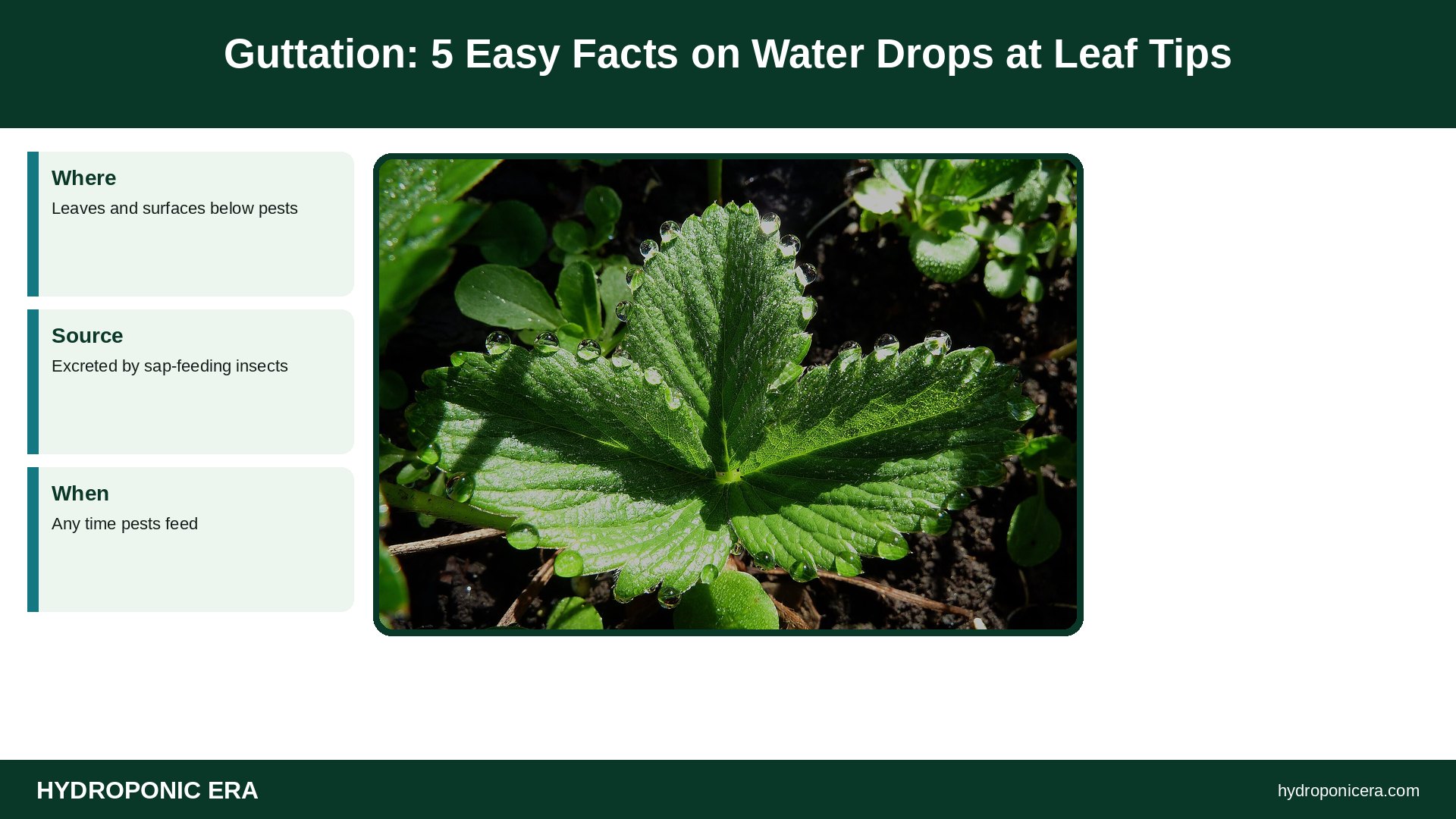
What is guttation? Guttation is the release of water droplets from leaf tips and edges through always-open pores called hydathodes. It happens at night or early morning when roots keep pushing water up but humid, cool air stops transpiration. NYBG and Colorado State University Extension say it is usually harmless, though the dried residue can leave white spots.
Key takeaway: Root-pressure water pushed out of hydathodes, usually harmless, mostly seen on humid mornings.
| Clue | Guttation | Dew | Insect honeydew |
|---|---|---|---|
| Where | Leaf tips and margins | Whole leaf surface | Leaves and surfaces below pests |
| Source | From inside the plant | Condensed from air | Excreted by sap-feeding insects |
| When | Night and early morning | Cool, clear nights | Any time pests feed |
| Feel | Clear water, may dry white | Plain water | Sticky |
| Sign of | Moist roots, low transpiration | Weather | Scale, aphids or mealybugs |
What Causes Guttation in Plants?
Root pressure with nowhere to go. NYBG explains that roots keep absorbing water and pushing it up the xylem. When cool, still, humid air slows evaporation and stomata close at night, pressure builds and the plant releases fluid through specialized glands. Colorado State University Extension (CSU) adds that warm, moist media and cool air make it more likely.
What Are Hydathodes?
Water pores at leaf edges. CSU explains that hydathodes are connected to the xylem and, unlike stomata, are always open. They act as a pressure relief system, so droplets form along margins and tips in the early morning. NYBG notes the fluid contains water plus organic and inorganic compounds, and the word comes from the Latin gutta, meaning droplet.

How Can You Tell Leaf-Tip Droplets From Dew?
Dew comes from the air; these droplets come from inside. Dew condenses on cool leaf surfaces and coats the whole leaf. Guttation droplets sit neatly at tips or along teeth on the margin, often one bead per vein ending. CSU notes that on grass the two often occur together, so you may see both on the same morning.
Is Guttation Bad for Plants?
Usually not. CSU calls it generally harmless, though salts in dried droplets can slightly burn leaf edges. There is a disease angle: CSU cites evidence that bacterial canker of tomato, botrytis gray mold and tobacco mosaic virus can be present in the fluid of infected plants and spread by handling wet plants early in the morning.
Separately, crusty white deposits on media are covered in our guide to salt crust on the media surface, which has a different cause.
Do Leaf-Tip Droplets Mean You Are Overwatering?
It can signal very moist roots. NYBG says it happens most often when soil is very moist, and CSU says it is common on houseplants watered just before dark. Frequent droplets plus yellowing or soggy media suggest watering too often. In hydroponics, droplets on healthy plants under high humidity is normal, not a nutrient problem.
Why Do Leaves Show White Spots After the Droplets Dry?
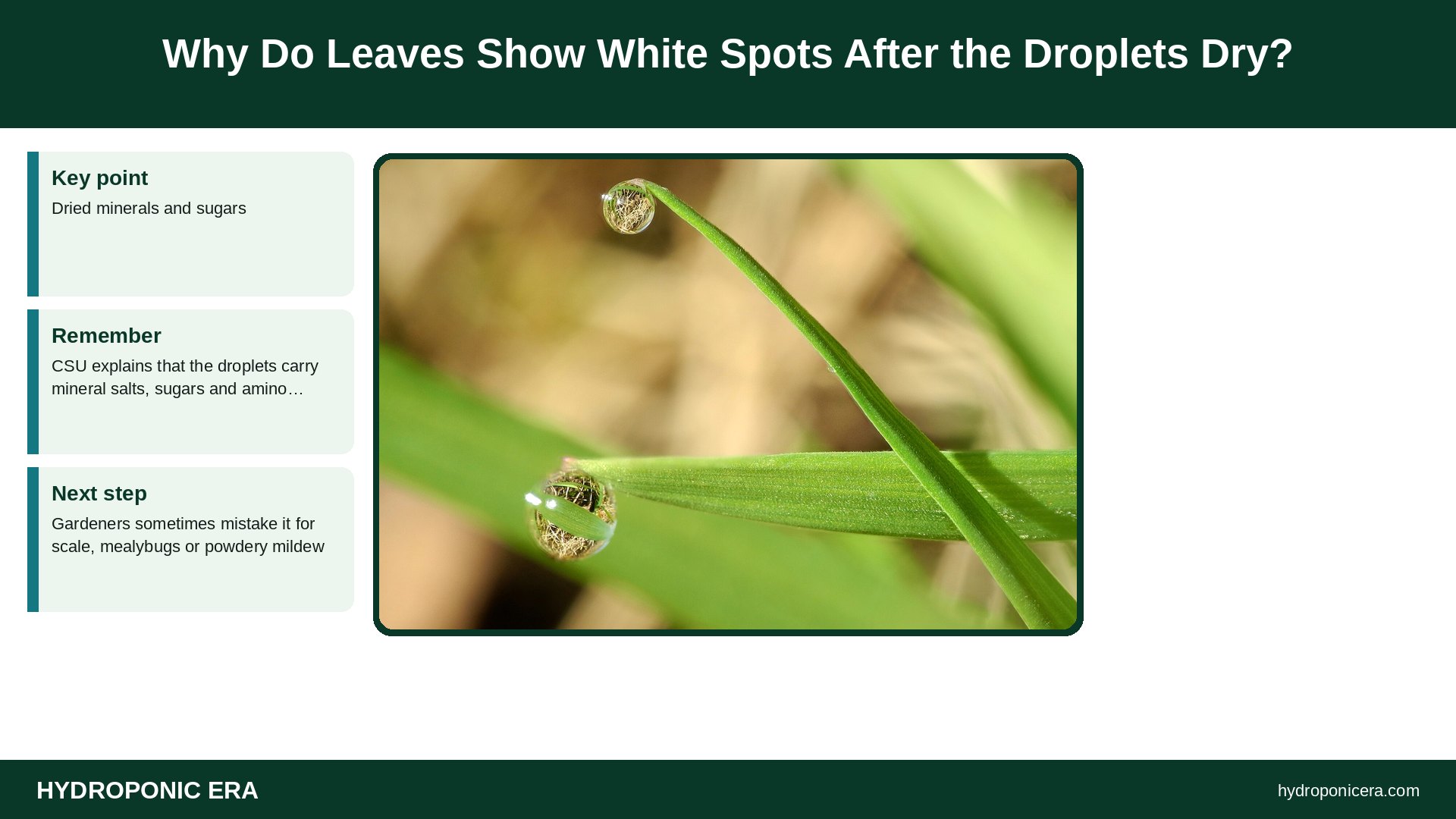
Dried minerals and sugars. CSU explains that the droplets carry mineral salts, sugars and amino acids, so they leave a whitish crust when they evaporate. Gardeners sometimes mistake it for scale, mealybugs or powdery mildew. Look closely before spraying. Wipe residue with a damp cloth, and check for real pests if spots feel waxy or move.
If you suspect pests, compare with our guide to mealybugs and scale on hydroponic plants.
Is Sticky Leaf Fluid Plant Sap or Insect Honeydew?
Check for insects. Arkansas Extension notes ficus trees often ooze sticky guttation fluid, especially after moving indoors in fall, and it can stain floors like honeydew from sucking insects. Small dark bumps on stems or leaves point to scale. CSU notes the sugary fluid can attract ants and foraging bees.
Which Plants Drip Water From Leaf Tips Most?
Short, herbaceous plants, and many common crops. CSU says it occurs mostly on plants under about 3 feet (0.9 m) tall, is very common on grasses, has not been observed on conifers, and is frequent on houseplants including many succulents. Tomatoes, strawberries and many vegetables show it too. NYBG notes it often appears on tropical plants when high humidity limits transpiration.
How Can You Reduce Guttation Indoors?
Lower evening humidity and moisture. Since the process follows wet roots and low transpiration, these steps help when droplets are frequent or residue builds up.
- Water houseplants in the morning instead of just before dark.
- Improve air movement with a small fan.
- Keep night humidity in a sensible range; see our guide to humidity and VPD indoors.
- Space plants so leaves dry quickly in the morning.
FAQ About Guttation
Is the water safe to touch?
It is plant sap water, but CSU warns it can carry pathogens from infected plants, so avoid handling wet, diseased plants.
Do pets need to avoid the drops?
Droplets carry plant compounds; keep pets away from toxic houseplants regardless.
Should I wipe the droplets off?
Not necessary; wipe dried white residue if it builds up.
Does it happen in daylight?
Rarely, since transpiration usually removes water once stomata open.
Why do hydathodes release water but not stomata?
CSU says hydathodes are always open; stomata close at night.
Sources
- NYBG Mertz Library Plant Information Service — Why Are My Plant Leaves Dripping Water?
- Colorado State University Extension, Tony Koski — Guttation: Just a Curious Plant Thing?
- University of Arkansas Cooperative Extension — Houseplants General Info
- Photo credits (Wikimedia Commons, edited with titles): Guttation on a strawberry leaf by Schnobby (CC BY-SA 3.0); Guttation on strawberry leaves 02 by Neworion (CC BY-SA 4.0); 2012-12-19 12-47-47-gouttes-eau-9f by Thomas Bresson (CC BY 3.0); Deepwater Aquaponics Floating Rafts Growing Lettuce, Basil and Arugula by Alabama Extension (CC0)