
Can you grow hyssop hydroponically? Yes. Hyssop hydroponics is practical for the young leafy tips of Hyssopus officinalis, a compact mint-family herb that NC State Extension says grows 1–2 feet (30–60 cm) tall. Start seed in plugs, grow it in a well-aerated system or a drained Dutch bucket, give it full sun or strong LEDs, and trim often to keep it bushy.
Key takeaway: Hyssop prefers light, dry, well-drained roots over rich, wet conditions, so the best hydroponic setups drain freely and stay well oxygenated. Use strong light to prevent legginess, harvest tips regularly, and expect the plant to be short-lived as a perennial.
| Factor | Guidance | Source |
|---|---|---|
| Botanical name | Hyssopus officinalis (mint family) | NC State Extension |
| Size | 1–2 feet (30–61 cm) tall, 1 foot (30 cm) to 18 inches (46 cm) wide | NC State Extension |
| Germination | 5–21 days; sow 1/4 inch (6 mm) deep | Johnny’s Selected Seeds |
| Light | Full sun best; leggy in part shade | Johnny’s Selected Seeds |
| Roots | Prefers light, well-drained conditions over rich and moist | Johnny’s Selected Seeds |
| Propagation | Seed, stem cuttings or division | NC State Extension |
What Is Hyssop?
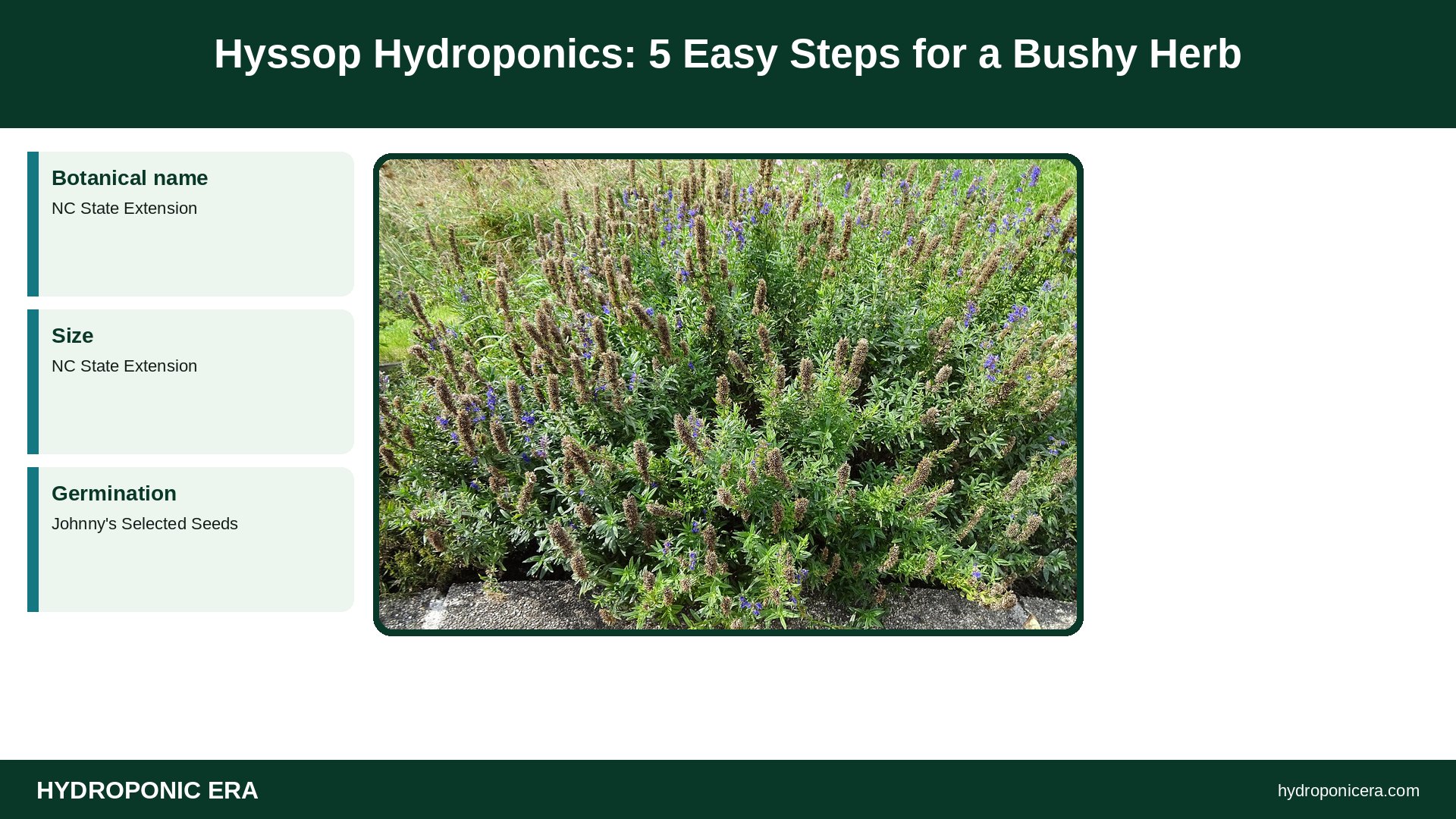
Hyssop is Hyssopus officinalis, a short-lived, semi-evergreen perennial or subshrub in the mint family, native to Europe, Asia and Africa. NC State Extension notes it has narrow, fragrant leaves, purple to blue flowers all summer, and foliage used as a flavoring in stews, soups and sauces. Its oils are used in Chartreuse liqueur.
Do not confuse it with anise hyssop (Agastache foeniculum), a different plant with a licorice scent. This guide covers true hyssop, which has a stronger, slightly bitter, minty flavor.
Is Hyssop Hydroponics a Good Idea?
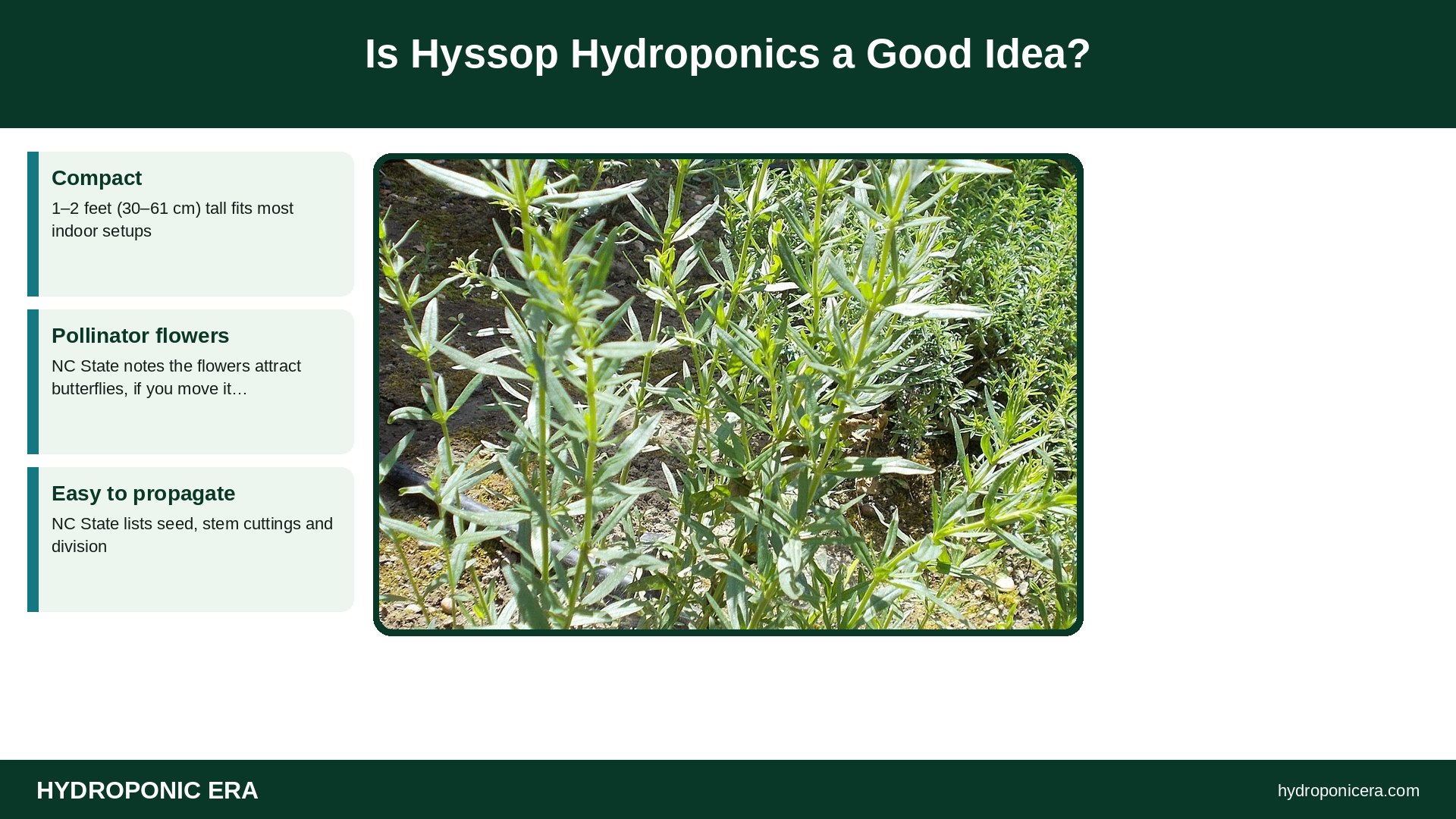
Hyssop hydroponics is a good idea if you match its preference for airy roots. Johnny’s says hyssop prefers a light, rocky soil over one that is rich and moist. In hydroponics, that means a free-draining medium, plenty of dissolved oxygen and moderate nutrient strength rather than a constantly saturated plug.
- Compact: 1–2 feet (30–61 cm) tall fits most indoor setups.
- Pollinator flowers: NC State notes the flowers attract butterflies, if you move it outdoors later.
- Easy to propagate: NC State lists seed, stem cuttings and division.
- Trade-off: it is short-lived, so plan to replace plants.
How Do You Start Hyssop for Hydroponics?
Start hyssop hydroponics from seed or cuttings. Johnny’s recommends sowing about 1/4 inch (6 mm) deep, with germination taking 5–21 days, then thinning to one seedling per cell. NC State notes hyssop can also be propagated from stem cuttings in spring, which gives a faster start in a cloning tray.
- Sow 2–3 seeds per rockwool or coco plug about 1/4 inch (6 mm) deep.
- Keep plugs moist, warm and bright until seedlings emerge.
- Thin to one seedling per plug.
- Transplant into net cups with clay pebbles once roots appear.
- For cuttings, root soft tips in a humid tray before moving them into the system.
For cloning setups, see our humidity dome guide for cuttings.
What Light and Nutrients Does Hyssop Need?
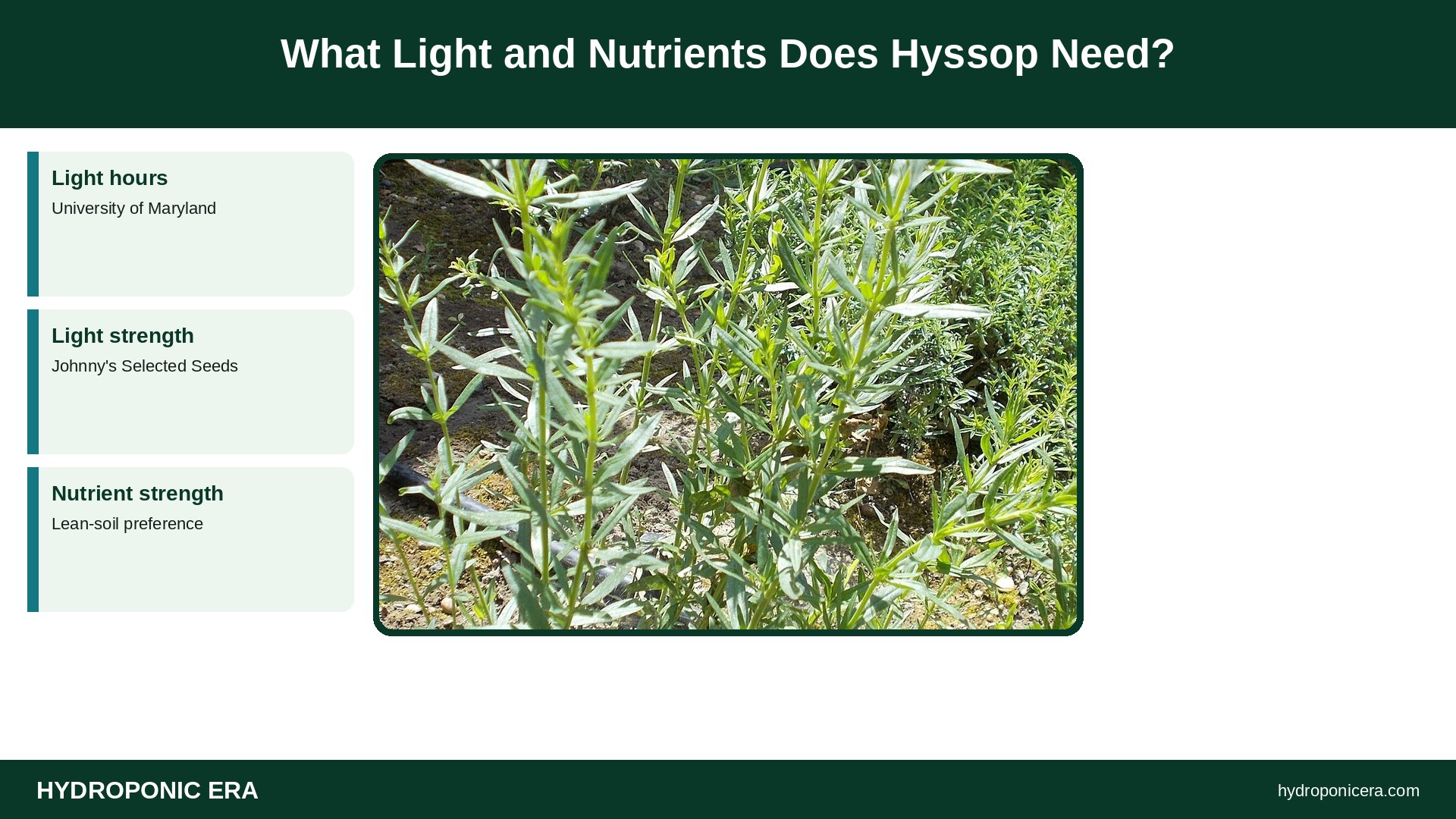
Give hyssop full sun or strong LEDs. Johnny’s says it will grow in part shade but becomes quite leggy. The University of Maryland recommends grow lights 14–16 hours a day for indoor herbs in winter. Feed a moderate herb nutrient solution and avoid pushing EC high, since hyssop is adapted to lean soils.
| Setting | Starting point | Basis |
|---|---|---|
| Light hours | 14–16 hours a day | University of Maryland |
| Light strength | Strong; avoid shade | Johnny’s Selected Seeds |
| Nutrient strength | Moderate herb range | Lean-soil preference |
| Root zone | Free-draining, well oxygenated | Johnny’s soil notes |
For herb feeding ranges, see hydroponic nutrients for herbs, and for light timing read how much light herbs need.
What Is the Best System for Hyssop Hydroponics?
The best system for hyssop hydroponics is one that drains freely: ebb and flow, a Dutch bucket with perlite or clay pebbles, or a well-aerated DWC with a clear air gap below the net cup. Avoid wicking setups that keep the crown wet, because hyssop prefers light, well-drained roots.
| System | Fit for hyssop hydroponics | Why |
|---|---|---|
| Ebb and flow | Excellent | Roots dry slightly between floods |
| Dutch bucket | Very good | Free-draining media for a woody herb |
| DWC | Good | Needs strong aeration and an air gap |
| Wick system | Poor | Keeps roots too wet |
How Do You Harvest and Prune Hyssop?
Harvest hyssop by snipping young leafy tips as needed, which keeps the plant compact. Johnny’s notes that for drying, flowering tops or the whole plant are harvested just as blooming begins, then hung in shade. NC State adds that spring trimming keeps a bushy, well-shaped plant that resists breakage.
Use fresh hyssop sparingly in soups, stews and sauces; its flavor is strong. Dried leaves keep well in a sealed jar.
What Problems Affect Hyssop Hydroponics?
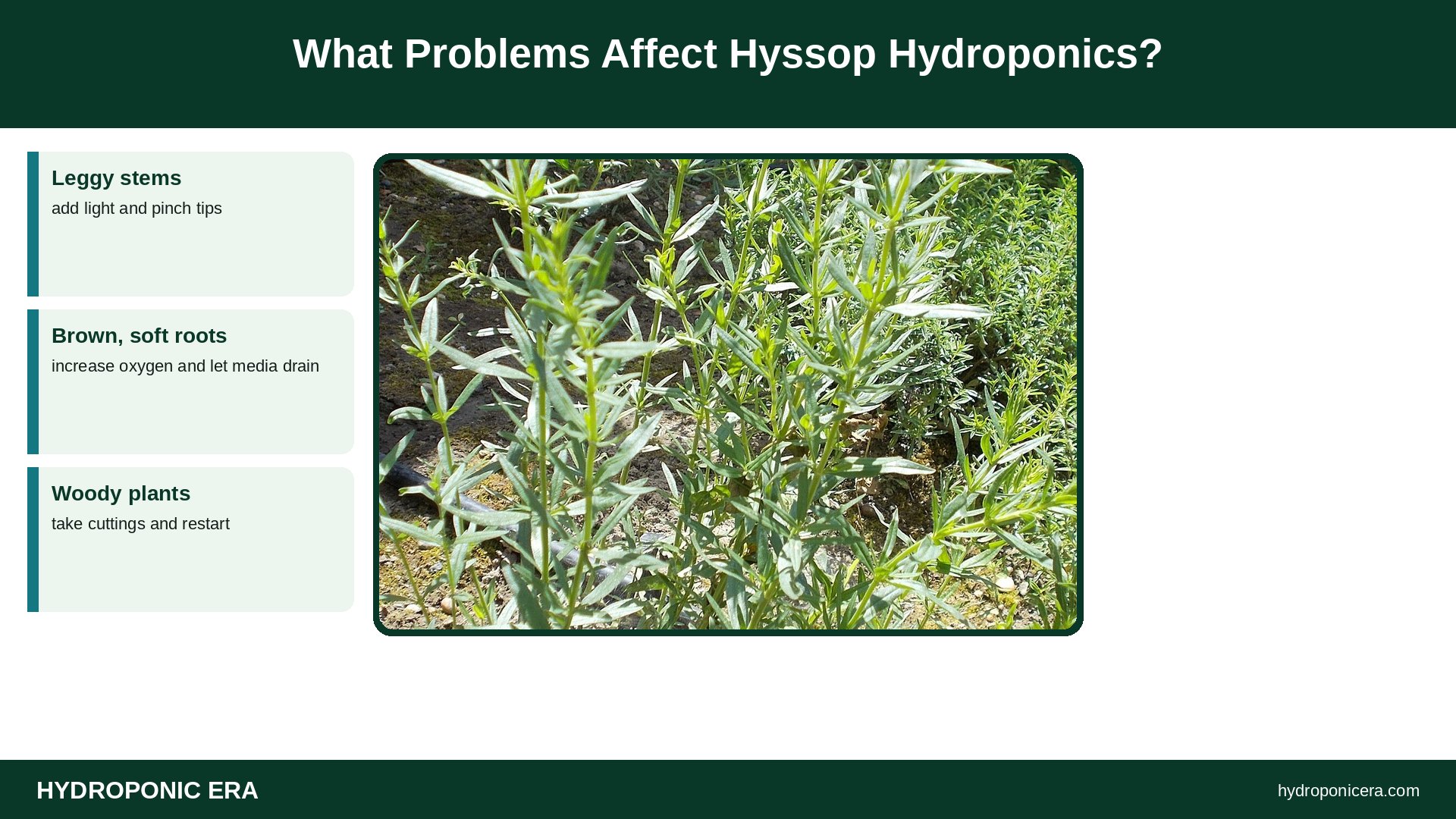
Common problems in hyssop hydroponics are leggy growth in low light, root rot from constantly wet media and woody, sparse stems on older plants. NC State reports no serious pests in gardens, though it notes nematodes can be an issue in soil. Clean hydroponic media avoids most soil problems.
- Leggy stems: add light and pinch tips.
- Brown, soft roots: increase oxygen and let media drain.
- Woody plants: take cuttings and restart.
- Pale leaves: raise nutrient strength slightly.
How Do You Keep Hyssop Hydroponics Productive Long Term?
Keep hyssop hydroponics productive by treating each plant as a short-term crop. NC State Extension describes hyssop as short-lived, so plan to replace plants every season or two. Take stem cuttings from vigorous tips before the parent gets woody, root them in a cloning tray, and swap the young plants into the system.
- Trim lightly but often: remove a third of the growth at most.
- Refresh plants: root cuttings in spring, as NC State suggests.
- Change the reservoir: a fresh solution every 2–3 weeks keeps nutrients balanced.
- Watch light: move lamps closer if stems stretch.
With regular renewal, hyssop hydroponics can supply fresh leafy tips through the year. Dry extra tips in shade and store them in an airtight jar for winter soups and stews.
FAQ About Hyssop Hydroponics
Is hyssop the same as anise hyssop?
No. Hyssop is Hyssopus officinalis; anise hyssop is Agastache foeniculum.
How tall does hyssop get in hydroponics?
NC State gives 1–2 feet (30–61 cm); regular trimming keeps it smaller.
How long does hyssop take to germinate?
About 5–21 days according to Johnny’s.
Can hyssop hydroponics use cuttings?
Yes. NC State lists stem cuttings as a propagation method.
Does hyssop need full sun?
Full sun is best; in shade it gets leggy.
Sources
- NC State Extension — Hyssopus officinalis
- Johnny’s Selected Seeds — Hyssop key growing information
- University of Maryland Extension — Growing herbs in containers and indoors
- Photo credits (Wikimedia Commons, edited with titles): Botanischer Garten Innsbruck Duft- und Tastgarten Ysop by Luftschiffhafen (CC BY-SA 4.0); Hyssopus officinalis – Kloster, Ysop, 2024 Bakonybél by Globetrotter19 (CC BY-SA 4.0)