
Can lettuce drop happen in hydroponic lettuce? It can, but the risk is lower than in soil. Lettuce drop is caused by Sclerotinia fungi that mostly survive as hard black sclerotia in soil. UC IPM and NC State note that one species, Sclerotinia sclerotiorum, also releases airborne spores that infect upper leaves, so cool, damp grow rooms near infested soil or debris can still see it.
Key takeaway: Lettuce drop makes lower leaves wilt and the whole head collapse, with white cottony mold and black seed-like sclerotia at the crown. Hydroponics removes most soil contact, but airborne spores, contaminated media and wet, crowded canopies can still bring it in. Remove infected heads quickly and keep leaves dry.
| Factor | What sources report | Source |
|---|---|---|
| Cause | Sclerotinia minor and S. sclerotiorum | NC State; UC IPM |
| Favored conditions | Cool, moist; about 60–70°F (16–21°C) for spores | USU; NC State |
| Survival | Sclerotia live 2–3 years in soil | UC IPM |
| S. minor sclerotia | Up to 1/8 inch (3 mm) | UC IPM |
| S. sclerotiorum sclerotia | 1/4–1/2 inch (6–13 mm) | UC IPM |
| Airborne spores | S. sclerotiorum only | NC State; UC IPM |
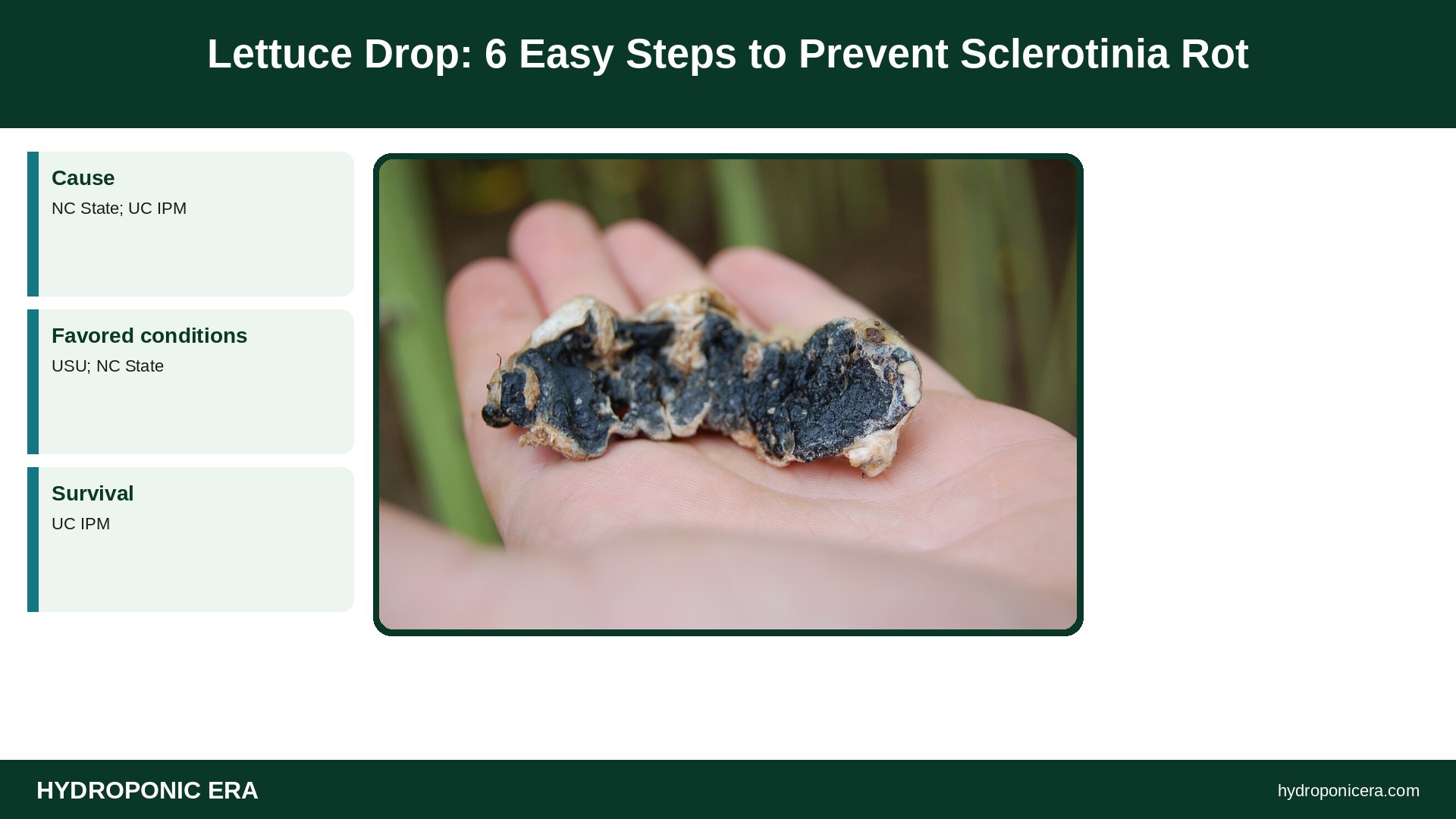
What Is Lettuce Drop?
Lettuce drop is a fungal disease caused by Sclerotinia minor and Sclerotinia sclerotiorum. NC State Extension says both have wide host ranges, including brassicas, cucurbits, peppers and potatoes, while USU notes that the name “drop” is used specifically for lettuce. The disease rots the crown so the plant collapses, usually near maturity.
UC IPM explains that S. minor infects only leaves and stems touching the soil, while S. sclerotiorum also forms small cup-shaped fruiting bodies that release airborne spores. Those spores can land on and infect upper leaves, especially damaged or aging tissue.
How Do You Identify Lettuce Drop?
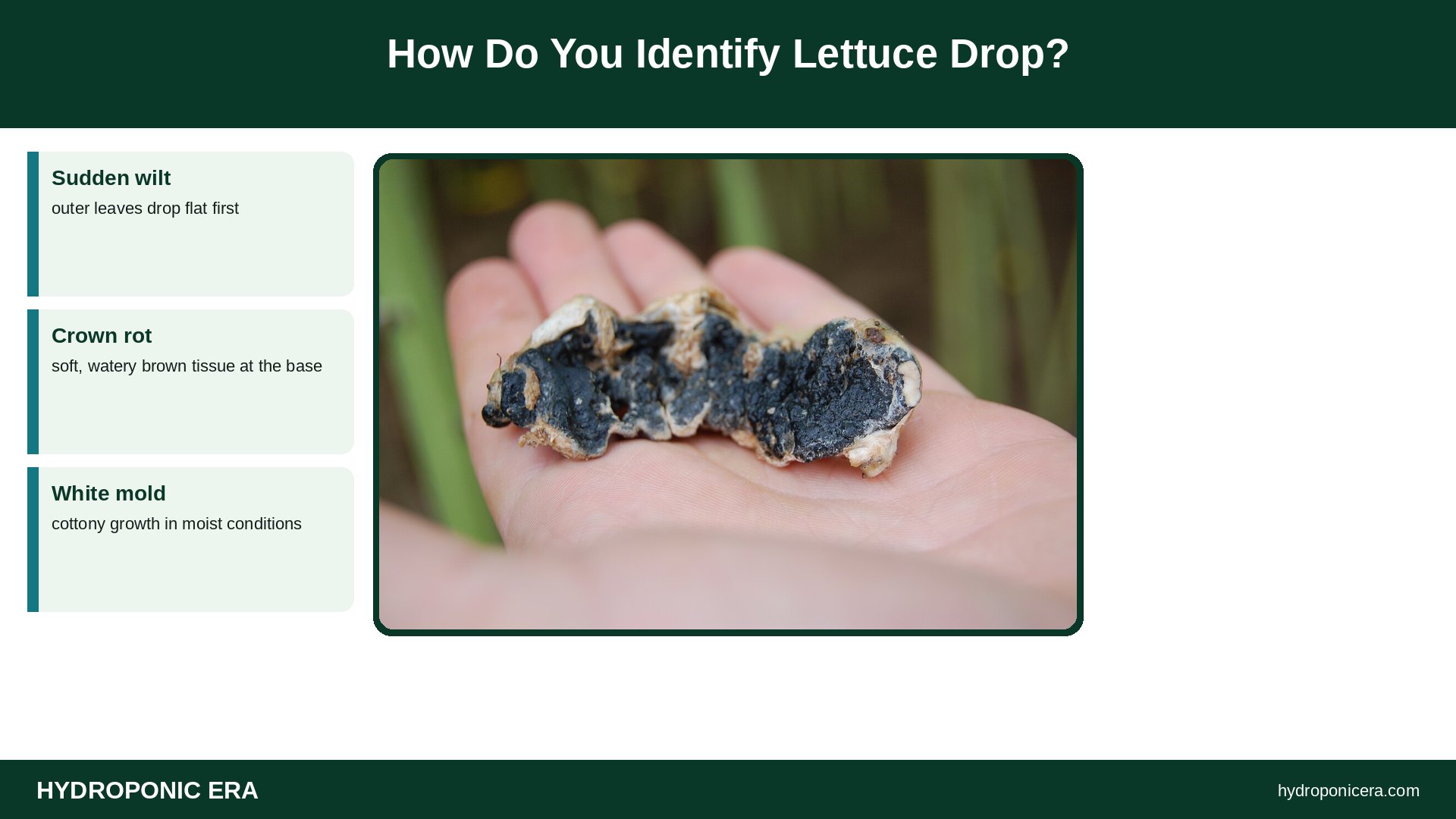
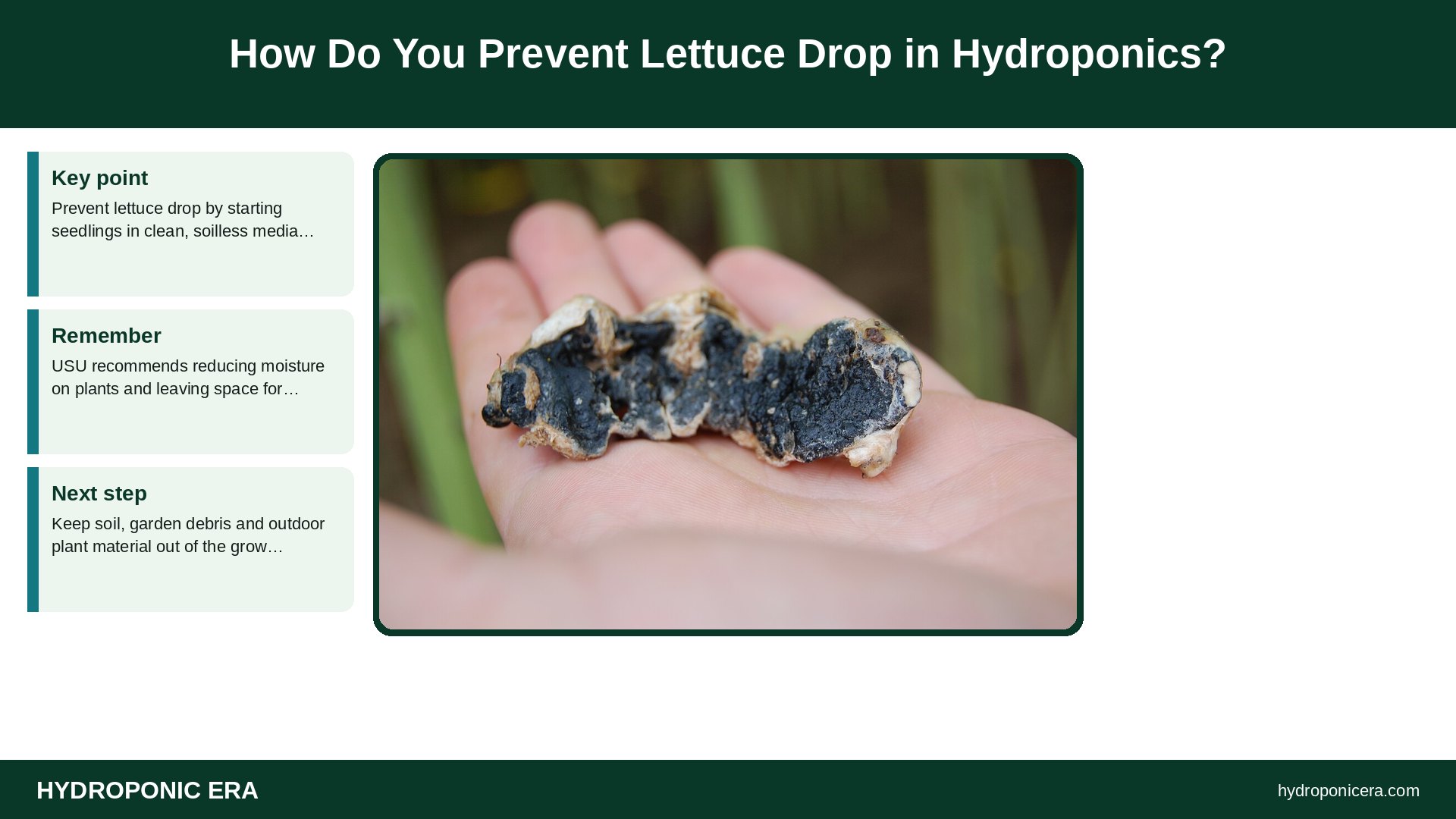
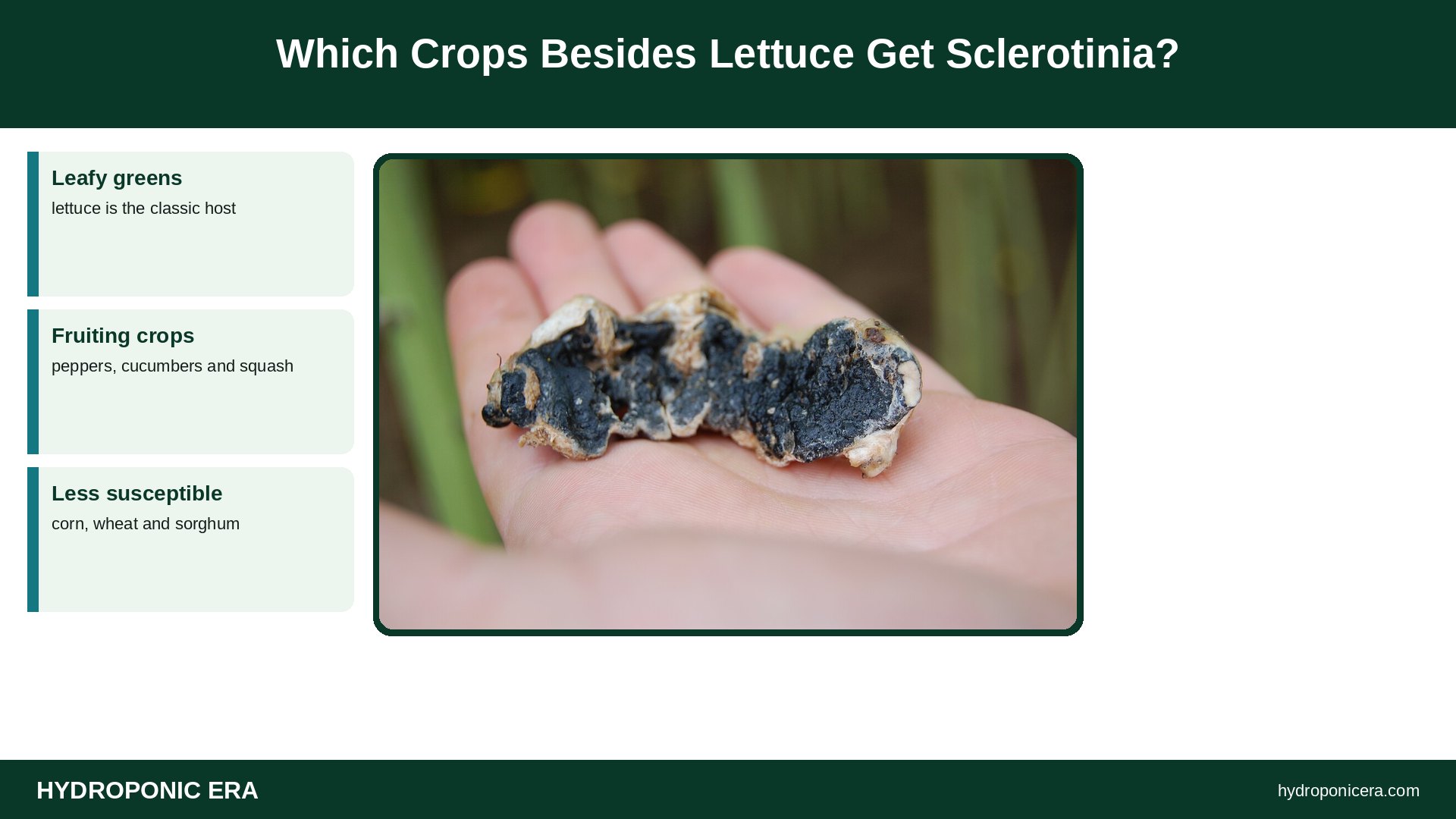
Identify lettuce drop by older leaves wilting and dropping flat, a soft brown rot at the crown, and white cottony mold with hard black sclerotia on the decayed tissue. UC IPM says the whole plant wilts and collapses, making it unharvestable. Sclerotia look like small black seeds or pellets.
- Sudden wilt: outer leaves drop flat first.
- Crown rot: soft, watery brown tissue at the base.
- White mold: cottony growth in moist conditions.
- Sclerotia: black, hard bodies on the rot.
UC IPM notes symptoms can resemble Verticillium wilt, Botrytis crown rot and Phoma basal rot. In hydroponics, also rule out root disease with our guide to pythium root rot in hydroponics.
How Does Lettuce Drop Get Into Hydroponic Systems?
Lettuce drop needs a source of sclerotia or spores. In soil, sclerotia survive 2 to 3 years, according to UC IPM. In hydroponics, likely routes are airborne S. sclerotiorum spores from nearby fields or gardens, soil-based seedlings or media, and infected debris left in the room. USU says spores spread by wind and water.
USU lists wet, cool conditions around 60–70°F (16–21°C) as optimal for sclerotia to produce spore-releasing structures. Dense lettuce canopies hold moisture, and UC IPM says spores usually infect damaged or senescent tissue, so yellowing lower leaves sitting in a humid canopy are a weak point.
How Do You Prevent Lettuce Drop in Hydroponics?
Prevent lettuce drop by starting seedlings in clean, soilless media, keeping leaves dry, spacing heads for airflow and removing damaged or yellow lower leaves. USU recommends reducing moisture on plants and leaving space for ventilation. Keep soil, garden debris and outdoor plant material out of the grow room.
- Start seeds in new rockwool, coco or other clean soilless media.
- Space heads so leaves do not form a wet mat.
- Run circulation fans and manage humidity.
- Remove damaged and senescent outer leaves.
- Keep soil-grown plants and debris away from the system.
- Clean rafts, cups and trays between crops.
See humidity and VPD in indoor hydroponics for targets that keep leaf surfaces drier.
What Should You Do If Lettuce Drop Appears?
Remove infected plants right away, including the roots and any sclerotia, and bag them before carrying them out. USU recommends removing and disposing of infected plants. Sclerotia that fall into channels or rafts can survive, so collect them before they scatter. Then lower humidity and check neighboring heads daily for wilting.
| Action | Purpose | Source |
|---|---|---|
| Remove and bag infected heads | Stop sclerotia spreading | USU |
| Improve ventilation | Dry the canopy | USU |
| Clean the system after harvest | Remove debris and sclerotia | UC IPM survival data |
| Labeled fungicide (commercial) | Protect healthy plants | NC State; UC IPM |
NC State and UC IPM list fungicides for field lettuce, applied before disease appears. Few are practical for home hydroponics, so sanitation is the main tool. Follow our steps for cleaning and sterilizing a hydroponic system after an outbreak.
Which Crops Besides Lettuce Get Sclerotinia?
Many. NC State says Sclerotinia species infect onions, garlic, cabbage, broccoli, peppers, potatoes, cucumbers, squash and sweet potatoes, while cereals are less susceptible. In a mixed hydroponic room, that means a lettuce drop outbreak deserves attention on other crops, where the disease is often called white mold.
- Leafy greens: lettuce is the classic host.
- Fruiting crops: peppers, cucumbers and squash.
- Less susceptible: corn, wheat and sorghum.
Are Some Lettuce Varieties Less Prone to Lettuce Drop?
The cited sources do not list resistant lettuce varieties. As a general principle from USU’s advice on ventilation, an open canopy dries faster than a dense, sprawling one. For hydroponics, romaine and other upright types may keep a more open base than sprawling heads; see best lettuce varieties for hydroponics.
How Is Lettuce Drop Different From Other Lettuce Rots?
Lettuce drop is marked by white cottony mold and hard black sclerotia at the crown. UC IPM says it can be confused with Verticillium wilt, Botrytis crown rot and Phoma basal rot. Gray fuzzy mold suggests Botrytis instead, while brown, slimy roots with healthy crowns point toward root rot in the reservoir.
- Lettuce drop: white mold and black sclerotia at the base.
- Botrytis: gray, fuzzy spore masses on damaged tissue.
- Root rot: brown, slimy roots and stunting first.
Take photos of the crown and roots, and if possible send a sample to an extension plant disease clinic. Knowing which disease you have decides whether you focus on the canopy, the roots or the room.
FAQ About Lettuce Drop
Is lettuce with lettuce drop safe to eat?
Discard collapsed, rotted heads; they are unharvestable, according to UC IPM.
Does lettuce drop spread through the nutrient solution?
Main spread is sclerotia, mycelium and airborne spores, not dissolved nutrients.
How long do lettuce drop sclerotia survive?
UC IPM says 2 to 3 years in soil without hosts.
What temperature favors lettuce drop?
Cool, moist conditions; USU gives about 60–70°F (16–21°C) for spore release.
Is lettuce drop the same as white mold?
Yes, the same Sclerotinia fungi cause white mold on many other crops.
Sources
- NC State Extension — Lettuce drop
- UC IPM — Lettuce drop
- Utah State University Extension — Drop (Sclerotinia rot)
- Photo credits (Wikimedia Commons, edited with titles): Sclerotinia sclerotiorum sclerortia by Kmcleveland (CC BY 3.0)