
Can gummy stem blight infect hydroponic cucumbers and melons? Yes. Gummy stem blight is a fungal disease of cucumbers, melons and other cucurbits that NC State Extension says affects both field and greenhouse crops. It enters through wounds, spreads in splashing water and thrives when leaves stay wet for hours, so humid hydroponic rooms with heavy pruning can still get it.
Key takeaway: Gummy stem blight causes tan stem cankers that ooze amber gum, brown wedges at leaf edges and black fruit rot. Spores spread on water splash and infect wounds. Indoors, the best defense is clean seed, dry leaves, good airflow, careful pruning and removal of infected vines.
| Factor | What sources report | Source |
|---|---|---|
| Cause | Stagonosporopsis species (formerly Didymella bryoniae) | NC State Extension |
| Hosts | Cucumber, melon, watermelon, squash, pumpkin | NC State; UF/IFAS |
| Favored temperature | 61–75°F (16–24°C) | NC State Extension |
| Moisture needed | Leaf wetness and high humidity | UMN; NC State |
| Entry | Wounds from pruning, insects, mildew | UMN Extension |
| Fruit stage | Called black rot | UMN; UF/IFAS |
What Is Gummy Stem Blight?
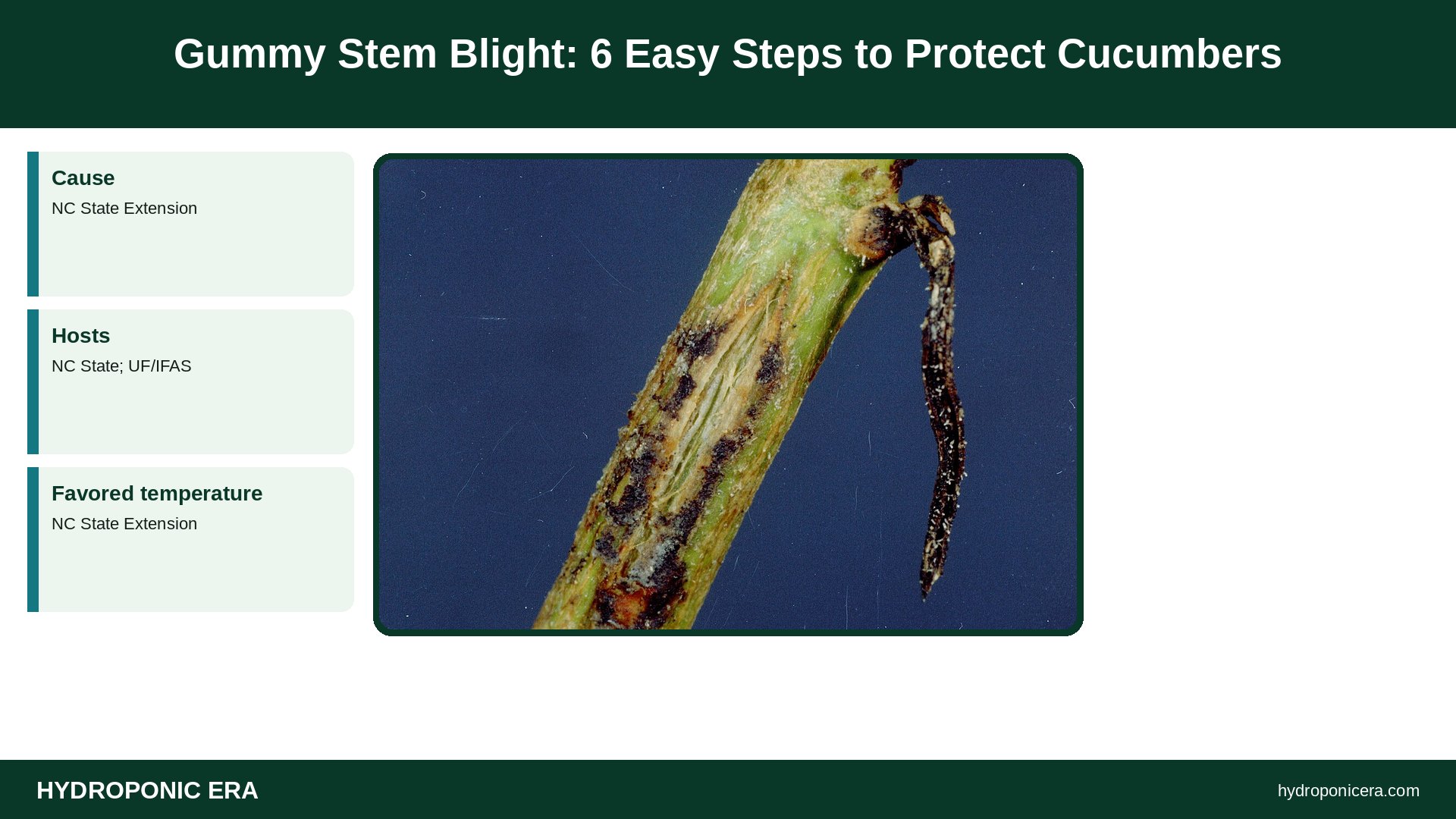
Gummy stem blight is a fungal disease of cucurbits caused by closely related Stagonosporopsis species, long known as Didymella bryoniae. NC State Extension lists watermelon, cantaloupe, cucumber, pumpkin, squash and gourds as hosts, with watermelon and muskmelon usually most susceptible. When the fungus infects fruit, the same disease is called black rot.
UF/IFAS notes plants can be infected at any growth stage, from seedling to mature vine, and that symptoms can appear on every part of the plant except the roots. That matters for hydroponic growers, because the disease lives above the root zone where your nutrient solution cannot help.
How Do You Identify Gummy Stem Blight?
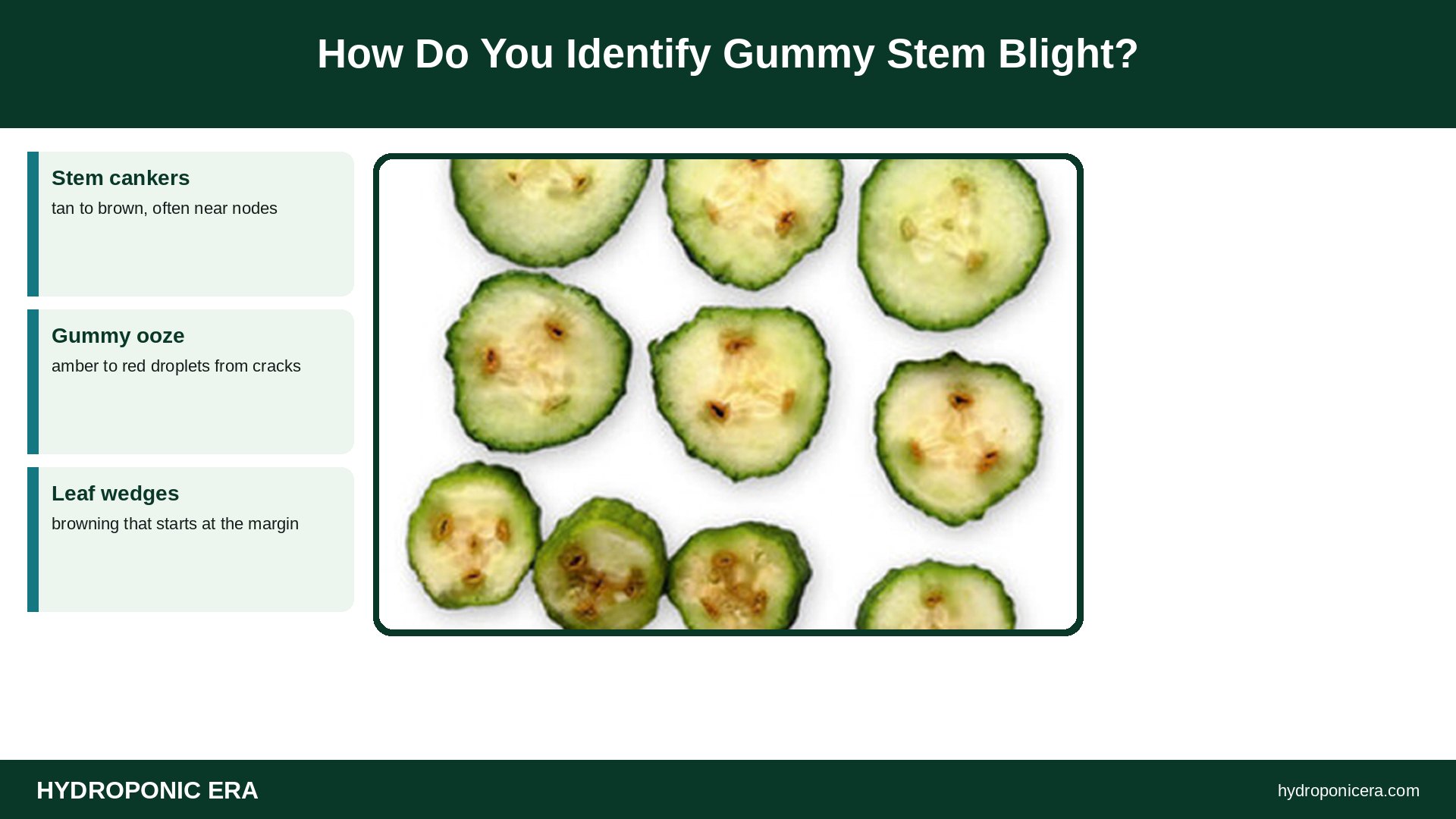
Identify gummy stem blight by tan or brown stem cankers, often near nodes or the crown, that crack and ooze amber or brown gum. UMN Extension says leaf symptoms start as browning at leaf edges, forming brown wedges on cucumber. Tiny black fruiting bodies inside lesions are visible with a 10x hand lens.
- Stem cankers: tan to brown, often near nodes.
- Gummy ooze: amber to red droplets from cracks.
- Leaf wedges: browning that starts at the margin.
- Black specks: pycnidia inside older lesions.
UF/IFAS cautions that gummy ooze alone is not proof, because anthracnose can also cause it, so look for the black fruiting bodies. For nutrient-related yellowing, compare with our guide to hydroponic cucumber leaves turning yellow.
How Does Gummy Stem Blight Spread Indoors?
Gummy stem blight spreads on infected seed and transplants, in crop debris and by splashing water, then enters plants through wounds. UMN Extension says plants with cucumber beetles, aphids or powdery mildew get more infections because of the small wounds those problems cause. Pruning cuts and harvest wounds are also entry points.
NC State lists high humidity with 4–10 hours of persistent moisture as a favorable condition. In a hydroponic greenhouse, that can mean dew on leaves at night, condensation dripping from glazing or foliar sprays that never dry. UF/IFAS says vine wilting often shows only three to four weeks after infection.
How Do You Prevent Gummy Stem Blight in Hydroponics?
Prevent gummy stem blight by starting with clean seed, keeping leaves and stems dry, running fans for airflow and making clean pruning cuts on dry days. UMN Extension recommends watering at the base instead of overhead and controlling insects and powdery mildew, which open wounds. Remove plant debris promptly between crops.
- Buy seed from a reputable source and inspect transplants.
- Keep relative humidity in check and avoid long leaf wetness.
- Prune in the morning so cuts dry quickly.
- Control aphids and powdery mildew early.
- Remove dropped leaves and old vines.
- Disinfect knives, clips and trellis lines between crops.
Read our guides to humidity and VPD in indoor hydroponics and powdery mildew in hydroponics to cut both risks.
How Do You Treat Gummy Stem Blight on Cucumbers?
Remove infected leaves and vines, lower humidity and improve airflow at the first sign of gummy stem blight. NC State says complete resistance is rare and most varieties need integrated management. Commercial growers use labeled fungicides as protectants; check that any product is labeled for greenhouse cucurbits and follow the label exactly.
| Action | Purpose | Source |
|---|---|---|
| Remove infected tissue | Reduce spore load | UMN Extension |
| Keep leaves dry | Stop new infections | UMN; NC State |
| Control pests and mildew | Fewer wounds | UMN Extension |
| Labeled fungicide | Protect healthy growth | NC State; UF/IFAS |
Bag removed vines instead of leaving them in the room. A trellis that keeps vines spread out and off wet surfaces also helps leaves dry faster.
Which Crops Get Gummy Stem Blight Most Often?
Watermelon and muskmelon are usually the most susceptible, according to NC State, with cucumbers and squash also badly affected when leaves stay wet. UMN Extension notes resistant varieties exist for watermelon, pumpkin, buttercup and canary melons. Tomatoes, peppers and leafy greens are not hosts.
- High risk: watermelon, cantaloupe and other melons.
- Moderate risk: cucumber, squash and pumpkin.
- Not hosts: lettuce, herbs, tomatoes and peppers.
How Long Does Gummy Stem Blight Survive?
The fungus survives in infected crop debris between seasons, and UMN Extension says infected seed can introduce it. In a hydroponic room, old vines, dropped leaves and dirty trays are the likely carryover points. Clean the whole system before replanting cucurbits; follow our guide to cleaning and sterilizing a hydroponic system.
Keep a simple log of where the first cankers appear. Repeated outbreaks at the same end of a room often point to a humidity pocket or a leak dripping onto plants.
How Is Gummy Stem Blight Different From Other Cucumber Problems?
Look for three clues together: brown wedges starting at leaf edges, cankers that ooze amber gum, and tiny black dots inside dead tissue. UF/IFAS warns that anthracnose and other stresses can also cause gummy ooze, so a single sign is not enough. A hand lens makes the black fruiting bodies easier to see.
- Powdery mildew: white powder on leaf surfaces, not cankers.
- Nutrient yellowing: even color change, no ooze or black dots.
- Root problems: brown, slimy roots with whole-plant wilt.
If you are unsure, send a sample to your local extension plant disease clinic. A correct diagnosis keeps you from removing healthy plants or missing an outbreak while it is still small.
FAQ About Gummy Stem Blight
Is gummy stem blight the same as black rot?
Yes. UMN says gummy stem blight is the leaf and stem stage, and black rot is the fruit stage.
Does gummy stem blight spread through the nutrient solution?
It spreads mainly by splashing water, seed and debris above the roots.
How fast does gummy stem blight kill a plant?
UF/IFAS says vine wilt often appears three to four weeks after infection.
Can cucumbers recover from gummy stem blight?
Plants with stem-girdling cankers usually decline; remove them to protect others.
Does gummy stem blight affect hydroponic watermelon?
Yes. NC State lists watermelon among the most susceptible hosts.
Sources
- NC State Extension — Gummy stem blight of cucurbits
- UMN Extension — Gummy stem blight and black rot
- UF/IFAS — Management of gummy stem blight (black rot) on cucurbits
- Photo credits (Wikimedia Commons, edited with titles): Didymella bryoniae Stem Lesion by Clemson University – USDA (CC BY 3.0 us); Gurken Gummistängelkrankheit – Roswitha Ulrich by Roswitha Ulrich, Pflanzenschutzdienst (CC BY-SA 4.0)