
Quick Answer
solar power planning home hydroponics planning starts with a load inventory—watts for lights, pumps, air pumps, fans, heaters/chillers—then battery autonomy and honest runtime goals. Off-grid hydro fails when growers size panels for Instagram watts while ignoring night-time pumps and cloudy-week reserves.
Connect to electricity cost, backup power, electrical safety, outage recovery, and grow lights.
Key takeaways for solar power planning home hydroponics
- Solar power home hydroponics is an electrical planning problem before it is a plant problem.
- List continuous vs intermittent loads; pumps often run when lights are off.
- Battery days of autonomy matter more than peak panel marketing.
- Ohio State small-farm electrical safety habits still apply around water.
- Original sheet: load W × hours × days autonomy × inefficiency fudge.
- Solar power home hydroponics fails when only lights are counted.
- GFCI, drip loops, and dry mounts are non-negotiable near reservoirs.
- Trial a grid system’s measured kWh before designing off-grid.
Related HydroponicEra guides

Why Load Inventory Beats Panel Shopping
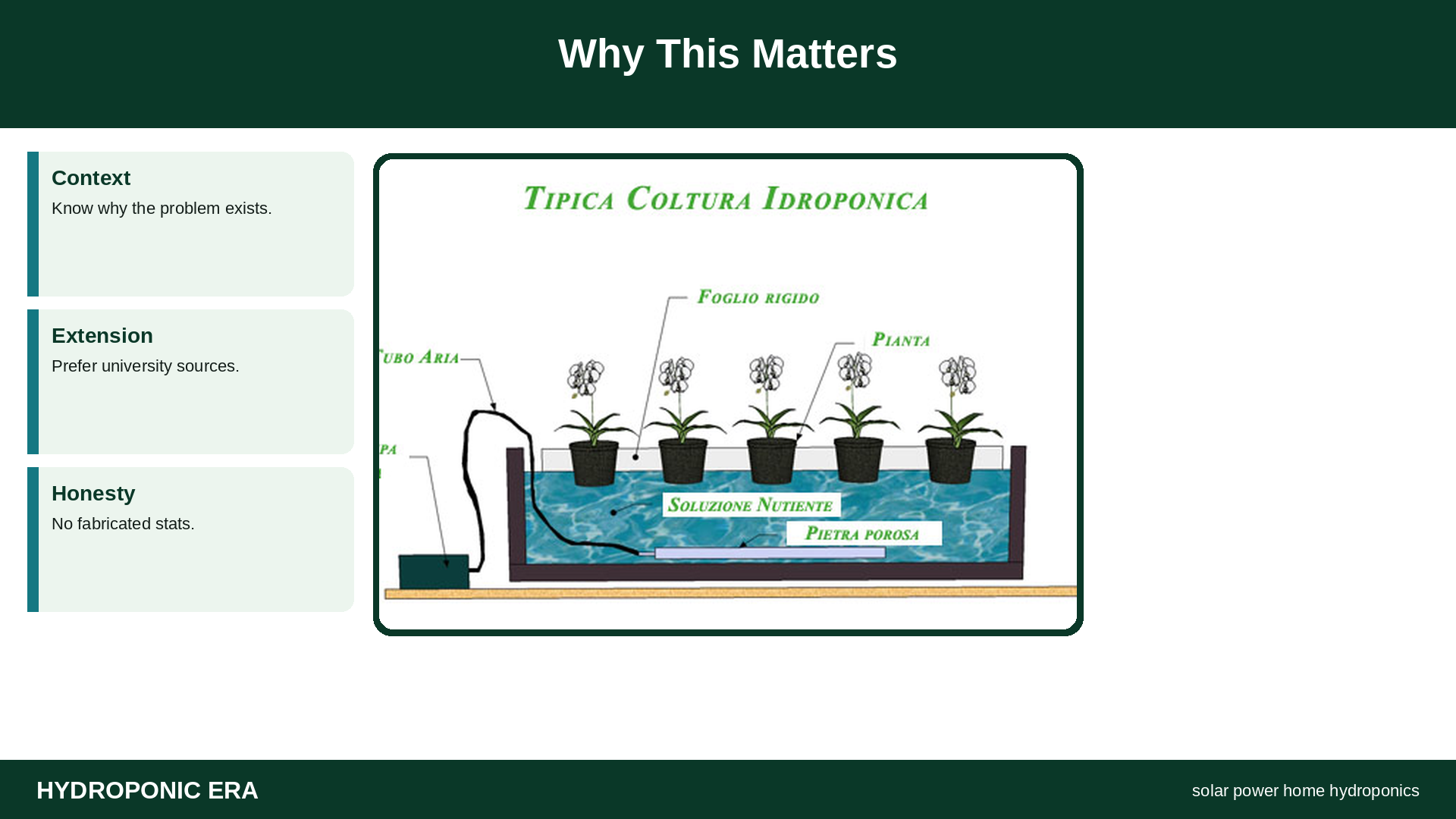
solar power planning home hydroponics succeeds when you know watt-hours, not when you own the shiniest panel. Measure or read nameplates for LED drivers, water pumps, air pumps, circulation fans, and any heater or chiller. Extension and small-farm electrical safety resources emphasize water/electricity boundaries—off-grid does not relax those rules.
This page is a planning framework. It does not size your exact array; a qualified electrician/solar designer should review real installs.
Load Classes Compared
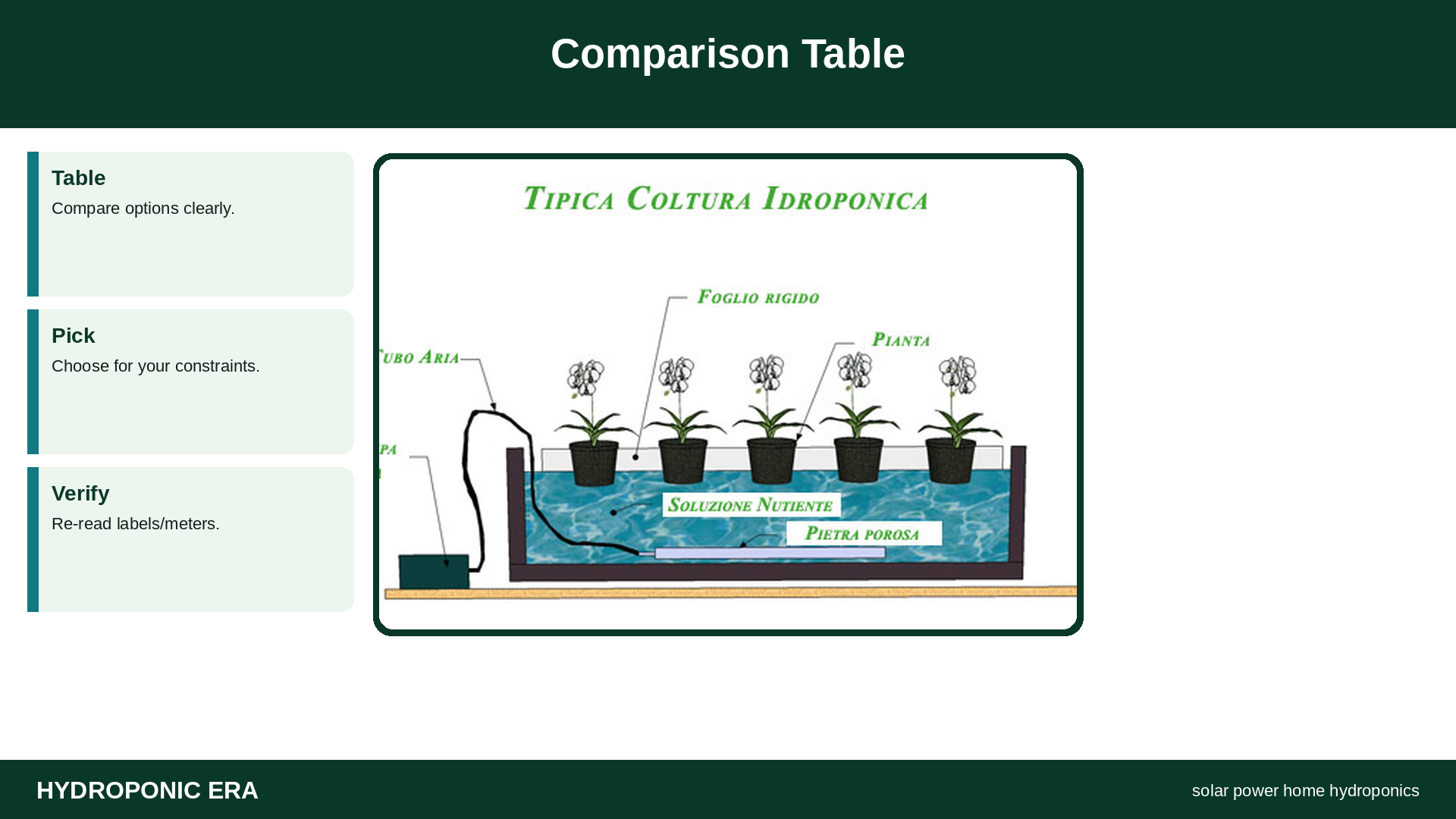
| Load | When it runs | Planning note |
|---|---|---|
| LED canopy | Photoperiod only | Largest daytime draw usually |
| Water pump | Often 24h or timer cycles | Night energy still counts |
| Air pump | Often 24h in DWC | Small W, critical uptime |
| Fans / dehumidifier | Climate dependent | Can dominate humid climates |
Step-by-Step Planning
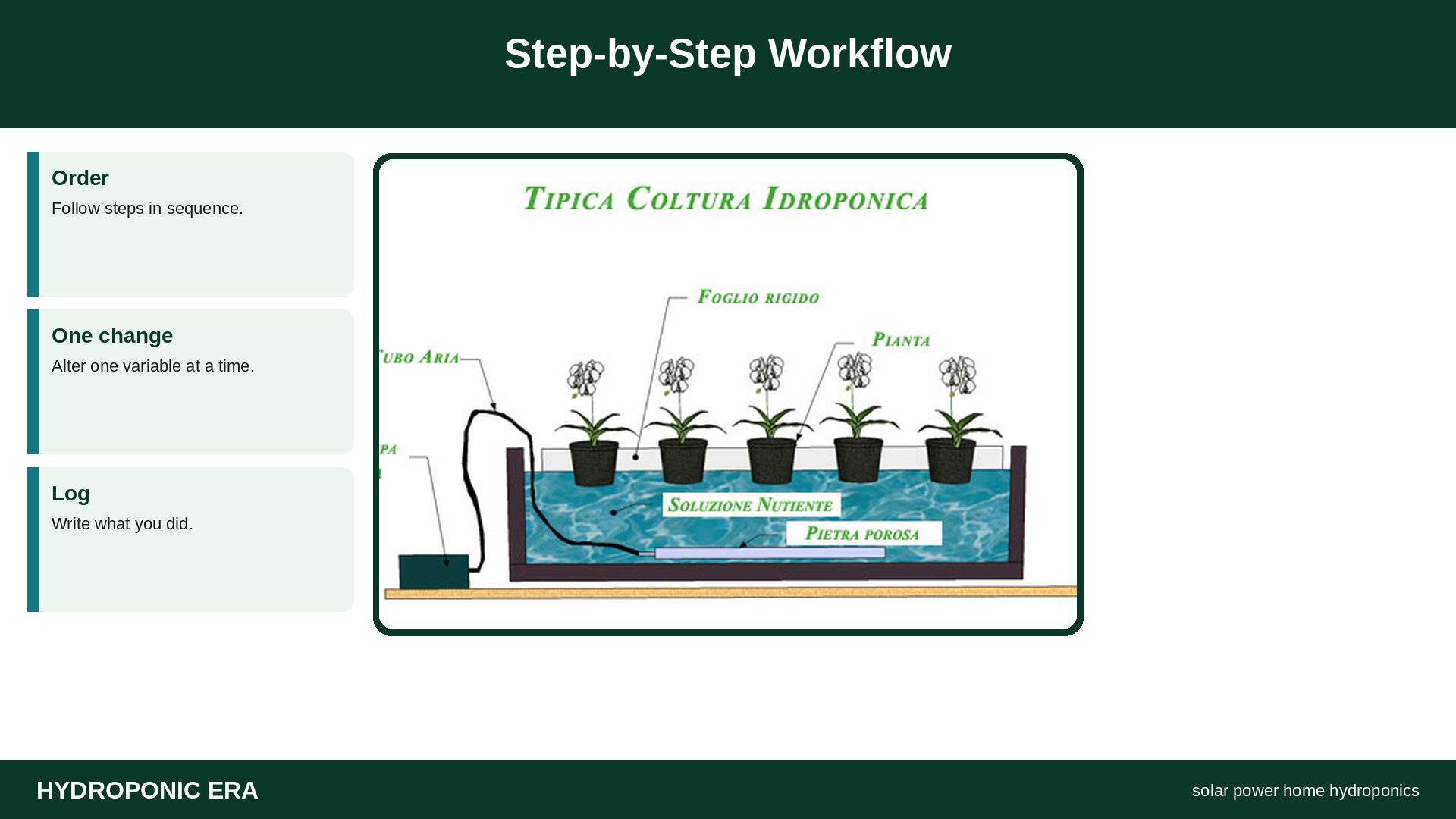
- List every device with watts (measure with a plug meter if possible).
- Estimate hours/day each device runs—including nights.
- Convert to watt-hours/day; multiply by desired autonomy days.
- Add inefficiency margin for inverter, wiring, and aging batteries.
- Decide must-run loads during outage (air + water vs full lights).
- Design a reduced-light survival mode (outage checklist).
- Plan GFCI-protected circuits and drip loops near water.
- Separate wet-area pumps from improvised outdoor wiring.
- Document shutdown order for low-battery events.
- Revisit the sheet when you add a second light bar.
Variables
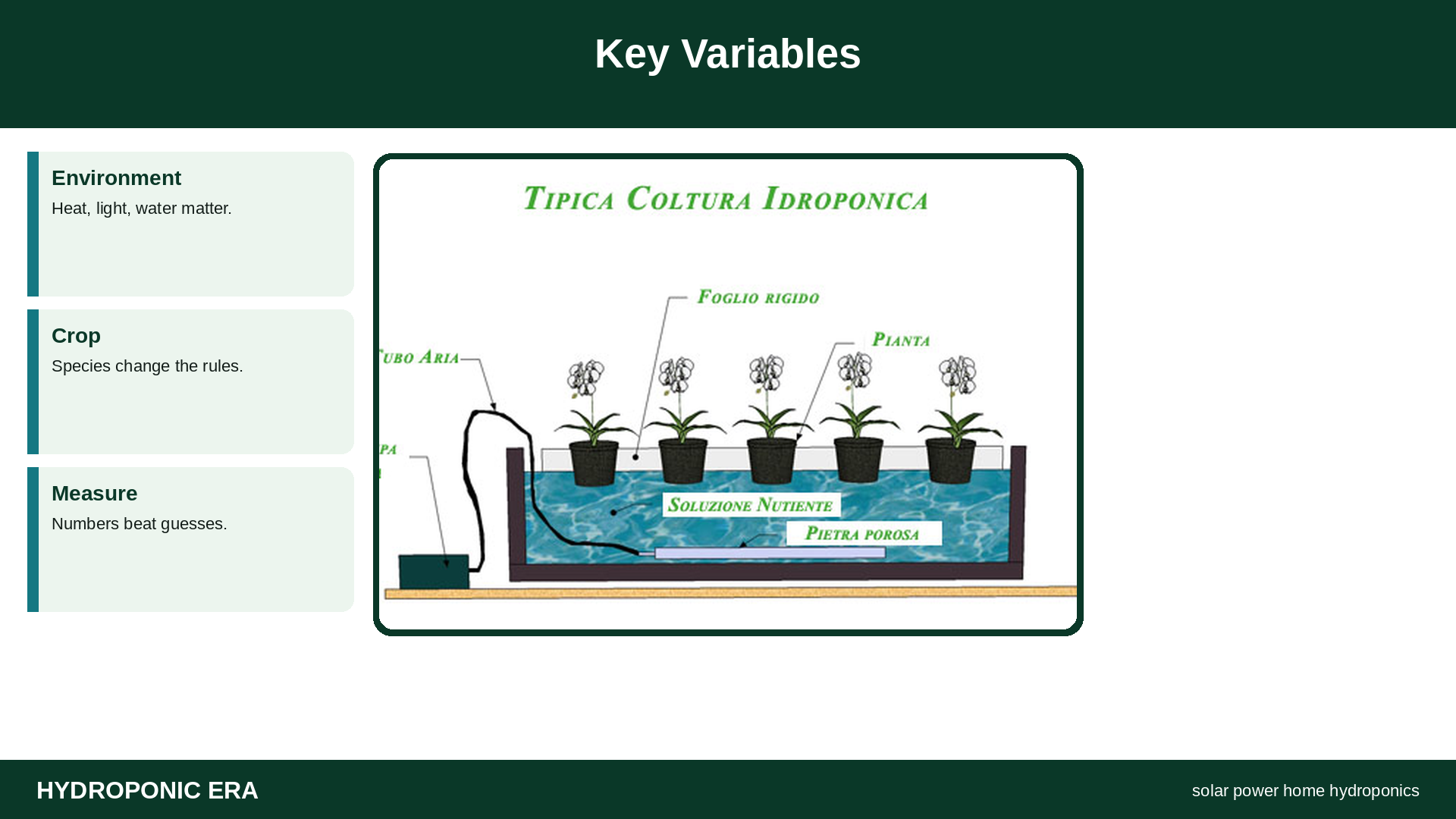
| Variable | Effect | Link |
|---|---|---|
| Photoperiod length | Directly scales light Wh | photoperiod |
| System type | NFT fails faster without pump | systems |
| Climate control | Dehumidifiers are hungry | humidity |
| Autonomy goal | 2–3 cloudy days changes battery size | backup |
Common mistakes with solar power planning home hydroponics
- Sizing only for lights
- No survival mode without full canopy power
- Skipping GFCI near reservoirs
- Assuming panel watts equal delivered Wh
- Ignoring air-pump uptime in DWC
- DIY mains wiring without qualification
Troubleshooting Planning Gaps

| Symptom | Likely gap |
|---|---|
| Batteries empty by morning | Night pumps underestimated |
| Lights dim, roots die | Wrong priority—air/water first |
| Tripped wet outlets | Safety layout failure |
| OK on sun days, crash on storms | Autonomy undersized |
Original Framework: Must-Run Stack

Stack priority: 1) life safety → 2) root oxygen/water movement → 3) reduced lighting → 4) niceties. Write Wh next to each tier.
Closing practice for solar power home hydroponics: if pumps die to keep lights pretty, the design failed.
What to Check Before You Buy Panels for Hydro
- Plug-meter data collected?
- Night loads listed?
- Autonomy days chosen?
- Must-run tier written?
- GFCI/drip loops planned?
- Qualified review scheduled for mains work?
Build the Load List Before the Shopping Cart
Solar power home hydroponics planning starts with watts and runtime, not panel aesthetics. List must-run loads: air stones, water pumps, controllers, and minimum light if plants cannot skip a day. Separate nice-to-have heaters and extra bars. Measure real draw with a plug meter; nameplates lie about duty cycles.
Decide autonomy hours for cloudy stretches. NFT and flood tables punish outages differently than DWC (outage recovery, backup power). If solar cannot cover must-run stacks, redesign the hydro system toward lower power before buying more panels.
Safety and Thermal Notes
Batteries, inverters, and wet floors are a serious mix—follow electrical safety and keep cords GFCI-protected. Heat from LEDs still exists off-grid; dimming plans should be written so you do not cook leaves while saving watt-hours. Solar power home hydroponics succeeds when the spreadsheet matches the plant’s non-negotiables.
Solar Power Home Hydroponics: Must-Run Versus Deferrable
Must-run: oxygenation and water movement that prevent immediate root death. Deferrable: extra light hours you can shorten on deep-cloud days if plants can tolerate a temporary DLI dip. Heaters may be must-run in winter or deferrable if insulation is strong—write the rule before the storm.
Simulate a cloudy day by reading the SOC (state of charge) plan aloud. If the plan depends on hope, redesign loads. Cross-link electricity cost framework, timers, and backup pumps so solar planning matches hydro reality.
FAQs about solar power planning home hydroponics
Can USB power banks run a tent?
Only tiny demos—not full LED canopies.
Do I need a generator too?
Many off-grid plans include generator backup for storms.
Is Kratky easier off-grid?
Fewer pumps help, but lights and climate remain.
What about cloudy weeks?
That is why autonomy days exist—do not ignore them.
Can I use car batteries?
Deep-cycle design matters; get competent advice—don’t improvise with random starter batteries.
First measurement to take?
Daily kWh of your current indoor system on grid.
Extended Home-Grower Walkthrough
Use this extended walkthrough as a second pass after the Quick Answer. Walk the system with a notebook: write the date, crop, EC, pH, reservoir temperature, and one observation about roots or leaves. Change only one control at a time when a problem appears. If last week’s fix did not show in new growth, revert and try the next smallest lever. Keep university and extension principles in mind—oxygen, sanitation, and measured nutrition beat product stacking.
Photograph the canopy and the reservoir surface weekly. Dated photos settle arguments about algae, tip burn, or stretch faster than memory. When a helper waters for you, leave a one-page card with do-not-touch items and the exact top-off rule. Store calibration sachets next to the meters so “I will calibrate later” stops being the default. Review timers after any power event. Confirm air stones still roar. Confirm drains still drain.
At the end of the week, score the cycle 1–5 for ease and plant quality. Low scores should trigger a sanitation or climate review before you buy new hardware. Link neighboring HydroponicEra guides when the symptom matches a cluster page. Prefer labeled procedures over improvisation under stress. Healthy boring routines are the real upgrade path for home hydroponics.
Keep solar power planning home hydroponics on your ops card so helpers follow one standard.
Keep solar power planning home hydroponics on your ops card so helpers follow one standard.
Keep solar power planning home hydroponics on your ops card so helpers follow one standard.
Keep solar power planning home hydroponics on your ops card so helpers follow one standard.
Keep solar power planning home hydroponics on your ops card so helpers follow one standard.
Keep solar power planning home hydroponics on your ops card so helpers follow one standard.
Review solar power planning home hydroponics whenever you change crop, climate, or water source.
Review solar power planning home hydroponics whenever you change crop, climate, or water source.
Review solar power planning home hydroponics whenever you change crop, climate, or water source.
Review solar power planning home hydroponics whenever you change crop, climate, or water source.
Review solar power planning home hydroponics whenever you change crop, climate, or water source.
Sources
- Ohio State University Extension — AEX-79020 Electrical safety around water (small farm)
- Oklahoma State University Extension — Hydroponics
- Michigan State University Extension — Hydroponics as an agricultural production system
- University of Florida IFAS — AE069 publication (greenhouse/env control context)
- Virginia Cooperative Extension — SPES-720: Calculating and Using Daily Light Integral (DLI)
- Ohio State University Extension — HYG-1132 Food safety / produce handling