
Can you root oregano cuttings in water? Yes. Take 4- to 6-inch (10 to 15 cm) oregano cuttings from non-flowering tips, cut below a node, strip the lower leaves and stand the stems in water or moist mix. Purdue and Cornell list oregano among herbs that root easily, but UF IFAS warns water-grown roots are more fragile in soil.
Key takeaway: Oregano (Origanum vulgare) roots readily from soft shoot tips taken before bloom. Water works if you pot up early and harden the roots; moist mix gives sturdier roots. Keep rooted plants in full sun and well-drained soil to avoid root rot.
| Step | What to do | Source |
|---|---|---|
| 1. Time it | Before flowering; any season | UC Master Gardeners |
| 2. Cut | 4 to 6 in (10 to 15 cm) at a node | Cornell, UF IFAS |
| 3. Strip | Remove leaves on the lower half | UF IFAS |
| 4. Root | Jar of water or moist mix | Purdue, UF IFAS |
| 5. Transplant | Full sun, good drainage | NC State |
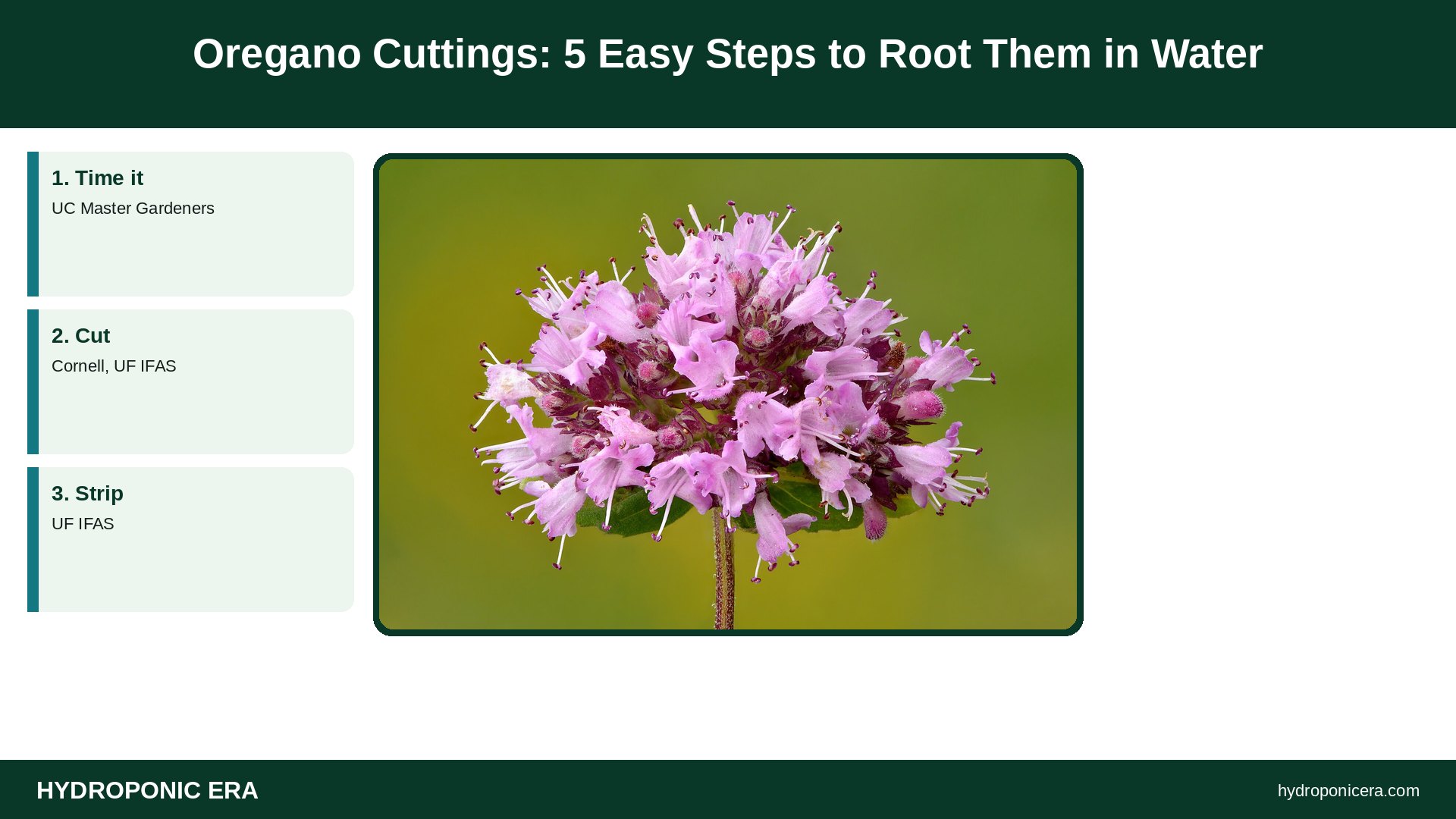
When Should You Take Oregano Cuttings?
Take oregano cuttings before the plant blooms. UC Master Gardeners of Santa Clara County say oregano cuttings and divisions can succeed year round and recommend propagating from cuttings prior to bloom. Soft, leafy shoot tips root faster than old woody stems, so spring and early summer growth is ideal.
Purdue Extension lists basil, oregano, lavender, rosemary, thyme and sage as herbs that root easily from shoot tip cuttings. Choose a healthy parent plant with the flavor you like, because cuttings are clones of it.
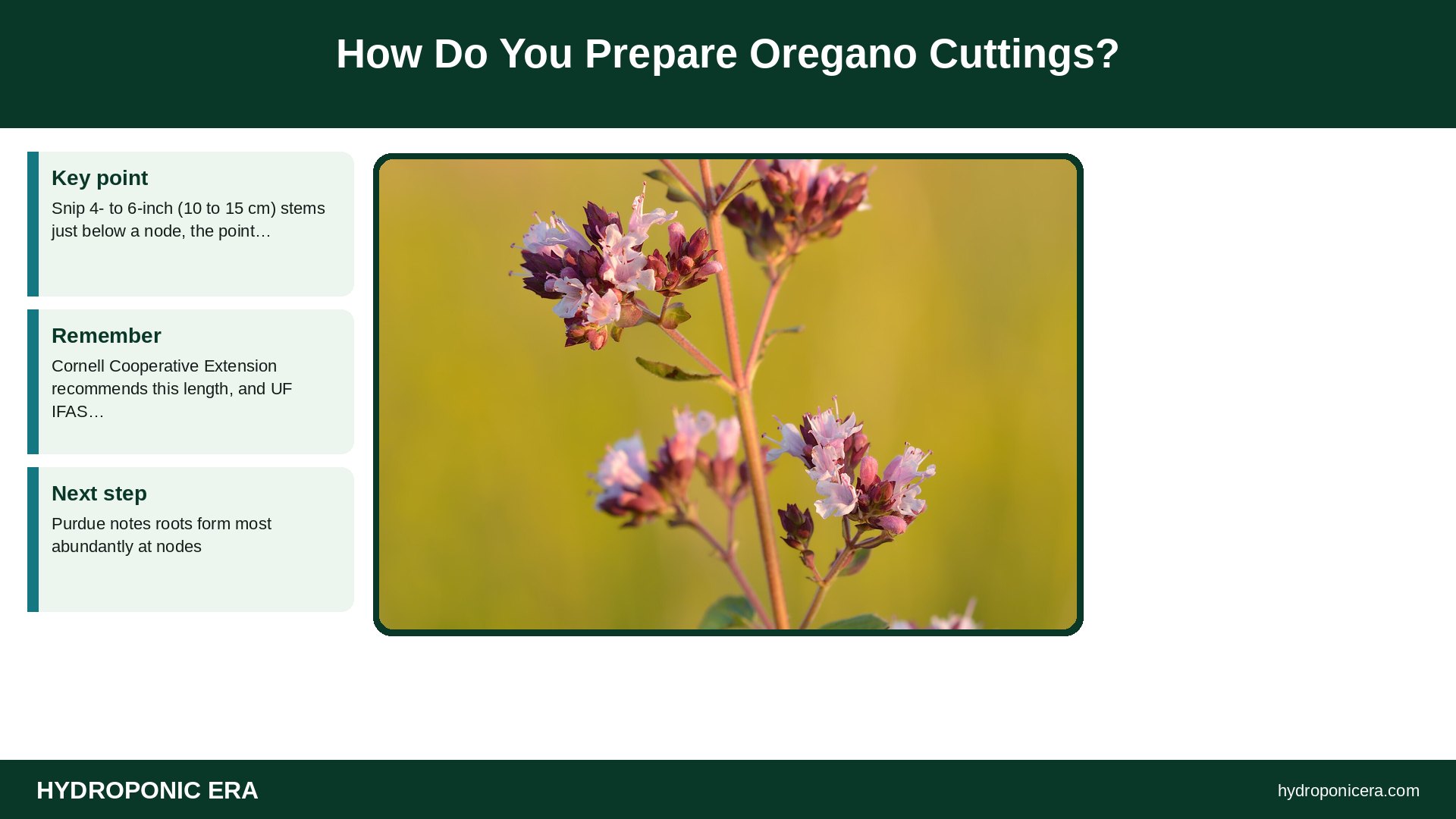
How Do You Prepare Oregano Cuttings?
Snip 4- to 6-inch (10 to 15 cm) stems just below a node, the point where leaves attach. Cornell Cooperative Extension recommends this length, and UF IFAS Extension in Leon County advises stripping leaves from the bottom half, because buried leaves rot and a rootless cutting cannot support many leaves.
- Choose non-flowering, green shoot tips.
- Cut just below a node with clean scissors.
- Strip the leaves from the lower half of the stem.
- Keep a few sets of leaves at the top.
- Move straight to water or mix so the end stays fresh.
Purdue notes roots form most abundantly at nodes. Learn more in our plant node guide.
How Do You Root Oregano Cuttings in Water?
Stand the stripped stems in a small jar so the bare nodes are under water and the leaves stay above it. Place the jar in bright, indirect light and change the water every few days to keep it fresh. Pot the cuttings once roots are about 1 inch (2.5 cm) long.
- Fill a narrow glass with room-temperature water.
- Submerge the lower nodes; keep leaves dry.
- Set it in bright, indirect light.
- Refresh the water every two to three days.
- Pot up when roots reach about 1 in (2.5 cm).
Short roots adapt to soil more easily than long, tangled ones. Our water propagation timeline explains what to expect.
Should Oregano Cuttings Go in Water or Soil?
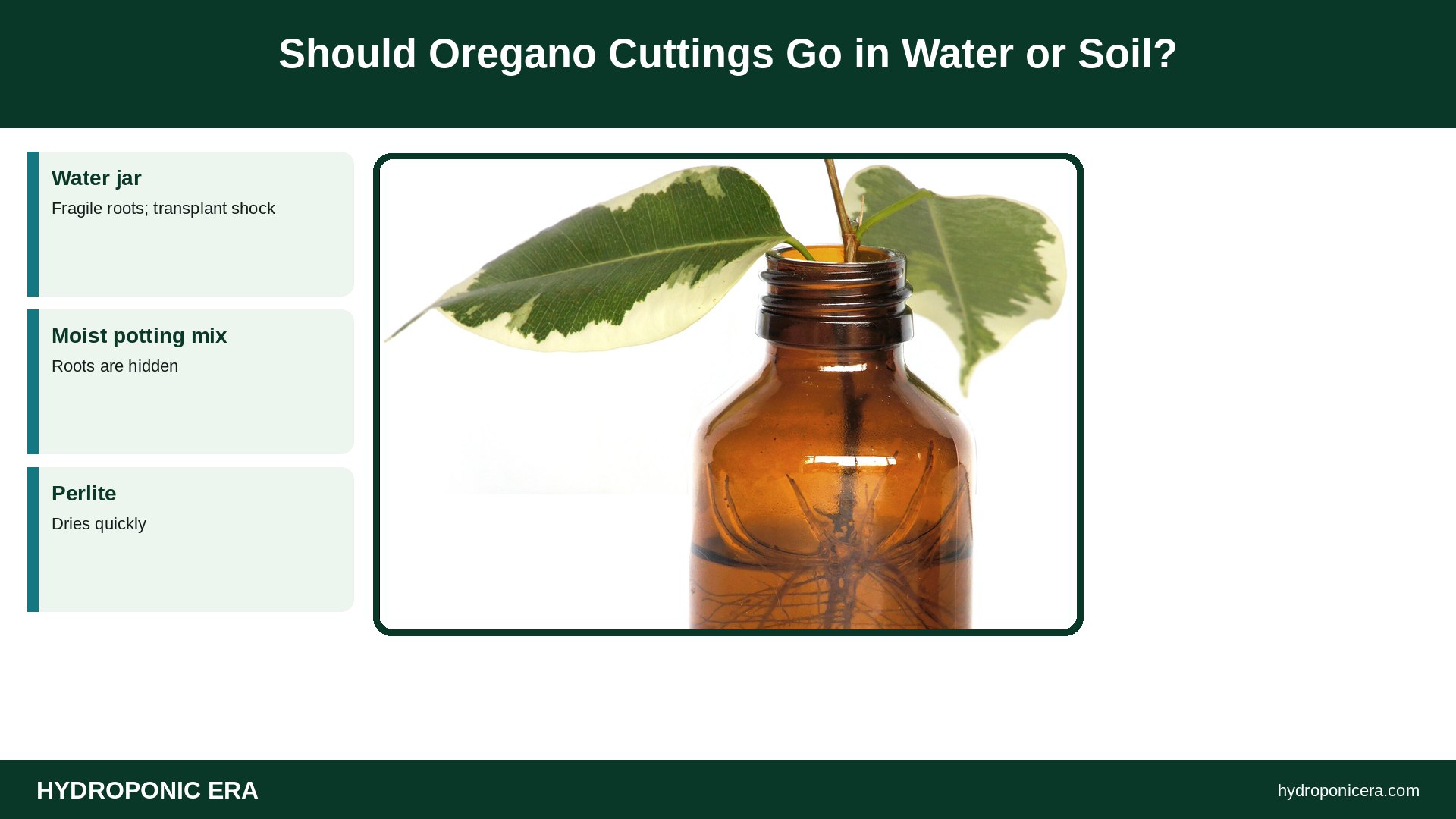
Both work, but soil gives sturdier roots. UF IFAS Extension in Leon County explains that roots formed in water are often more fragile and can struggle when moved to soil, so the plant wilts or stalls while it adjusts. Rooting oregano cuttings directly in moist mix avoids that transition.
| Method | Pros | Cons |
|---|---|---|
| Water jar | Easy; you can watch roots | Fragile roots; transplant shock |
| Moist potting mix | Sturdier roots | Roots are hidden |
| Perlite | Drains fast; low rot risk | Dries quickly |
Compare both in water propagation vs soil propagation, or try perlite propagation.
How Long Do Oregano Cuttings Take to Root?
Expect one to several weeks. Cornell Cooperative Extension says herb cuttings take anywhere from a week to six weeks to root depending on the herb, with basil fast and rosemary slow. Warmth and bright light speed rooting. New leaf growth or white root tips mean your oregano cuttings are ready.
- Healthy: firm stems, white roots, new leaves.
- Slow: cool room or woody stems.
- Wilting: low humidity; loosely cover with a clear bag.
- Slimy stems: change water and trim rot.
How Do You Transplant Rooted Oregano Cuttings?
Move rooted oregano cuttings into well-drained soil in full sun. NC State Extension says oregano does best in average or sandy soil with dry to medium moisture and good drainage, and that root rot can occur in wet, poorly drained soils. Water when the top inch (2.5 cm) is dry, as Purdue advises.
| Need | Guideline | Source |
|---|---|---|
| Light | Full sun; 5 to 6 h in a bright window | UC MG, NC State |
| Soil | Average, well-drained | NC State |
| Water | When the top inch (2.5 cm) is dry | Purdue |
| Size | 1 to 2 ft (30 to 60 cm) tall | UC MG |
Indoors, UC Master Gardeners suggest 5 to 6 hours in a bright window or 12 to 16 hours under lights. For soil-free growing, see how to grow oregano hydroponically.
Why Are My Oregano Cuttings Not Rooting?
The usual causes are woody or flowering stems, too little light, or stale water. UF IFAS recommends non-flowering stems, and Purdue says cutting at a node matters most. If stems turn black, rot has set in; trim above it, rinse the jar and start fresh with clean water.
FAQ About Oregano Cuttings
Do oregano cuttings need rooting hormone?
Not usually. Oregano roots easily; hormone may help woody stems.
Can I root grocery store oregano?
Fresh, soft sprigs with nodes may root; dry, old stems rarely do.
How else can I propagate oregano?
UC Master Gardeners list divisions, and NC State also lists seed and root cuttings.
How do I keep oregano from getting woody?
UC MG suggests cutting woody stems near the base in winter or early spring.
Sources
- Purdue University. Propagate herbs now for yearlong enjoyment.
- Cornell Cooperative Extension Orleans County. Propagate herbs now to enjoy all winter.
- UF IFAS Extension Leon County. Borrowed herbs: grow a garden from a friend’s clippings.
- UC Master Gardeners of Santa Clara County. Oregano.
- NC State Extension Gardener Plant Toolbox. Origanum vulgare.
- Photo credits (Wikimedia Commons, edited with titles): Origanum vulgare inflorescence – Keila by Ivar Leidus (CC BY-SA 4.0); Origanum vulgare – harilik pune by Ivar Leidus (CC BY-SA 3.0); Ficus cuttings with roots in a bottle, White background by Biusch (CC BY-SA 3.0); Basil plant in a pot 02 by Netha Hussain (CC BY-SA 4.0)