
Is ozone in hydroponics safe to use? Ozone in hydroponics can disinfect water, but it is a powerful oxidizer. Research on rockwool tomatoes found growth suppression at 6.0 mg/L applied daily and recommended a 3.0 mg/L upper limit. Ozone gas is also a workplace hazard, with an OSHA limit of 0.1 ppm in air over an 8-hour shift.
Key takeaway: Ozone kills pathogens by oxidation and breaks down fast, leaving little residual. The biggest risks are root damage at high doses, corroded parts, and ozone gas escaping into the grow room.
| Factor | What the sources say |
|---|---|
| How it is made | Electrical arc on oxygen or air, injected by venturi (Clean WateR3) |
| Residual in water | Degrades very quickly; byproducts add a short residual |
| Root-zone upper limit (rockwool tomato) | 3.0 mg/L recommended; 6.0 mg/L suppressed growth |
| Penetration into rockwool | Most lost in the top 0.8 in (2 cm), none past 1.6 in (4 cm) |
| Materials | Highly corrosive: use Teflon tubing and stainless steel |
| Air limit for people | OSHA PEL 0.1 ppm, 8-hour average |
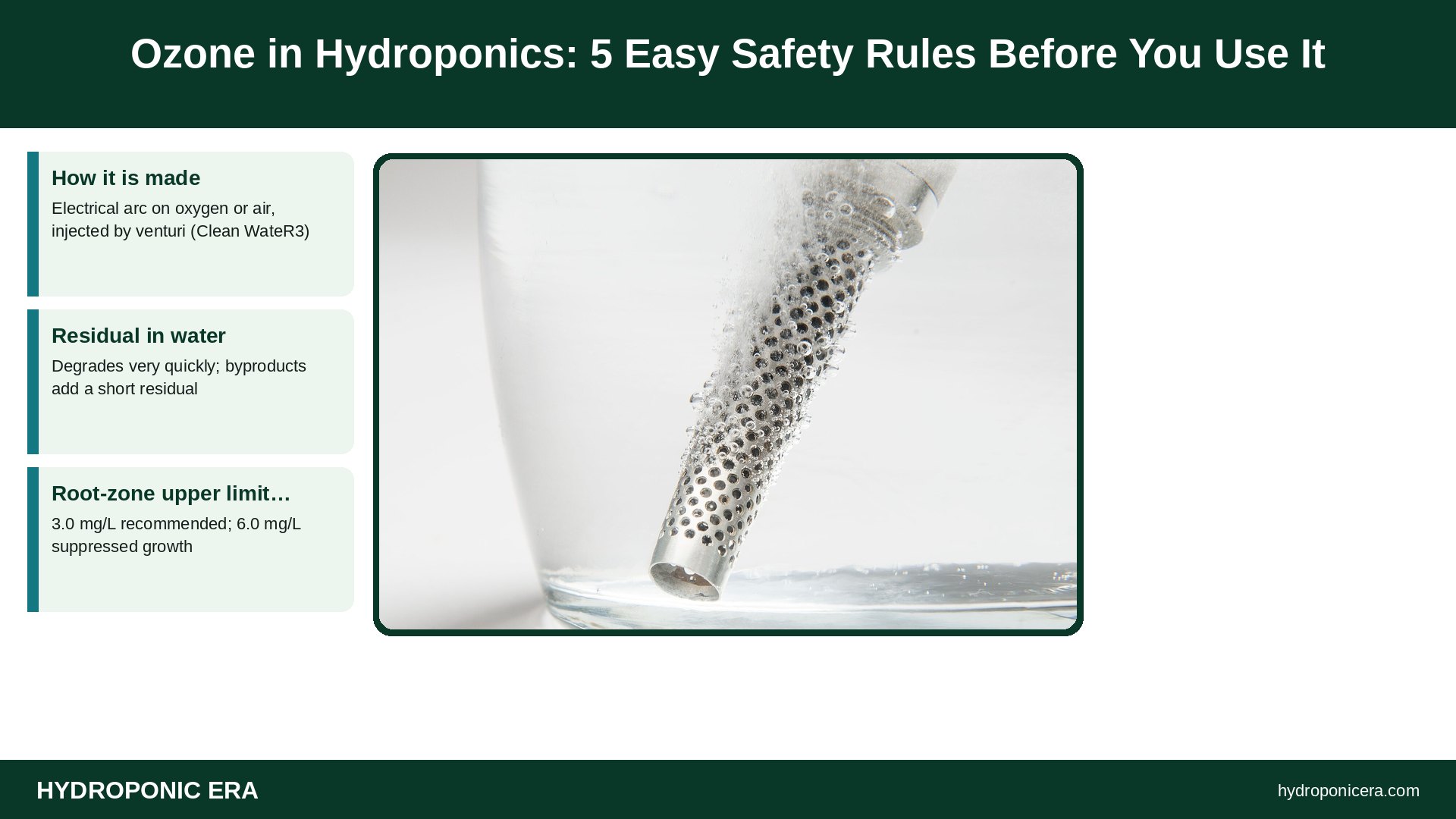
What Does Ozone in Hydroponics Do to Water?
Ozone (O3) changes the chemical structure of organic material through oxidation, according to the Clean WateR3 irrigation water treatment project. That oxidation damages pathogens, algae and biofilm. An electrical arc produces ozone from bottled oxygen or air, and a venturi injector bubbles it into the water. No raw chemicals are needed and there is no waste stream.
For other ways to protect a reservoir, compare UV sterilizers for hydroponic reservoirs and hydrogen peroxide in hydroponics.
How Much Ozone in Hydroponics Can Roots Tolerate?
In a 2012 Scientia Horticulturae study, Graham, Zhang and Dixon applied aqueous ozone daily through drip irrigation to rockwool-grown hydroponic tomatoes. Some growth measures were suppressed at 6.0 mg/L. Based on that and earlier work, they recommended an upper limit of 3.0 mg/L for this type of system until more research is done.
The same study found ozone barely moved into the substrate. Most was lost in the top 0.8 in (2 cm), and none passed 1.6 in (4 cm) except after excessive volumes. Extra dissolved oxygen alone did not change productivity, so the effects were attributed to ozone. These numbers apply to rockwool tomatoes only, not to deep water culture.
Why Does Ozone Leave So Little Residual?
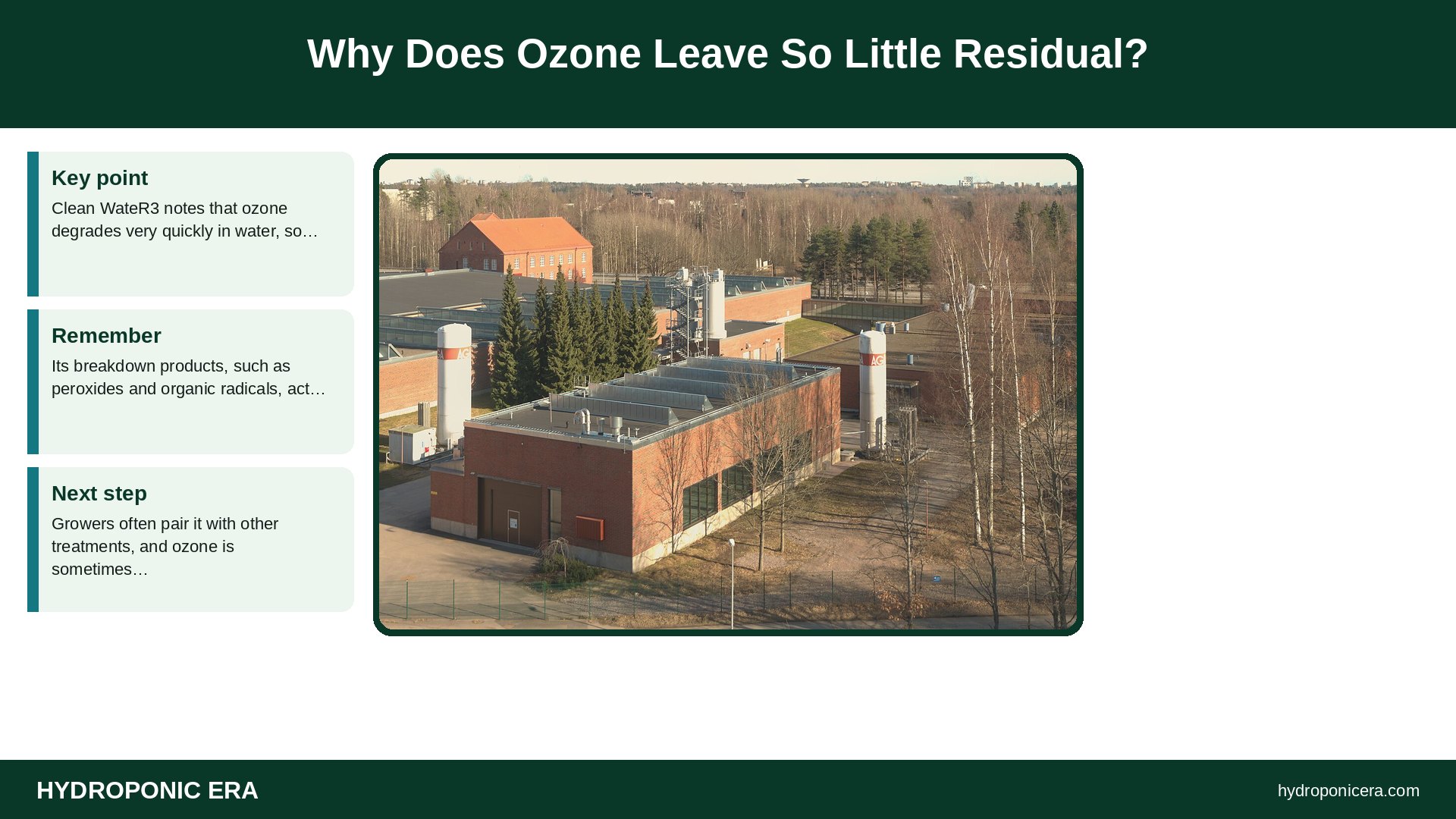
Clean WateR3 notes that ozone degrades very quickly in water, so concentration is hard to monitor directly. Its breakdown products, such as peroxides and organic radicals, act as disinfectants too and give a short residual effect. Growers often pair it with other treatments, and ozone is sometimes used to add residual action after UV.
- Measure pathogen load before and after treatment to judge activity.
- Instruments that strip ozone out of water can estimate concentration.
- Do not expect ozone to protect water sitting in the reservoir for days.
What Are the Safety Risks of Ozone Gas?
Ozone that escapes from water becomes an air hazard. OSHA lists ozone as a colorless to blue gas with a very pungent odor, and sets a permissible exposure limit of 0.1 ppm (0.2 mg/m3) as an 8-hour average. NIOSH lists 5 ppm as immediately dangerous to life or health. Clean WateR3 says professional system design is required to prevent hazardous escape.
- Never run an ozone generator in a closed, occupied grow room.
- Vent or destruct off-gas from contact tanks outdoors.
- Use a monitor that reads in the ppb range; OSHA lists 25–1000 ppb screening devices.
- Shut the system down if you notice a very pungent odor.
What Equipment Does Ozone in Hydroponics Need?
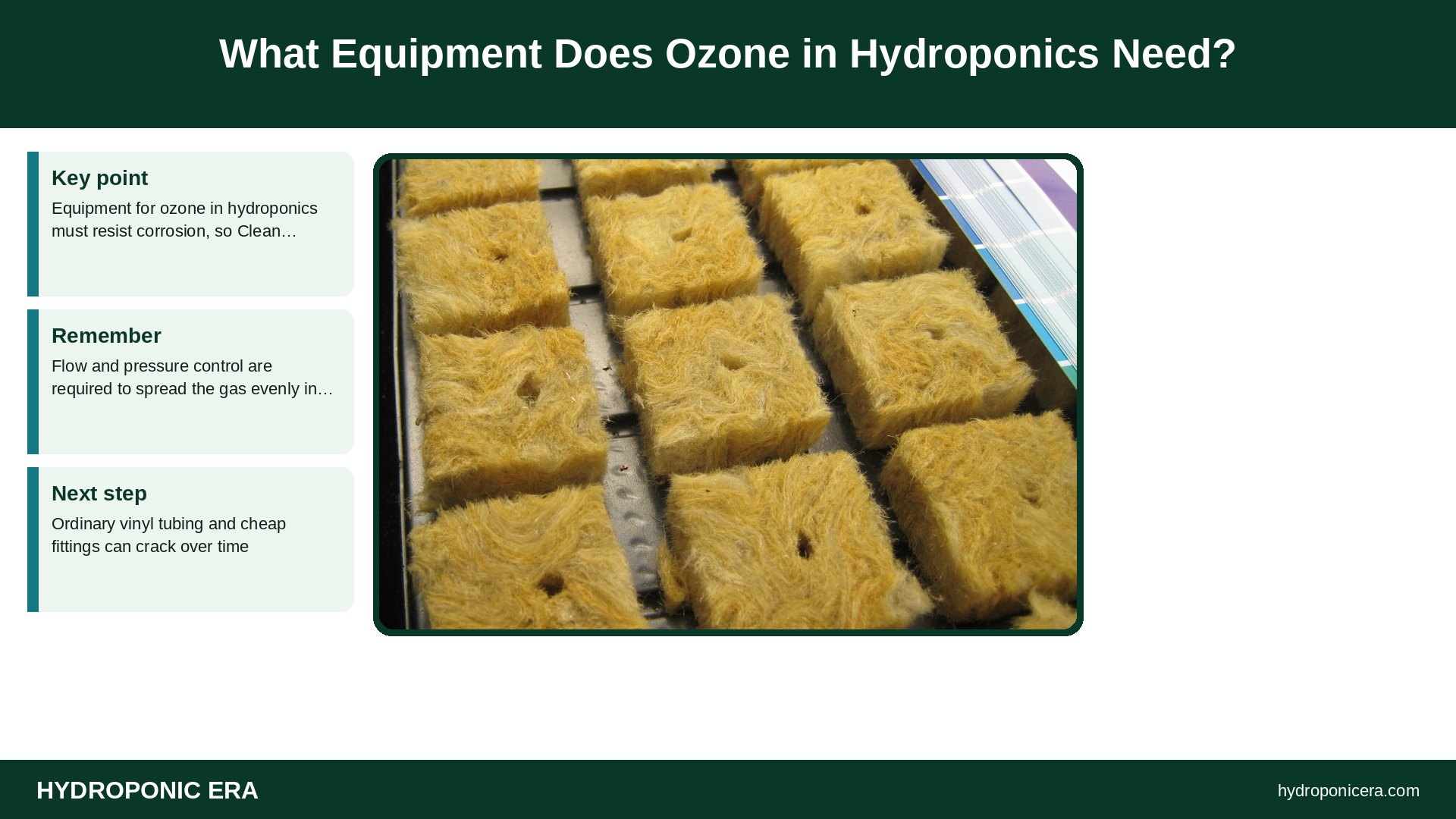
Equipment for ozone in hydroponics must resist corrosion, so Clean WateR3 advises Teflon tubing and stainless steel components. Flow and pressure control are required to spread the gas evenly in the water stream. Ordinary vinyl tubing and cheap fittings can crack over time. For most home growers, the equipment and safety controls cost more than simpler options.
Keep pumps and filters clean either way; see our cleaning and sterilizing guide.
Should Home Growers Use Ozone in Hydroponics?
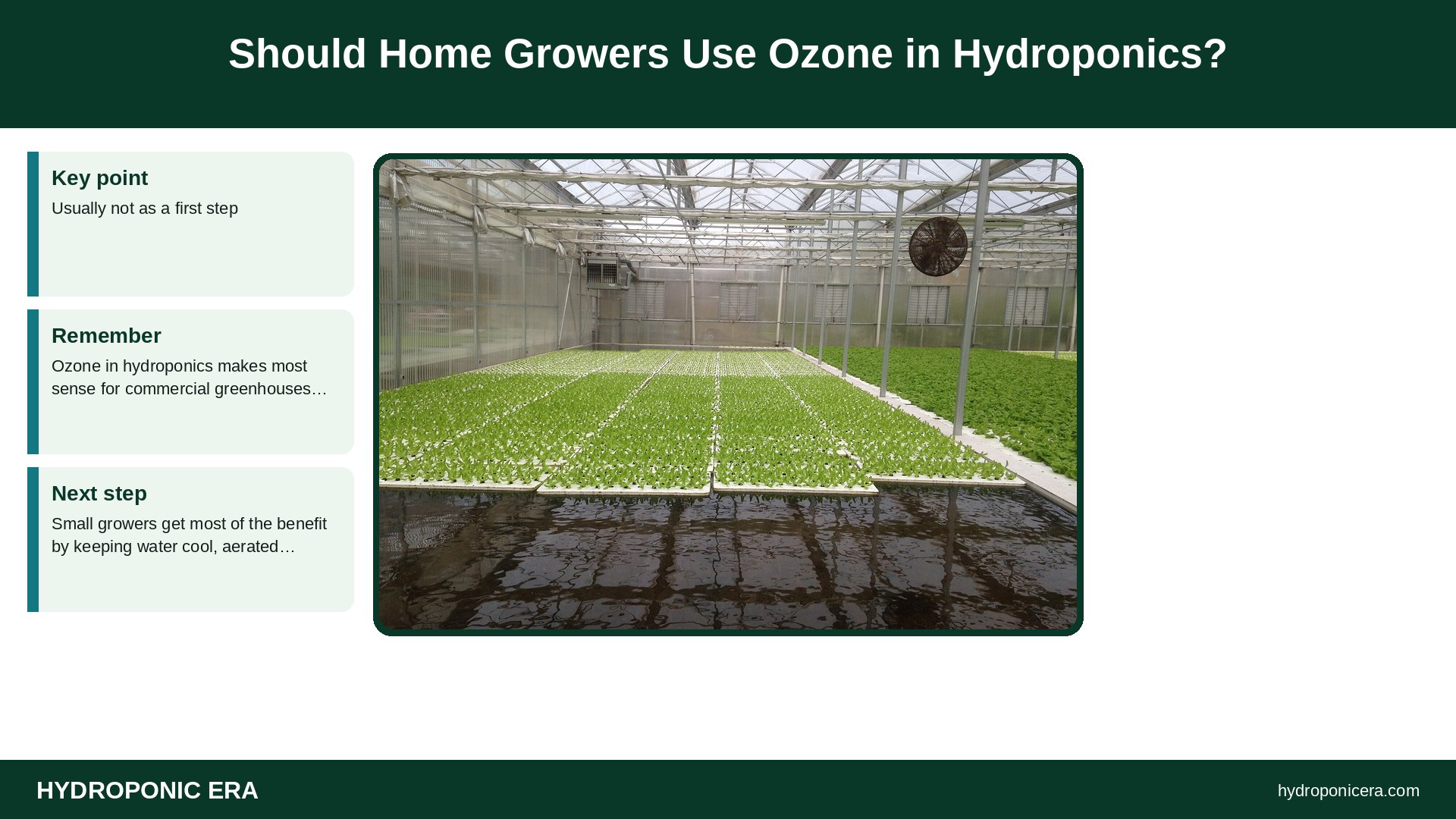
Usually not as a first step. Ozone in hydroponics makes most sense for commercial greenhouses treating source or recycled water with a professionally designed system. Small growers get most of the benefit by keeping water cool, aerated and clean, and by fixing root problems early. Our Pythium root rot guide explains prevention.
If slime is your issue, see biofilm in hydroponic reservoirs before buying an ozone generator. Strong dissolved oxygen also matters; see dissolved oxygen in hydroponics.
How Does Ozone Compare With UV and Peroxide?
Each method trades strength against residual. The Clean WateR3 project summarizes the differences below. Ozone in hydroponics gives strong oxidation but only a brief residual, UV leaves none, and activated peroxygen can last longer when organic matter is low. Chlorine dioxide provides residual control at low doses.
| Method | Residual effect (Clean WateR3) |
|---|---|
| Ozone | Degrades very quickly; byproducts give short residual |
| UV radiation | No residual; often paired with ozone |
| Activated peroxygen | Up to 3 days in recycled water with little organic matter |
| Chlorine dioxide | Provides residual control |
Organic matter uses up oxidizers fast, so filtration before treatment helps every method work better.
FAQ About Ozone for Hydroponic Systems
Does ozone add oxygen to nutrient solution?
Yes, it breaks down to oxygen, but the 2012 study found extra dissolved oxygen alone did not change tomato productivity.
What is a safe aqueous ozone level for roots?
For rockwool tomatoes, researchers recommended no more than 3.0 mg/L.
Can ozone damage my tubing?
Yes. It is highly corrosive; use Teflon and stainless steel parts.
What is the OSHA limit for ozone in air?
0.1 ppm as an 8-hour time-weighted average.
Does ozone in hydroponics keep working in the reservoir?
Only briefly. It degrades very quickly, with a short residual from byproducts.
Sources
- Clean WateR3 (USDA SCRI project) — Water treatment technologies: key information
- Graham, Zhang and Dixon, Scientia Horticulturae 2012, via US EPA HERO — Upper limits for root zone aqueous ozone
- OSHA — Ozone chemical data and exposure limits
- Photo credits (Wikimedia Commons, edited with titles): An example of an electrolytic ozone generator by Mdemyer (CC BY-SA 4.0); Vanhakaupunki Water Treatment Plant ozonation plant from Koskela outcrop by Antti Leppänen (CC BY 4.0); Rockwool cubes-inlay PNr°0091 by D-Kuru (CC BY-SA 3.0 at); Deep water culture by ArcadiYay (CC BY-SA 4.0)