
Can you grow papalo hydroponically? Yes, with patience at the start. Papalo hydroponics works like other leafy herbs once a seedling is established, but the seed is slow and fragile: Terroir Seeds lists germination at 2–3 weeks at 75–85°F (24–29°C). Keep it warm, give it strong light, and harvest the tops often so it stays bushy.
Key takeaway: Papalo (Porophyllum ruderale) is the pungent “summer cilantro” of Mexican cooking. University of Maryland Extension’s Maryland Grows blog says it is in the aster family and native to Central and South America and the U.S. Southwest. Papalo hydroponics is uncommon, so there is no published nutrient recipe for it, but seed-company growing data and extension guidance on small hydroponic systems give you a clear plan.
| Factor | Guideline | Source |
|---|---|---|
| Germination | 2–3 weeks at 75–85°F (24–29°C) | Terroir Seeds |
| Seed handling | Keep the feathery top attached; broken seeds will not germinate | Terroir Seeds |
| Cold tolerance | Does not tolerate cold; keep indoors until frost risk is past | UMD Extension |
| Mature height | Up to 5 ft (1.5 m) if not harvested | UMD Extension |
| Spacing in soil | 12–18 in (30–46 cm) | Terroir Seeds |
| Simple system | DWC in a 5-gallon bucket or storage bin | UMN Extension |
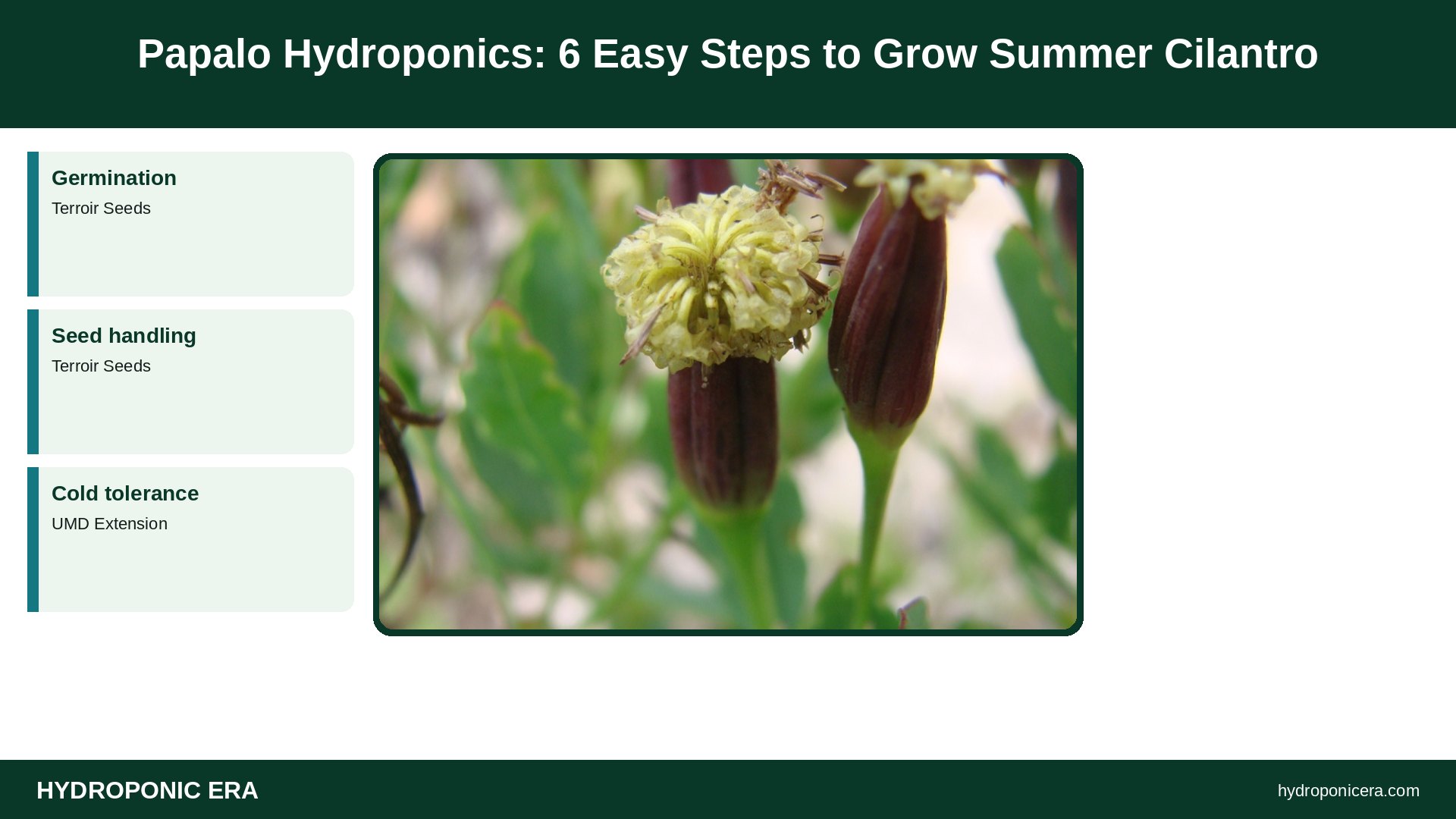
What Is Papalo and Why Grow It Hydroponically?
Papalo is a cilantro-like herb that loves heat. UMD Extension lists other names including Bolivian coriander, quillquiña and pápaloquelite, and says the flavor is not exactly like cilantro but close enough to use as an alternative. Terroir Seeds notes that, unlike cilantro, it does not bolt in summer. Papalo hydroponics lets you keep a warm-season supply indoors year-round.
For the classic cool-season herb, see our guide on how to grow cilantro hydroponically.
How Do You Start Seeds for Papalo Hydroponics?
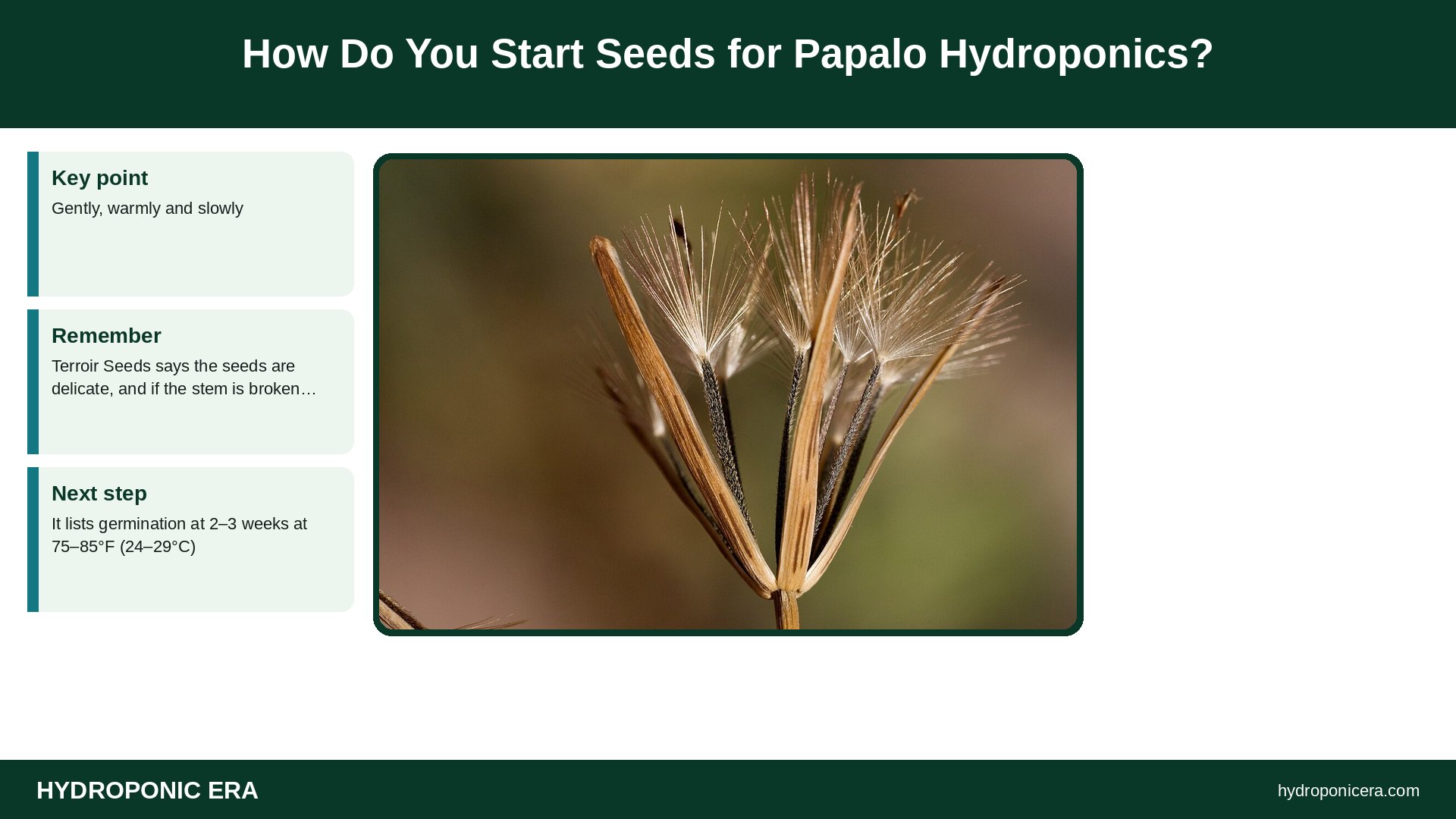
Gently, warmly and slowly. Terroir Seeds says the seeds are delicate, and if the stem is broken from the umbrella-like top the seed will not germinate. It lists germination at 2–3 weeks at 75–85°F (24–29°C). For papalo hydroponics, sow the intact seed onto a moist starter cube or plug and keep it warm, ideally on a heat mat.
- Handle each seed by its feathery top; do not snap it off.
- Press the seed lightly onto a moist rockwool cube or plug.
- Keep the tray at 75–85°F (24–29°C).
- Expect sprouts in about 2–3 weeks; do not give up early.
- Transplant into a net pot once roots show at the bottom of the cube.
Our seed germination temperature guide explains how heat speeds slow sprouters.
Which System Works Best for Papalo Hydroponics?
Start simple. University of Minnesota (UMN) Extension says the simplest home systems are deep water culture (DWC), where plants sit in net pots above a tank of water, and that a 5-gallon bucket or plastic storage bin works. In a passive Kratky setup, UMN says to keep roots only one-third to one-half submerged so the air gap provides oxygen.
- DWC bucket: one or two plants per 5-gallon bucket with an air stone.
- Kratky bin: fine for a short run; lower the water as roots grow.
- Media: UMN suggests soaking any substrate in water for 24 hours and changing the water before transplanting.
Papalo hydroponics in a bucket is easier if you follow our deep water culture for beginners walkthrough.
How Much Light Does Papalo Hydroponics Need?
Plenty. Terroir Seeds lists papalo’s light preference as full sun, so a windowsill alone rarely gives indoor plants enough. UMN Extension notes that artificial lighting helps faster growth indoors, and its example budget for a one- or two-bucket system uses a 9-watt LED with a PPF of 16 micromoles per second, run for 5,110 hours a year, or about 14 hours a day.
That small bulb is UMN’s budget example, not a papalo test; a bigger fixture will suit a tall, sun-loving herb better. Our guide to how much light herbs need covers intensity targets.
What Temperature Does Papalo Hydroponics Need?
Warm. UMD Extension says papalo will not tolerate cold and should stay indoors until there is no chance of frost, and the Maryland grower suggests starting seed around the same time as tomatoes. Terroir Seeds describes papalo as a heat-loving cilantro alternative that keeps producing in summer. For papalo hydroponics, a warm room and warm germination temperature matter most.
- Germination: 75–85°F (24–29°C), per Terroir Seeds.
- Growing: a warm, frost-free room; avoid cold drafts.
- Outdoors: move plants out only after frost risk is gone.
How Do You Harvest Papalo Grown Hydroponically?
Pinch the tops often. UMD Extension says papalo can reach up to 5 feet (1.5 m) tall if you do not keep up with harvesting, and the author’s plants never flowered, probably because the author kept chopping off the tops. Regular tip harvests in papalo hydroponics keep plants compact under lights and push out fresh side shoots with tender leaves.
Use the leaves raw. UMD Extension advises never cooking papalo; use it fresh or add it at the very end of cooking, and Terroir Seeds says it does not dry well. Start with a small amount, because UMD warns the flavor is strong until you get used to it.
The U.S. Botanic Garden adds that young leaves taste milder and the flavor gets stronger as leaves age, so frequent picking keeps it gentler. It also notes that in Mexico, papalo branches are kept in water on café tables so diners can tear fresh leaves into beans or tortillas, a simple sign that cut stems hold up well in water.
Is Papalo Hydroponics Worth It Over Cilantro?
For summer flavor, yes. UMD Extension points out that cilantro is not native to the Americas and still earns its place, especially when flowering plants attract helpful small insects. Papalo hydroponics fills the hot-weather gap, when cilantro bolts. Terroir Seeds warns that if you dislike cilantro you will like papalo even less, so taste a leaf first.
- Grow both: cilantro for cool months, papalo for warm ones.
- Pollinators: Terroir Seeds says papalo flowers feed butterflies and attract bees.
- Kitchen use: tacos, salsas, meats and cheeses, added fresh.
What Are the Main Problems With Papalo Hydroponics?
Most trouble comes from the slow start. Seeds with broken tops will not germinate, according to Terroir Seeds, and a 2–3 week wait tempts growers to reseed too early. After transplant, UMN Extension advises sanitation, keeping the reservoir topped up, and weekly pH and EC checks, because warm water favors algae and bacteria.
- No sprouts: check that seeds were intact and kept warm for three weeks.
- Leggy plants: raise light intensity or move the light closer.
- Tall, woody stems: harvest the tops more often.
- Cloudy water: clean the system and change the nutrient solution.
FAQ About Papalo Hydroponics
How long does papalo take to germinate?
About 2–3 weeks at 75–85°F (24–29°C), per Terroir Seeds.
Does papalo bolt like cilantro?
Terroir Seeds says it does not bolt in summer.
How tall does papalo get?
Up to 5 ft (1.5 m) if not harvested, per UMD Extension.
Can you cook papalo?
UMD Extension says to use it raw or add it at the very end.
Can you dry papalo?
Terroir Seeds says it does not dry well.
Is papalo cold hardy?
No; UMD Extension says it will not tolerate cold.
Sources
- University of Maryland Extension (Maryland Grows) — Papalo: The “Summer Cilantro”
- Terroir Seeds (Underwood Gardens) — Papalo/Quilquiña Seeds (Porophyllum ruderale ssp. macrocephalum)
- University of Minnesota Extension — Small-Scale Hydroponics
- United States Botanic Garden — Papalo Science Page
- Photo credits (Wikimedia Commons, edited with titles): Porophyllum ruderale 2 by Marcia Stefani (CC BY 2.0); Porophyllum ruderale – Flickr – aspidoscelis by Patrick Alexander from Las Cruces, NM (CC0); Porophyllum ruderale 3 by Marcia Stefani (CC BY 2.0)