
What does a pH controller do in hydroponics? A pH controller reads a probe in the reservoir and, when pH drifts past a set limit, runs a dosing pump to add pH down or pH up in small doses. Good setups move about 0.1 pH per dose, wait for mixing, cap total additions and stop on alarms.
Key takeaway: A pH controller automates the pH up and pH down routine, but only works safely with a calibrated probe, small doses and hard limits.
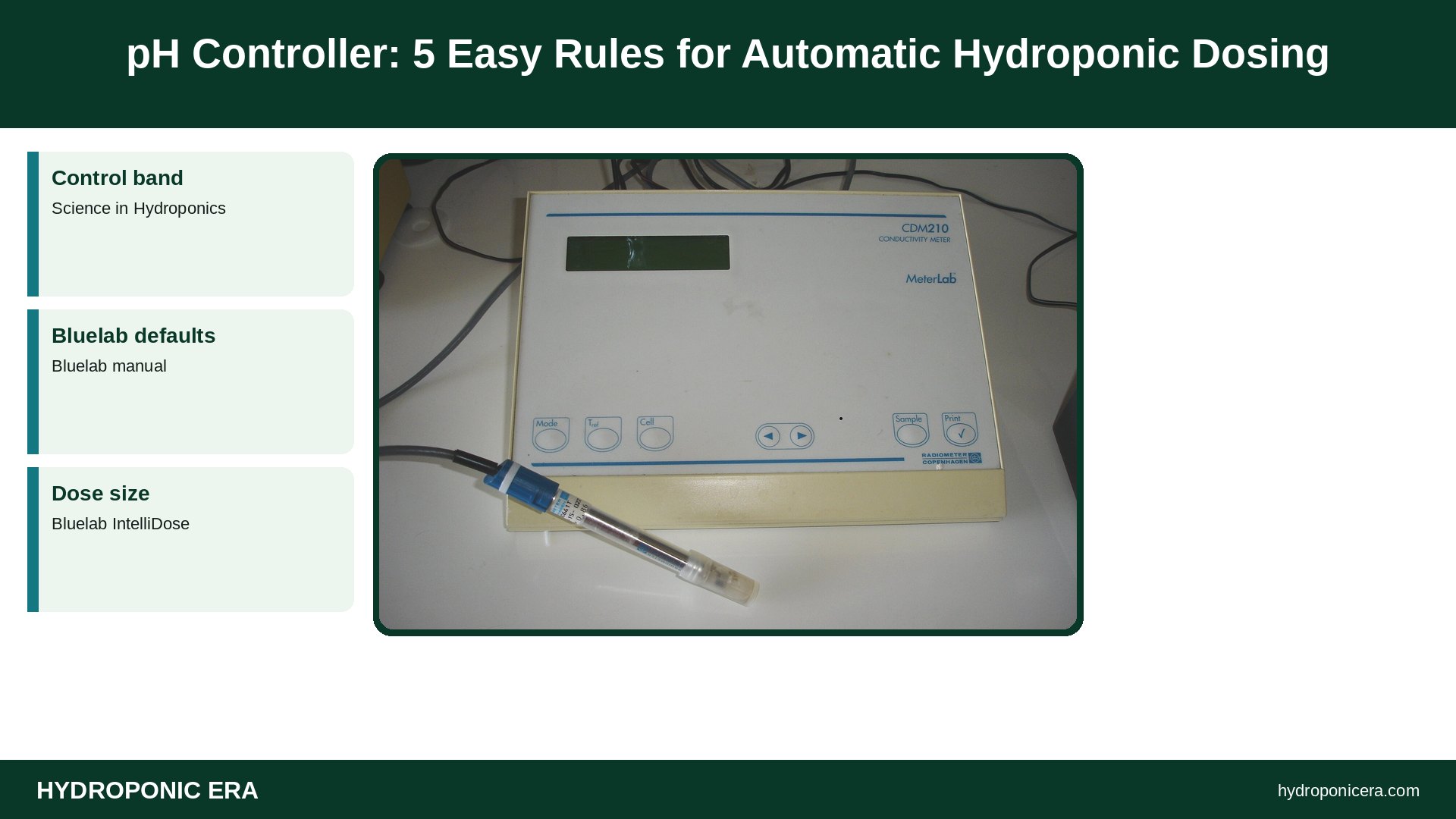
| Setting | Typical starting point | Source |
|---|---|---|
| Control band | pH 5.6–6.4, return to about 6.0 | Science in Hydroponics |
| Bluelab defaults | Set pH 5.8, low alarm 5.6, high alarm 6.5 | Bluelab manual |
| Dose size | About 0.1 pH change per dose | Bluelab IntelliDose |
| Mixing wait | 2–3 minutes small systems, 10+ minutes large | Bluelab IntelliDose |
| Probe check | Test with buffer weekly | Science in Hydroponics |
| Calibration | pH 7.0 first, then 4.0 for readings below 7 | Bluelab manual |
| Acid or base strength | 10–20% is usually enough | Science in Hydroponics |
How Does a pH Controller Work?
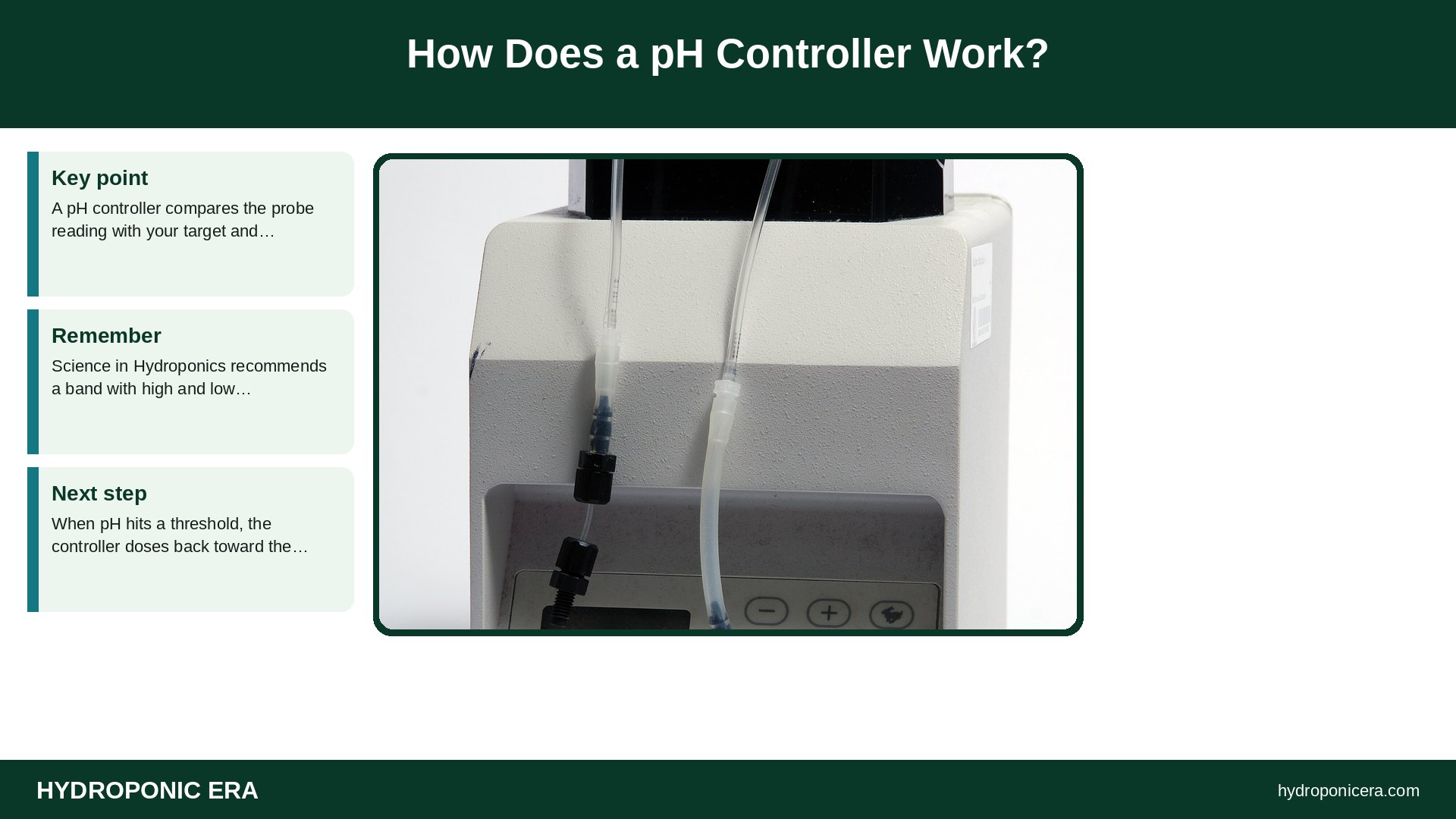
A pH controller compares the probe reading with your target and switches a peristaltic pump. Science in Hydroponics recommends a band with high and low thresholds, such as 5.6–6.4. When pH hits a threshold, the controller doses back toward the middle, about 6.0, then stops instead of chasing one exact number.
Many growers dose acid only. Bluelab’s IntelliDose guide says pH lower is the usual choice, and to switch to pH raise only if pH keeps drifting below 5.5. Our pH up and pH down guide covers the products.
How Do You Set Dose Size and Mixing Time?
Small and slow wins. Bluelab says each pH dose should move pH by about 0.1, and the dose interval should let solution mix and readings settle, often 2–3 minutes for a small system and 10 minutes or more for large ones. If the interval is too short, the controller doses again before mixing and overshoots.
- Start with a short OnTime, such as the Bluelab default of 1 second.
- Set a long OffTime, such as the Bluelab default of 10 minutes.
- Watch how far one dose moves pH after full mixing.
- Lengthen OnTime until one dose moves about 0.1 pH.
- Shorten OffTime only if mixing is fast and thorough.
How Do You Calibrate a pH Controller Probe?
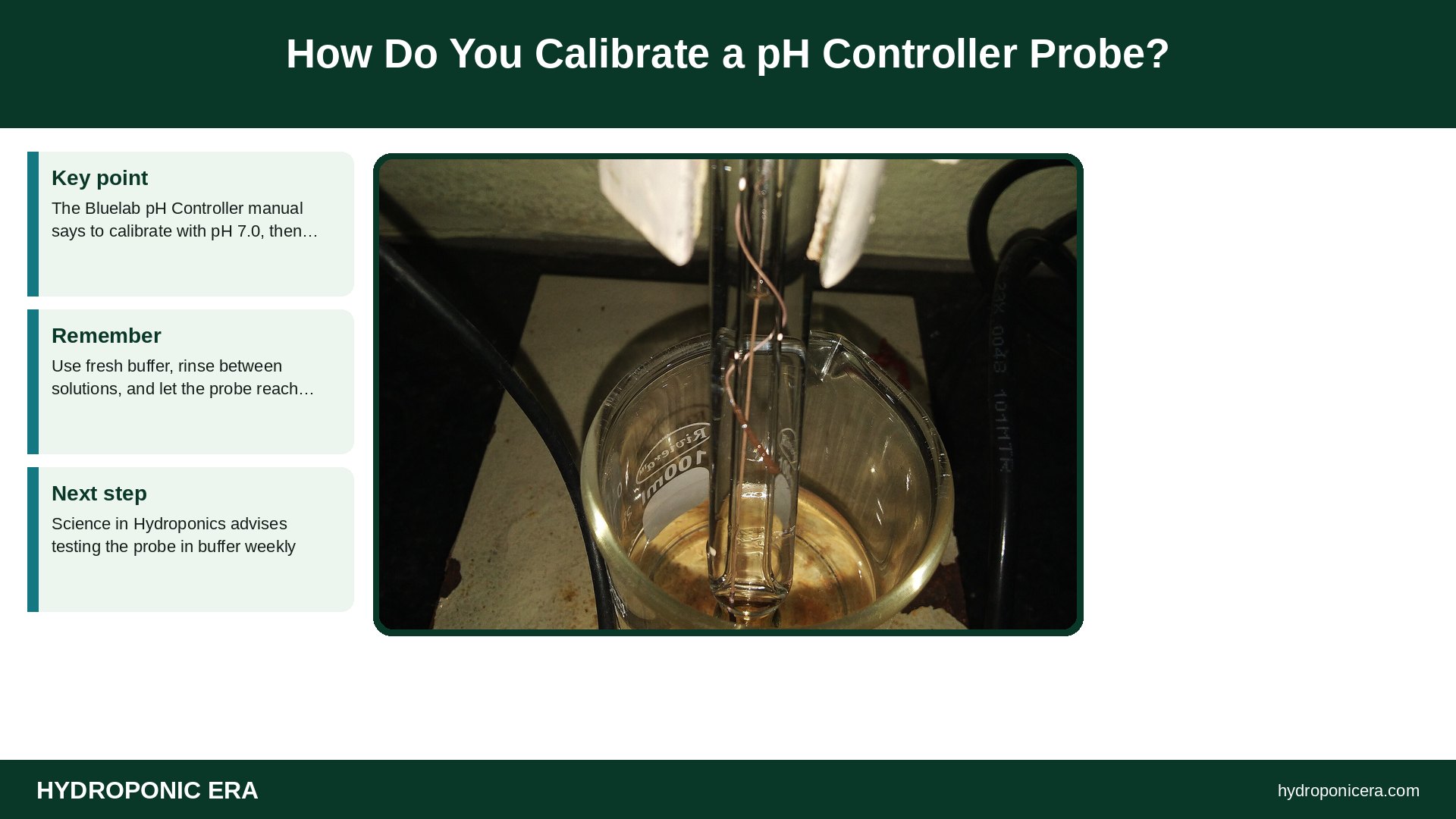
Always start at pH 7.0. The Bluelab pH Controller manual says to calibrate with pH 7.0, then pH 4.0 if readings will be below 7, or pH 10.0 if above. Use fresh buffer, rinse between solutions, and let the probe reach solution temperature. Science in Hydroponics advises testing the probe in buffer weekly.
Never let the probe tip dry. Bluelab warns a dried probe must be hydrated 24 hours in KCl storage solution, never RO or distilled water. See our probe care and calibration guide and pH and EC meters guide.
What Safety Limits Should a pH Controller Have?
Hard limits protect the crop. Science in Hydroponics warns that a probe losing calibration, a damaged controller or electrical noise can trigger enough acid to kill a crop, so set maximum additions per unit time. The Bluelab pH Controller stops dosing during high or low alarms and locks out if pH does not change after 15 dose cycles.
- Set high and low alarms that stop dosing, not just warn.
- Cap the total dose volume per hour or day.
- Keep the ineffective-dosing lockout on unless your system needs otherwise.
- For commercial systems, use two probes that cross-check each other.
Where Should You Place the pH Probe?
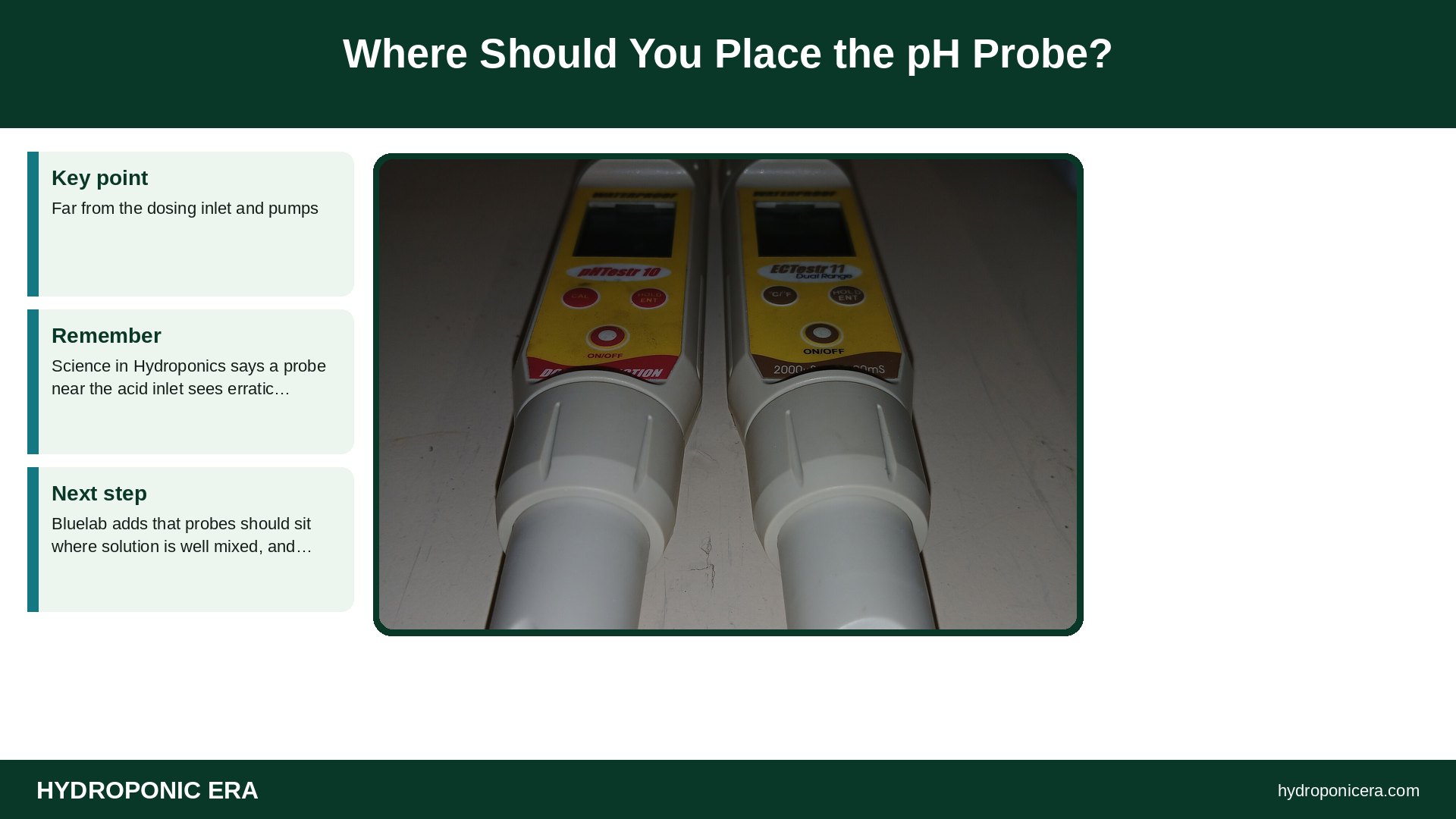
Far from the dosing inlet and pumps. Science in Hydroponics says a probe near the acid inlet sees erratic swings that do not reflect the whole reservoir, and probes near pumps pick up electrical interference. Bluelab adds that probes should sit where solution is well mixed, and concentrated pH adjuster must never be poured onto them.
What Mistakes Make a pH Controller Fail?
Concentrated chemicals and ignored data are common culprits. Science in Hydroponics says strong acid or base causes overshoot or an up-down loop; 10–20% solutions are usually enough. It also urges tracking how often and how much the pH controller doses, since pH adjusters can also add phosphorus or potassium. Pair it with hydroponic automation carefully.
FAQ About pH Controllers
What pH should a hydroponic pH controller hold?
Commonly a band of about 5.6–6.4 for many crops.
How often should I calibrate a pH controller probe?
Test it with buffer weekly and recalibrate if it reads off.
Should a pH controller dose up or down?
Bluelab says pH lower (acid) is the usual choice.
Can I leave any pH probe submerged all the time?
Use probes designed for constant immersion.
Does a pH controller replace checking by hand?
No; verify readings and review dosing data regularly.
Sources
- Science in Hydroponics — Five dos and don’ts for automated pH control in hydroponics
- Bluelab — IntelliDose: Setting up One or Two Part Dosing
- Bluelab — pH Controller Wi-Fi Care and User Manual (PDF)
- Photo credits (Wikimedia Commons, edited with titles): Electrical conductivity meter by Nuno Nogueira (Nmnogueira) (CC BY-SA 2.5); Laboratory peristaltic pump Gilson-01 by Lilly_M (CC BY-SA 3.0); Glass electrode by Chandrajit Karmakar (CC BY-SA 4.0); PH- und Leitfähigkeitsmessgeräte by Rotkaeppchen68 (CC0)