
Quick Answer
plant labels tracking multi crop hydroponics is the practical focus of this home-hydro guide.
Plant labels tracking multi-crop hydroponics keeps variety, sow date, reservoir ID, and harvest notes attached to the plant—not stuck in your head.
When lettuce, basil, and peppers share a room, unlabeled net pots turn troubleshooting into guesswork and wreck continuous harvest planning.
See record-keeping logs, multi-crop compatibility, continuous harvest, and plant spacing.
Key takeaways for plant labels tracking multi crop hydroponics
- Plant labels tracking multi-crop hydroponics is ops hygiene, not fancy software.
- Every net pot needs: crop, variety, sow/transplant date, reservoir code.
- Waterproof ink + UV-stable tags beat paper scraps in tents.
- Match labels to log rows so EC events map to the right crop class.
- UF/IFAS and extension crop guides assume you know which cultivar you grew.
- Original code: R1-L03 = Reservoir 1, lettuce slot 3.
- Plant labels tracking multi-crop hydroponics fails when tags fade and you “remember later.”
- Color dots help crop class; they do not replace written dates.
Related HydroponicEra guides
Why Labels Beat Memory

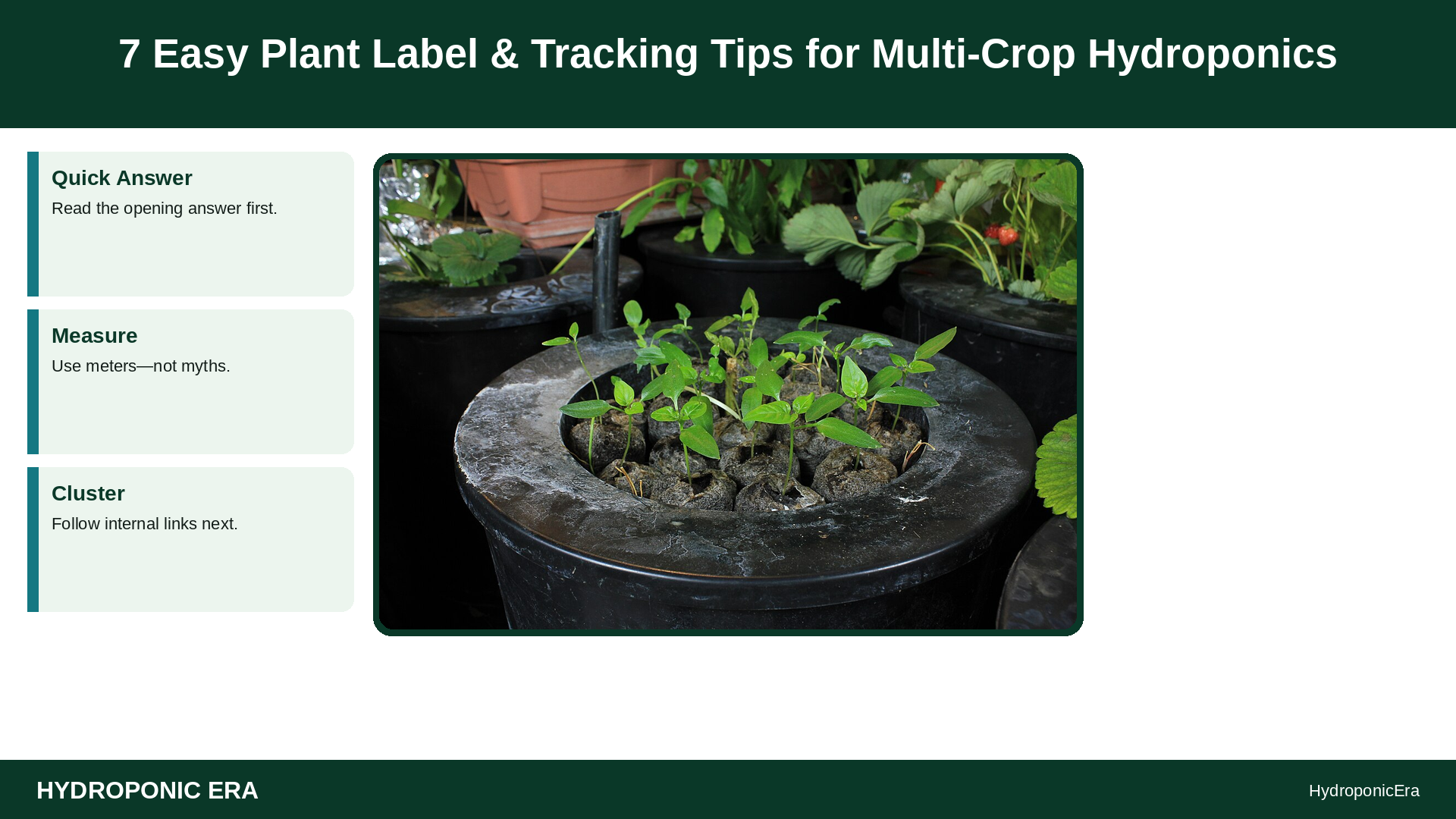
Plant labels tracking multi-crop hydroponics matters because recirculating rooms accumulate look-alike greens. Extension vegetable guides emphasize cultivar choice; that only helps if you still know which cultivar is in which hole after week three.
This is adjacent to logs but narrower: physical identification at the plant, plus a simple code that survives wet gloves.
Label Systems Compared
| System | Pros | Cons |
|---|---|---|
| Plastic stake + paint pen | Cheap, visible | Ink fade under strong LED |
| Engraved/embossed tags | Durable | Slower to update |
| QR to phone note | Rich history | Fails when phone is elsewhere |
| Tray map only | Fast for one crop | Breaks when you rearrange pots |
Step-by-Step Labeling Workflow

- Assign reservoir codes (R1, R2) on lids.
- On sow day, write crop + variety + date on the tag.
- Add slot number when transplanting into the system.
- Mirror the code in your weekly log (logs).
- When you change EC recipe lanes, note which codes moved.
- At harvest, tick the tag or move it to compost notes.
- Replace faded tags immediately—do not “do it Sunday.”
- For shared tanks, mark crop class (leafy/fruiting) to respect compatibility.
- Photograph the canopy map monthly for backup.
- Retire codes when pots are empty to avoid ghost entries.
Variables
| Variable | Effect | Link |
|---|---|---|
| LED intensity | Bleaches cheap ink | PPFD |
| Humidity | Paper tags delaminate | humidity/VPD |
| Many varieties | Need stricter codes | harvest planning |
| Sales harvests | Traceability helps trust | food safety |
Common mistakes with plant labels tracking multi crop hydroponics

- Pencil on wet plastic
- Same name for two sow dates
- Moving pots without moving tags
- Logging EC without plant codes
- Using only color dots for 12 crops
- Leaving dead tags in empty holes
Troubleshooting Identity Chaos

| Problem | Fix |
|---|---|
| Two “basils” bolted differently | Relabel from photos + restart codes |
| Wrong EC blamed on lettuce | Map fruiting codes off leafy tank |
| Harvest glut then empty holes | Align tags with stagger plan |
Original Framework: Pot Code Card
Use R#-CROP-DATE (example: R2-BAS-1002). Hang a legend on the reservoir. Cluster next: logs, spacing, shared tanks.
Closing practice for plant labels tracking multi-crop hydroponics: if a pot has no tag, it does not get special treatment—pause and identify it first.
What to Check Before You Rearrange Net Pots
- Reservoir codes on lids?
- Every pot tagged?
- Log mirrors codes?
- Fade check this week?
- Harvest ticks recorded?
Building a Code That Survives Wet Gloves
Short codes beat paragraphs on a tag. R1-LET-1002 tells you reservoir, crop class, and transplant date at a glance.
Add a variety abbreviation when you grow multiple lettuces. Mirror the same string in your notebook or spreadsheet row so EC events and pest notes attach to the right plant after you rearrange pots.
UV from strong LEDs fades cheap markers. If tags bleach within two weeks, switch paint pens marketed for outdoor plant use or engraved plastic.
Paper jewelry tags curl into illegible mush in high humidity. Color dots help crop class (leafy vs fruiting) but never replace dates—dots alone cannot explain why one basil bolted earlier.
Labels for Sales and Kitchen Partners
If you sell or share produce, labels support honest harvest timing conversations.
A chef asking “when was this cut?” deserves an answer grounded in your codes, not memory. For household kitchens, labels prevent culinary mix-ups—culantro is not cilantro, marjoram is not oregano—especially when guests help harvest.
FAQs about plant labels tracking multi crop hydroponics
Do I need software?
No—waterproof tags + a notebook beat abandoned apps.
Seedling trays?
Label the tray and the first transplant tag together.
Clones?
Include mother plant code on the tag.
Selling produce?
Codes support honesty about harvest dates.
Is this record-keeping?
Logs are the ledger; labels are the plant ID layer.
Kids helping?
Use large print and color dots with adult date writing.
Digital Backup Without App Theater
A phone note or simple spreadsheet that mirrors pot codes is enough. Fancy farm software abandoned after a week is worse than a damp notebook you actually use.
Sync codes when you transplant, when you change reservoirs, and when you harvest. If a pot moves, the code moves with it—or you create ghosts that poison your troubleshooting.
For continuous harvest planning, labels reveal empty holes and overdue sowings at a glance. Walk the canopy weekly with a checklist: missing tags, faded ink, wrong reservoir codes after a rearrange.
Replace immediately. Fruiting vs leafy class marks prevent accidental shared-tank compromises from going unnoticed.
Teaching helpers or family members? Large print and a legend on the reservoir lid reduce errors. Kids can place color dots; adults still write dates. Sales days benefit from harvest ticks on tags so you do not double-pick the same basil stem set.
Finally, retire codes when pots empty. Old tags left in holes confuse the next crop and make logs look haunted. A clean labeling culture is part of hydroponic record-keeping—not a replacement for meter logs, but the identity layer those logs need.
Extended Home-Grower Walkthrough
Use this extended walkthrough as a second pass after the Quick Answer. Walk the system with a notebook: write the date, crop, EC, pH, reservoir temperature, and one observation about roots or leaves.
Change only one control at a time when a problem appears. If last week’s fix did not show in new growth, revert and try the next smallest lever. Keep university and extension principles in mind—oxygen, sanitation, and measured nutrition beat product stacking.
Photograph the canopy and the reservoir surface weekly. Dated photos settle arguments about algae, tip burn, or stretch faster than memory. When a helper waters for you, leave a one-page card with do-not-touch items and the exact top-off rule.
Store calibration sachets next to the meters so “I will calibrate later” stops being the default. Review timers after any power event. Confirm air stones still roar. Confirm drains still drain.
At the end of the week, score the cycle 1–5 for ease and plant quality. Low scores should trigger a sanitation or climate review before you buy new hardware.
Link neighboring HydroponicEra guides when the symptom matches a cluster page. Prefer labeled procedures over improvisation under stress. Healthy boring routines are the real upgrade path for home hydroponics.
Keep plant labels tracking multi-crop hydroponics visible on your weekly ops card so helpers follow one standard.
Revisit plant labels tracking multi-crop hydroponics after any system change, relocation, or new crop introduction.
If notes disagree, rerun the plant labels tracking multi-crop hydroponics checklist before buying more gear.
Apply plant labels tracking multi crop hydroponics as a repeatable habit—measure, log, and revisit after changes.
Apply plant labels tracking multi crop hydroponics as a repeatable habit—measure, log, and revisit after changes.
Apply plant labels tracking multi crop hydroponics as a repeatable habit—measure, log, and revisit after changes.
Apply plant labels tracking multi crop hydroponics as a repeatable habit—measure, log, and revisit after changes.
Apply plant labels tracking multi crop hydroponics as a repeatable habit—measure, log, and revisit after changes.
Apply plant labels tracking multi crop hydroponics as a repeatable habit—measure, log, and revisit after changes.
Apply plant labels tracking multi crop hydroponics as a repeatable habit—measure, log, and revisit after changes.
Apply plant labels tracking multi crop hydroponics as a repeatable habit—measure, log, and revisit after changes.
Apply plant labels tracking multi crop hydroponics as a repeatable habit—measure, log, and revisit after changes.
Apply plant labels tracking multi crop hydroponics as a repeatable habit—measure, log, and revisit after changes.
Apply plant labels tracking multi crop hydroponics as a repeatable habit—measure, log, and revisit after changes.
Apply plant labels tracking multi crop hydroponics as a repeatable habit—measure, log, and revisit after changes.
Apply plant labels tracking multi crop hydroponics as a repeatable habit—measure, log, and revisit after changes.
Apply plant labels tracking multi crop hydroponics as a repeatable habit—measure, log, and revisit after changes.
Apply plant labels tracking multi crop hydroponics as a repeatable habit—measure, log, and revisit after changes.
Apply plant labels tracking multi crop hydroponics as a repeatable habit—measure, log, and revisit after changes.
Sources
- University of Florida IFAS — HS1421: Growing Herbs in Small Hydroponic Systems
- University of Florida IFAS — HS1279: Leafy Greens in Hydroponics and Protected Culture for Florida
- Oklahoma State University Extension — Hydroponics
- NC State Extension — Central North Carolina planting calendar
- Michigan State University Extension — Hydroponics as an agricultural production system
- University of Minnesota Extension — Growing herbs in home gardens