
How do you root plumeria cuttings? Cut a 1- to 2-foot (30 to 60 cm) tip, remove mature leaves, and cure the cutting in a cool, shaded spot until a callus forms, usually in 2 to 3 weeks. Then plant it 2 to 4 inches (5 to 10 cm) deep in well-drained mix and let it dry between waterings.
Key takeaway: Plumeria cuttings root best when they are cured dry, not soaked. University of Hawaii research found 1- to 2-foot (30 to 60 cm) cuttings grew larger plants than 3- to 4-foot (0.9 to 1.2 m) branches. Callus first, plant shallow, water sparingly and move to sun gradually.
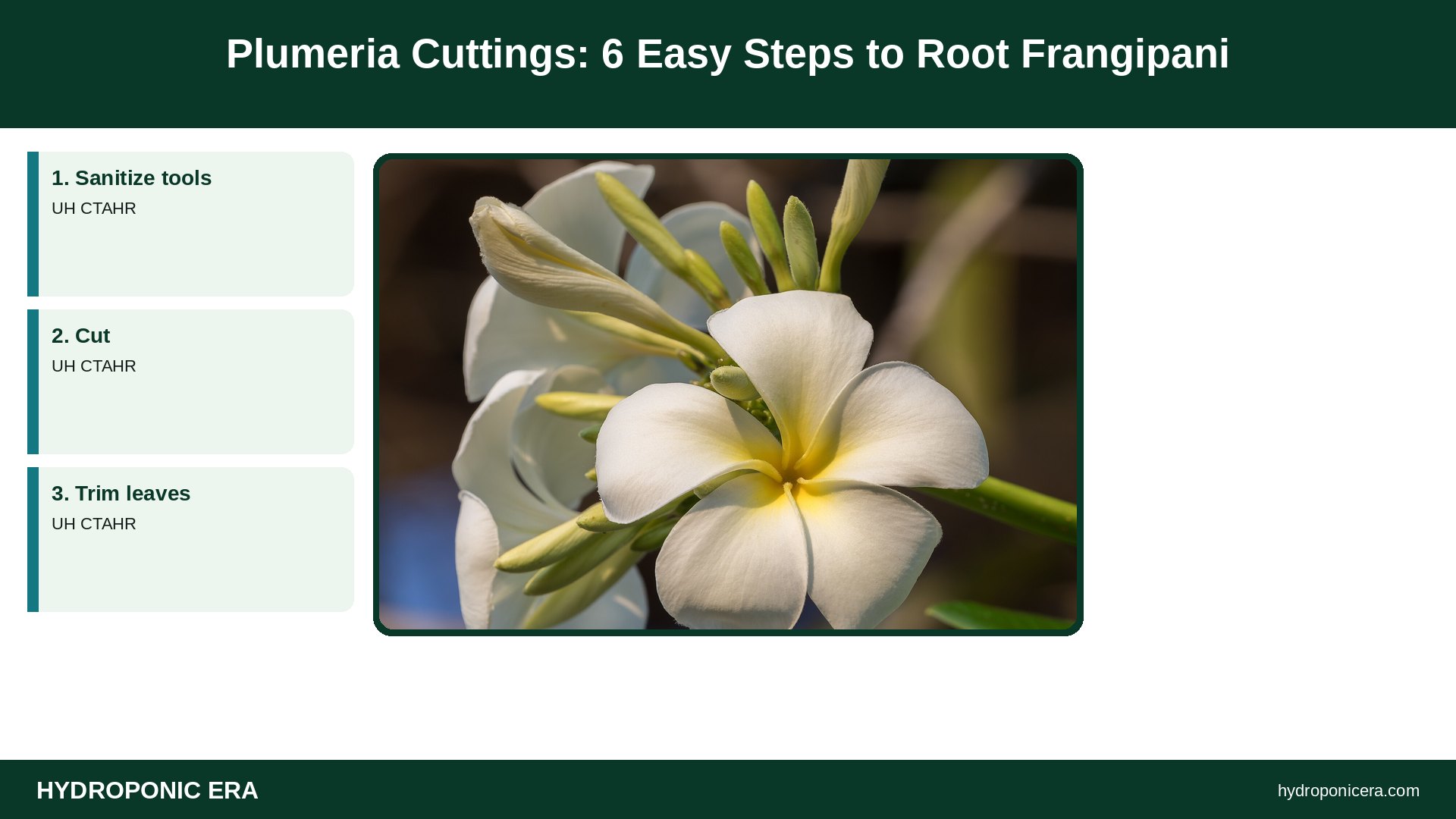
| Step | What to do | Source |
|---|---|---|
| 1. Sanitize tools | Clean pruners before every cut | UH CTAHR |
| 2. Cut | 1 to 2 ft (30 to 60 cm) tip or branched cutting | UH CTAHR |
| 3. Trim leaves | Cut leaves, leaving 1/4 to 1/2 in (6 to 13 mm) of petiole | UH CTAHR |
| 4. Treat (optional) | 0.1% or 0.3% IBA plus plastic wrap at the base | UH CTAHR |
| 5. Cure | Cool shade until callus shows, 2 to 3 weeks | UH CTAHR |
| 6. Plant | 2 to 4 in (5 to 10 cm) deep; dry between waterings | UH CTAHR |
What Size Plumeria Cuttings Root Best?
Cuttings 1 to 2 feet (30 to 60 cm) long are the sweet spot. In a trial at the University of Hawaii Urban Garden Center, 1- to 2-foot plumeria cuttings produced up to 5 feet (1.5 m) of new growth in 19 months, while 3- to 4-foot (0.9 to 1.2 m) branches were stunted and grew only about 18 inches (46 cm).
Tip cuttings grow into upright, single-trunk trees, while branched cuttings with several tips make a compact plant with low flowering branches. Very large cuttings can root, but they need stakes or scaffolding for years.
How Do You Prepare Plumeria Cuttings?
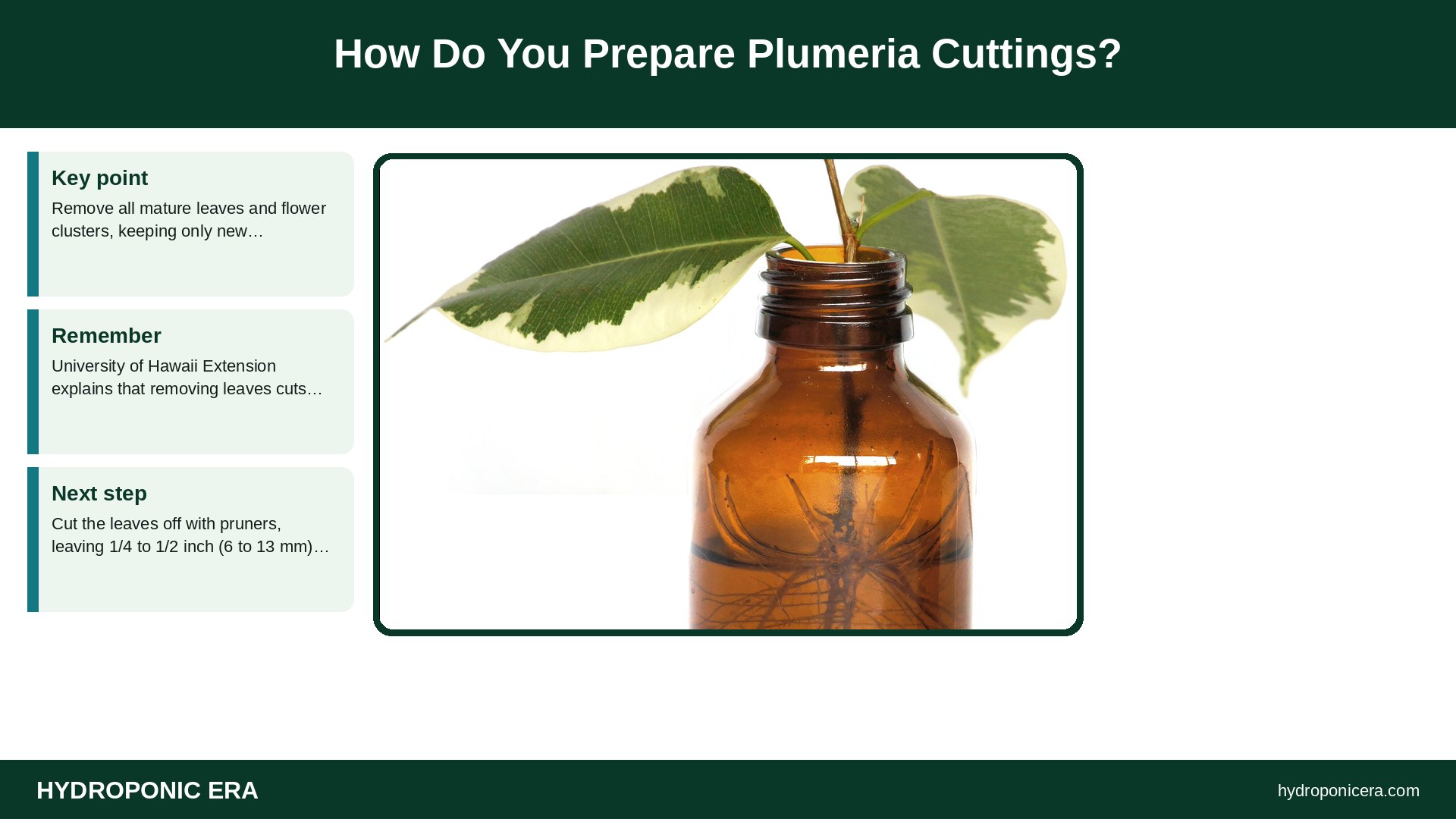
Remove all mature leaves and flower clusters, keeping only new, immature leaves. University of Hawaii Extension explains that removing leaves cuts water loss and improves rooting. Cut the leaves off with pruners, leaving 1/4 to 1/2 inch (6 to 13 mm) of stalk, rather than pulling them, which creates wounds that invite disease.
- Sanitize pruning shears before cutting and between plants.
- Cut a healthy tip or branched piece 1 to 2 ft (30 to 60 cm) long.
- Snip off mature leaves and flower stalks, leaving short petiole stubs.
- Keep the small new leaves at the tip.
- Wear gloves: University of Wisconsin Extension warns the milky sap irritates eyes and can cause dermatitis.
Do Plumeria Cuttings Need Rooting Hormone?
Most do not, but some cultivars are hard to root and benefit from it. University of Hawaii Extension recommends 0.1% or 0.3% indolebutyric acid (IBA) powder for difficult types. Wrapping the base in plastic wrap also prevents dehydration and has been shown to help callus and new roots form on plumeria cuttings.
- Dust IBA powder on the base, about 0.5 to 1 inch (1.3 to 2.5 cm) up the stem.
- Cut a square of plastic wrap about 4 by 4 inches (10 by 10 cm).
- Set the cutting base in the middle and fold the wrap up around it.
- Secure non-stick wrap with a rubber band, snug but not tight.
A band that is too tight can girdle the stem. Learn more in our rooting hormone guide.
How Long Do Plumeria Cuttings Take to Callus?
Callus and the first root bumps usually appear within 2 to 3 weeks, according to University of Hawaii Extension. Keep the cuttings in a shaded, cool place while they cure. They are ready to plant when you can see callus or roots at the base. New leaves after planting are the sign that roots are developing.
Can You Root Plumeria Cuttings in Water?
No. University of Hawaii Extension specifically warns not to leave plumeria cuttings in water, because it causes the base to rot. Plumeria is a succulent-stemmed tree that roots best from a dry, callused base in moist air or well-drained mix. This is one plant where water propagation is the wrong choice.
Compare methods in water propagation vs soil propagation, and use a gritty mix like the one in our perlite propagation guide.
How Do You Plant and Water Plumeria Cuttings?
Plant callused cuttings about 2 to 4 inches (5 to 10 cm) deep in well-drained mix, then let the mix dry completely between waterings. University of Hawaii Extension warns that cuttings rot in permanently saturated soil. Move them from shade into full sun gradually, because sudden sun can scald and dehydrate them.
| Stage | Water | Light |
|---|---|---|
| Curing | None; keep dry | Cool shade |
| Just planted | Light watering, then dry out completely | Bright shade |
| New leaves showing | Water when mix is dry | Gradually increase to full sun |
| Established | More light means more water (UW) | Full sun (UF IFAS) |
UF IFAS notes that plumeria grows best in full sun and well-drained soil, and University of Wisconsin Extension adds that overwatering leads to root rot.
How Do You Grow Plumeria in Cold Climates?
Grow plumeria in containers and bring them indoors before nights get cold. University of Wisconsin Extension recommends moving plants inside when night temperatures drop into the 40s °F (about 4 to 9°C). UF IFAS notes plumeria is susceptible to cold damage, and even central Florida, in zone 9B, faces frost risk.
- Use a pot with large drainage holes.
- Keep it bright and on the dry side indoors in winter.
- Repot in late winter, as UW Extension suggests.
- Prune overgrown pots and save the tips as new plumeria cuttings.
FAQ About Plumeria Cuttings
Do I have to wrap plumeria cuttings in plastic?
No, it is optional. UH CTAHR found plastic wrap at the base helps prevent dehydration and supports callus and root formation.
Why is my plumeria cutting soft at the base?
It is rotting, usually from wet mix. Cut above the soft tissue, re-cure it dry and replant.
How fast will a cutting grow?
In the UH trial, 1- to 2-foot cuttings grew up to 5 feet (1.5 m) in 19 months in the ground.
When will a plumeria cutting bloom?
UF IFAS notes plants are prolific bloomers once leaves reestablish, flowering May to November in Florida.
Can I root several cuttings together?
Yes, but give each enough space and drainage so the bases stay dry.
For general cloning tips, see our hydroponic cuttings and cloning guide.
Sources
- University of Hawaii CTAHR. Propagation of plumeria via cuttings (OF-67) (PDF).
- University of Wisconsin Extension. Plumeria.
- UF IFAS Gardening Solutions. Plumeria.
- Photo credits (Wikimedia Commons, edited with titles): Plumeria (Frangipani) flowers by Basile Morin (CC BY-SA 4.0); Ficus cuttings with roots in a bottle, White background by Biusch (CC BY-SA 3.0)