
Can you propagate a prayer plant in water? Yes. A prayer plant in water roots from a tip cutting with at least one node below the leaves. Cut just under a node, remove leaves that would sit underwater, and keep the jar warm in bright, indirect light. Change the water weekly and pot the cutting when roots reach about 1–2 inches (2.5–5 cm). Division also works.
Key takeaway: A prayer plant in water needs a node, warmth and humidity. Leaves alone won’t make a new plant, and cold drafts or fluoride-heavy water cause most failures.
| Method | Source support | Best for |
|---|---|---|
| Tip cutting in water | Texas A&M lists Maranta as propagated by tip cuttings | Watching roots form; leggy stems |
| Division at repotting | NC State and Illinois list division | Large, crowded plants |
| Tip cutting in moist mix | Illinois favors rooting media over water | Sturdier roots |

Does a Prayer Plant in Water Root Easily?
Fairly easily, if the cutting has a node. Texas A&M AgriLife lists Maranta (prayer plant) among plants propagated from tip cuttings, which include the stem tip, leaves and a section of stem with a leaf joint. NC State Extension describes the prayer plant as an evergreen tropical in the arrowroot family that spreads horizontally and is propagated by rhizome division. Water rooting is a home-grower favorite because the clear jar shows each stage, though both Illinois Extension and Texas A&M warn that water roots can be stringy and slower to adapt to soil.
Where Do You Cut a Prayer Plant for Water Propagation?
Cut just below a node, the slightly swollen joint where a leaf stalk meets the stem. Prayer plant stems often branch at nodes, so a good cutting has two or three leaves and one node below them. Roots and new shoots both form at the node.
- Length: About 3–6 inches (8–15 cm), the tip size Penn State Extension suggests for stem cuttings.
- Leaves: Keep two or three; remove any that would sit in the water.
- Tools: Illinois Extension recommends sharp tools sterilized in alcohol before and between cuts.
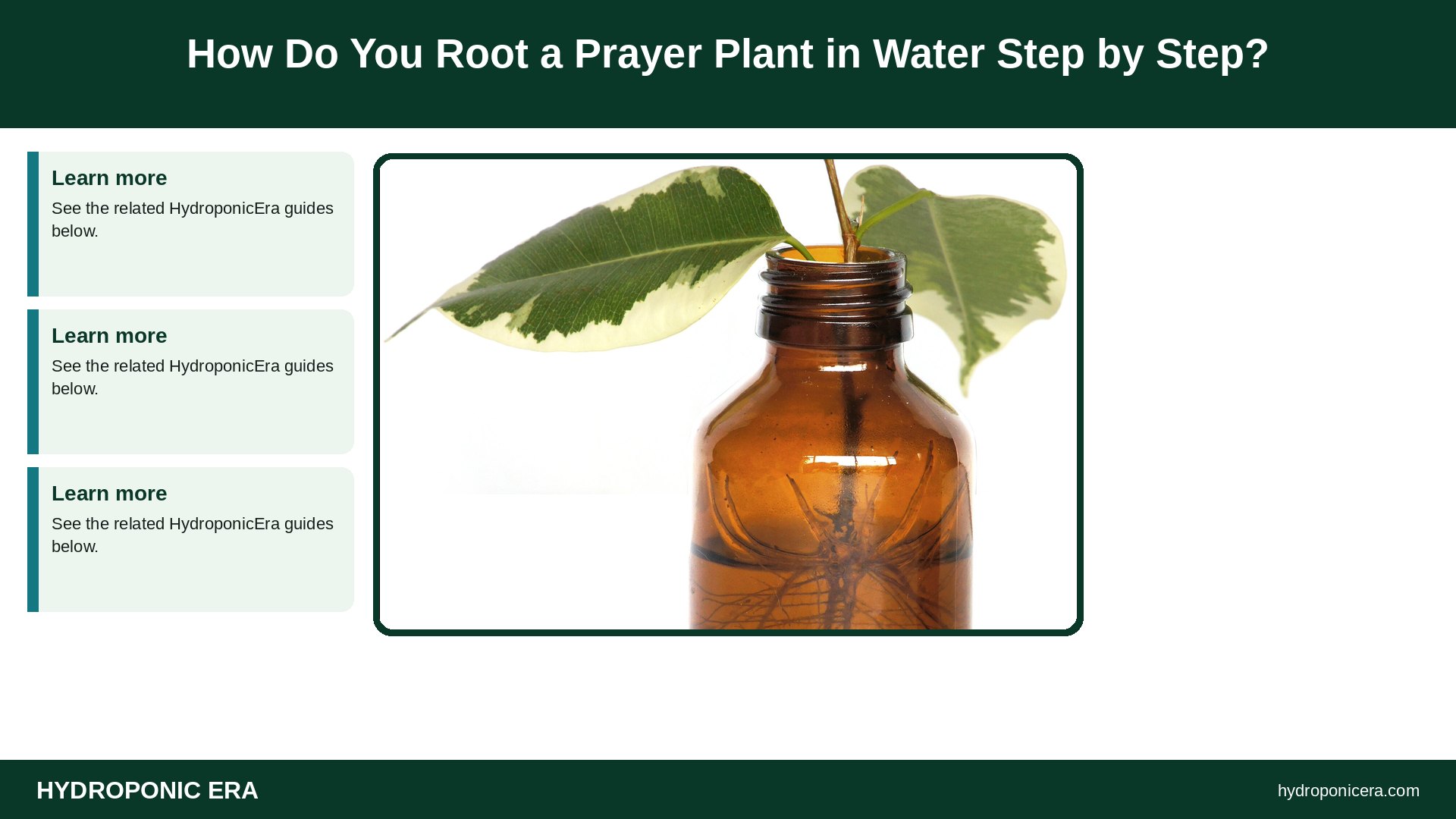
How Do You Root a Prayer Plant in Water Step by Step?
- Choose a healthy stem during active growth in spring or summer.
- Cut ¼ inch (6 mm) below a node with clean scissors.
- Strip lower leaves so only bare stem goes underwater.
- Use clean, room-temperature water. NC State notes prayer plant leaves burn with high fluoride, so filtered, distilled or rainwater helps if your tap water is fluoridated.
- Submerge the node and keep leaves above the rim.
- Place in bright, indirect light. NC State says too much sun bleaches leaf colors.
- Keep it warm. Illinois Extension recommends 75–80°F (24–27°C) for rooting cuttings.
- Change the water weekly; Texas A&M says water for rooting must be clean and well aerated.
How Long Does a Prayer Plant in Water Take to Root?
Usually a few weeks in warm conditions. Small white roots appear at the node first. Vermont Extension notes that rooting can take weeks or months depending on the plant and conditions, so cool rooms slow things down. Don’t wait too long to pot once roots form; Illinois Extension lists that as a key rule for cuttings.
What Water Is Best for a Prayer Plant in Water?
Low-fluoride, chlorine-free water at room temperature. NC State says prayer plant leaves burn with high fluoride and over-fertilization, so the water you choose shows up as brown leaf tips. Options:
- Rainwater or distilled water: Little or no fluoride.
- Filtered tap water: Only reverse osmosis removes much fluoride; carbon filters remove chlorine.
- Tap water left out overnight: Chlorine gas escapes but fluoride and chloramine stay.
See our guides to fluoride in water for plants and chlorine and chloramine in tap water.

Why Is My Prayer Plant in Water Curling or Browning?
- Low humidity: NC State says prayer plants require high humidity and are intolerant of low humidity. Cover the jar loosely with a clear bag.
- Cold or drafts: NC State lists intolerance of low temperatures and cold drafts.
- Fluoride: Brown, crispy tips; switch water.
- Too much sun: Faded, bleached leaves.
- Rot: A soft, dark stem base; Illinois warns prayer plant stems rot easily. Cut above the damage and use fresh water.
A humidity dome solves the first problem for most cuttings.
When Should You Move a Prayer Plant in Water to Soil?
When roots are about 1–2 inches (2.5–5 cm) long. Use a small pot with drainage and regular potting mix, as Illinois Extension advises for prayer plants. Keep the soil evenly moist but not soggy, since NC State notes root rot can occur in poorly drained soil. Illinois also says not to let water stand on the crowns.
Can a Prayer Plant Live in Water Permanently?
It can survive for a while, but it does better in soil. Long-term water growth needs a weak, complete fertilizer and frequent water changes, and NC State warns that over-fertilization burns prayer plant leaves. Keep any feeding at quarter strength or less. Our list of plants that grow in water covers better long-term choices.
How Do You Divide a Prayer Plant Instead of Water Rooting?
Divide at repotting in spring. Slide the plant out, tease apart the rhizomes so each section keeps roots and several stems, and pot each piece at the same depth. NC State and Illinois both list division as a standard method, and it gives instantly larger plants than a cutting.
Is a Prayer Plant Safe for Pets?
Yes. The ASPCA lists the prayer plant (common names include Maranta) as non-toxic to dogs, cats and horses. Still, keep a prayer plant in water where pets can’t knock the jar over or drink stale water.
How Do You Care for a Prayer Plant After Water Rooting?
Treat a new prayer plant gently for the first month. NC State recommends bright, indirect light, evenly moist soil in the growing season and drier soil in winter. It also notes the plant tolerates low to medium light, so a north or east window often works. Raise humidity with a tray of wet pebbles, which NC State suggests, or group plants together. Watch leaf undersides for spider mites and mealybugs, the occasional pests NC State lists. Leaf colors fade in low light and low fertility, so feed lightly in spring and summer once new leaves appear.
FAQs
Do prayer plant cuttings need rooting hormone?
No. Illinois says many houseplants root easily without it, though hormone can shorten rooting time.
Can I root a single prayer plant leaf?
Not into a plant. Include a node.
Why do the leaves fold at night?
NC State says leaves move to a vertical “prayer” position at night. Cuttings often keep doing it.
Does this work for calathea?
Calathea is usually divided; see NC State’s Goeppertia page.
Can I put several cuttings of prayer plant in water together?
Yes, if leaves don’t touch, which Illinois advises.
Sources
- North Carolina State Extension — Maranta leuconeura (Prayer Plant)
- Texas A&M AgriLife Extension — Propagating Foliage & Flowering Plants
- University of Illinois Extension — Prayer Plant
- University of Illinois Extension — Houseplant Propagation
- ASPCA — Prayer Plant (Toxic and Non-Toxic Plants)
- Penn State Extension — Propagating Houseplants
- University of Vermont Extension — More, Please: Propagating Houseplants
- Photo credits (Wikimedia Commons, edited with titles): Maranta leuconeura ‘Marisela’ by KATHERINE WAGNER-REISS (CC BY-SA 4.0); Ficus cuttings with roots in a bottle, White background by Biusch (CC BY-SA 3.0); Basilikum (Ocimum basilicum) Stecklinge — Josef Schlaghecken by Schlaghecken Josef (CC BY-SA 4.0); US Navy 050107-N-0057P-246 Aviation Electronics Technician 2nd Class Jason D. Schapp of Oakridge, Ore., and members of the Indonesian Army unload jugs of water that were purified in distilling plant aboard USS Abraham Lincoln ( by U.S. Navy photo by Photographer’s Mate 2nd Class Seth C. Peterson (Public domain); Spathiphyllum wallisii hydroponically grown by Kephalian (CC BY-SA 4.0)