
Why are my strawberry leaves turning red? Strawberry leaves turning red point to one of five causes: fall color on old leaves, cold roots that block phosphorus uptake, nitrogen or phosphorus deficiency, or fungal leaf spot and leaf scorch. Check which leaves are affected and whether the red is uniform or spotted, as UC IPM, NC State and UMass explain.
Key takeaway: Uniform red on old leaves suggests age, cold or nutrients; red spots suggest leaf spot or scorch.
| Pattern | Likely cause | Source |
|---|---|---|
| Old leaves reddish orange, uniform | Nitrogen deficiency | UC IPM |
| Dark green leaves, purple undersides, metallic top | Phosphorus deficiency | UC IPM |
| Purple tint in cool spring weather | Cold roots slowing phosphorus uptake | Montana State |
| Round purple spots with pale centers | Leaf spot (Mycosphaerella) | NC State, UMass |
| Solid reddish purple spots, red patches | Leaf scorch (Diplocarpon) | UMass |
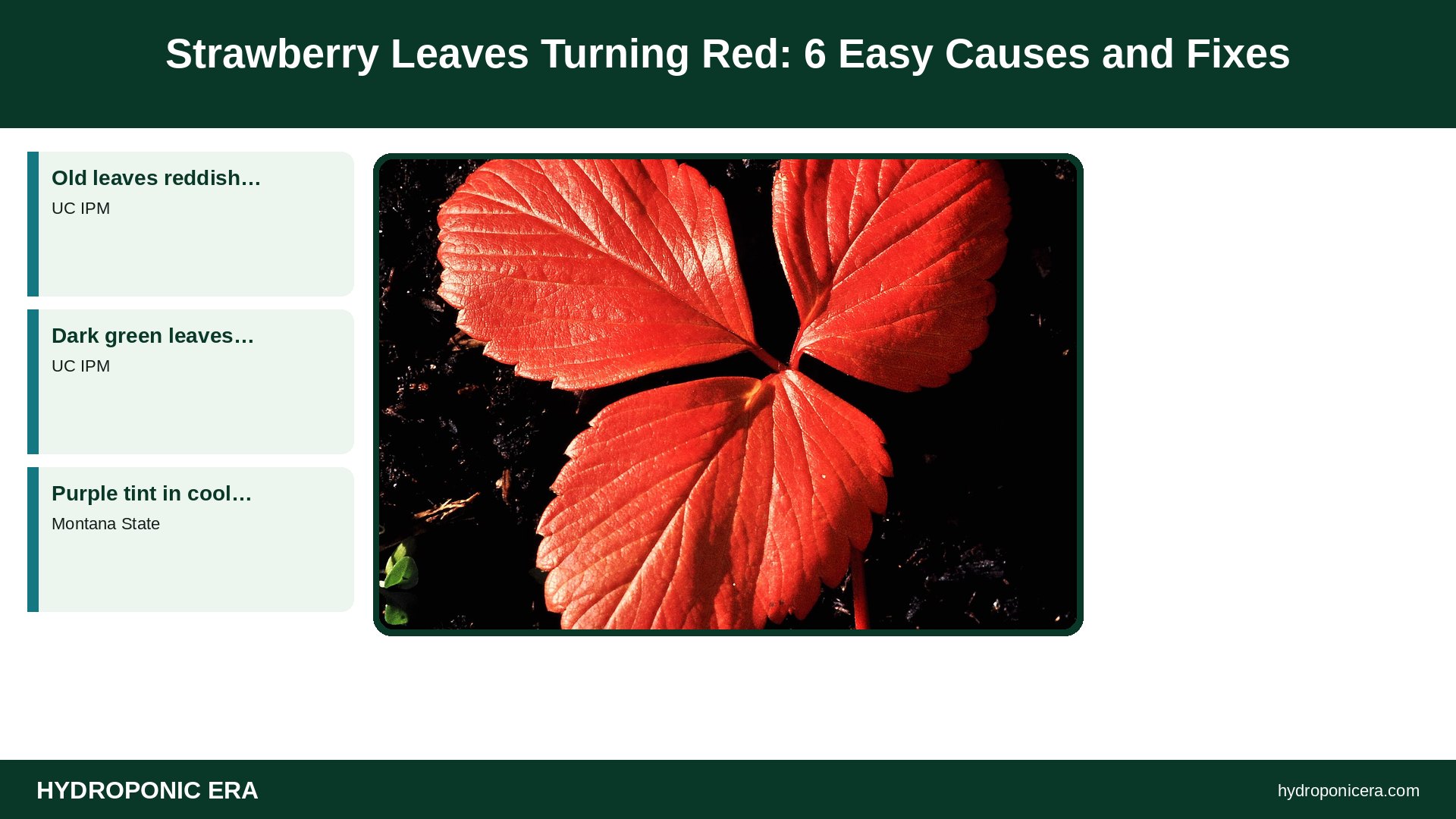
Is It Normal for Strawberry Leaves Turning Red in Fall?
Sometimes, but check for spots. Strawberry leaves turning red in autumn can be seasonal color on old foliage. UMass notes, however, that leaf scorch is most common in late summer and fall and on older leaves, so look closely. Clean, evenly colored old leaves with healthy green new growth are less worrying than spreading spots.
Can Cold Cause Strawberry Leaves Turning Red?
Yes, indirectly. Montana State University Extension explains that phosphorus moves slowly in cold soils, so plants may not take it up even when enough is present. If cold is the cause, symptoms fade once roots warm, and adding fertilizer is a waste. Keep hydroponic solution warm to avoid strawberry leaves turning red from cold.
See our guide to heat and cold stress in indoor hydroponics for safe root-zone temperatures.
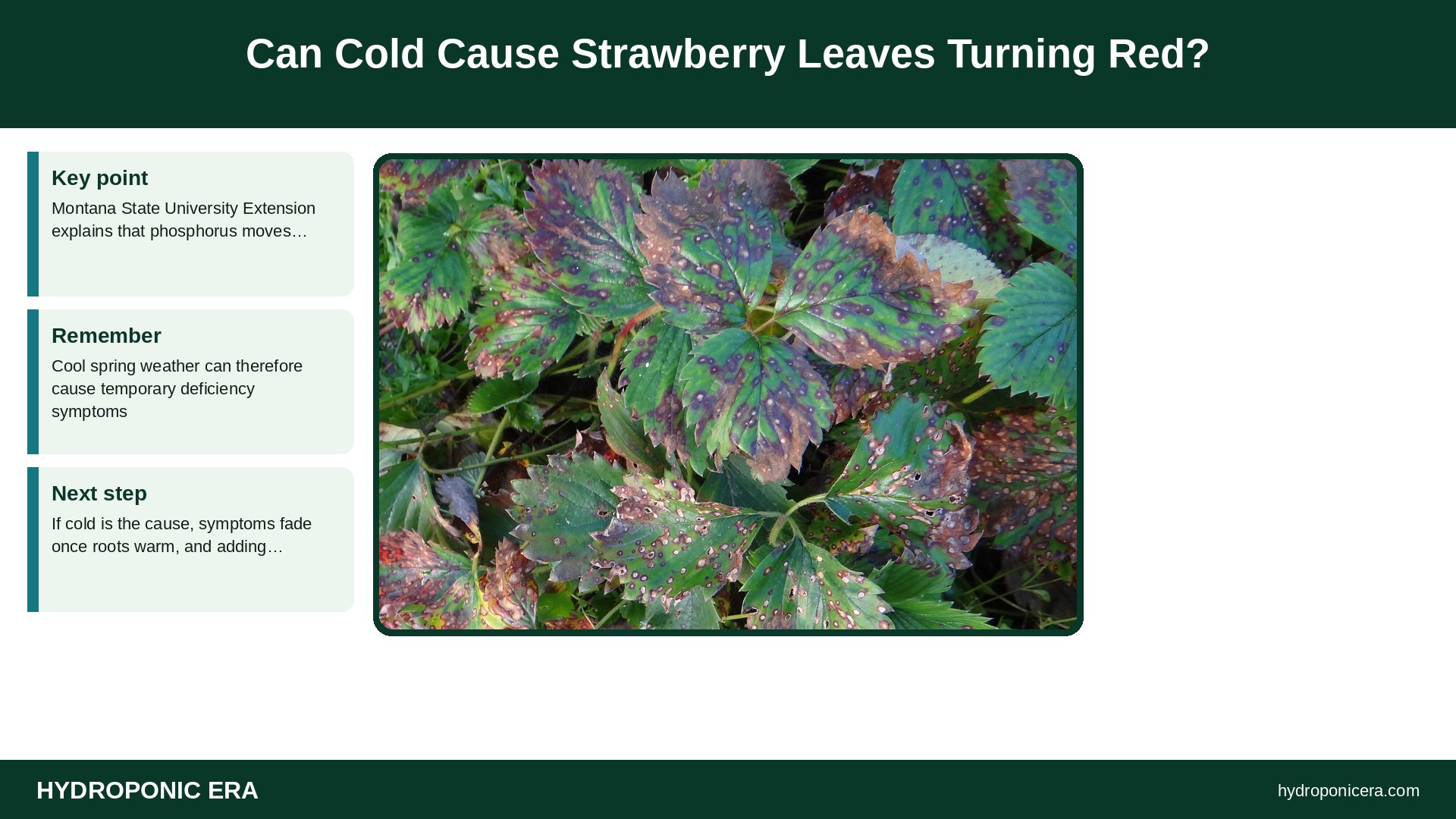
Does Phosphorus Deficiency Turn Strawberry Leaves Red?
Purple, mostly underneath. UC IPM says phosphorus-deficient strawberry plants have older leaves that turn dark green with a shiny, metallic upper surface, purplish lower surfaces and bluish veins. Montana State adds that phosphorus symptoms appear on lower, older leaves first. Confirm with a tissue test, because cold roots can mimic the same purple color.
Our guide to phosphorus deficiency in hydroponics explains how to correct it in a nutrient solution.
Does Nitrogen Deficiency Cause Red Strawberry Leaves?
Yes, reddish orange. UC IPM says nitrogen-deficient leaves turn uniformly yellow or reddish orange, older leaves first, and petioles may turn reddish. It also notes deficiencies are rare in strawberries when recommended practices are followed, and to use only the minimum fertilizer needed to avoid harmful salt buildup.
How Do You Recognize Strawberry Leaf Spot?
Small purple spots with pale centers. NC State Extension says common leaf spot (Mycosphaerella fragariae) begins as round purple spots 1/8 to 1/4 inch (3 to 6 mm) across on upper leaf surfaces. On older leaves centers turn tan, gray, then white with reddish purple margins. Leaves can die when lesions merge.
What Is Strawberry Leaf Scorch?
Spots that stay solid red-purple. UMass Extension says leaf scorch (Diplocarpon earlianum) makes reddish purple lesions 1 to 5 mm across that do not change color in the center. Large areas of leaves can turn red or yellow and then brown, with margins curling up. Wet weather and 59 to 77°F (15 to 25°C) favor it.
How Do You Stop Fungal Strawberry Leaves Turning Red?
Keep leaves dry and clean. UMass says these fungi need 12 to 18 hours or more of leaf wetness and spread by splashing water. It recommends drip irrigation, good spacing, debris removal and sparing spring nitrogen. NC State advises starting with disease-free transplants. UMass lists Allstar, Earliglow and Jewell as resistant to leaf spot and scorch.
How Do You Diagnose Strawberry Leaves Turning Red?
- Note leaf age: old leaves only, or new growth too.
- Check for spots; uniform color suggests nutrients or cold.
- Look under leaves for purple undersides and metallic tops.
- Check root-zone temperature and nutrient strength.
- Remove spotted leaves and send samples to a diagnostic lab if unsure.
For feeding targets, see hydroponic nutrients for strawberries.
Does Overwatering Cause Strawberry Leaves Turning Red?
It can contribute. Montana State Extension explains that waterlogged soil invites root rot, which further stresses plants and reduces nutrient uptake, making nitrogen and iron deficiencies worse. Stressed roots may then show the reddish orange of nitrogen shortage described by UC IPM. In hydroponics, keep solution aerated and check roots for brown, slimy tissue.
FAQ About Strawberry Leaves Turning Red
Should I cut off red strawberry leaves?
Removing old or spotted leaves improves airflow and removes fungal spores.
Will red leaves turn green again?
Cold-related color can fade as roots warm; dead tissue will not recover.
Are red strawberry leaves a sign of overwatering?
Waterlogging can stress roots and reduce nutrient uptake, says Montana State.
Does leaf spot affect the fruit?
UMass says fruit infection is uncommon but can appear as small black spots.
Do hydroponic strawberries get leaf spot?
Less often without splashing water, but infected transplants can carry it.
Is Honeoye resistant to leaf scorch?
UMass rates Honeoye as tolerant of leaf spot and scorch rather than fully resistant.
Can a strong nutrient solution harm strawberry leaves?
Strong solutions build salts; UC IPM advises using only the minimum fertilizer needed.
Sources
- UC Statewide IPM Program — Nitrogen and Phosphorus Deficiencies in Strawberries
- NC State Extension — Common Leafspot of Strawberry
- UMass Amherst Extension, Angela Madeiras — Strawberry IPM: Common Foliar Diseases
- Montana State University Extension, Clain Jones — Plant Nutrient Deficiency Symptoms
- Photo credits (Wikimedia Commons, edited with titles): Strawberry leaf in autumn by Schnobby (CC BY-SA 3.0); Ramularia grevilleana a2 by Jerzy Opioła (CC BY-SA 4.0); Fragaria vesca fruit – Keila by Ivar Leidus (CC BY-SA 4.0); Terrington St. Clement, Hydroponic strawberry growing – geograph.org.uk – 7897514 by Michael Garlick (CC BY-SA 2.0)