
What causes manganese toxicity in plants? Manganese toxicity usually follows low root-zone pH. Below about pH 5.5, manganese becomes very soluble, and sensitive crops absorb too much, showing blackish, purplish or reddish-brown spots on older leaves. Fix it by raising pH and avoiding excess micronutrients. NC State e-GRO, the University of New Hampshire and Premier Tech describe the pattern.
Key takeaway: Low pH makes manganese soluble; raise pH to about 6.0, cut excess micronutrients and confirm with tissue tests.
| Clue | Manganese toxicity | Manganese deficiency | Source |
|---|---|---|---|
| Leaves affected | Older, lower leaves | Young leaves | e-GRO, Premier Tech |
| Symptom | Black, purple or reddish-brown spots that merge | Interveinal yellowing, then tan spots | e-GRO, Premier Tech |
| pH trigger | Below about 5.5 to 6.0 | Above about 6.5 | Premier Tech, UNH |
| Fix | Raise pH, reduce micronutrients | Lower pH, feed micronutrients | Premier Tech, NC State |
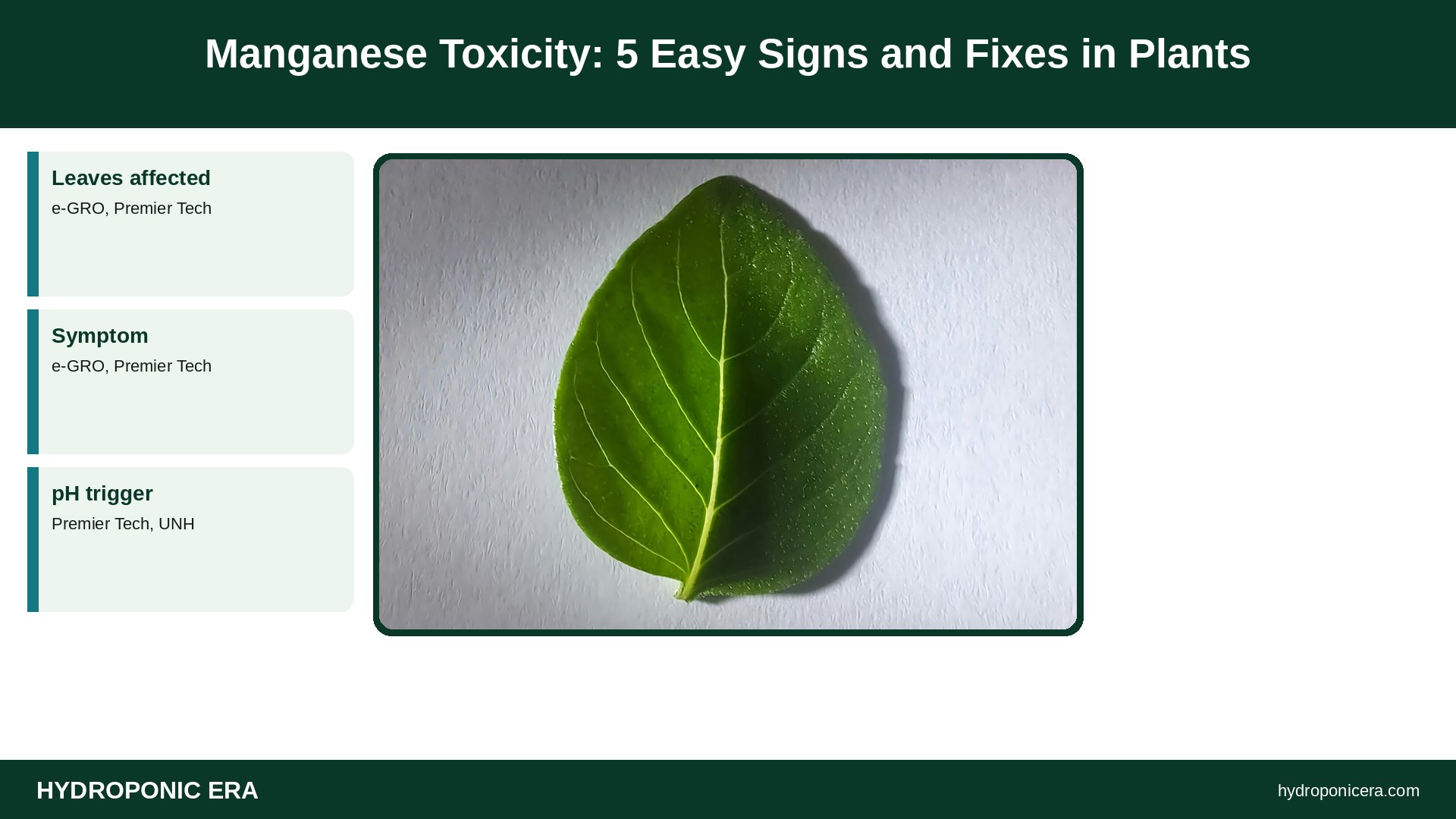
What Are the Symptoms of Manganese Toxicity?
Spots on older leaves. NC State’s e-GRO alert says toxicity often begins as blackish or purplish spotting on lower leaves, with spots growing more numerous until they merge into patches. Premier Tech describes burning of leaf tips and margins or reddish-brown spots on older leaves. UNH adds that growth and leaf expansion slow even when roots look healthy.
Why Does Low pH Cause Manganese Toxicity?
Solubility rises as pH falls. UNH researchers Fisher and Argo explain that iron and manganese become more soluble as media pH drops, and efficient species absorb the excess. e-GRO says that below pH 5.5 micronutrients including iron and manganese become readily available and can reach toxic levels. Below pH 5.0, low pH is very likely the cause.
Read our guide to pH drifting down in hydroponics to catch falling pH early.
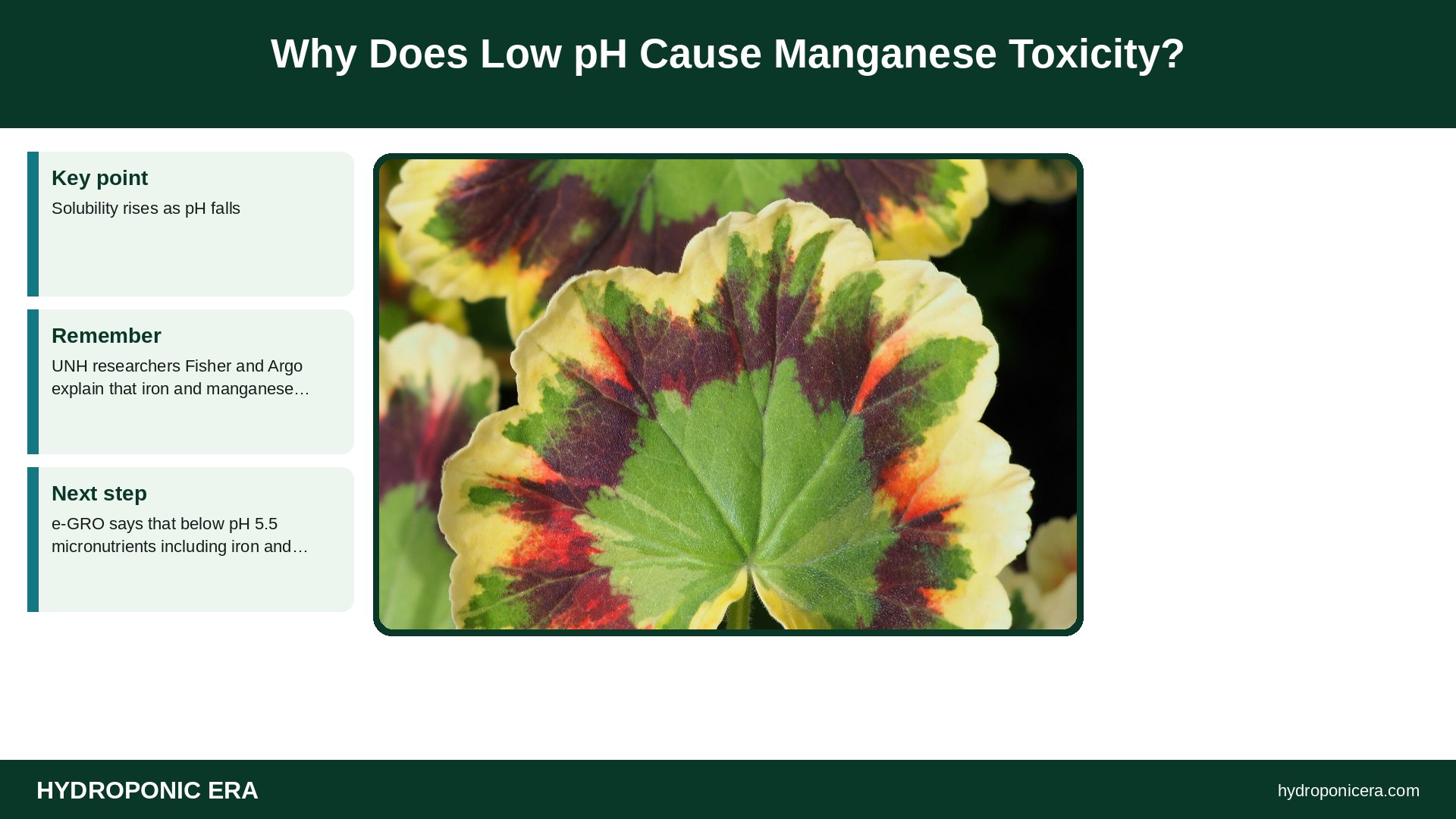
Which Plants Are Prone to Manganese Toxicity?
Efficient accumulators. e-GRO lists basil, cosmos, dahlia, pepper, strawflower and zinnia among crops that commonly show it. Premier Tech names zonal geraniums, marigolds, lisianthus and New Guinea impatiens as likely victims when pH is below 5.5. UNH notes geraniums can also drive media pH down over time, raising risk without any fertilizer change.
If basil leaves are spotting, compare with our guide to basil leaves turning black.
What pH Prevents Manganese Toxicity?
About 6.0 or higher for sensitive crops. UNH’s Iron-Out program aims for media pH of 6.0 to 6.6 and calls 6.0 the threshold where iron and manganese can reach toxic levels in accumulator species. e-GRO gives a general soilless range of 5.8 to 6.2. UNH warns symptoms can appear within 1 to 2 weeks after pH falls below 6.0.
How Do You Fix Manganese Toxicity?
Raise pH first. Premier Tech recommends a potentially basic fertilizer or liquid limestone to raise media pH and reduce manganese solubility. UNH tested flowable lime and potassium bicarbonate for fast correction and suggests switching to a nitrate-based fertilizer. In hydroponics, adjust solution pH upward with a pH-up product and replace a badly drifted reservoir.
- Test pH and EC of the solution or media.
- Raise pH into the crop’s target range.
- Stop extra micronutrient additives.
- Send leaf tissue for analysis to confirm.
- Watch new growth; damaged leaves will not heal.
Can Too Much Fertilizer Cause Manganese Toxicity?
Yes. Premier Tech notes toxicity can occur when fertilizer rates are excessive. NC State’s Paul Nelson writes that excessive micronutrient application probably causes more greenhouse micronutrient disorders than shortages, often because several micronutrient sources are combined. UNH adds that high fertilizer concentration together with low pH and sensitive cultivars creates the worst risk.
Does Manganese Toxicity Cause Iron Deficiency?
It can. Nelson explains that high root-zone manganese suppresses iron uptake and, to a lesser extent, zinc. Applying iron can suppress manganese uptake and raise iron, easing both problems. Premier Tech recommends keeping the manganese to iron ratio at about 1:2 to 1:4. That is why yellow new growth can appear alongside spotted old leaves.
See our guide to iron deficiency in hydroponics for chelate choices.
How Is Toxicity Different From Manganese Deficiency?
Opposite leaves and pH. Premier Tech says manganese deficiency shows interveinal yellowing on young leaves that develops tan areas, and it occurs when media pH exceeds 6.5. Toxicity hits older leaves at low pH. Lab testing of both normal and abnormal plants, plus the nutrient solution, is the only sure way to tell them apart.
FAQ About Manganese Toxicity
Do damaged leaves recover?
UNH says affected leaves do not fully heal; new healthy growth must cover them.
Is manganese toxicity common in hydroponics?
It becomes likely when solution pH runs low for long periods.
How fast can symptoms appear?
UNH reports as little as 1 to 2 weeks after pH drops below 6.0.
Do marigolds show different symptoms?
UNH says marigolds often show bronzing or speckled dead spots.
Where can I compare deficiency signs?
See our guide to manganese deficiency in hydroponics.
Sources
- NC State University e-GRO, Whipker and Cockson — Nutrient Disorder Primer, e-GRO Alert 9-8 (PDF)
- University of New Hampshire, Fisher and Argo — Iron-Out: Preventing Iron and Manganese Toxicity at Low Media pH (PDF)
- Premier Tech, Ed Bloodnick — Role of Manganese in Plant Culture
- NC State University, Paul V. Nelson — Managing Micronutrients in the Greenhouse (PDF)
- Photo credits (Wikimedia Commons, edited with titles): Ocimum Basilicum leaf lighted by the left by BernaBotto (CC BY-SA 4.0); Pelargonium ‘Contrast’ Pelargonia 2016-09-04 03 by Agnieszka Kwiecień, Nova (CC BY-SA 4.0); French marigold garden 2009 G1 by George Chernilevsky (Public domain); Staande geranium Pelargonium zonale wit. 20-06-2025. (actm.) 02 by Agnes Monkelbaan Staande geranium Pelargonium zonale wit. 20-06-2025. (actm.) 03 (CC BY-SA 4.0)