
Quick Answer
tomato catfacing is a physiological blossom-end deformity (enlarged scars, puckering, cavities)—often linked to cool temperatures during flower development, extremes, heavy pruning, excess nitrogen pressure, and susceptible large-fruited cultivars—not the same as cracking or blossom-end rot. Pair with tomatoes, BER, cracking, blossom drop, heat/cold stress, and NPK stages.
Key takeaways for tomato catfacing
- Tomato catfacing hydroponics is a practical home-hydro workflow—not filler.
- Catfacing ≠ BER calcium pits ≠ rain-check cracking.
- Cool nights during bloom raise risk on many large cultivars.
- Avoid excess vegetative nitrogen push and harsh pruning during sensitive set.
- Prefer university/extension sources over forum myths.
- Choose less-prone cultivars if deformities dominate early clusters.
- Original ops card keeps Tomato catfacing hydroponics decisions consistent.
- Tomato catfacing hydroponics fails when growers skip the boring checks.
Related HydroponicEra guides

Why This Matters
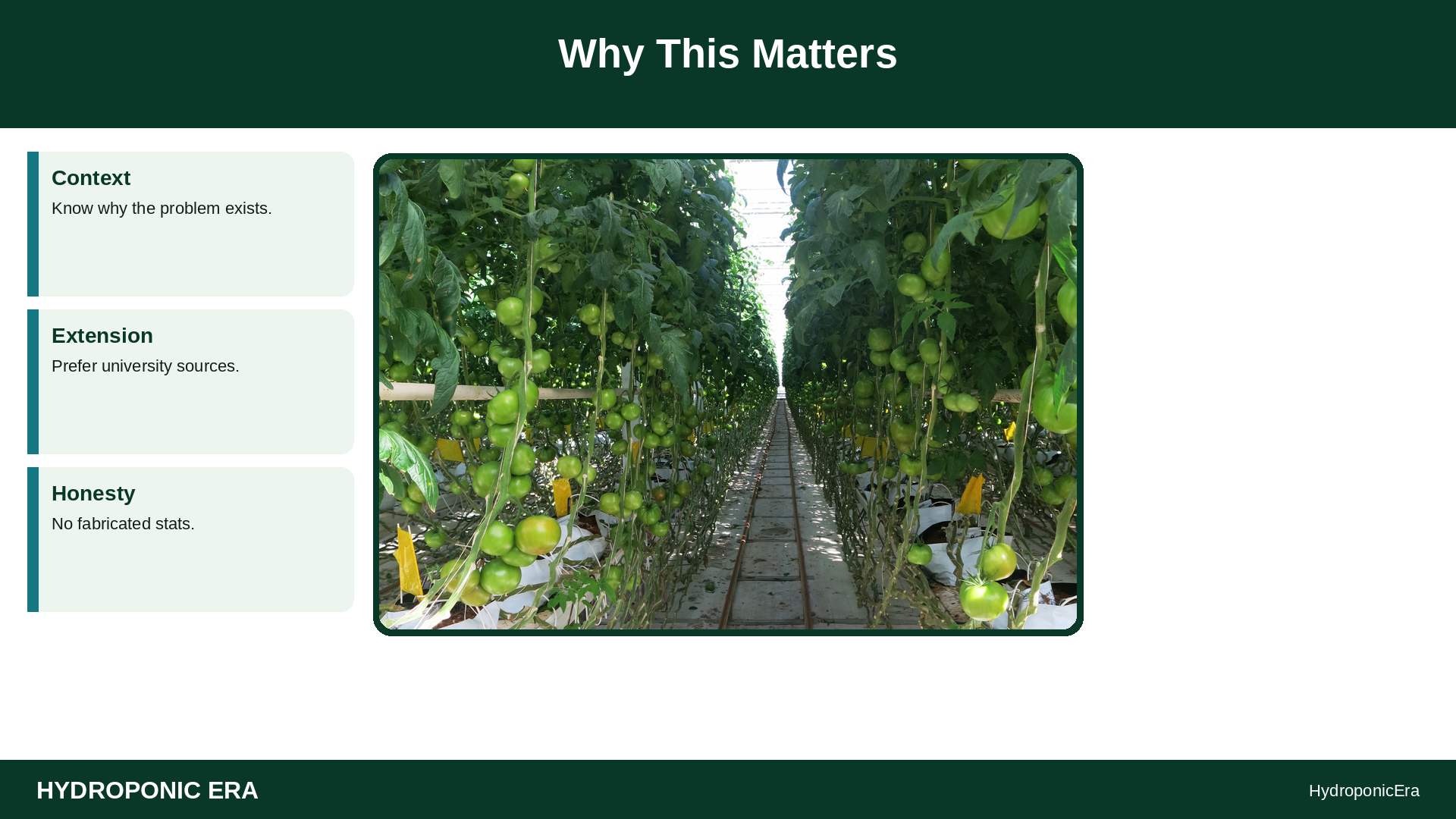
tomato catfacing prevention uses extension physiology, not folklore. UMass, Oklahoma State, and Maryland Extension describe catfacing as abnormal pistil/fruit development with enlarged blossom scars and misshapen fruit—associated with cold during flowering, temperature swings, and in some guidance excess nitrogen or heavy pruning. Large-fruited and many heirlooms are more prone.
Indoor hydro still sees cool nights near AC vents or unheated rooms. Do not treat catfaced fruit as a calcium BER clone.
Comparison / Decision Table
| Disorder | Look | Typical drivers |
|---|---|---|
| Catfacing | Puckered blossom scar, cavities, odd shape | Cool bloom temps, swings, N/prune, cultivar |
| BER | Dark leathery blossom-end patch | Ca movement / stress—see BER guide |
| Cracking | Radial/concentric splits | Water/uptake swings—see cracking guide |
| Zippering (related scars) | Thin brown zipper lines | Flower anatomy / environment; cultivar |
Step-by-Step Workflow
- Keep night temperatures appropriate for tomato flowering—avoid chronic cold drafts on blooms.
- Prefer stable day/night swings over wild AC cycling on flower clusters.
- Do not overpush nitrogen in early fruiting.
- Prune with purpose—avoid extreme defoliation during sensitive set.
- Prioritize cultivars less prone if catfacing wrecks first clusters.
- Remove severely catfaced fruit so the plant focuses on better set.
- Assist pollination indoors but do not confuse poor set with catface scars.
- Log min night temps during bloom weeks.
- Separate BER calcium triage from catface diagnosis.
- Sanitize and scout thrips—extension notes thrips flower damage can contribute in some cases.
Key Variables
| Variable | Effect | Link |
|---|---|---|
| Night temperature | Catface risk | temp stress, res temp |
| Cultivar | Large heirlooms often worse | tomato |
| Nitrogen vigor | Can worsen incidence | NPK, N |
| Pruning intensity | Stress on set | trellis/prune |
Common mistakes with tomato catfacing
- Calling every ugly fruit BER and dumping Cal-Mag blindly
- Planting huge beefsteaks in a cold basement bloom window
- Heavy prune + high N + cold nights stacked
- Leaving catfaced fruit forever to ripen evenly when they often will not
- Skipping cultivar choice after repeated first-cluster catface
Troubleshooting
| Signal | Action |
|---|---|
| First clusters deformed, later OK | Classic cool-early pattern—warm nights next round |
| Dark BER patch without deep catface scars | Use BER guide |
| Splits after big uptake swings | Cracking guide |
| Herbicide-like leaf twist + odd fruit | Check phenoxy exposure (OSU notes) |
Practical Framework

| Extra | Note |
|---|---|
| Taste | Catfaced fruit may still be edible if healthy—quality/market suffer |
Catface card: Night temps | Cultivar | N not excessive | Prune moderately | Differential vs BER/crack.
Closing practice for tomato catfacing hydroponics: warm, stable bloom nights beat another bottle of calcium for this scar pattern.
What to Check When Tomato Fruit Looks Catfaced
- Min night temps during bloom logged?
- Cultivar susceptibility known?
- N intensity reviewed?
- Pruning not extreme?
- BER vs catface distinguished?
- Worst fruit removed?
Differential With BER and Cracking
Catfacing is about blossom-scar deformity and odd shape from flower development issues. Blossom-end rot is a dark leathery patch tied to calcium movement and stress. Cracking is splitting from uptake/water swings. Mislabeling catface as BER sends you on a Cal-Mag loop that does not warm cold bloom nights.
UMass, Oklahoma State, and Maryland Extension emphasize cool temperatures during flowering, cultivar susceptibility, and—in some guidance—excess nitrogen or heavy pruning as contributors. Log minimum night temperatures during bloom weeks.
Cultivar Strategy
Large heirloom beefsteaks in a chilly basement are a catface invitation. If deformities dominate early clusters, switch cultivars or warm the bloom environment before the next cycle. Remove severely catfaced fruit so later set can proceed.

Practice & Field Notes
During bloom weeks, log the coldest night temperature near flowers—not the warmest afternoon brag. AC vents and cold concrete floors create catface weather indoors. Deflect airflow; raise night setpoints into a tomato-sensible range when you can.
On the fruit itself, describe what you see in writing: enlarged scar and puckering (catface class), dark leathery BER patch, or split cracking. That sentence chooses the correct HydroponicEra guide and stops random bottle stacking.
For cultivar trials, note which varieties catface in your room. Data beats forum folklore. Remove hopeless fruit; keep plants guided with trellis/pruning without extreme defoliation during sensitive set.
Scenario Walkthrough
First cluster on a large heirloom shows deep blossom scars and odd lobes. Nights near the AC vent run cold. Later clusters look cleaner after you deflect the vent. That matches extension catfacing stories better than a calcium deficiency narrative. Leave BER patches to the BER guide; leave splits to cracking.
Next cycle, pick a less-prone cultivar for the cold corner or warm nights during bloom. Remove the worst fruit early so the plant stops investing in deformities.
Key Limits & Honest Scope
Extension sources note catfacing causes are not fully settled in every detail, but cold bloom temperatures, swings, cultivar, and sometimes nitrogen/pruning show up repeatedly. This page will not pretend a single home remedy erases genetics.
Catfaced fruit may still be edible when healthy; marketability suffers. Remove severe fruit. Keep differentials crisp versus BER and cracking. Herbicide drift is uncommon indoors but appears in outdoor-adjacent stories—OSU notes phenoxy injury patterns.
Warm, stable bloom nights and sensible cultivars are the highest-leverage home controls.
Review Cadence
Revisit this guide after any major equipment or climate change. Log what you measured, what you changed, and what new growth did within a week. Share the checklist with anyone who helps water the system so diagnosis stays consistent. Internal links in the Related section keep you inside the HydroponicEra cluster instead of random search loops. Prefer extension sources in the Sources list when advice conflicts with forum lore.
If symptoms span multiple articles, solve hydraulics and climate before micronutrient folklore. Steady meters, clean probes, and dated notes are the authority tools available to home growers without a lab.
FAQs about tomato catfacing
Will Cal-Mag fix catfacing?
Not as a primary fix—wrong disorder class vs BER.
Are cherry tomatoes immune?
Less common on small fruit types, not impossible.
Greenhouse tomatoes too?
Yes—UMass notes greenhouse and field.
Remove fruit?
Yes when severely deformed—plant resources.
Cold AC vent on flowers?
Relocate plants or deflect airflow.
Sources?
UMass cat facing, OSU non-infectious tomato diseases, UMD catfacing.
Extended Home-Grower Walkthrough
Use this extended walkthrough as a second pass after the Quick Answer. Walk the system with a notebook: write the date, crop, EC, pH, reservoir temperature, and one observation about roots or leaves. Change only one control at a time when a problem appears. If last week’s fix did not show in new growth, revert and try the next smallest lever. Keep university and extension principles in mind—oxygen, sanitation, and measured nutrition beat product stacking.
Photograph the canopy and the reservoir surface weekly. Dated photos settle arguments about algae, tip burn, or stretch faster than memory. When a helper waters for you, leave a one-page card with do-not-touch items and the exact top-off rule. Store calibration sachets next to the meters so “I will calibrate later” stops being the default. Review timers after any power event. Confirm air stones still roar. Confirm drains still drain.
At the end of the week, score the cycle 1–5 for ease and plant quality. Low scores should trigger a sanitation or climate review before you buy new hardware. Link neighboring HydroponicEra guides when the symptom matches a cluster page. Prefer labeled procedures over improvisation under stress. Healthy boring routines are the real upgrade path for home hydroponics.
Keep tomato catfacing on your ops card so helpers follow one standard.
Keep tomato catfacing on your ops card so helpers follow one standard.
Keep tomato catfacing on your ops card so helpers follow one standard.
Keep tomato catfacing on your ops card so helpers follow one standard.
Keep tomato catfacing on your ops card so helpers follow one standard.
Keep tomato catfacing on your ops card so helpers follow one standard.
Keep tomato catfacing on your ops card so helpers follow one standard.
Keep tomato catfacing on your ops card so helpers follow one standard.
Keep tomato catfacing on your ops card so helpers follow one standard.
Keep tomato catfacing on your ops card so helpers follow one standard.
Sources
- UMass Extension — Tomato, Cat Facing
- Oklahoma State University Extension — Common Diseases of Tomatoes Part III — Non-Infectious Diseases (catface)
- University of Maryland Extension — Catfacing on Tomatoes
- University of Florida IFAS — CV266: Production of Greenhouse Tomatoes
- University of Minnesota Extension — Growing tomatoes
- Penn State Extension — Heat Stress and Tomatoes