
Can you grow bee balm hydroponically? Yes. Bee balm hydroponics works best from rooted stem cuttings in a Dutch bucket, ebb-and-flow or deep water system with very bright light. Bee balm (Monarda didyma) is a mint-family perennial, so it roots easily, but no published trial gives a hydroponic recipe, so treat it like a vigorous mint-family herb and watch for powdery mildew.
Key takeaway: There is no research-tested nutrient recipe for bee balm hydroponics, so the safest plan combines what extension services say about the plant with standard hydroponic herb practice. Give it at least 6 hours of strong light, keep pH around 5.5 to 6.5, feed moderately rather than heavily, and keep air moving, because Iowa State warns that heavy feeding and shade both make powdery mildew worse.
| Fact | What sources report | Source |
|---|---|---|
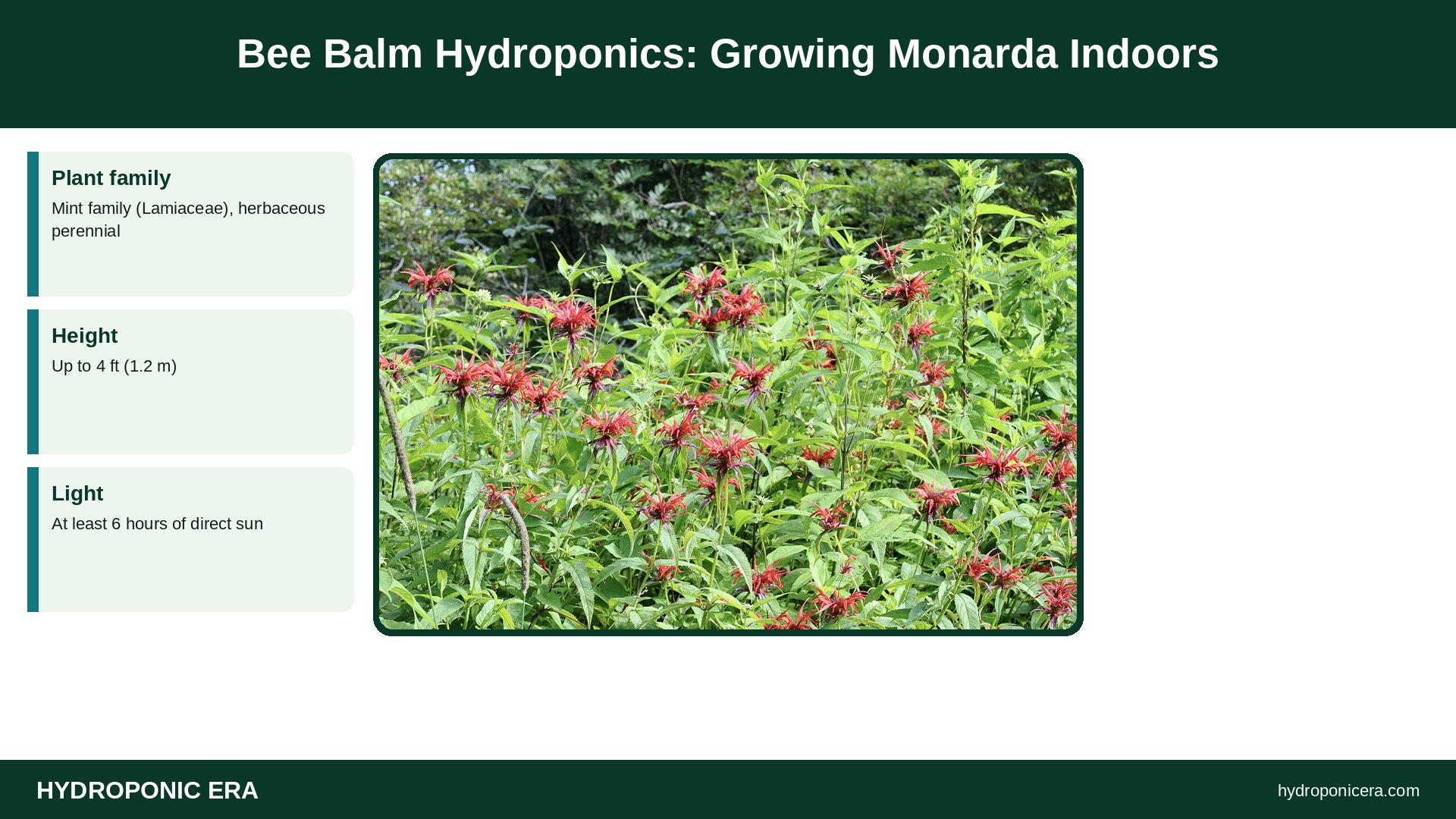
| Plant family | Mint family (Lamiaceae), herbaceous perennial | NC State Extension |
| Height | Up to 4 ft (1.2 m) | NC State Extension |
| Light | At least 6 hours of direct sun | Iowa State Extension |
| Soil pH in the garden | Acid to neutral, up to 8.0 | NC State Extension |
| Hardiness | USDA zones 4 to 9 | NC State Extension |
| Main disease | Powdery mildew, also rust | NC State Extension |
Does Bee Balm Hydroponics Really Work?
Yes, bee balm hydroponics works. Bee balm is a fast-spreading, mint-family perennial that NC State Extension says spreads by underground stolons and grows up to 4 feet (1.2 m) tall. Plants that root this readily usually adapt well to soilless culture. The challenge is size, light and mildew, not getting roots to grow.
Bee balm is grown mainly for its showy, edible flowers and minty leaves used for tea. NC State lists the flowers as edible, and the plant has long been called Oswego tea. Indoors it will stay smaller than in a garden bed, especially compact types.
If you already grow mint hydroponically or lemon balm hydroponically, bee balm will feel familiar.
Which Varieties Are Best for Bee Balm Hydroponics?
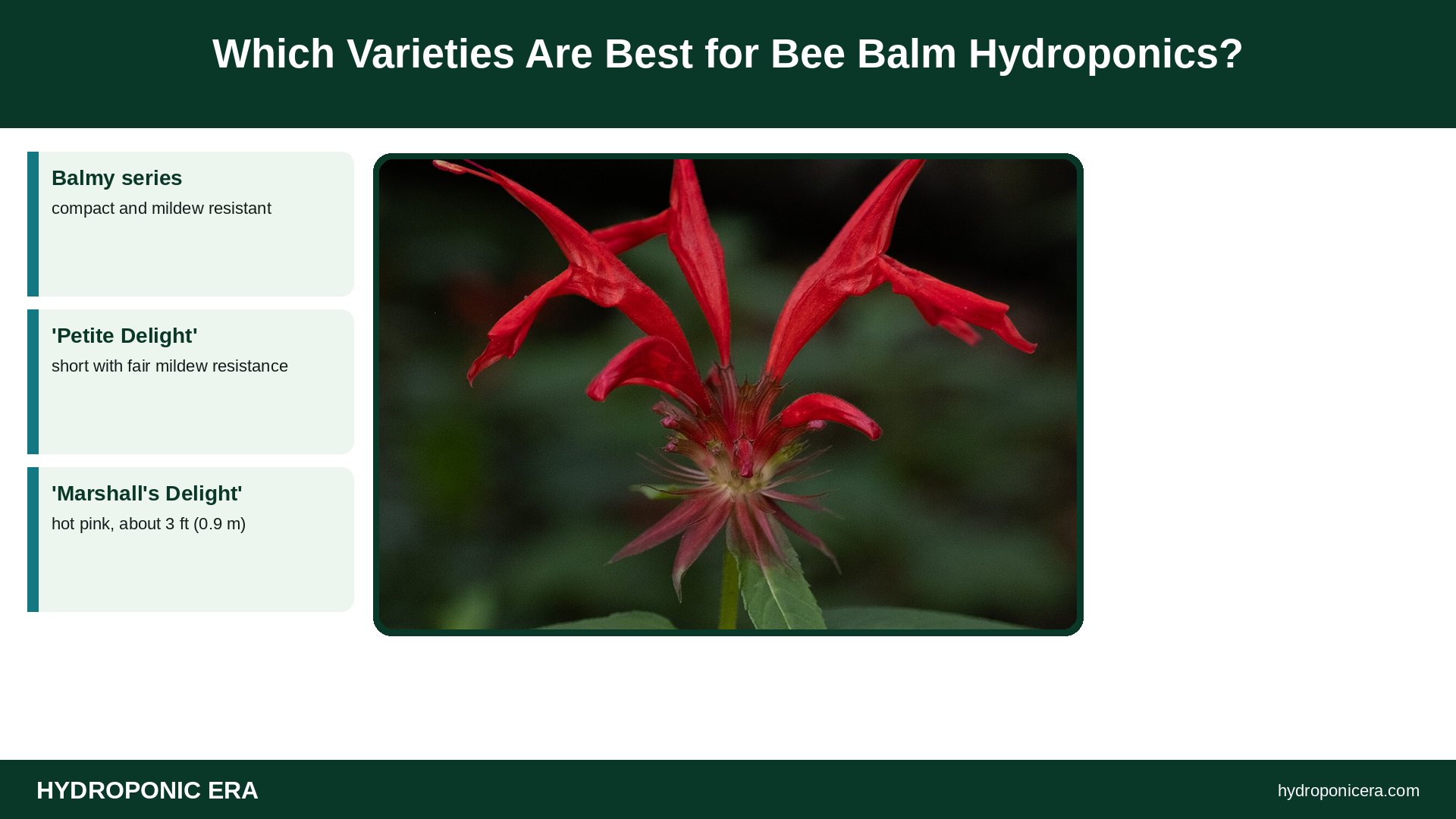
For bee balm hydroponics, pick compact, mildew-resistant types. NC State lists the Balmy series as compact, powdery mildew resistant plants in several flower colors, and ‘Petite Delight’ as having fair resistance to mildew. ‘Marshall’s Delight’ reaches about 3 feet (0.9 m). Shorter plants fit under grow lights and resist flopping in net pots.
- Balmy series: compact and mildew resistant.
- ‘Petite Delight’: short with fair mildew resistance.
- ‘Marshall’s Delight’: hot pink, about 3 ft (0.9 m).
- ‘Jacob Cline’: large red flowers, but tall for indoor setups.
How Do You Start Plants for Bee Balm Hydroponics?
Start bee balm hydroponics from stem cuttings for the fastest results. Iowa State Extension says to take a 2 to 4 inch (5 to 10 cm) stem tip, strip the lower leaves, dip in rooting hormone if you have it, and root it in moist perlite under a clear tent in indirect light. Most herbaceous cuttings root in 4 to 6 weeks.
- Take soft, non-flowering tips in spring or early summer.
- Root in perlite, rockwool or a cloning collar.
- Keep humidity high and light indirect while roots form.
- Tug gently; move cuttings when roots are at least 1 inch (2.5 cm) long.
You can also divide an existing plant. Iowa State recommends dividing garden bee balm in early spring, with each section carrying at least two or three shoots. Wash the soil off the roots before moving a division into clay pebbles. Our rockwool for hydroponics guide covers starting cubes.
What pH, EC and Temperature Does Bee Balm Hydroponics Need?
Use a typical hydroponic pH of 5.5 to 6.5, the range Rakocy’s aquaponics work gives for hydroponic plants, and a moderate herb-strength feed. NC State lists bee balm as tolerating acid to neutral soil up to pH 8.0, so it is not fussy. Keep the nutrient solution cool, roughly 65 to 72°F (18 to 22°C), a common target for healthy hydroponic roots.
Do not push nutrients hard. Iowa State warns that frequent or heavy fertilizer causes rampant, soft growth and can increase powdery mildew. Start at a light herb strength and raise it only if older leaves pale. See our hydroponic nutrients for herbs guide for starting ranges and our hydroponic PPM chart for conversions.
How Much Light Does Bee Balm Hydroponics Need?
Bee balm hydroponics needs the brightest spot you have. Iowa State says garden plants need at least 6 hours of direct sun, and that partial shade means fewer flowers and more powdery mildew. Indoors, that means a strong LED close to the canopy for 14 to 16 hours a day, not a weak windowsill.
Our guide to how much light herbs need explains how to turn sun hours into grow light targets.
How Do You Prevent Powdery Mildew in Bee Balm Hydroponics?
Prevent it with airflow, spacing, light and moderate feeding. NC State says bee balm is susceptible to powdery mildew and rust and advises avoiding overhead watering. Iowa State adds that shade and heavy fertilizer make mildew worse. Indoors, run a small fan, thin crowded stems, and never mist the leaves.
- Spacing: keep leaves from touching neighbors.
- Fan: gentle air movement over the canopy all day.
- Humidity: avoid damp, still air around the leaves.
- Remove infected leaves: bag them and clean tools.
If white patches appear, compare them with our powdery mildew in hydroponics guide, and see our mint rust article for the orange pustules of rust.
How Long Until Plants in Bee Balm Hydroponics Bloom?
Expect leaves for tea within a few weeks of rooting, but flowers usually come in summer. NC State lists the bloom time as summer into fall. As a hardy perennial for USDA zones 4 to 9, bee balm is timed by the seasons, so long summer days and strong light give the best chance of indoor flowering.
Iowa State recommends deadheading spent flower heads to extend bloom. Harvest leaves just before flowering for the strongest flavor, cutting no more than a third of the plant at a time.
Does Bee Balm Hydroponics Need a Winter Rest?
Probably. For long-term bee balm hydroponics, a rest helps. Bee balm is a cold-hardy perennial, and garden clumps die back each winter. No hydroponic study has tested how well it grows without that rest, so many growers treat indoor plants as short-term, replace them with fresh cuttings, or move a plant outdoors for winter.
Iowa State notes that clump centers often die out after a few years, which is another reason to keep starting new cuttings rather than nursing one old plant.
FAQ About Bee Balm Hydroponics
Can bee balm grow in water?
Yes; cuttings root readily, then move to a hydroponic system.
Is bee balm edible?
NC State lists the flowers as edible, and leaves are used for tea.
Is bee balm a mint?
Yes; it belongs to the mint family, Lamiaceae.
How tall does bee balm get?
Up to 4 feet (1.2 m), so choose compact types indoors.
Why is my bee balm white on the leaves?
Usually powdery mildew; improve airflow and light.
Does bee balm attract pollinators?
Yes; NC State says it draws bees, butterflies and hummingbirds outdoors.
Sources
- North Carolina Extension Gardener Plant Toolbox — Monarda didyma (Bee Balm)
- Iowa State University Extension — Growing Bee Balm in the Home Garden
- Iowa State University Extension — Propagating Herbaceous Plants from Stem Cuttings
- Frontiers in Plant Science (2023) — Withania somnifera production using aquaponics (cites Rakocy on hydroponic pH 5.5–6.5)
- Photo credits (Wikimedia Commons, edited with titles): Monarda didyma (2021) by sonnia hill (CC BY 2.0); Monarda didyma inflorescence 539279097 by Alex Abair (CC BY 4.0)