
Quick Answer
Tip burn in hydroponics is necrotic browning on the margins or tips of young leaves—especially lettuce and other fast leafy greens—driven largely by calcium transport limits during rapid growth, not simply “an empty calcium bottle.” High EC, low airflow, high humidity that slows transpiration, excessive light/heat stacking, and unstable irrigation all make tip burn worse. Prevention focuses on environment and moderate nutrition before stacking calcium products.
Read this together with the calcium/magnesium guide, lettuce guide, EC/TDS guide, and nutrient burn guide.
Key Takeaways
- University of Kentucky hydroponic lettuce materials discuss tip burn as a production quality issue tied to growth rate and environment.
- UF/IFAS leafy greens hydroponics guidance (HS1279, HS1422) frames protected leafy production as a balance of climate, cultivar, and nutrition.
- Calcium moves with the transpiration stream; low transpiration to enclosed heads or still air can starve young leaf margins even when solution calcium looks adequate.
- Raising EC hard to “push growth” often increases tip burn risk.
- Airflow across the canopy is a first-line cultural control.
- Distinguish tip burn from general salt burn and from pest stippling.
- Measure pH—lockout can coexist with tip burn symptoms.
Related HydroponicEra guides
- Calcium and magnesium deficiency
- Grow lettuce hydroponically
- PPFD and DLI
- Nutrient lockout
- Nutrient burn
- Dissolved oxygen
What Tip Burn Looks Like
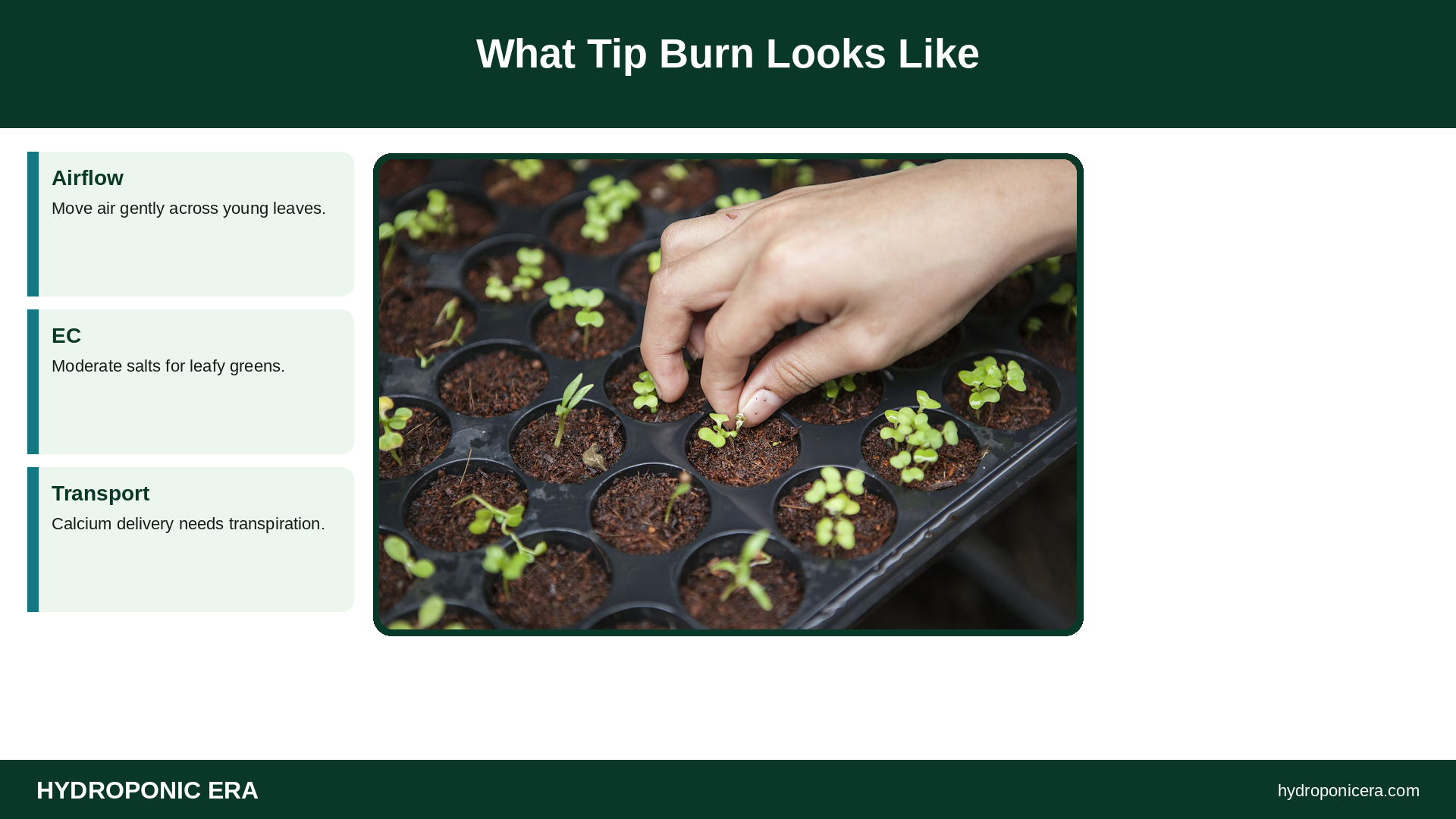
Classic tip burn shows brown, dried edges on the youngest leaves or inner leaves of heading lettuce. Older leaves may look fine. The plant often continues growing, leaving a trail of damaged margins that ruin salad quality. Tip burn is a quality defect as much as a survival threat.
Do not confuse tip burn with mobile-nutrient yellowing of older leaves, nor with powdery mildew’s white fungal coating. Also separate tip burn from broad necrotic burn after a severe EC spike—those patterns can overlap, so always read EC history.
Why “Just Add Calcium” Often Fails
Calcium deficiency in tissue can occur even when the reservoir contains calcium, because calcium delivery depends on water flow to that tissue. Young leaves inside a dense head, or leaves in stagnant humid air, transpire less. Extension and greenhouse practice commonly treat tip burn as a calcium distribution problem under rapid growth conditions.
NC State’s soils and plant nutrients handbook explains calcium’s role in plant structure. Penn State’s hydroponic nutrition overview ties essential nutrients to function and deficiency patterns. Neither implies that dumping extra calcium always repairs tip burn if airflow, EC, and growth rate remain extreme.
Prevention Checklist
- Moderate EC for leafy greens—avoid fruiting-crop strength on butterhead lettuce.
- Increase gentle airflow so leaves flutter slightly without thrashing.
- Avoid stacking maximum PPFD with high heat and high EC on the same day.
- Keep pH in a soilless band (~5.5–6.5 per Oklahoma State hydroponic framing) so calcium and other ions remain available.
- Maintain root oxygen—stressed roots undermine uptake (DO guide).
- Choose cultivars known for better tip-burn tolerance when you produce heading types in warm rooms.
- Harvest earlier as baby leaf when heading quality keeps failing.
- Keep a climate log of afternoon leaf-zone conditions, not only room thermostat readings.
Variables Table
| Variable | Effect on tip burn risk | Practical move |
|---|---|---|
| EC / salts | High EC raises risk | Dilute; reset if climbing |
| Airflow | Still air raises risk | Add canopy air movement |
| Humidity | Very high RH can cut transpiration | Ventilate; avoid stagnant tents |
| Light intensity | Sudden high PPFD speeds growth beyond supply | Ramp lights; watch new margins |
| Root health | Poor roots limit uptake | Aerate; cool; clean |
| pH | Out-of-range reduces availability | Adjust gradually; calibrate meters |
Step-by-Step Response When Tip Burn Appears
- Measure EC and pH now; note reservoir temperature.
- If EC is high for leafy greens, dilute or perform a reservoir change (water-change guide).
- Add gentle airflow across the canopy.
- Slightly reduce light intensity or raise fixtures for a few days if leaves feel hot.
- Confirm calcium is present via a complete nutrient program—not necessarily a separate dramatic bolus.
- Remove severely damaged leaves for quality; they will not undamage.
- Review cultivar choice for the next cycle.
Common Mistakes
- Pouring calcium supplements weekly while EC keeps climbing
- Sealed humidity tents with zero leaf movement under strong LEDs
- Copying tomato feed charts onto soft lettuce
- Ignoring root browning while treating only foliar symptoms
- Confusing tip burn with pest damage and spraying incorrectly
What Tip Burn Teaches About Measurement
Tip burn rewards growers who measure. A $ cheap uncalibrated meter that drifts high can trick you into thinking EC is “fine” while salts concentrate. Calibrate. Track top-off habits: repeatedly replacing transpired water with nutrient solution instead of fresh water concentrates salts. Oklahoma State’s EC/pH fact sheet and the HydroponicEra EC/TDS article explain why numbers matter more than bottle folklore.
Kentucky’s controlled-environment lettuce publication is a useful commercial-minded reference for how tip burn shows up when pushing productivity. Home growers can adopt the same logic at smaller scale: balance growth rate with transport capacity.
Tip Burn Versus Nutrient Burn Versus Lockout
Nutrient burn from excessive overall salts often scorches margins more broadly and pairs with a high EC reading and sometimes a crusty look on leaf edges. Tip burn can appear at moderate EC when growth is very fast and airflow is poor—especially on inner lettuce leaves. Lockout from high pH may yellow new leaves (iron-pattern chlorosis) without the same crisp necrotic tip pattern. Use meters and the HydroponicEra nutrient burn, lockout, and Ca/Mg articles to separate these paths.
Commercial leafy producers treat tip burn as a quality KPI. Home growers can borrow that seriousness: if every head shows burn, your environment is telling you the growth recipe is too aggressive for calcium delivery. Slow down growth slightly, move air, and stabilize EC before the next seed tray.
FAQs
Is tip burn the same as calcium deficiency?
Tissue calcium can be low locally even when solution calcium exists. Treat it as a transport and growth-rate problem first.
Will foliar calcium sprays fix tip burn overnight?
Do not expect miracles. Damaged margins stay damaged. Focus on preventing new injury through climate and EC.
Does tip burn mean my nutrients are incomplete?
Not necessarily. Many tip burn cases happen on complete hydroponic fertilizers under aggressive environment.
Which crops tip burn most?
Fast leafy greens—especially some lettuce types—are classic. Fruiting crops show related calcium disorders differently (see blossom end rot).
Should I lower humidity to zero?
No. Extremely dry air brings other stresses. Aim for moving air and sensible humidity, not desert conditions.
Practice log and next steps
Keep a simple logbook for this topic: date, meter readings when relevant, what you changed, and what the plants did over the next three to seven days. Hydroponics rewards slow feedback loops more than frantic daily recipe rewrites.
When in doubt, return to calibrated pH and EC, root inspection, and light adequacy before buying another bottle. Extension hydroponic and plant nutrition resources emphasize fundamentals for a reason.
Link outward to the matching HydroponicEra cluster pages so readers can continue into systems, water, crops, or troubleshooting without dead ends. Internal links are part of topical authority, not decoration.
Sanitation and opaque reservoirs prevent many secondary problems that look like nutrient mysteries. Clean systems make diagnosis clearer.
If you sell produce or teach workshops, document procedures. Consistency protects customers and your future self.
Sources
- University of Kentucky CCD — Hydroponic Lettuce Production in Controlled Environments (PDF)
- University of Florida IFAS — HS1279: Leafy Greens in Hydroponics and Protected Culture for Florida
- University of Florida IFAS — HS1422: Growing Lettuce in Small Hydroponic Systems
- Oklahoma State University Extension — Electrical Conductivity and pH Guide for Hydroponics
- Penn State Extension — Hydroponics Systems and Principles of Plant Nutrition
- NC State Extension — Soils and Plant Nutrients
- Virginia Cooperative Extension — SPES-720: Calculating and Using Daily Light Integral (DLI)
6 thoughts on “Tip Burn in Hydroponics: Causes and Prevention”