
You can grow cucamelon hydroponically with the same basic setup you’d use for cucumbers: a drip, Dutch bucket, or deep water culture system, a trellis, warm temperatures, and lots of light. Cucamelon (Melothria scabra), also called mouse melon or Mexican sour gherkin, is a fast vine native to Mexico and Central America that produces grape-sized fruits with a lemony cucumber flavor. Penn State Extension notes the vines can reach about 10 feet, so plan for vertical support.
Key takeaway: Cucamelons are a fun, productive vine for hydroponics if you give them warmth, a trellis, and enough light. Harvest fruits around 1 inch long.
| Factor | Target to grow cucamelon hydroponically |
|---|---|
| Germination | Within about 10 days in warmth (Penn State, UW–Madison) |
| Start indoors | 4–6 weeks before last frost if moving outdoors |
| Temperature | Warm; protect from cold; ideal root zone warmth similar to cucumbers |
| Vine length | Up to about 10 feet |
| Best systems | Dutch buckets, drip containers, DWC with trellis |
| Harvest | Firm fruits about 1 inch long |

Why Cucamelons Suit Hydroponics

Cucamelons are cucurbits, like cucumbers and melons, and they enjoy the steady water and nutrients that hydroponics provides. Ontario’s agriculture ministry even notes that hydroponic greenhouse production gives optimal yields for mouse melon. Compared with full-size cucumbers, the vines are finer and the fruits are tiny, so plants are easier to manage in small spaces.
One interesting difference: UW–Madison’s horticulture program points out that cucamelon female flowers appear before male flowers, the reverse of typical cucumbers.
Starting Cucamelon Seeds
- Sow in rockwool or coco plugs at about 1/4 inch deep.
- Keep warm, ideally in the upper 70s °F, with a heat mat if needed. See our heat mat guide.
- Expect sprouts within about 10 days.
- Give strong light right away to prevent leggy seedlings. Our leggy seedlings guide explains why.
- Transplant when roots poke out of the plug.
Best Systems to Grow Cucamelon Hydroponically
| System | Fit | Notes |
|---|---|---|
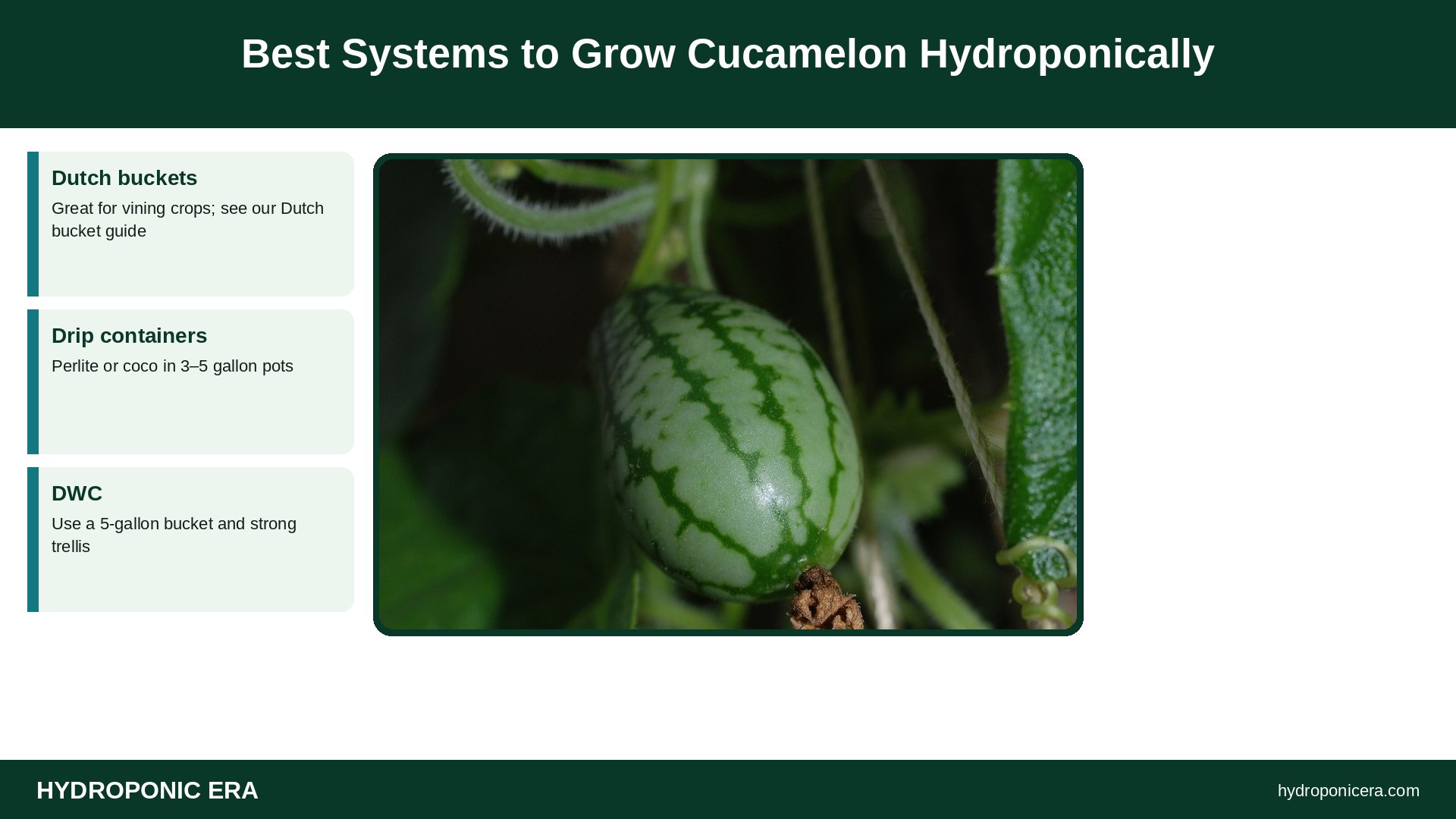
| Dutch buckets | Excellent | Great for vining crops; see our Dutch bucket guide |
| Drip containers | Excellent | Perlite or coco in 3–5 gallon pots |
| DWC | Good | Use a 5-gallon bucket and strong trellis |
| Kratky | Fair | Large vines drink a lot; frequent refills |
| NFT | Fair | Roots can clog channels over a long season |
Nutrients, pH, and Trellising
Feed cucamelons like cucumbers: a vegetative formula during vine growth, then a fruiting formula once flowering starts. Keep pH around 5.8–6.3. Our cucumber guide and leafy vs fruiting nutrient guide show typical approaches.
- Trellis early. Tender stems and tendrils are easily damaged by rough handling and cold.
- Use netting or string up to 6–10 feet.
- Thin crowded side shoots for airflow. See our trellising guide.
Pollination and Harvest

Indoors, there are no bees, so fruit set may need help. Gently transfer pollen from male to female flowers with a small brush. Our indoor pollination guide covers technique.
Pick fruits when firm and about 1 inch long. Older fruits get seedy and are better for pickling. Regular picking keeps vines producing.
| Symptom | Likely cause | Fix |
|---|---|---|
| Flowers but no fruit | No pollination | Hand-pollinate |
| Slow vine growth | Cold or low light | Warmer room, more light |
| Powdery white leaves | Powdery mildew | Airflow, remove affected leaves |
| Yellow lower leaves | Nitrogen shortage or aging | Check EC; remove old leaves |
| Soft, seedy fruit | Harvested too late | Pick at about 1 inch |
Common Mistakes
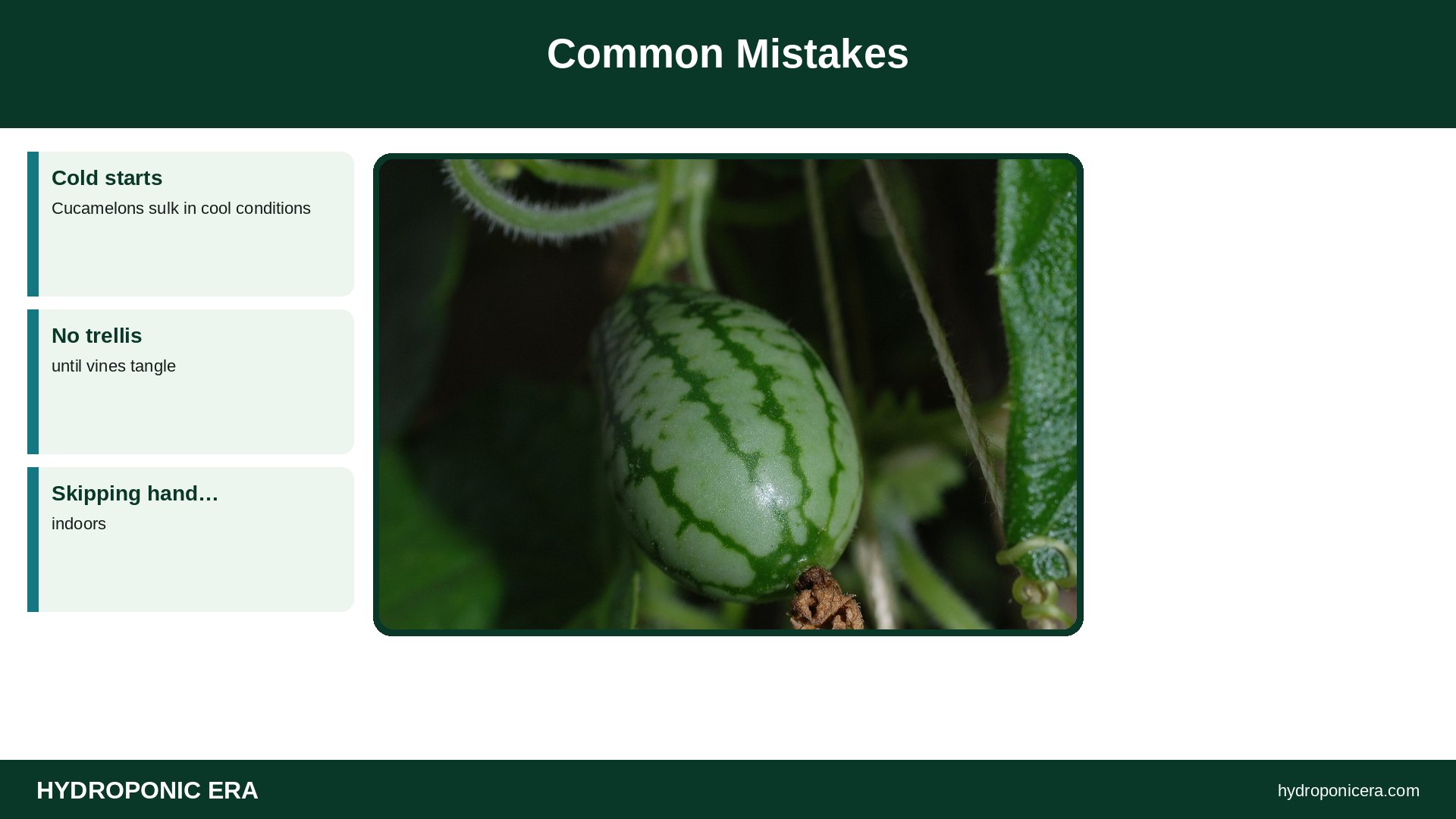
- Cold starts. Cucamelons sulk in cool conditions.
- No trellis until vines tangle.
- Skipping hand pollination indoors.
- Letting fruits get too big.
Powdery mildew is the most common cucurbit disease indoors. See our powdery mildew guide.
Spacing, Timeline, and Yield Expectations
When you grow cucamelon hydroponically, one plant per 3–5 gallon bucket or one plant every 12 inches along a drip line is a good starting point. UW–Madison suggests spacing garden plants 9–12 inches apart, and indoor systems follow similar logic.
| Stage | Approximate timing | What to do |
|---|---|---|
| Germination | Within about 10 days | Warm plugs, steady moisture |
| Seedling | 3–5 weeks | Strong light, gentle airflow |
| Vine growth | Several weeks | Train onto trellis, vegetative nutrients |
| Flowering and fruit | Mid-season onward | Hand pollinate, fruiting nutrients |
| Harvest window | Weeks to months | Pick every few days at 1 inch |
Yield varies widely with light, temperature, and pollination, so we don’t promise a number. What we can say is that well-pollinated, warm vines produce steadily once they get going.
Light and Temperature to Grow Cucamelon Hydroponically
To grow cucamelon hydroponically indoors, give it the same strong light you’d give cucumbers. Our PPFD and DLI guide explains targets for fruiting crops. Warmth matters too. Ontario’s agriculture ministry lists an optimum soil temperature of 25–30°C (77–86°F) at planting, and the vines are easily damaged by cold. Avoid drafty basements unless you add heat.
You can also grow cucamelon hydroponically outdoors on a patio or balcony; outdoor hydroponic setups work well in most US summers. Start seeds indoors 4–6 weeks before your last frost and move plants out once nights stay warm.
Common Mistakes When You Grow Cucamelon Hydroponically
- Starting too cold. Cucamelons sulk below comfortable room temperatures.
- Waiting to trellis until vines tangle.
- Skipping hand pollination indoors.
- Letting fruits get big and seedy.
- Ignoring powdery mildew on crowded vines.
If you already grow cucumbers, it’s easy to grow cucamelon hydroponically alongside them, since they share nutrients, pH range, and trellis needs. Keep vines from shading each other.
Bottom line: it’s easy to grow cucamelon hydroponically once you provide warmth, light, and a trellis, and the tiny fruits are a hit with kids.
As a final tip, start a second round of seeds about six weeks after the first if you want to grow cucamelon hydroponically through a long season, since older vines slow down as summer goes on.
FAQs: Grow Cucamelon Hydroponically
How long until cucamelons produce fruit?
Expect fruit a couple of months after transplant in warm conditions. Growth is slower to start than regular cucumbers.
Do cucamelons need pollination?
Indoors, hand pollination helps fruit set reliably.
Are cucamelons perennial?
They are tender perennials that form tubers, usually grown as annuals. Penn State notes the tubers can be dug and stored like dahlias.
What do cucamelons taste like?
Like a crisp cucumber with a lemony, slightly sour note.
Related HydroponicEra Guides
- How to grow cucumbers hydroponically
- How to grow melons hydroponically
- Indoor pollination
- Trellising and pruning
Sources
- Penn State Extension — Unusual Vegetables for the Home Garden
- UW–Madison Division of Extension — Mouse Melon or Mexican Sour Cucumber
- Ontario Ministry of Agriculture — Mousemelon (CropOp)
- Photo credits (Wikimedia Commons, edited with titles): Melothria scabra fruit by User:Tigerente (CC BY-SA 3.0)