
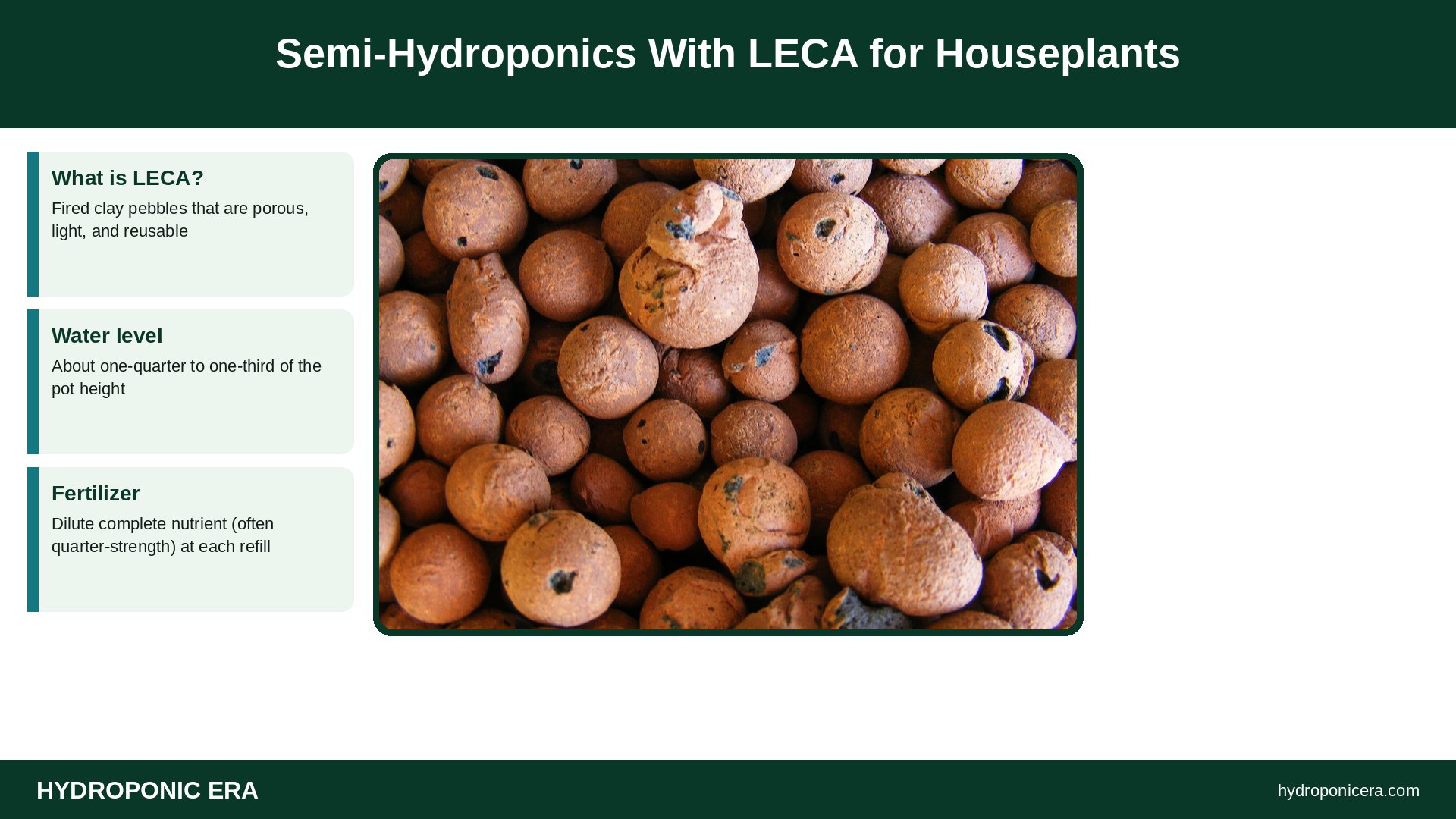
Semi-hydroponics with LECA (lightweight expanded clay aggregate, or clay pebbles) means growing houseplants in inert clay balls instead of soil, with a shallow reservoir of dilute nutrient solution at the bottom of the pot. The clay wicks water up to the roots while the gaps between pebbles keep plenty of air around them. LECA suits many popular houseplants, including pothos, philodendron, monstera, hoya, and peace lily. Success depends on fully rinsing soil off the roots, keeping the water level low, and feeding with a weak, complete fertilizer.
Key takeaway: In LECA, the roots should sit above the reservoir, not in it. Keep water in the bottom inch or two of the pot and let the clay do the wicking.
| Question | Short answer |
|---|---|
| What is LECA? | Fired clay pebbles that are porous, light, and reusable |
| Water level | About one-quarter to one-third of the pot height |
| Fertilizer | Dilute complete nutrient (often quarter-strength) at each refill |
| Flush | Rinse with plain water about monthly |
| Best plants | Aroids, hoya, peace lily, many tropicals |
| Main risk | Root rot from too-high water during transition |
Why Grow Houseplants in LECA?
- Clear watering cues. You can see the reservoir level in a clear inner pot.
- Fewer soil pests. No organic soil means fewer places for fungus gnat larvae, though they can still find algae or debris. See fungus gnats.
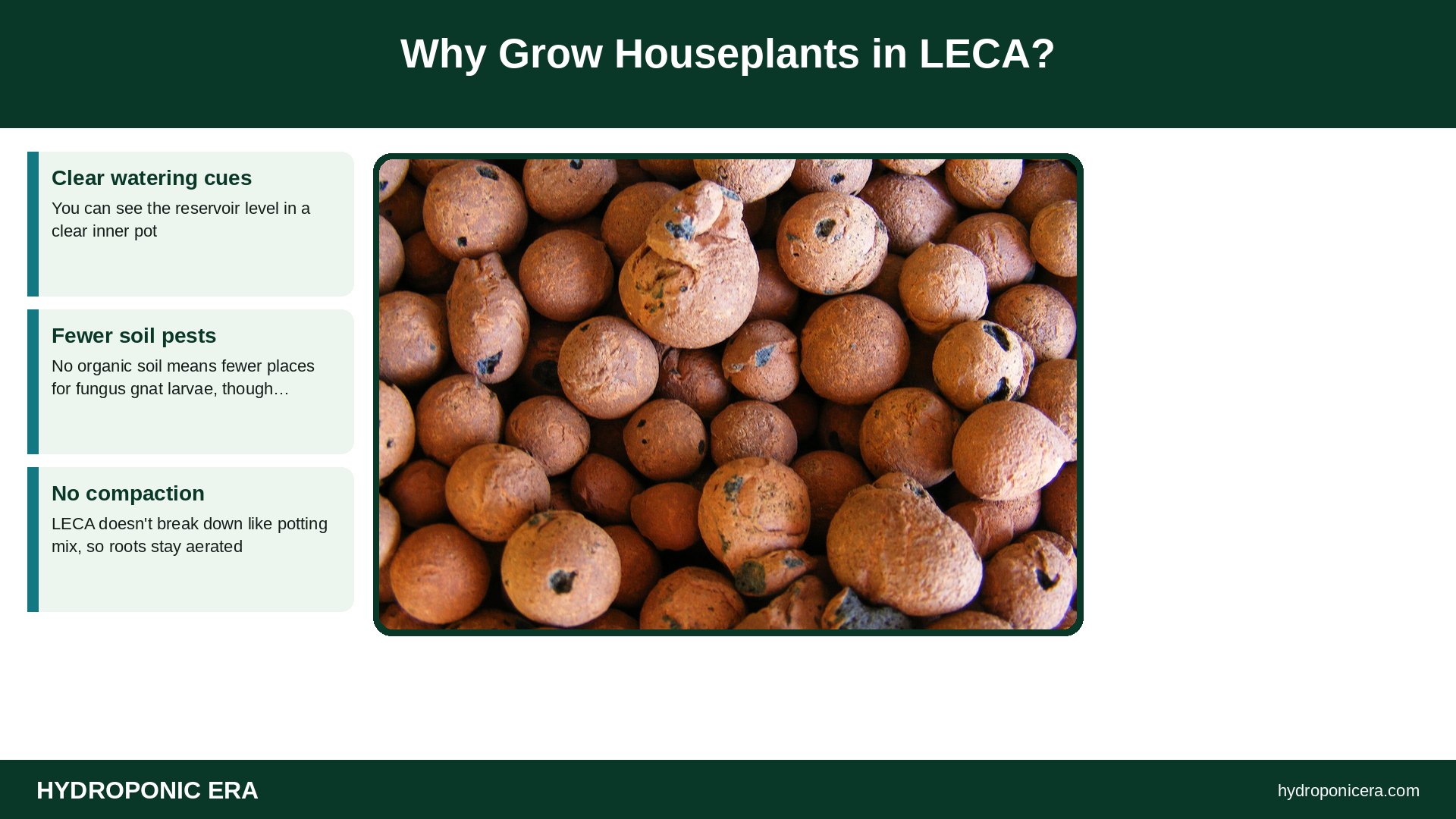
- No compaction. LECA doesn’t break down like potting mix, so roots stay aerated.
- Reusable. Rinse and sterilize between plants.
The trade-offs: you must feed every time you refill, the transition from soil can take weeks, and some plants never love it. Our overview of clay pebbles in hydroponics covers LECA’s properties in detail.
What You Need
- LECA, sized for houseplants (often 4–8 mm or 8–16 mm)
- An inner pot with holes (a net pot or slotted orchid pot) and a waterproof outer cachepot, or a pot with no drainage hole
- A complete liquid fertilizer formulated for hydroponics or semi-hydroponics
- Optional: pH test drops or a meter, and a water level indicator
Prepare the LECA
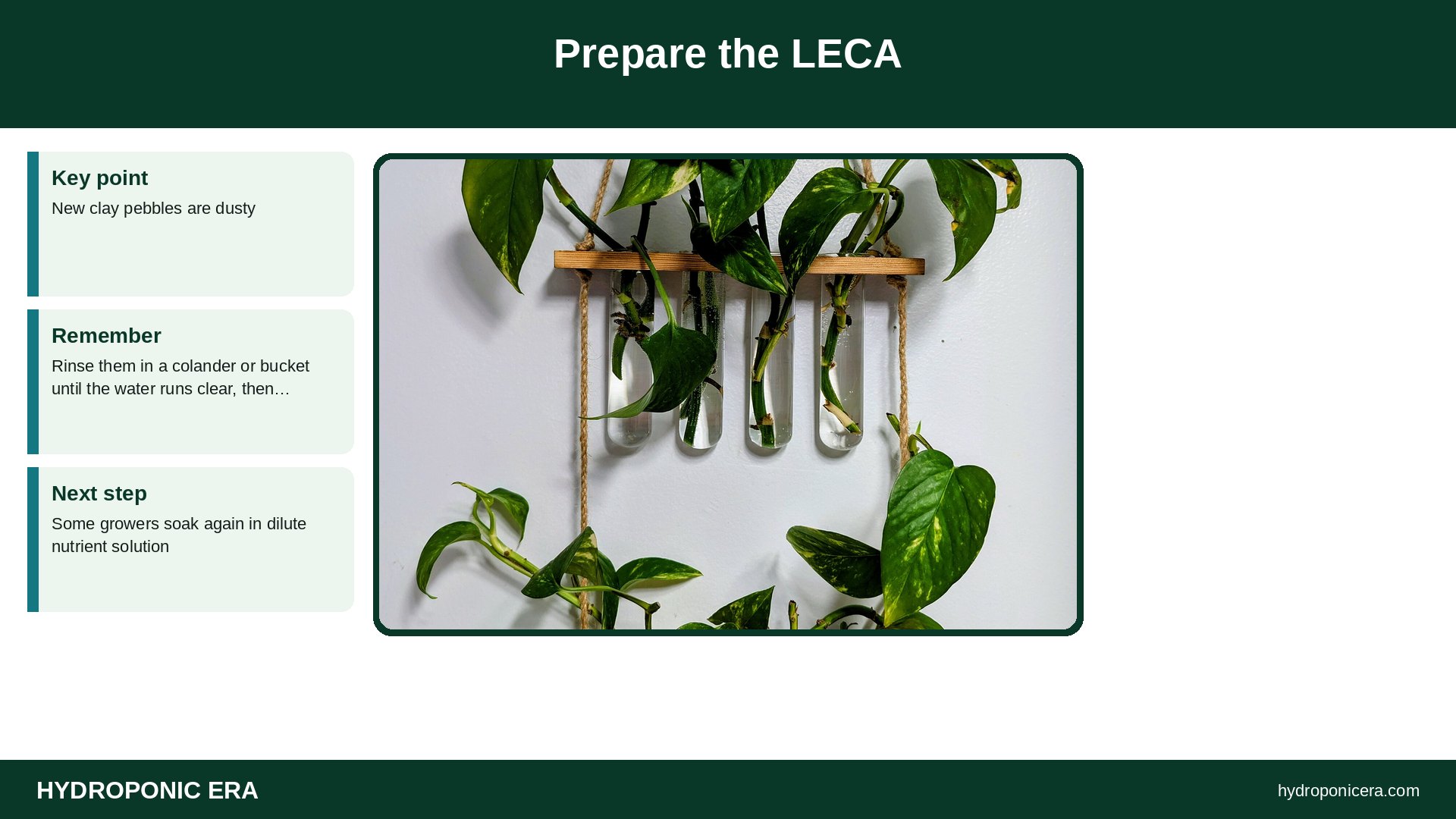
New clay pebbles are dusty. Rinse them in a colander or bucket until the water runs clear, then soak them for several hours or overnight so the pores fill with water. Some growers soak again in dilute nutrient solution. Rinsing also removes fine particles that could clog the pot bottom. Our guide on media pre-rinse and buffering explains why this matters.
How to Transition a Plant From Soil to LECA
- Choose a healthy plant. Stressed plants rarely improve during a big move.
- Remove soil completely. Soak the root ball, then gently rinse until no soil clings to the roots. Leftover soil rots in a wet, airless pocket.
- Trim damaged roots. Cut off mushy or dead roots with clean scissors.
- Pot up. Add a layer of soaked LECA, place the plant, and fill around it. Keep the crown at the same depth as before.
- Add water. Pour in plain or very weak solution so the reservoir sits low, roughly a quarter of the pot height.
- Wait and watch. Over 2–6 weeks, the plant grows new “water roots.” Some older soil roots will die back; that’s normal.
Rooting cuttings directly into LECA, or rooting them in water first, avoids the soil transition entirely. See hydroponic cuttings and pothos in water.
Watering and Reservoir Level
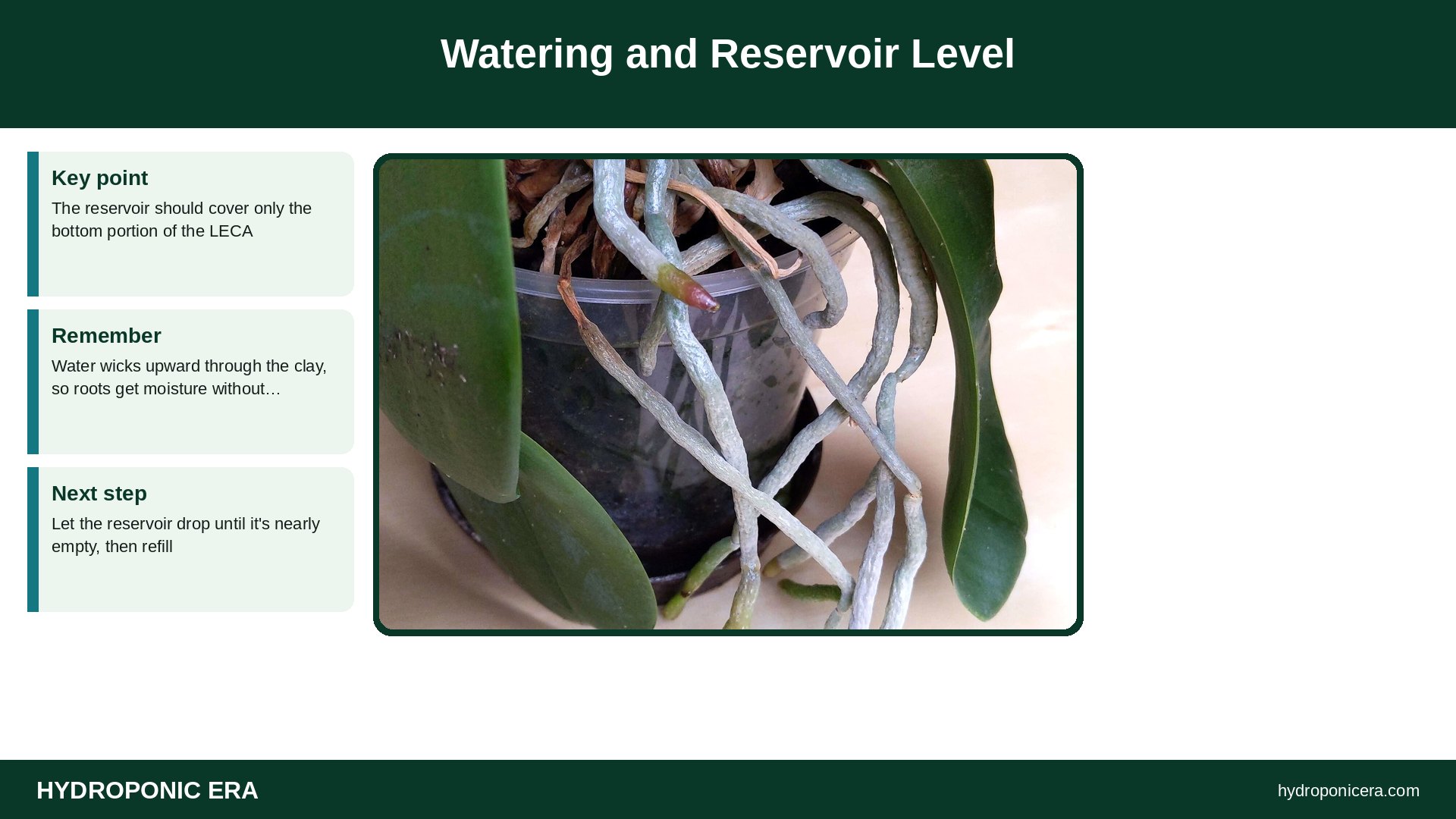
The reservoir should cover only the bottom portion of the LECA. Water wicks upward through the clay, so roots get moisture without sitting submerged. Let the reservoir drop until it’s nearly empty, then refill. Many growers let it stay dry for a day before topping up, which gives the lower roots more air.
If you see mushy brown roots or a sour smell, lower the water level and trim rot. See why roots turn brown.
Feeding LECA Plants
LECA contains no nutrients, so every refill should include a weak, complete fertilizer that supplies both macro and micronutrients, including calcium and magnesium. A common starting point is quarter strength of a hydroponic nutrient label rate. Avoid using only a soil fertilizer that lacks micronutrients. See using hydroponic nutrients and one-part vs multi-part nutrients.
A target pH of roughly 5.5–6.5 works for most houseplants. If you use hard tap water, pH may drift high; see hard water.
Flushing and Salt Buildup
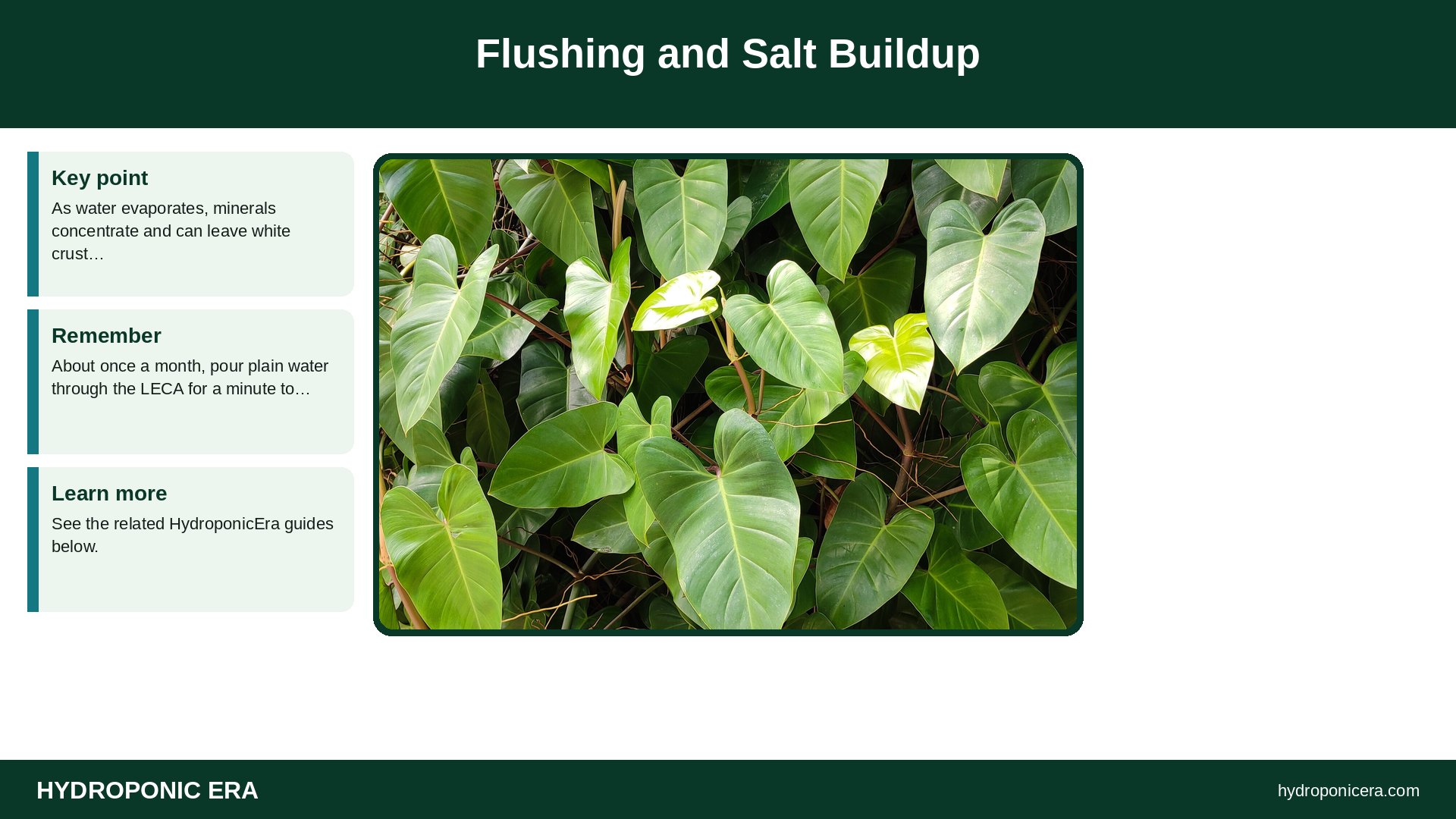
As water evaporates, minerals concentrate and can leave white crust on the top pebbles. About once a month, pour plain water through the LECA for a minute to rinse out excess salts, then refill with fresh solution. See salt crust on media.
Best and Tricky Plants for LECA
| Usually easy | Can be tricky |
|---|---|
| Pothos, philodendron, monstera | Succulents and cacti (prefer drier) |
| Hoya, peace lily, syngonium | Calatheas (sensitive to water quality) |
| Anthurium, spider plant | Ferns with very fine roots |
| Orchids (with care) | Plants with thick tubers or bulbs |
For orchids, see water culture orchids.
Common Mistakes
- Leaving soil on the roots.
- Filling the reservoir too high.
- Using plain water with no fertilizer for months.
- Skipping flushes, which leads to salt buildup.
- Expecting instant results during the transition period.
LECA vs Other Soil-Free Options
Pon-style mineral substrates hold more water and buffer nutrients but cost more. Sphagnum moss and coco hold more moisture but break down. Pure water culture works for some plants but needs regular changes. See growing media and plants that grow in water to compare.
A Simple Weekly Routine
- Check the reservoir level in each pot and refill with weak nutrient solution when it’s nearly empty.
- Look at new growth: firm, steady leaves mean the plant has adapted.
- Wipe algae from clear inner pots, or switch to opaque cachepots.
- Once a month, flush and inspect roots for any brown, mushy sections.
Keeping a short log of refill dates helps you learn each plant’s pace. See record keeping.
FAQs: LECA and Semi-Hydroponics
How high should the water be in LECA?
About one-quarter to one-third of the pot height. Roots should sit in moist pebbles above the water, not submerged.
Do I need to fertilize plants in LECA?
Yes. LECA has no nutrients, so add a weak, complete fertilizer with each refill.
How often should I flush LECA?
About once a month, or when you see white crust on the top pebbles.
Can I reuse LECA?
Yes. Remove old roots, scrub, rinse, and sterilize before reusing.
Why is my plant drooping after moving to LECA?
Transition stress is common. Keep light moderate, humidity higher, and the water level low while new roots grow.
Sources
- Penn State Extension — Propagating Houseplants
- University of Minnesota Extension — Cacti and succulents
- Photo credits (Wikimedia Commons, edited with titles): Hydroton by Lucis (CC BY-SA 3.0); Pothos plant on water by Joli Rumi (CC BY-SA 4.0); Aerial roots by Nefronus (CC BY-SA 4.0); Philodendron hederaceum, Singapore Botanic Gardens (141542) by Moheen Reeyad (CC BY-SA 4.0)