
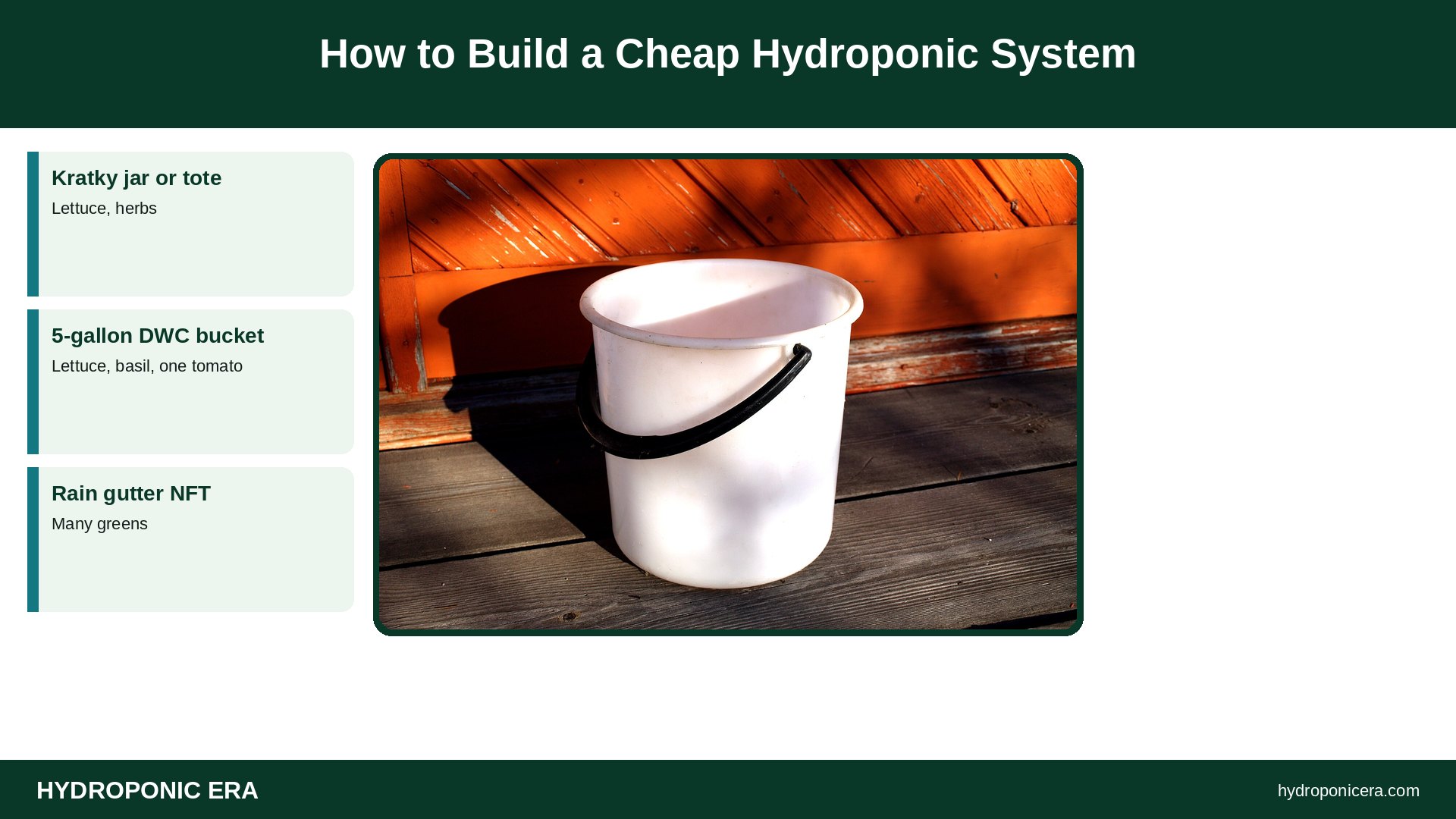
The cheap hydroponic system that works best for beginners is a Kratky setup: an opaque bucket or tote, a lid with holes for net cups, nutrient solution, and seedlings. It needs no pump or electricity and can cost under about $20 if you reuse containers. The next step up is a single 5-gallon bucket deep water culture (DWC) system with an aquarium air pump and air stone. Either can grow lettuce, herbs, and greens well. The parts you shouldn’t skimp on are a decent hydroponic nutrient, a pH test, and an opaque, food-safe container.
Key takeaway: Start with Kratky or a single DWC bucket, reuse food-safe containers, and spend your money on nutrients and pH testing.
| System | Parts | Rough cost | Best for |
|---|---|---|---|
| Kratky jar or tote | Container, lid, net cups, nutrients | Lowest | Lettuce, herbs |
| 5-gallon DWC bucket | Bucket, lid, air pump, stone, tubing | Low | Lettuce, basil, one tomato |
| Rain gutter NFT | Gutters, pump, reservoir | Moderate | Many greens |
| Wick system | Container, wick, media | Lowest | Small herbs |
Cheapest Option: A Kratky Cheap Hydroponic System
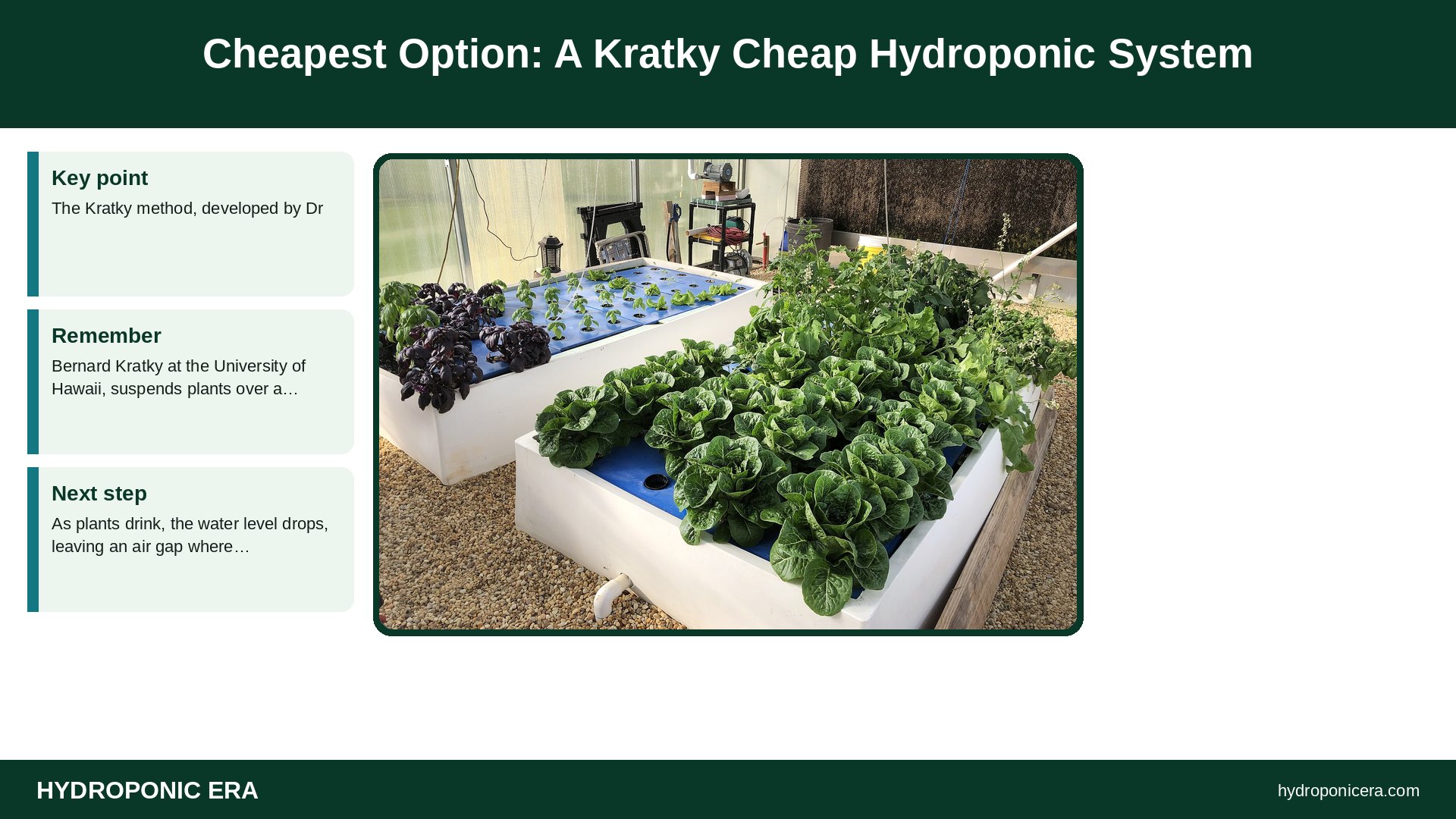
The Kratky method, developed by Dr. Bernard Kratky at the University of Hawaii, suspends plants over a container of nutrient solution. As plants drink, the water level drops, leaving an air gap where upper roots get oxygen. Nothing needs power. Build one:
- Get an opaque container: a food-grade bucket, a storage tote, or a painted jar.
- Cut holes in the lid to fit 2-inch net cups.
- Fill with nutrient solution so the bottom of each cup touches the water.
- Place a seedling in a starter plug in each cup.
- Don’t top up to the brim; let the level fall as roots grow.
See Kratky method.
Next Step: A DWC Cheap Hydroponic System
A 5-gallon bucket DWC system adds an aquarium air pump and air stone, so roots sit in oxygenated solution. It grows faster than Kratky and supports bigger plants. See 5-gallon bucket DWC.
Cheap Hydroponic System Shopping List
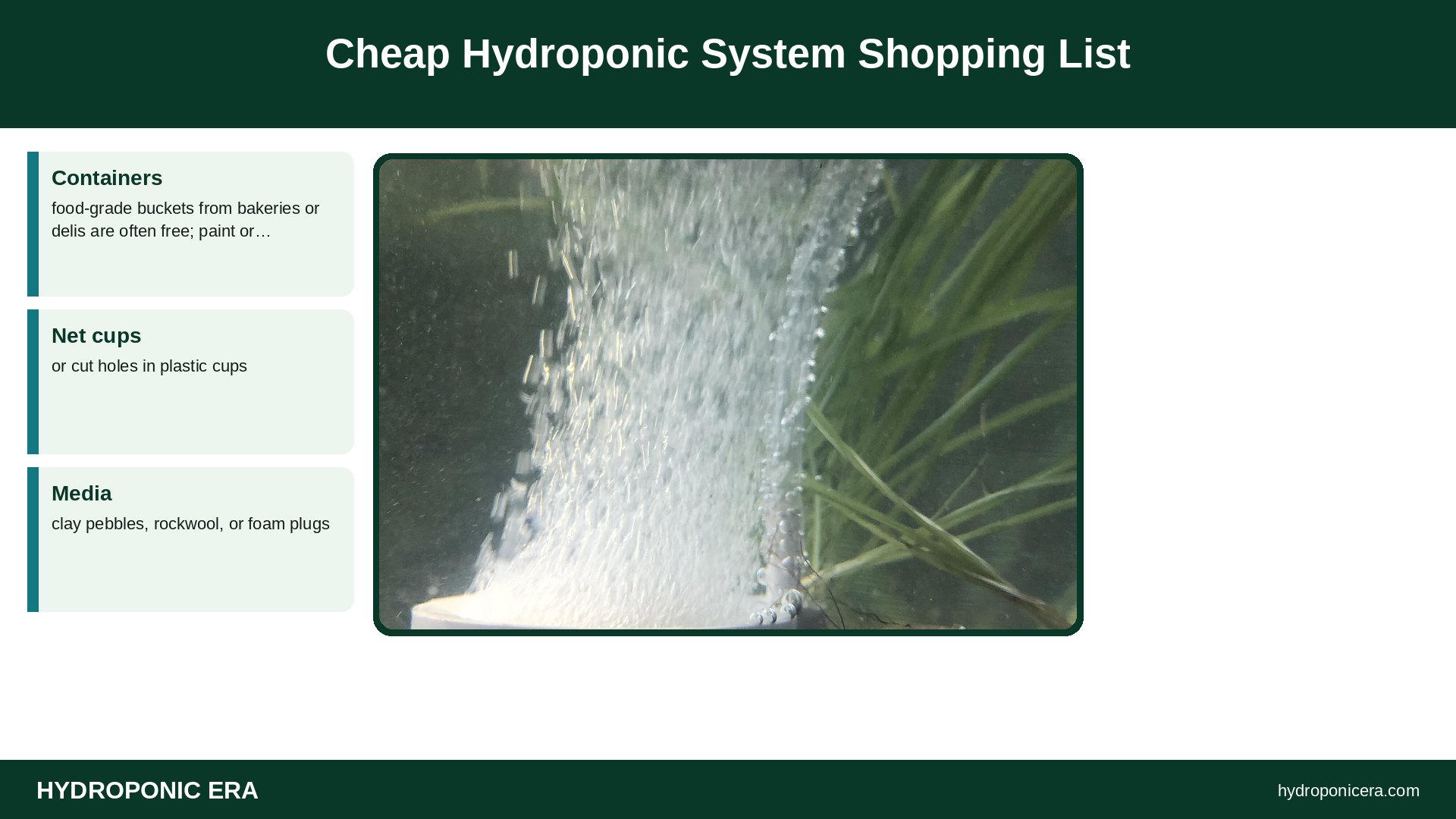
- Containers: food-grade buckets from bakeries or delis are often free; paint or wrap clear containers.
- Net cups: or cut holes in plastic cups.
- Media: clay pebbles, rockwool, or foam plugs.
- Nutrients: a complete hydroponic fertilizer; a powdered one is cheapest per gallon. See homemade hydroponic nutrients.
- pH test: drops or strips at minimum; a meter is better.
Where Not to Cut Corners
- Nutrients: garden fertilizers made for soil often contain urea and may not dissolve completely; use a hydroponic formula.
- Food safety: avoid containers that held chemicals.
- Light: clear containers grow algae; block light.
- Light for plants: a sunny window works in summer; indoors in winter, plan a basic LED.
Cheap Hydroponic System Running Costs
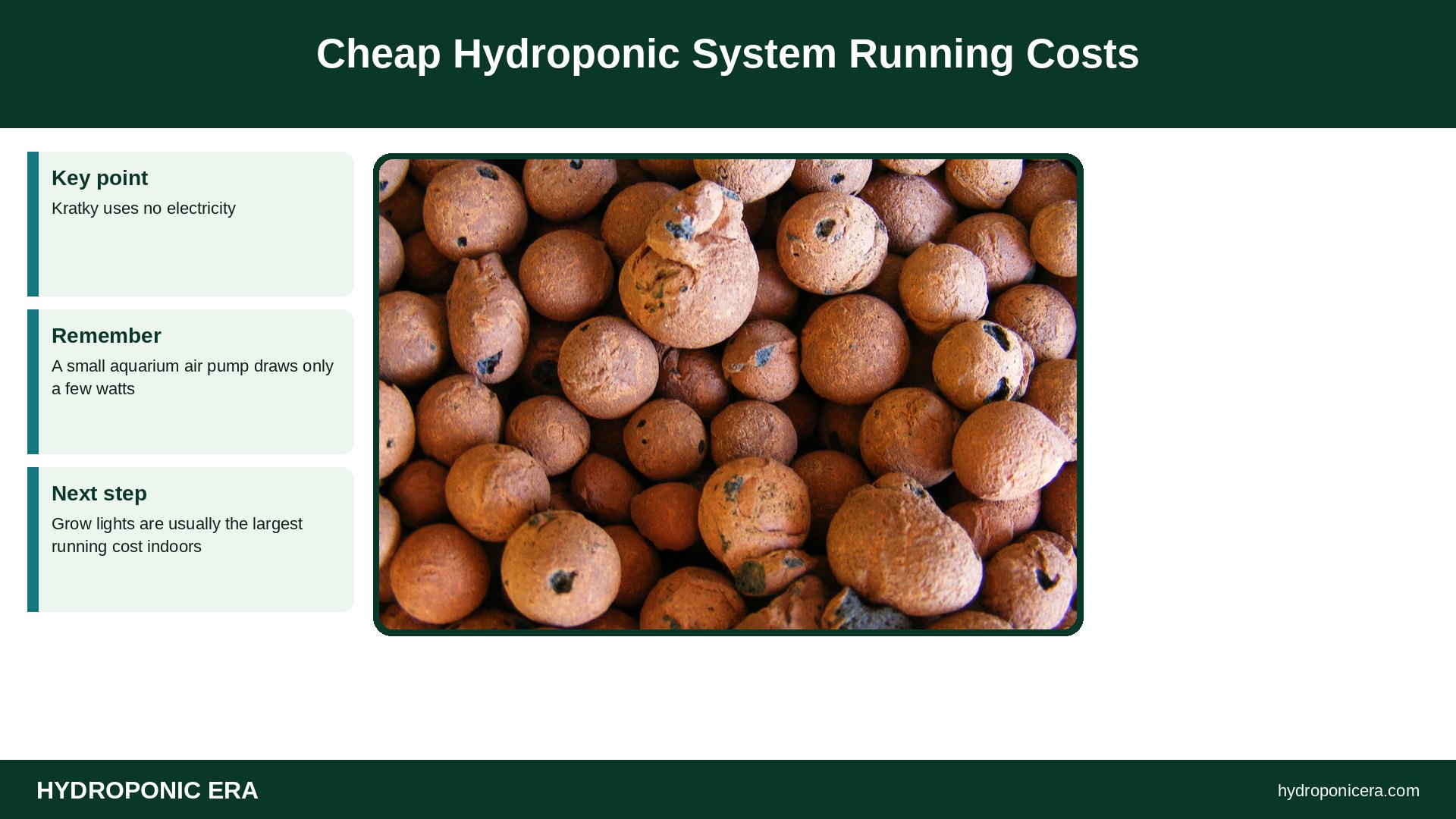
Kratky uses no electricity. A small aquarium air pump draws only a few watts. Grow lights are usually the largest running cost indoors. Nutrients for a few gallons cost very little per month. See cost to start home hydroponics.
Best Crops for a Cheap Hydroponic System
- Lettuce and other leafy greens.
- Basil, mint, parsley, chives, and cilantro.
- Bok choy and kale.
Leafy greens are fast, compact, and forgiving. Tomatoes and cucumbers need bigger containers and more nutrients.
Common Mistakes With a Cheap Hydroponic System
- Filling Kratky containers back to the top, which drowns the air roots.
- Using clear containers that grow algae.
- Skipping pH checks.
- Too little light indoors.
- Overcrowding plants.
Scaling Up Cheaply
Once a bucket works, add more buckets or build a gutter or tower system. See rain gutter hydroponics and DIY hydroponic tower.
Planning Tips: Cheap Hydroponic System
Saving money on a cheap hydroponic system works best when you spend on the few parts that matter: a complete hydroponic nutrient, a pH test kit, and a reliable air pump if your system needs one. Buckets, totes, and net cups can be reused or bought cheaply, but a poor nutrient or no pH testing causes most failures.
Start small. One tote of lettuce or herbs teaches the basics with little risk before you scale up.
Weekly Routine for Cheap Hydroponic System
- Check pH and EC, and record them.
- Top off the reservoir with plain, pH-adjusted water.
- Look at roots for color and smell.
- Check leaves, especially undersides, for pests.
- Clean filters, emitters, and pump intakes.
- Change the nutrient fully every two to three weeks, or sooner if EC drifts.
Beginner Mistakes With Cheap Hydroponic System
The most common mistakes are skipping pH testing, using nutrient that’s too strong, letting light reach the water, and ignoring water temperature. Each one is easy to fix once you know to check for it. Start with fewer plants than you think you need, learn the routine, and expand once the system runs smoothly.
Cheap Hydroponic System Options Compared
- Kratky jar or tote: lowest cost, no power, best for lettuce and herbs.
- DWC bucket or tote: needs an air pump and stone, fast growth.
- Wick system: no power, slow, good for herbs.
- Homemade NFT or gutter: needs a pump, more parts.
For most beginners, a cheap hydroponic system means a Kratky or DWC tote. Both are simple, use recycled containers, and teach pH and nutrient basics.
Where to Find Cheap Hydroponic System Parts
Food-grade buckets from bakeries, storage totes from hardware stores, aquarium air pumps, and net cups bought in bulk all keep costs down. Use opaque containers, or paint them, to stop algae.
Running Costs of a Cheap Hydroponic System
After setup, ongoing costs are mainly nutrients, seeds, net cups or plugs, and electricity for pumps and lights. A Kratky system uses no power for water, and growing near a sunny window avoids light costs. Concentrated nutrients last a long time in a small system, so a single bottle or bag often covers many crops of greens. Track what you spend and harvest to see whether your system pays off.
FAQs: Cheap Hydroponic System
What is the cheapest hydroponic system?
Kratky, because it needs no pump or power.
Can I use any bucket?
Use food-grade, opaque buckets that never held chemicals.
Do I need a pH meter?
Test strips or drops work to start; a meter is more accurate.
Can I use Miracle-Gro?
Soil fertilizers aren’t designed for hydroponics; use a hydroponic formula.
What should I grow first?
Lettuce or basil.
Is a cheap hydroponic system worth it?
Yes, for learning; upgrade once you know what you want to grow.
Sources
- University of Hawaii CTAHR — A Suspended Net-Pot, Non-Circulating Hydroponic Method (Kratky, VC-1)
- UF/IFAS Extension — Growing Lettuce in Small Hydroponic Systems
- Photo credits (Wikimedia Commons, edited with titles): White plastic bucket by Santeri Viinamäki (CC BY-SA 4.0); Deepwater Aquaponics Floating Rafts Growing Lettuce, Basil and Arugula by Alabama Extension (CC0); Air Stone Disk aquarium Germany 2024 by Nimmerwelk (CC BY-SA 4.0); Hydroton by Lucis (CC BY-SA 3.0); Romaine lettuce by Rainer Zenz (CC BY-SA 3.0)