
Microgreen grow mats are thin, soil-free pads that hold water and give roots something to grip in a hydroponic tray. The main types are hemp, coco coir, jute, felt (synthetic fiber), and biostrate-style blends. For most home growers, hemp mats are the best all-round choice: they hold moisture well, are compostable, and work for nearly every crop. Coco mats suit larger seeds like peas and sunflowers, jute is cheap but dries quickly, and reusable felt pads save money but need careful cleaning.
Key takeaway: Hemp for most crops, coco for big seeds, felt if you want reusable pads, and coir or soil mix if you want the most forgiving option.
Microgreen Grow Mats Compared
| Mat type | Water holding | Reusable | Compostable | Best for |
|---|---|---|---|---|
| Hemp | Good | No | Yes | Most crops; brassicas, radish, basil |
| Coco coir mat | Very good | No | Yes | Peas, sunflower, larger seeds |
| Jute | Moderate; dries fast | No | Yes | Fast crops; low budget |
| Felt (synthetic) | Good | Sometimes | No | Small seeds; reusable trays |
| Biostrate / wood fiber blends | Very good | No | Varies | Commercial, small seeds |
| Loose coco coir (not a mat) | Very good | No | Yes | Beginners; all crops |
Why Use Microgreen Grow Mats
Mats are cleaner and lighter than potting mix. There’s no dirt on the harvest, trays are easy to stack, and the used mat can go straight into compost. They also fit hydroponic setups such as ebb-and-flow shelves and NFT channels, where loose mix would wash away. Virginia Cooperative Extension notes that mats and pads are widely used in indoor vertical farms for these reasons.
The trade-off is less water-holding than a deep layer of coir or soil. Mats dry faster, so they need more attention to watering, and some crops grow a bit slower on thin mats than in mix.
Hemp Mats
Hemp microgreen grow mats are made from pressed hemp fibers, often about 1/4 inch thick. They wick water evenly, have a neutral pH, and roots weave into them well. They work for radish, broccoli, kale, mustard, arugula, cabbage, and basil. They are compostable and widely available in 10-by-20-inch sheets. Pre-wet them before sowing.
Coco Coir Mats
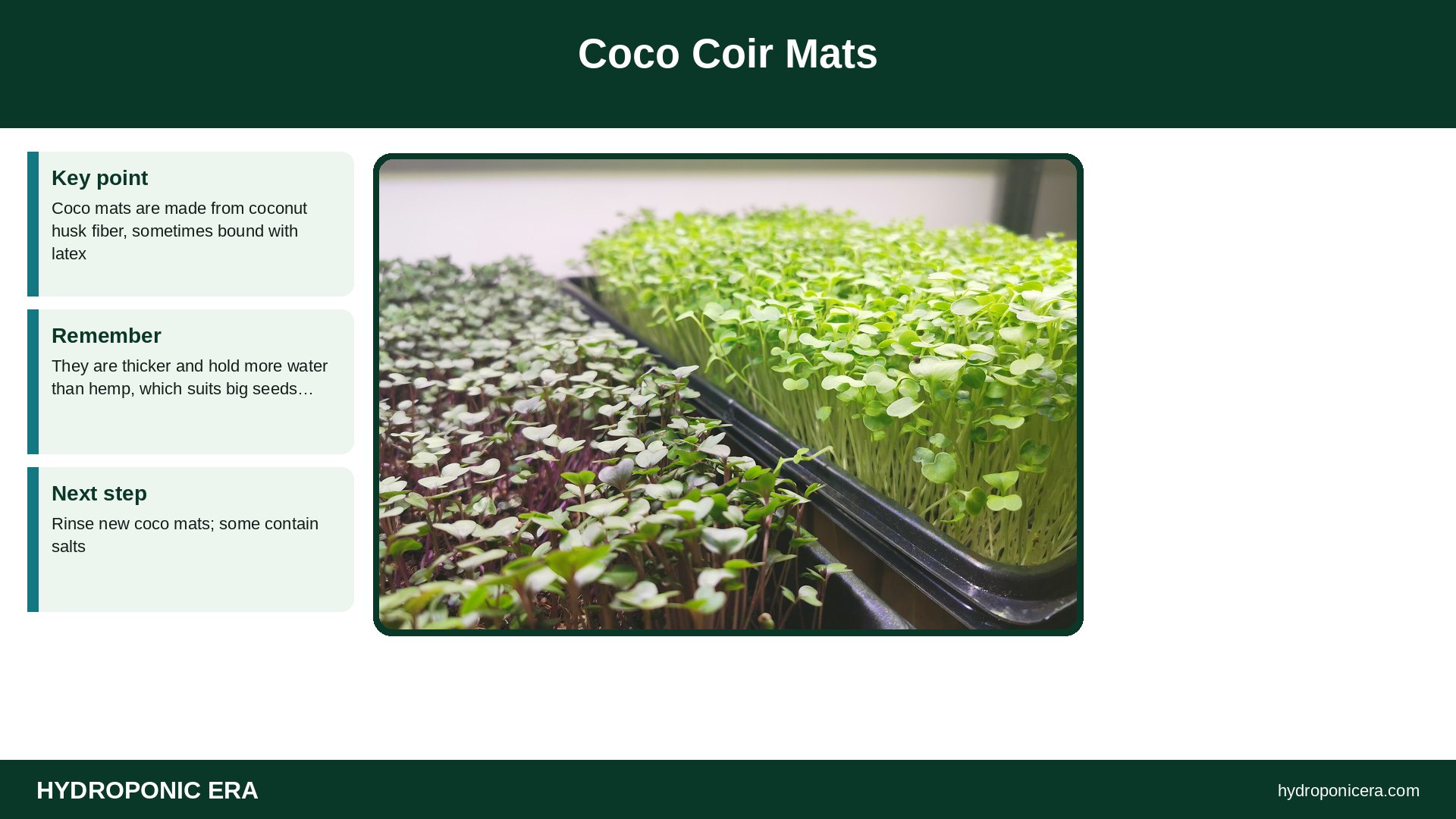
Coco mats are made from coconut husk fiber, sometimes bound with latex. They are thicker and hold more water than hemp, which suits big seeds like peas and sunflowers that need moisture for several days. Rinse new coco mats; some contain salts. See coco coir in hydroponics.
Jute Mats
Jute (burlap-like) mats are inexpensive and fully compostable. They dry out faster than hemp, so plan to water more often. They are good for fast crops like radish that are harvested before drying becomes a problem.
Felt and Synthetic Pads
Synthetic felt pads are made from polyester or similar fibers. Some are sold as reusable. They hold water well and are good for tiny seeds like amaranth or mustard. To reuse them, you must pull out all roots and sanitize the pad, which takes time. Many growers find it simpler to use compostable mats. If you reuse pads, inspect for mold every time. See microgreens mold.
How to Use Microgreen Grow Mats
- Cut the mat to fit the tray if needed.
- Soak the mat in clean, pH-adjusted water (about 6.0) until fully wet. Let excess drain.
- Place it in a tray with drainage holes over a solid tray.
- Sow seed evenly and mist.
- Cover and weight for the crop’s dark period.
- After uncovering, bottom water: add a little water to the solid tray and let the mat wick it up.
- Harvest by cutting above the mat.
See how to grow microgreens hydroponically.
Feeding Microgreens on Mats
Most microgreens grow fine on water alone because their seeds hold stored energy. Mats contain almost no nutrients, so for slower crops like basil, or if you want greener leaves, add a very weak hydroponic nutrient once seedlings are uncovered. See hydroponic nutrients for seedlings.
Choosing Microgreen Grow Mats by Crop
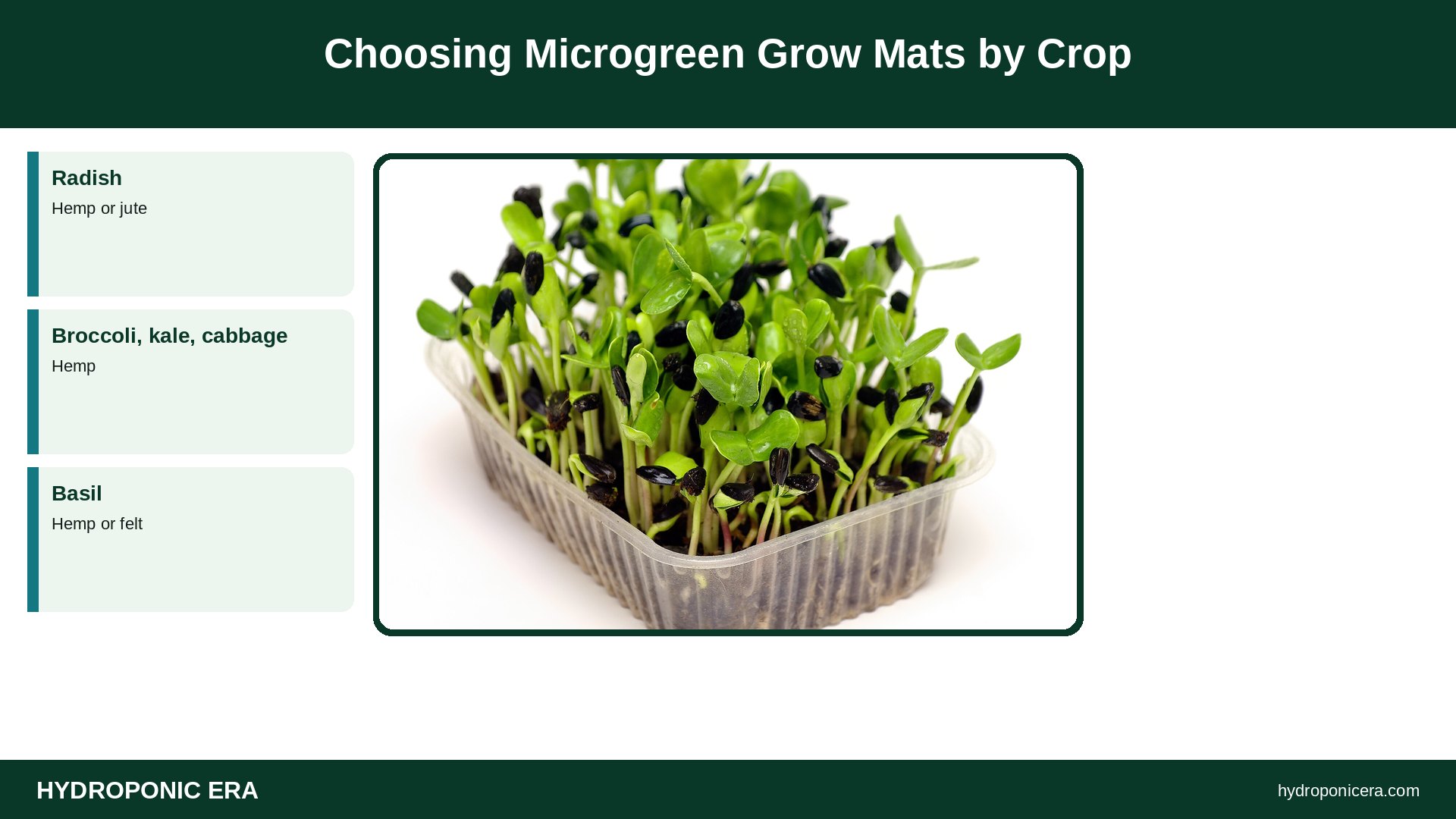
| Crop | Best mat |
|---|---|
| Radish | Hemp or jute |
| Broccoli, kale, cabbage | Hemp |
| Basil | Hemp or felt |
| Pea shoots | Coco or hemp |
| Sunflower | Coco mat or loose coir |
| Amaranth, mustard | Felt or hemp |
For crop details see radish microgreens, pea shoots, and sunflower microgreens.
Mats vs Soil or Coir
Loose coir or seed-starting mix holds more water and nutrients, so it’s more forgiving for beginners and gives slightly larger yields for some crops. Mats are cleaner, lighter, and better for hydroponic shelves. Many growers use coir for sunflower and pea and mats for everything else.
Cost Per Tray
Hemp and coco mats typically cost from about 50 cents to $1.50 per 1020 sheet, depending on brand and quantity. Jute is usually cheaper. Reusable felt costs more up front but less per crop if you clean it well. Factor mat cost into your tray cost along with seed. See microgreen cost worksheets.
Common Problems With Microgreen Grow Mats
- Mats drying out: bottom water more often or switch to a thicker mat.
- Seeds sliding off: mist after sowing and weight the tray.
- Roots on top of the mat: not enough weight or the mat is too dry.
- Mold on the mat: too wet, still air, or dirty reused pads.
- Salty residue: rinse new coco mats before use.
Disposal
Natural-fiber mats can go into compost with the roots. Break them up for faster composting. Synthetic felt goes in the trash once it can’t be cleaned. See composting for beginners.
Using Microgreen Grow Mats in Hydroponic Shelves
On ebb-and-flow or NFT-style microgreen shelves, mats sit in shallow channels or trays that are flooded briefly a few times a day. Keep floods short so seeds don’t sit in water, and make sure trays drain completely. Thin hemp or felt mats work best here because they wick quickly. A timer and a small pump make this almost hands-off. See ebb and flow hydroponics.
FAQs
What are the best microgreen grow mats?
Hemp mats for most crops; coco mats for peas and sunflowers.
Can microgreen grow mats be reused?
Natural fiber mats, no. Some felt pads can be cleaned and reused.
Do mats need nutrients?
Most microgreens don’t; slow crops benefit from a weak solution.
Are hemp mats better than coir?
Hemp is cleaner and lighter; loose coir is more forgiving.
Do I soak the mat first?
Yes. Pre-wet and drain before sowing.
Why are my mats moldy?
Usually too much water and too little airflow.
Sources
- Virginia Cooperative Extension — Introduction to Microgreen Production in Indoor Vertical Farms and Greenhouses
- Utah State University Extension — Grow Your Own Microgreens
- Perennia — Microgreens Fact Sheet
- Photo credits (Wikimedia Commons, edited with titles): Lufa Farms Microgreens in Trays by Lufa Farms (CC BY-SA 2.0); Lufa Farms Microgreens in Trays by Lufa Farms (CC BY-SA 2.0); Mikrolistki – brokuł i rzodkiewka na tacach plastikowych by Teogenesis (CC BY-SA 4.0); Garden pea sprouts by Yarzaryeni (CC BY 3.0); Sunflower microgreens 01 by Pannet (CC BY 4.0)