
Hydroponic tomato pruning for indeterminate plants means training each plant to one (or two) main stems, snapping off side shoots (suckers) when they are 1–3 inches long, removing leaves below the lowest ripening fruit cluster, and lowering the stem along the support wire as it reaches the top. Do it once or twice a week, in the morning, with clean hands or tools. Determinate and dwarf tomatoes need much less pruning: remove only suckers below the first flower cluster and any yellow or touching-water leaves.
Key takeaway: One stem, weekly suckering, strip leaves up to the ripening truss, and lower-and-lean when the plant hits the wire.
| Task | How often | Applies to |
|---|---|---|
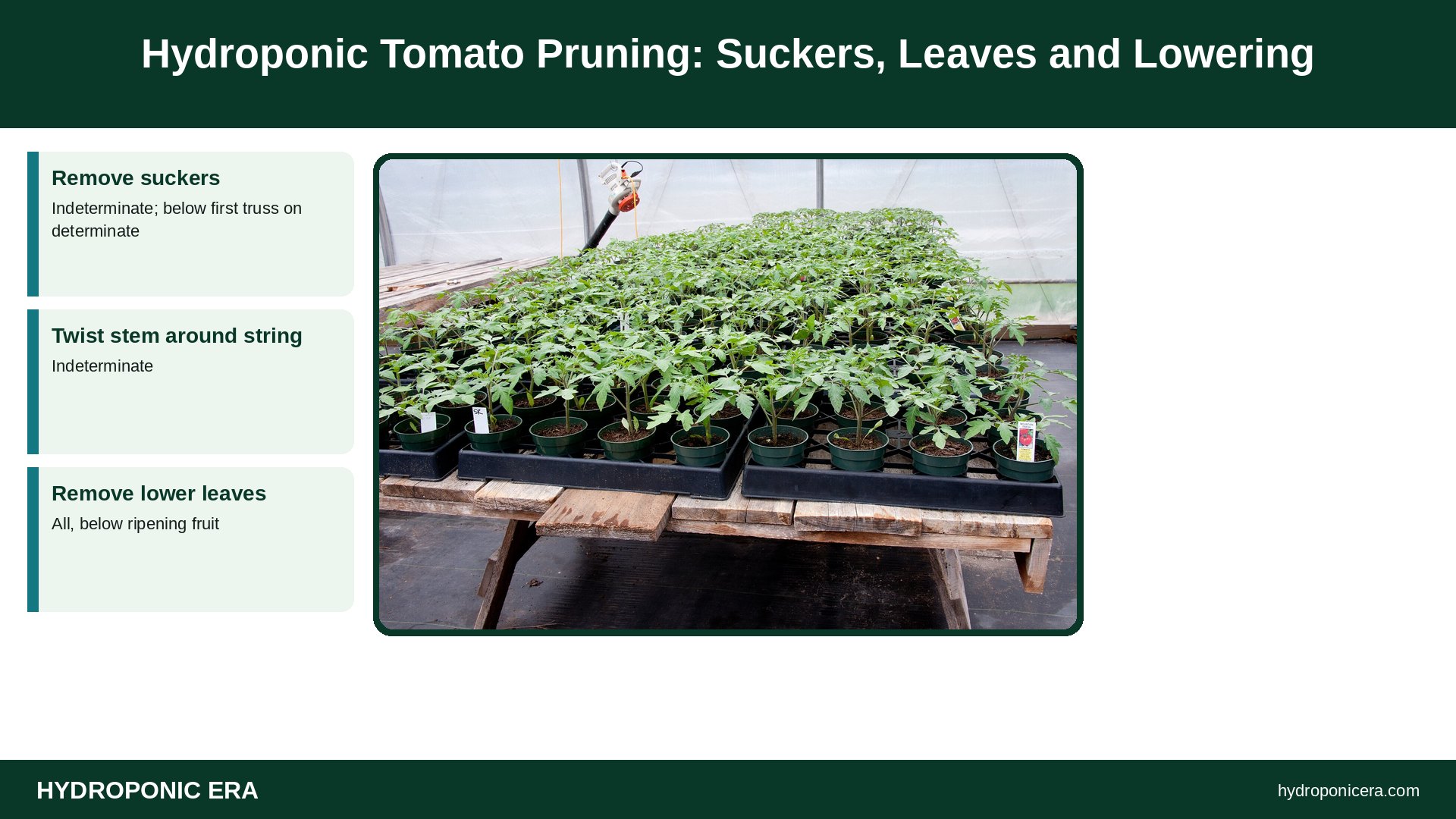
| Remove suckers | 1–2 times a week | Indeterminate; below first truss on determinate |
| Twist stem around string | Weekly | Indeterminate |
| Remove lower leaves | Weekly, 2–3 leaves at a time | All, below ripening fruit |
| Prune trusses (fruit thinning) | At flowering | Beefsteaks and large cluster types |
| Lower and lean | When the head reaches the wire | Indeterminate |
| Top the plant | 6–8 weeks before season end | Indeterminate |
Why Hydroponic Tomato Pruning Matters
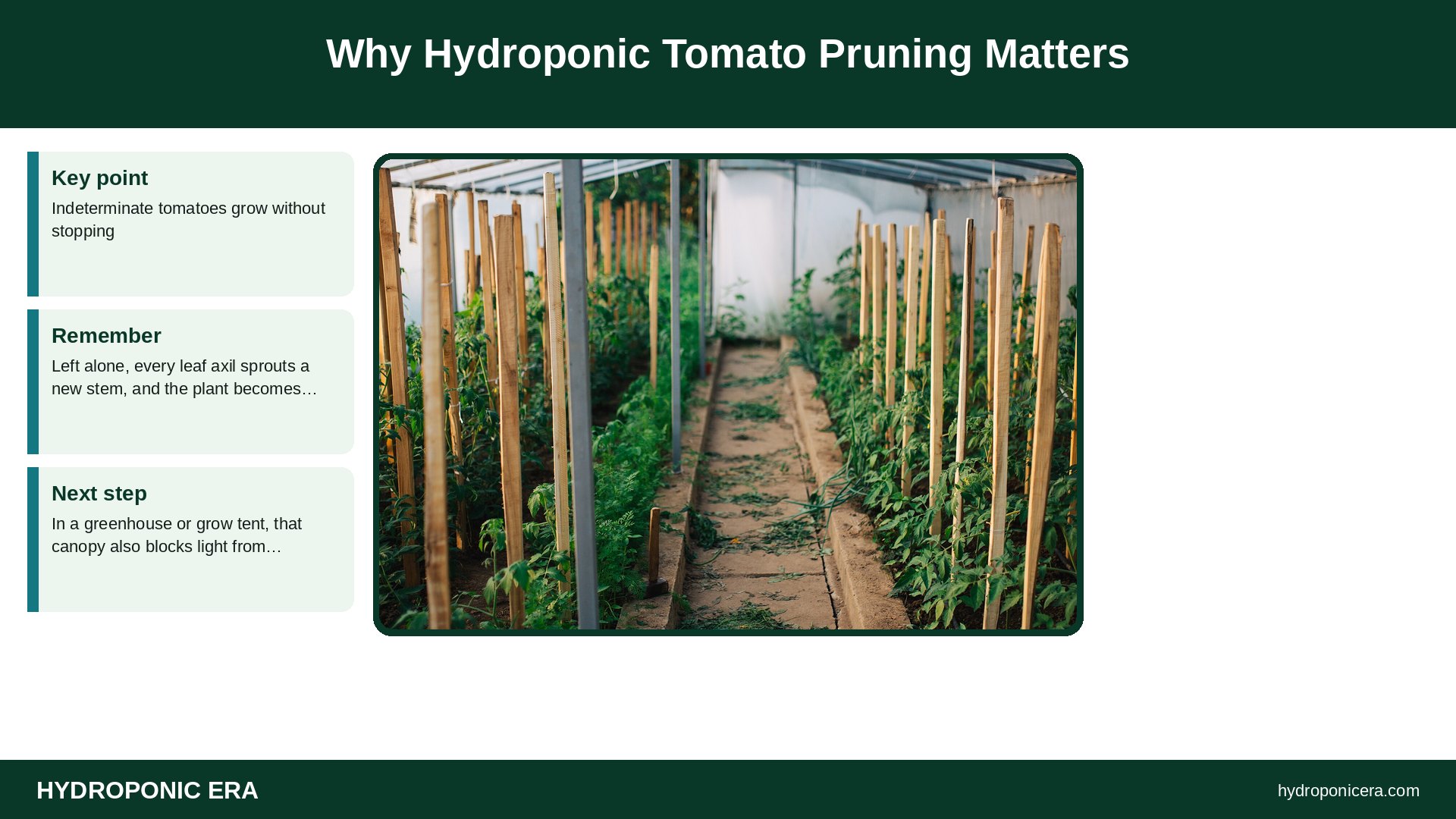
Indeterminate tomatoes grow without stopping. Left alone, every leaf axil sprouts a new stem, and the plant becomes a dense bush that shades its own fruit, traps humidity, and invites disease. In a greenhouse or grow tent, that canopy also blocks light from neighbors.
UF/IFAS’s greenhouse tomato guidance describes the commercial standard: a single stem trained up a string to an overhead wire, with suckers removed and leaves stripped as fruit ripens. This puts the plant’s energy into fruit and keeps air moving through the canopy.
How to Identify and Remove Suckers
A sucker is a side shoot that grows in the “armpit” between the main stem and a leaf. It will become another full stem with leaves and flowers if left. Remove suckers when they’re 1–3 inches long by snapping them sideways with your fingers. Small suckers leave a small wound that heals fast. Large ones need a clean cut with pruners.
Don’t confuse suckers with flower clusters, which grow from the stem between leaves, not in the leaf axils.
Single-Stem vs Two-Stem Training
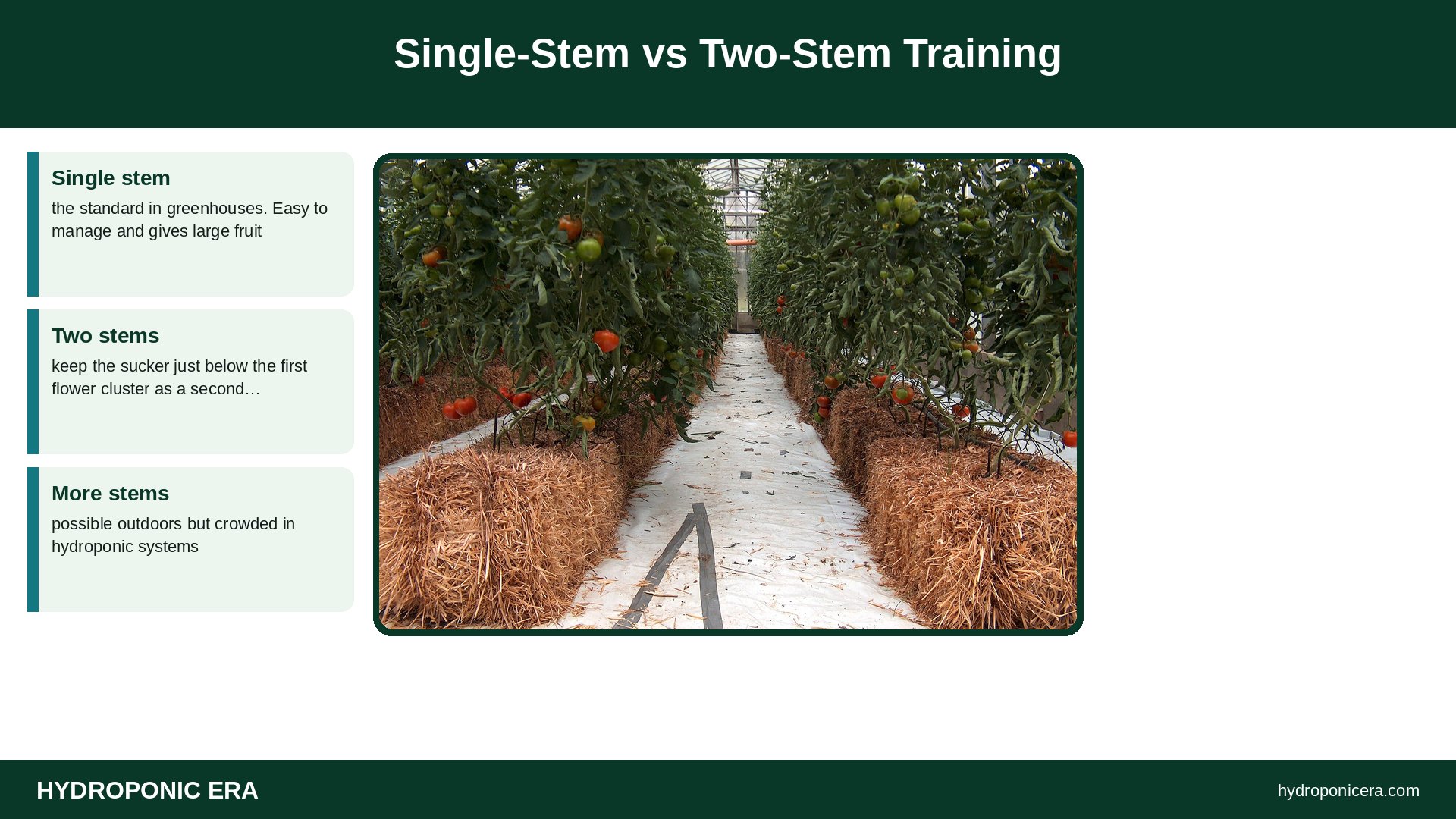
- Single stem: the standard in greenhouses. Easy to manage and gives large fruit.
- Two stems: keep the sucker just below the first flower cluster as a second leader. Good for cherry tomatoes and wider spacing.
- More stems: possible outdoors but crowded in hydroponic systems.
See trellising and pruning and Dutch bucket hydroponics.
Leaf Removal (Deleafing)
As fruit clusters ripen, the leaves below them have done their job. Remove leaves below the lowest ripening truss, 2–3 leaves per week. This improves airflow, reduces disease, and helps fruit color. Leave at least 15–18 leaves on a mature greenhouse plant so it has enough leaf area for photosynthesis. Never strip more than a few leaves at once; too much deleafing can cause sunscald and smaller fruit.
Truss Pruning for Bigger Fruit
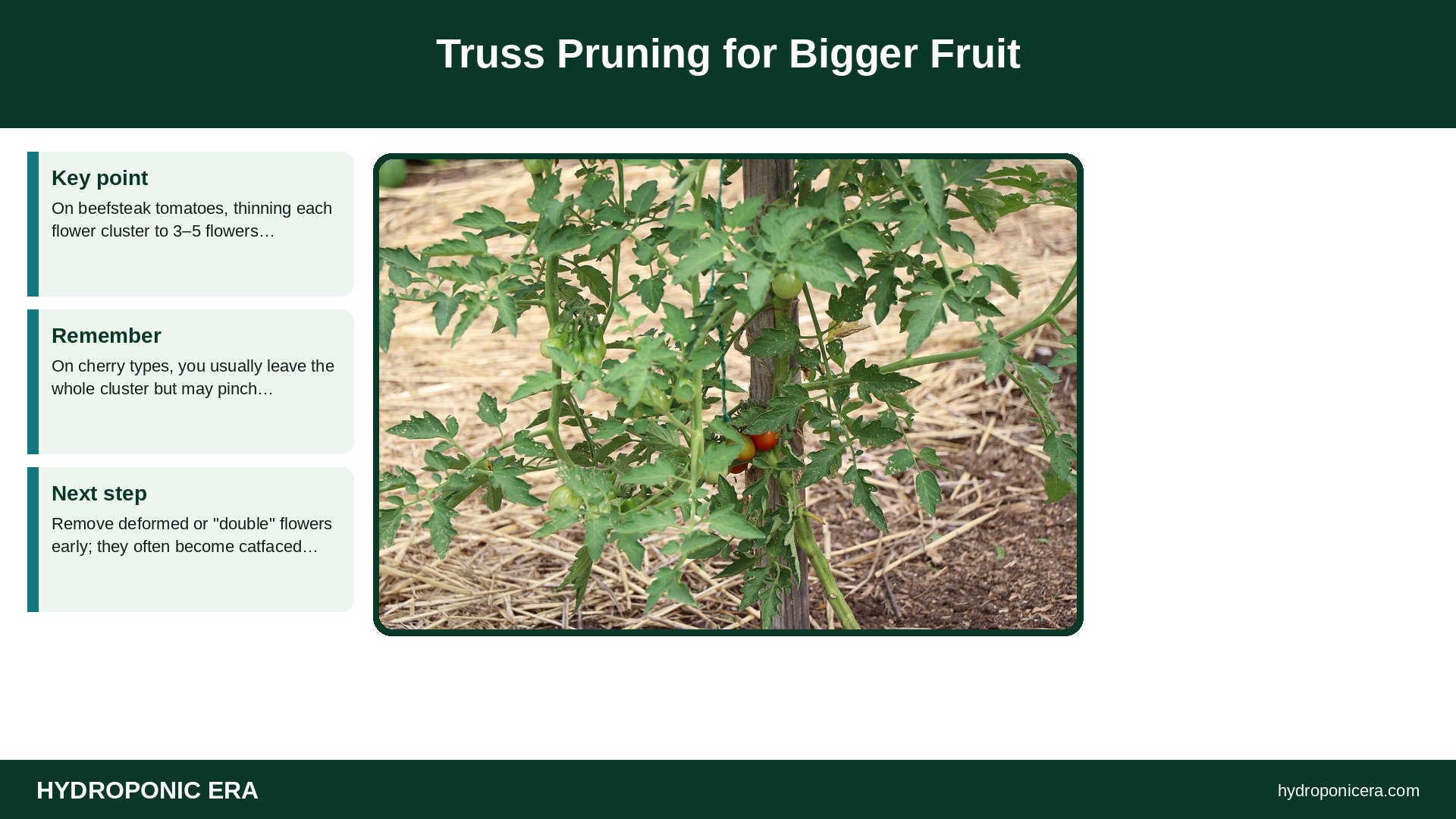
On beefsteak tomatoes, thinning each flower cluster to 3–5 flowers gives larger, more even fruit. On cherry types, you usually leave the whole cluster but may pinch off the weak tip of very long trusses. Remove deformed or “double” flowers early; they often become catfaced fruit. See catfacing.
Lowering and Leaning
In greenhouses, tomatoes are grown on strings hung from a high wire, often 8–12 feet up, using hooks that hold extra string. When the plant reaches the wire, unwind some string, lower the plant, and slide it along the row so the bare lower stem lies horizontally. This lets one plant grow 30 feet or more over a long season while the fruiting top stays at working height.
Hydroponic Tomato Pruning for Determinate and Dwarf Plants
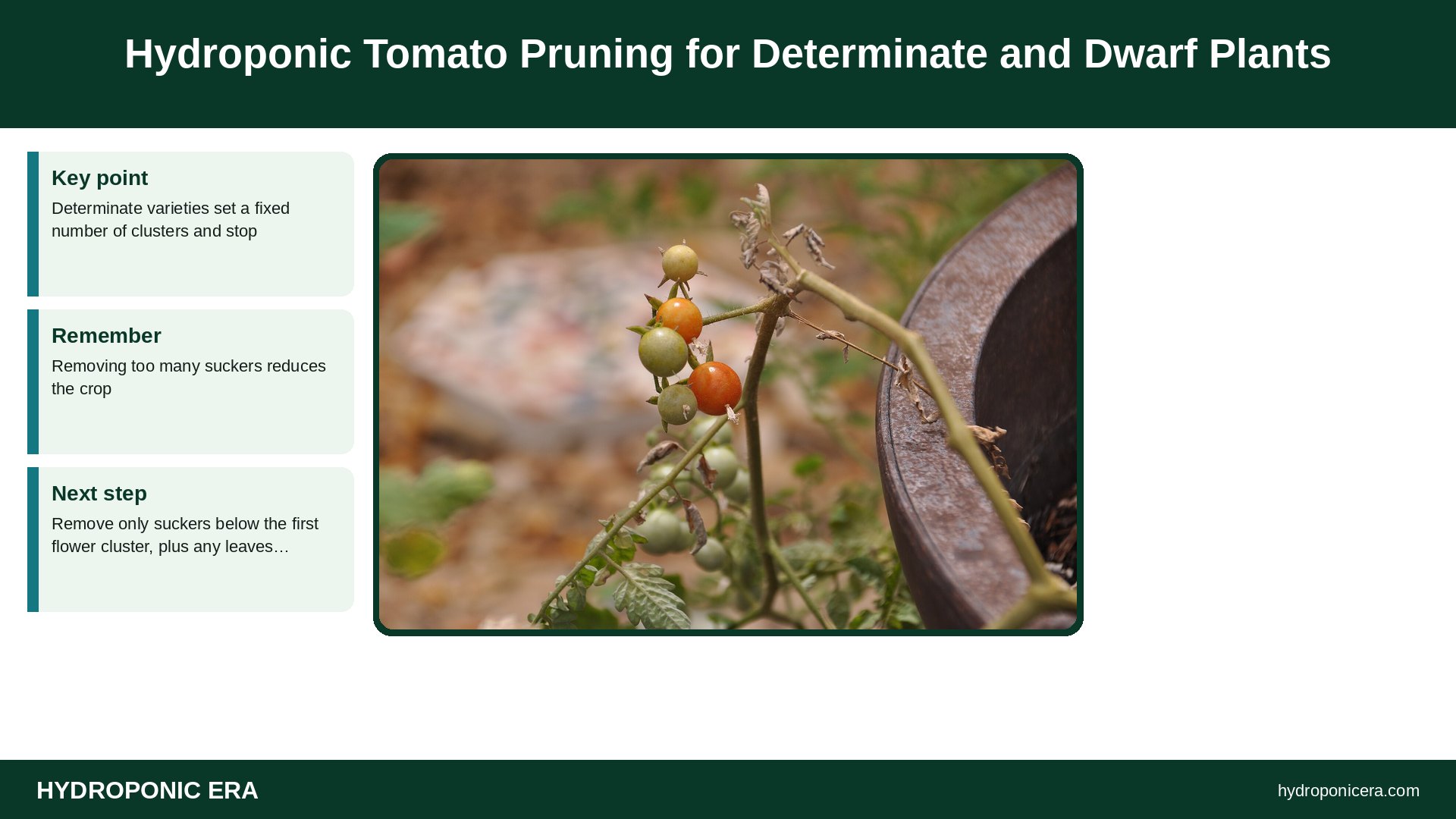
Determinate varieties set a fixed number of clusters and stop. Removing too many suckers reduces the crop. Remove only suckers below the first flower cluster, plus any leaves that touch the water or turn yellow. Dwarf varieties in countertop kits need almost no pruning; just remove damaged leaves. See best tomato varieties for hydroponics.
Topping at the End of the Season
About 6–8 weeks before you plan to end the crop, cut off the growing tip above the last flower cluster you want to ripen. The plant then puts its energy into ripening the fruit already set instead of making new flowers that won’t have time to mature.
Hygiene During Hydroponic Tomato Pruning
- Prune in the morning when plants are turgid; wounds dry faster during the day.
- Wash hands or wear gloves; sanitize pruners between plants.
- Avoid handling plants when wet.
- Remove all prunings from the growing area.
- Tobamoviruses like ToBRFV spread on hands and tools. See tomato brown rugose fruit virus.
Pruning and Nutrition
Pruned plants put more resources into fruit, so they need consistent feeding: EC roughly 2.0–3.5 mS/cm during fruiting, pH 5.8–6.3, and enough calcium to avoid blossom end rot. UF/IFAS publishes stage-based nutrient formulas for hydroponic tomatoes. See nutrients for tomatoes and calcium nitrate in hydroponics.
Common Mistakes
- Letting suckers grow large before removing them.
- Cutting off flower clusters by mistake.
- Removing too many leaves at once.
- Pruning determinate plants like indeterminate ones.
- Skipping tool sanitation.
A Weekly Hydroponic Tomato Pruning Routine
- Twist each plant’s head clockwise around its string.
- Remove all suckers.
- Remove 2–3 leaves below the lowest ripening cluster.
- Thin new flower clusters on beefsteaks.
- Lower plants if they’ve reached the wire.
- Check for pests and disease while you work.
Tools for Hydroponic Tomato Pruning
Most hydroponic tomato pruning can be done by hand. Young suckers snap off cleanly when they are 1–2 inches long, which leaves a small wound that dries quickly. Use clean pruners or snips for older suckers, leaves and trusses, and keep a second pair soaking in disinfectant so you can swap them between rows. Greenhouse growers also use tomato clips, hooks with spooled twine, and truss supports. Disposable gloves help, because tomato viruses such as tomato brown rugose fruit virus spread on hands.
Best Time of Day for Hydroponic Tomato Pruning
Prune in the morning on a dry day, after plants have dried off and before the hottest part of the afternoon. Wounds made in the morning dry faster, which lowers the risk of gray mold (Botrytis) entering through the cut. Avoid pruning right after misting or foliar sprays and on very humid days. In a closed tent, run the fans for a while after hydroponic tomato pruning so the cuts dry.
How Much Leaf to Keep
A healthy greenhouse tomato usually carries around 15–20 leaves on each stem. Remove leaves from the bottom only after the truss next to them has started to ripen, and never take more than two or three leaves per stem in a week. Too much hydroponic tomato pruning reduces sugar production and can expose fruit to sunscald.
FAQs
Should I prune hydroponic tomatoes?
Yes, especially indeterminate plants.
How often should I remove suckers?
Once or twice a week, while they’re small.
How many leaves should a tomato keep?
About 15–18 on a mature greenhouse plant.
Do determinate tomatoes need pruning?
Only suckers below the first cluster and damaged leaves.
What is lower and lean?
Lowering the plant on its string and sliding it along the row as it grows.
When should I top tomato plants?
6–8 weeks before the end of the season.
Sources
- UF/IFAS Extension — Production of Greenhouse Tomatoes
- UF/IFAS Extension — Nutrient Solution Formulation for Hydroponic Tomatoes in Florida
- UF/IFAS Extension — Production Systems — Florida Greenhouse Vegetable Production Handbook
- Photo credits (Wikimedia Commons, edited with titles): Early tomatoes (5673784575) by Dwight Sipler from Stow, MA, USA (CC BY 2.0); Greenhouse filled with tomato plants and a bucket on the path by Shixart1985 (CC BY 2.0); Hydroponic g12 by Giancarlo Dessì (CC BY-SA 3.0); Several green unripe and red ripe tomatoes growing on the vine. (086c449c-117b-44f6-a7c4-e2acbf284092) by NPS (Public domain); Ripening Tomatoes by WarmPhoto (CC BY-SA 4.0)