
This aquaponics nutrient deficiencies chart helps you match a leaf symptom to the most likely missing nutrient and the aquaponics-safe fix. The first clue is where symptoms start. Problems on old, lower leaves point to mobile nutrients such as nitrogen, phosphorus, potassium and magnesium. Problems on new growth point to immobile ones such as iron, calcium and sulfur. In fish-fed systems, the three most common aquaponics nutrient deficiencies are iron, potassium and calcium, because fish feed is designed for fish, not plants. Always check pH first; many “deficiencies” are really nutrient lockout.
Key takeaway: Check pH (aim for about 6.8–7.0), then read where symptoms appear (old vs new leaves), then fix the likely element with chelated iron or a potassium or calcium base, never with random hydroponic fertilizer.
Aquaponics Nutrient Deficiencies Chart
| Nutrient | Where it shows | Main symptoms | Aquaponics fix |
|---|---|---|---|
| Nitrogen (N) | Old leaves | Overall yellowing, thin stems, low vigor | More fish or feed, fewer plants; check nitrate |
| Phosphorus (P) | Old leaves | Dull green or purplish leaves, burnt tips, weak roots | Check pH and feed; avoid excess calcium |
| Potassium (K) | Old leaves | Burned spots on margins, weak fruit | Potassium hydroxide or carbonate as pH buffer; seaweed |
| Magnesium (Mg) | Old leaves | Yellow between veins | Rarely needed; dolomite or a small Epsom salt dose |
| Calcium (Ca) | New leaves, fruit | Tip burn, blossom-end rot, hooked new leaves | Calcium hydroxide, carbonate, coral; improve airflow |
| Sulfur (S) | New leaves | General yellowing, stiff brittle leaves | Rare; usually supplied by feed |
| Iron (Fe) | New leaves | Yellow between green veins, then pale or white | Chelated iron to about 2 mg/L |
| Manganese (Mn) | New to mid leaves | Dull grey, interveinal yellowing | Lower pH; poor uptake above pH 8 |
| Zinc (Zn) | New growth | Small leaves, short internodes | Check pH; trace element supplement if confirmed |
| Boron (B) | Growing tips, flowers | Poor bud and flower set, tip necrosis | Rare; confirm before dosing |
| Copper (Cu) | New leaves | Dark green or orange tips | Rare; copper is toxic to fish, don’t add casually |
| Molybdenum (Mo) | Old leaves | Looks like nitrogen shortage | Unavailable below pH 5; correct pH |

Why Aquaponics Nutrient Deficiencies Happen
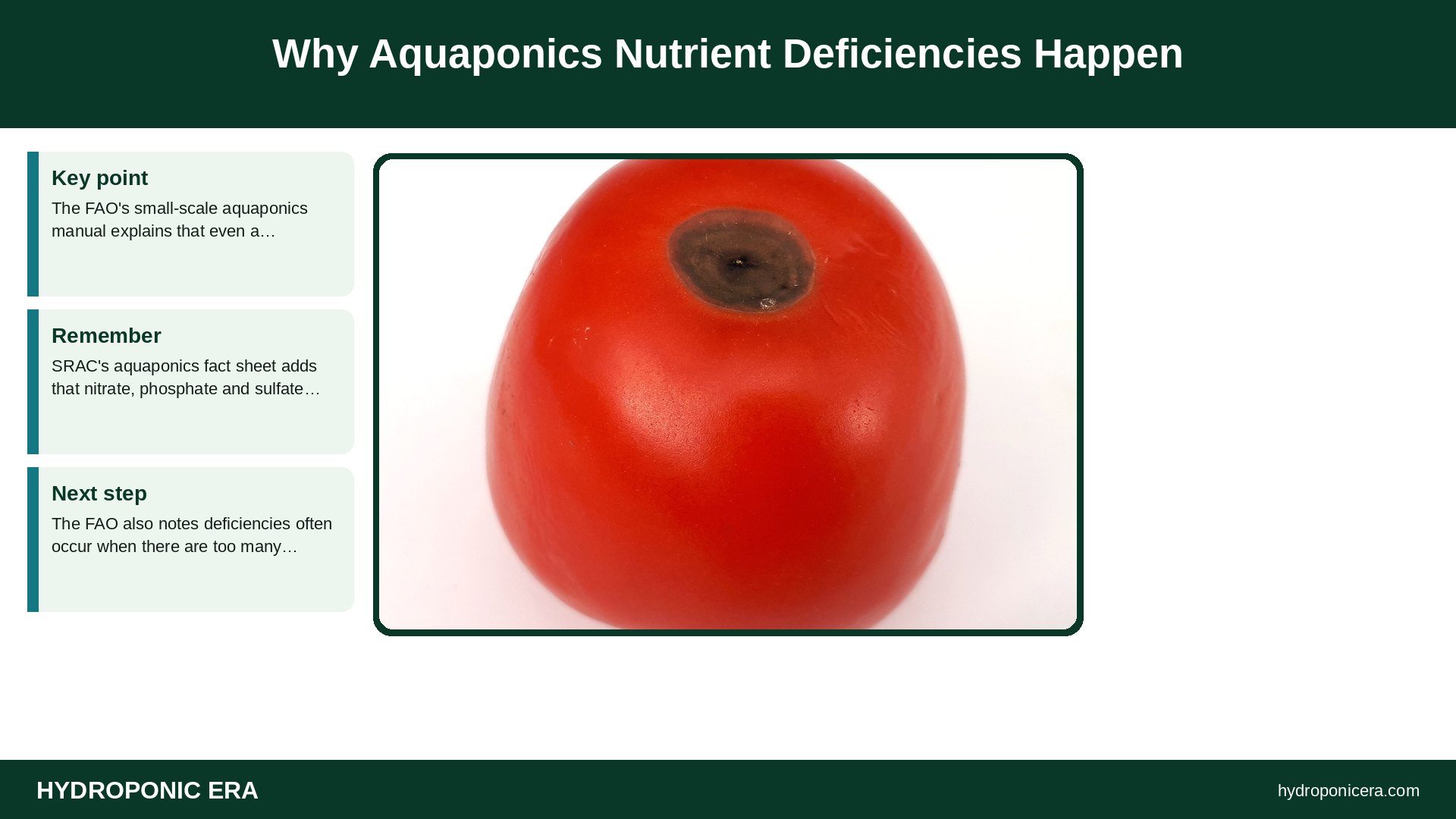
The FAO’s small-scale aquaponics manual explains that even a perfectly balanced system may become deficient in iron, potassium or calcium over time because of fish feed composition. SRAC’s aquaponics fact sheet adds that nitrate, phosphate and sulfate are usually sufficient, while potassium and calcium are generally insufficient and iron from feed is too low for vegetable production. The FAO also notes deficiencies often occur when there are too many plants for the number of fish, or when feeding drops in winter. Balance plants with feed using the fish to plant ratio.
Step 1: Check pH Before Anything Else
The FAO calls pH the most important plant parameter in aquaponics because it controls nutrient availability. Iron precipitates above about pH 7, manganese uptake is very poor above pH 8, and molybdenum is unavailable below pH 5. Bring pH to about 6.8–7.0 and wait a week before adding supplements; symptoms often fade on their own. See aquaponics pH and nutrient lockout.
Step 2: Old Leaves or New Leaves?
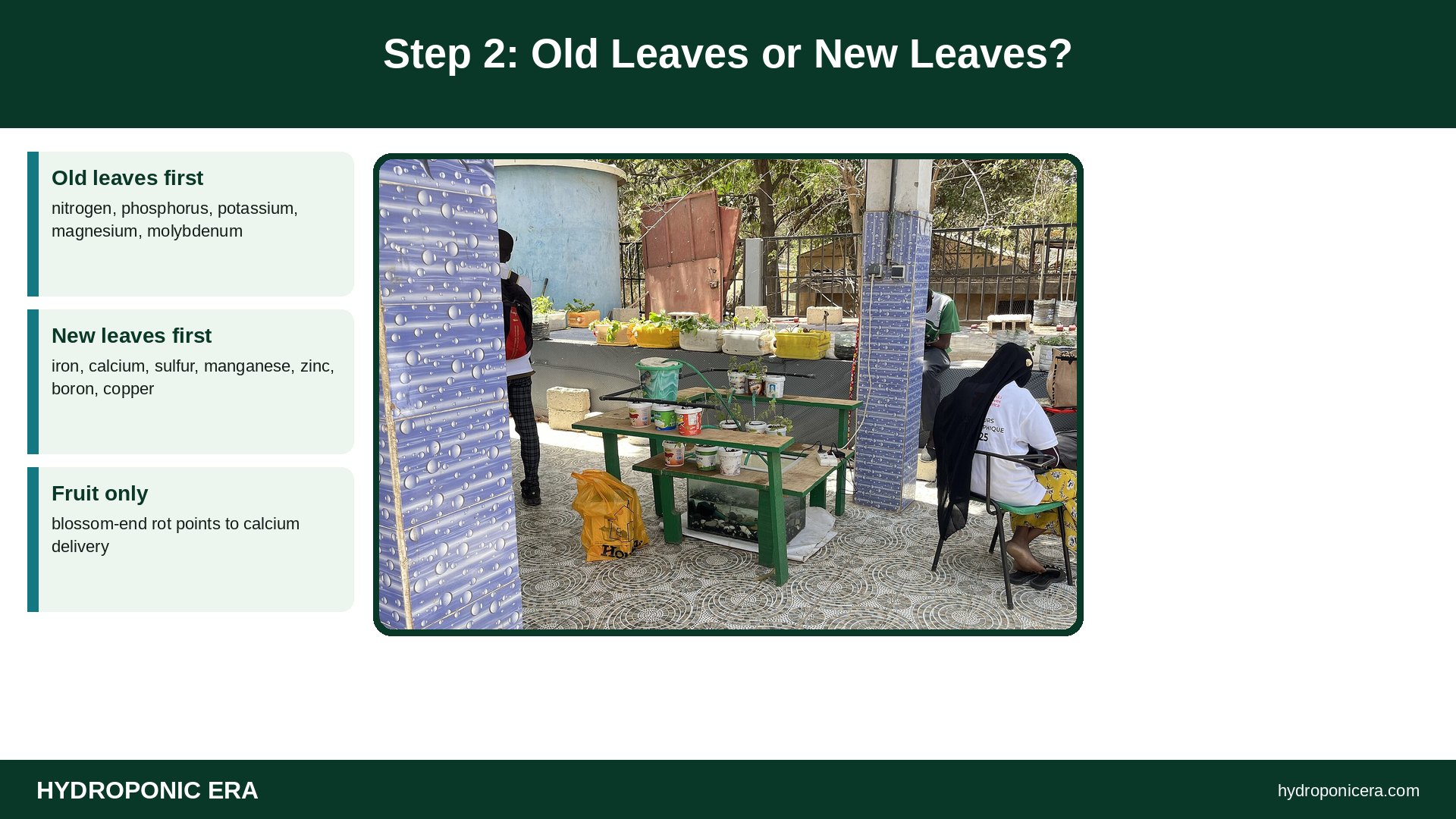
The FAO explains that nitrogen is mobilized from older leaves to new growth, which is why nitrogen deficiency shows on old leaves, while iron is non-movable so deficiency appears on new leaves. Calcium is also immobile and travels only through transpiration. Use this rule:
- Old leaves first: nitrogen, phosphorus, potassium, magnesium, molybdenum.
- New leaves first: iron, calcium, sulfur, manganese, zinc, boron, copper.
- Fruit only: blossom-end rot points to calcium delivery.
Step 3: Fix the Big Three
Iron: SRAC recommends chelated iron to about 2.0 mg/L and names Fe-DTPA as the best chelate because it stays soluble at pH 7.0. The FAO suggests adding iron up to about 3 mg/L when new leaves yellow while nitrate is high. See aquaponics iron deficiency.
Potassium: add potassium hydroxide or potassium carbonate when raising pH. See aquaponics potassium deficiency.
Calcium: add calcium hydroxide or carbonate, or keep crushed coral in the sump, and improve airflow. See aquaponics calcium deficiency.
SRAC describes alternating potassium and calcium bases several times a week to hold pH near 7.0, which supplies both nutrients while neutralizing the acid from nitrification.
Aquaponics-Safe Supplements

| Supplement | Supplies | Caution |
|---|---|---|
| Chelated iron (Fe-DTPA, Fe-EDTA) | Iron | Can stain tanks; EDTA less stable at high pH |
| Potassium hydroxide / carbonate | Potassium, raises pH | Caustic; dilute first |
| Calcium hydroxide / carbonate | Calcium, raises pH | Too much can precipitate phosphorus |
| Dolomite | Calcium and magnesium | Slow; SRAC lists it for Mg |
| Seaweed or kelp extract | Potassium, iron, trace elements | Start with small doses |
| Compost tea | Broad nutrients | Use only fully finished compost |
The FAO recommends compost tea and seaweed tea as aquaponics-safe organic supplements. Avoid baking soda for pH control; SRAC warns sodium is toxic to plants and blocks potassium and calcium uptake.
When It Isn’t a Deficiency
- Root rot: brown, slimy roots cause yellowing that no supplement fixes. See pythium root rot.
- Temperature stress: cold water slows uptake of everything.
- Low light: pale, stretched plants.
- Pests: stippling or speckling from mites and thrips.
- Viruses: mosaic or mottled patterns that don’t follow the old-or-new rule.
For a symptom-first walkthrough, use aquaponics plants turning yellow.
Using EC as a Health Check
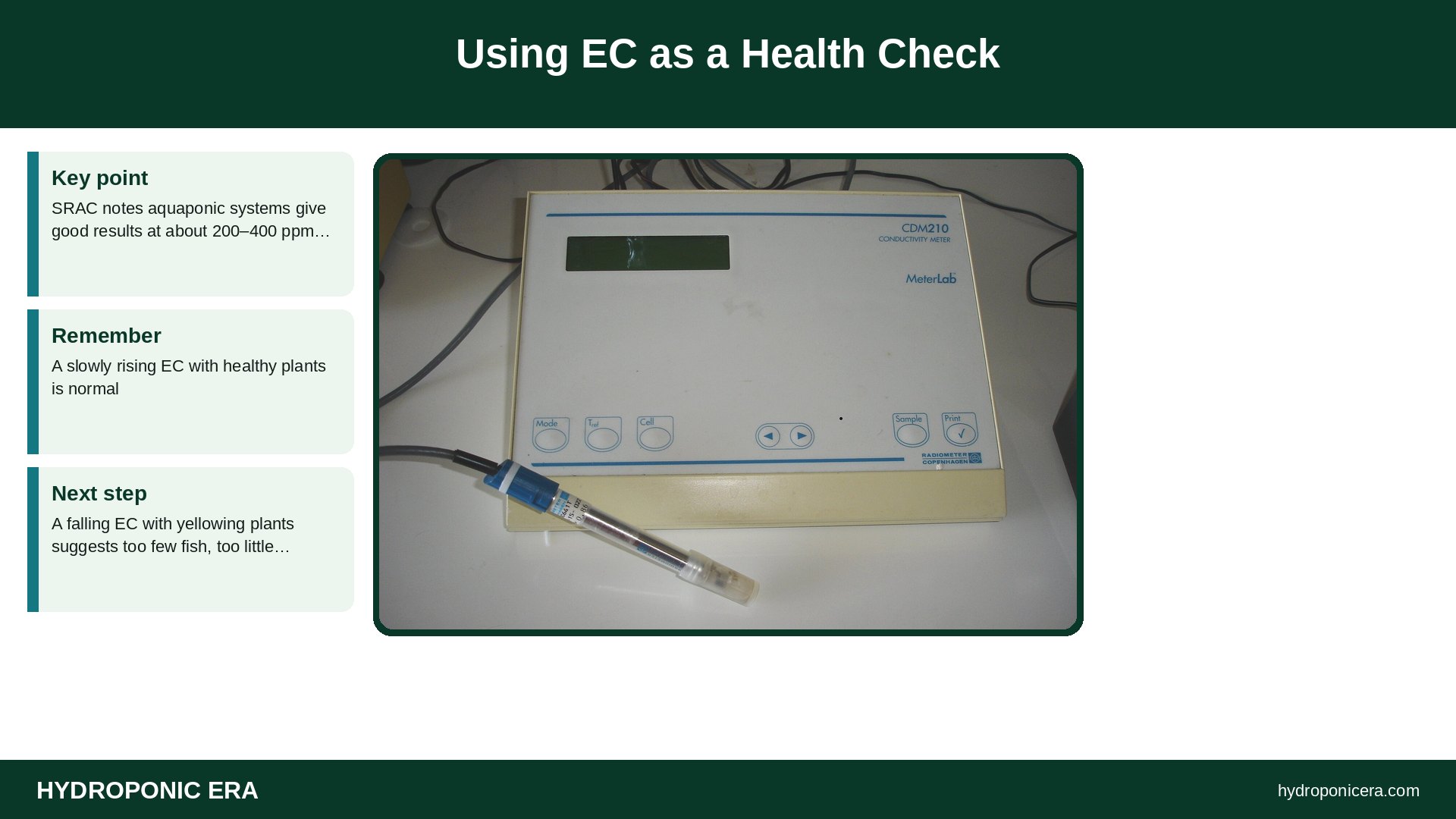
SRAC notes aquaponic systems give good results at about 200–400 ppm TDS (0.3–0.6 mS/cm), much lower than hydroponics, because nutrients are generated continuously. A slowly rising EC with healthy plants is normal. A falling EC with yellowing plants suggests too few fish, too little feed or too many plants. EC can’t tell you which element is short, but it shows the trend. See EC and TDS.
Prevention Routine
- Feed a complete, quality fish feed at a steady rate.
- Test pH, ammonia, nitrite and nitrate weekly.
- Add chelated iron every few weeks or at first sign of pale new leaves.
- Alternate potassium and calcium bases for pH correction.
- Capture and mineralize solids. See aquaponics mineralization.
- Photograph plants weekly and log every supplement.
How to Use This Aquaponics Nutrient Deficiencies Chart
Start with one plant showing clear symptoms. Note whether old or new leaves are affected, whether the yellowing is between the veins or across the whole leaf, and whether fruit is involved. Then test pH, nitrate and EC. Find the row in the aquaponics nutrient deficiencies chart that matches both the location and the pattern, and try the fix on a small scale first. Recheck after one to two weeks; new growth should come in healthy if you picked the right element.
Several aquaponics nutrient deficiencies can appear together, especially iron and potassium in fruiting beds. Fix pH first, then iron, then potassium or calcium, and change only one thing at a time so you can see what worked. Keep a dated photo log; it turns guesswork into a record you can reuse each season.
FAQs
What are the most common aquaponics nutrient deficiencies?
Iron, potassium and calcium.
Can I use hydroponic nutrients in aquaponics?
Not general blends; add single, fish-safe supplements instead.
Why are my new leaves yellow with green veins?
Most likely iron deficiency, often from high pH.
Why are my old leaves yellow?
Usually nitrogen shortage from too few fish or too little feed.
Do I need to add magnesium?
Rarely; the FAO says it’s generally unnecessary.
How often should I add iron?
Every few weeks, or when new leaves start to pale.
Sources
- FAO — Small-scale aquaponic food production
- Southern Regional Aquaculture Center — SRAC 454: Aquaponics—Integrating Fish and Plant Culture
- New Mexico State University — Important Water Quality Parameters in Aquaponics Systems
- Photo credits (Wikimedia Commons, edited with titles): Tomate Blatt Kalimangel by Goldlocki (CC BY-SA 3.0); Blossom end rot tomato 2017 A by Fructibus (CC0); AQUAPONIE by Hopeballa (CC BY-SA 4.0); Deepwater Aquaponics Floating Rafts Growing Lettuce, Basil and Arugula by Alabama Extension (CC0); Electrical conductivity meter by Nuno Nogueira (Nmnogueira) (CC BY-SA 2.5)