
Aquaponics calcium deficiency shows up on the newest growth: lettuce tip burn, blossom-end rot on tomatoes and peppers, and distorted, hooked young leaves. Fish feed doesn’t supply enough calcium for most crops, so aquaponic growers add it while buffering pH, usually with calcium hydroxide (hydrated lime), calcium carbonate, crushed coral or seashells. Because calcium moves only with water flow through the plant, good airflow and steady transpiration are just as important as the amount in the water.
Key takeaway: Fix aquaponics calcium deficiency with two steps: add a calcium base when pH drifts down, and keep air moving so plants can actually pull calcium into new leaves and fruit.
| Symptom | Crop | Likely cause |
|---|---|---|
| Brown, dry edges on inner young leaves | Lettuce, greens | Calcium not reaching fast-growing tips |
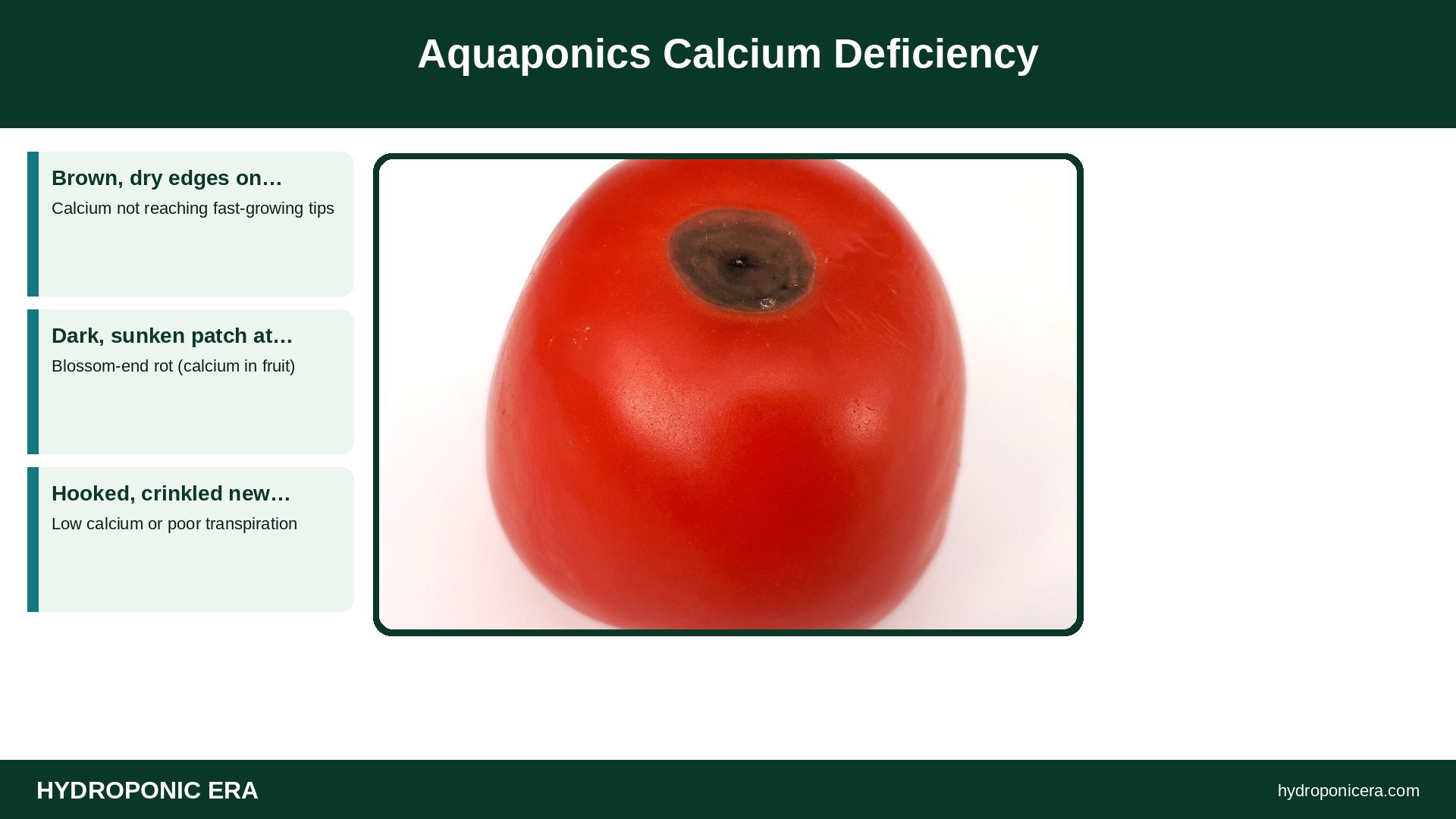
| Dark, sunken patch at the fruit’s base | Tomato, pepper, zucchini | Blossom-end rot (calcium in fruit) |
| Hooked, crinkled new leaves | Many crops | Low calcium or poor transpiration |
| Old leaves pale, new leaves fine | Any | Not calcium; check nitrogen or magnesium |
Why Aquaponics Calcium Deficiency Is Common

The FAO’s small-scale aquaponics manual lists calcium alongside iron and potassium as the nutrients most often deficient, because fish feed is formulated for fish rather than plants. SRAC’s aquaponics fact sheet agrees that calcium and potassium levels are generally insufficient in fish-fed systems. Soft source water makes it worse, and so does relying only on potassium for pH correction.
The FAO also explains that calcium is immobile in the plant and travels only through active xylem transpiration. When conditions are too humid, calcium can be present in the water yet locked out because plants aren’t transpiring. That’s why tip burn often appears in still, humid greenhouses even when calcium tests fine.
Calcium Deficiency Symptoms by Crop
- Lettuce and leafy greens: tip burn on young inner leaves, worst in warm weather and fast growth. See tip burn.
- Tomatoes, peppers, zucchini: blossom-end rot, a leathery dark area on the bottom of the fruit. See blossom-end rot.
- Strawberries: crinkled, small new leaves and soft fruit tips.
- Brassicas: internal browning of young leaves in heads.
For the full picture, compare with calcium and magnesium deficiency.
How to Add Calcium in Aquaponics

Nitrification constantly lowers pH, so the natural time to add calcium is when you raise pH. SRAC describes the UVI commercial system adding calcium hydroxide and potassium hydroxide alternately several times a week to keep pH near 7.0. The FAO adds calcium carbonate, and suggests coral sand or seashells in a mesh bag as an inexpensive slow source that also buffers pH.
| Calcium source | Speed | Notes |
|---|---|---|
| Calcium hydroxide (hydrated lime) | Fast | Raises pH quickly; dissolve and add slowly |
| Calcium carbonate / crushed coral | Slow | Gentle buffer; dissolves faster as pH drops |
| Seashells in a mesh bag | Slow | Cheap; rinse well first |
| Calcium chloride or calcium nitrate | Fast, pH-neutral | Useful when pH is already high; dose carefully |
- Test pH and hardness. If pH is above 7.5, use a pH-neutral source or wait.
- Dissolve first. Mix calcium hydroxide in a bucket of system water and let it settle.
- Add to the sump. Pour slowly, away from fish, and retest after an hour.
- Alternate with potassium. See aquaponics potassium deficiency.
- Log it. Record amount, pH before and after, and plant response.
SRAC cautions that too much calcium can make phosphorus precipitate out of the water, so more is not always better.
Fix Airflow and Humidity Too
The FAO recommends increasing airflow with vents or fans when humidity blocks calcium movement. Gentle air across the canopy, avoiding very high humidity at night, and shading during hot spells all help calcium reach young leaves and fruit. Keep water temperatures moderate; very fast growth in warm water outpaces calcium delivery. See humidity and VPD and airflow and fans.
Sodium Makes It Worse
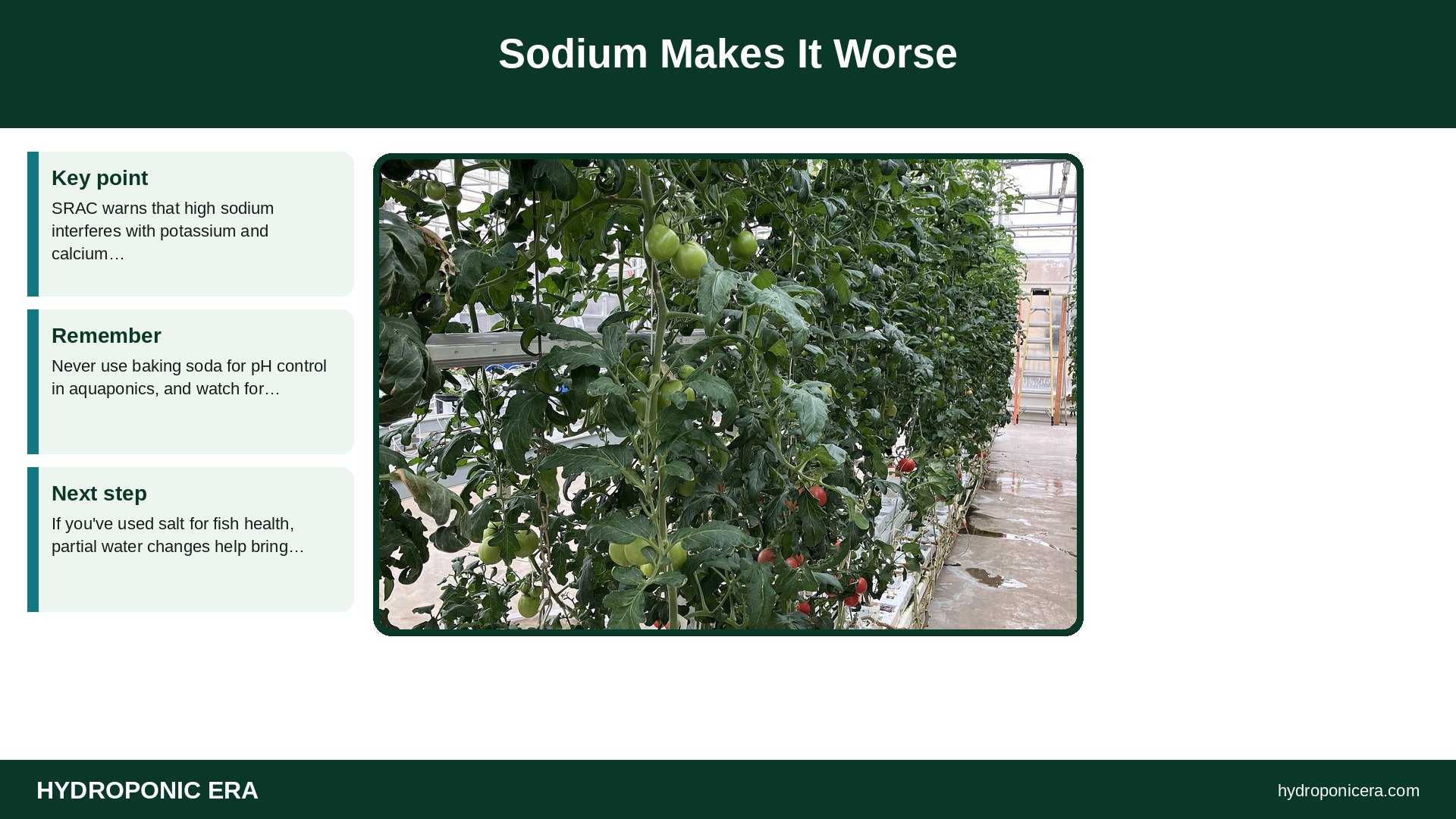
SRAC warns that high sodium interferes with potassium and calcium uptake and specifically mentions lettuce tip burn from reduced calcium uptake. Never use baking soda for pH control in aquaponics, and watch for sodium from salt treatments or softened water. If you’ve used salt for fish health, partial water changes help bring sodium back down. See salt treatment in aquaponics and sodium buildup.
Preventing Aquaponics Calcium Deficiency
- Use a calcium base for at least part of your pH corrections.
- Keep a bag of crushed coral or shells in the sump as a slow buffer.
- Run fans so leaves move slightly; avoid stagnant, humid air.
- Choose tip-burn-resistant lettuce for warm months.
- Harvest lettuce on time; oversized heads tip-burn more.
- Water tomatoes and peppers evenly; flow interruptions trigger blossom-end rot.
Troubleshooting Table

| Situation | Action |
|---|---|
| Tip burn but calcium source in use | Improve airflow, lower humidity, slow growth slightly |
| Blossom-end rot on first fruits | Add calcium, keep flow constant, remove affected fruit |
| pH always high, can’t add lime | Use calcium chloride carefully or let pH drift down first |
| Symptoms after a salt treatment | Partial water change to dilute sodium |
| Pale new leaves with green veins | Not calcium; check iron |
Leafy Greens vs Fruiting Crops
The FAO notes the choice of buffer can follow your crops: leafy vegetables may need more calcium, and fruiting plants more potassium. A greens-heavy raft system might lean on calcium hydroxide, while a tomato bed would alternate more toward potassium. Mixed systems simply alternate. Mineralizing fish solids also recycles some calcium back into the water; see aquaponics mineralization.
Aquaponics Calcium Deficiency in Hard vs Soft Water
Source water makes a big difference. Hard well water or city water often carries plenty of calcium and carbonate, so aquaponics calcium deficiency is less common, but pH tends to stay high. Soft water, rainwater and RO water carry almost no calcium, so systems filled with them need regular calcium additions from the start. Test your source water’s hardness once, and again if you change sources. See GH and KH water tests and rainwater in hydroponics.
If your water is hard and pH sits near 7.5, you may not need any lime at all; let nitrification bring pH down, then use calcium carbonate as a slow buffer. If your water is soft, plan on calcium hydroxide or crushed coral as a routine part of preventing aquaponics calcium deficiency.
FAQs
What causes aquaponics calcium deficiency?
Low calcium in fish feed, soft water, and poor transpiration in humid air.
How do I add calcium to aquaponics?
Use calcium hydroxide, calcium carbonate, crushed coral or shells while correcting pH.
Is tip burn always calcium deficiency?
It’s a calcium delivery problem, often from humidity or fast growth rather than low levels.
Can I use eggshells?
Clean, crushed shells release calcium slowly, much like seashells.
Will blossom-end rot fruit recover?
No; remove it and protect the next fruits.
Is calcium safe for fish?
Yes, when added slowly and pH stays in range.
Sources
- FAO — Small-scale aquaponic food production
- Southern Regional Aquaculture Center — SRAC 454: Aquaponics—Integrating Fish and Plant Culture
- Cornell CEA — Cornell CEA Lettuce Handbook
- Photo credits (Wikimedia Commons, edited with titles): Blossom end rot tomato 2017 A by Fructibus (CC0); Tomato je by Softeis (CC BY-SA 3.0); Hydroponic lettuce @ Plaine des Cafres 03 by Rémih (CC BY-SA 4.0); Solanum lycopersicum in aquaponics at the NC Greenhouse Nursery by Gogerr (CC BY-SA 4.0); Electrical conductivity meter by Nuno Nogueira (Nmnogueira) (CC BY-SA 2.5)