
Aquaponics potassium deficiency is common because fish feed contains far less potassium than fruiting plants need. It shows first on older leaves as yellowing or brown, scorched spots along the margins, weak stems and poor flowering or fruit fill. The standard fix is to add potassium while you correct pH: dose small amounts of potassium hydroxide or potassium carbonate whenever pH drifts toward 6.0, and alternate with a calcium base. Seaweed extract is a gentler organic option for small systems.
Key takeaway: If old leaves on tomatoes, peppers or cucumbers scorch at the edges while nitrate looks fine, suspect potassium first, check pH, then supplement through your pH buffer rather than adding random fertilizer.
| Sign | Potassium deficiency? | Look-alike |
|---|---|---|
| Brown, burned spots on old leaf edges | Likely | Salt or nutrient burn |
| Yellowing between veins on old leaves | Possible | Magnesium deficiency |
| Pale new leaves, green veins | Unlikely | Iron deficiency |
| Small, poorly colored fruit | Likely | Low light, low temperature |
| Whole plant pale, old leaves first | Unlikely | Nitrogen shortage |

Why Aquaponics Potassium Deficiency Happens
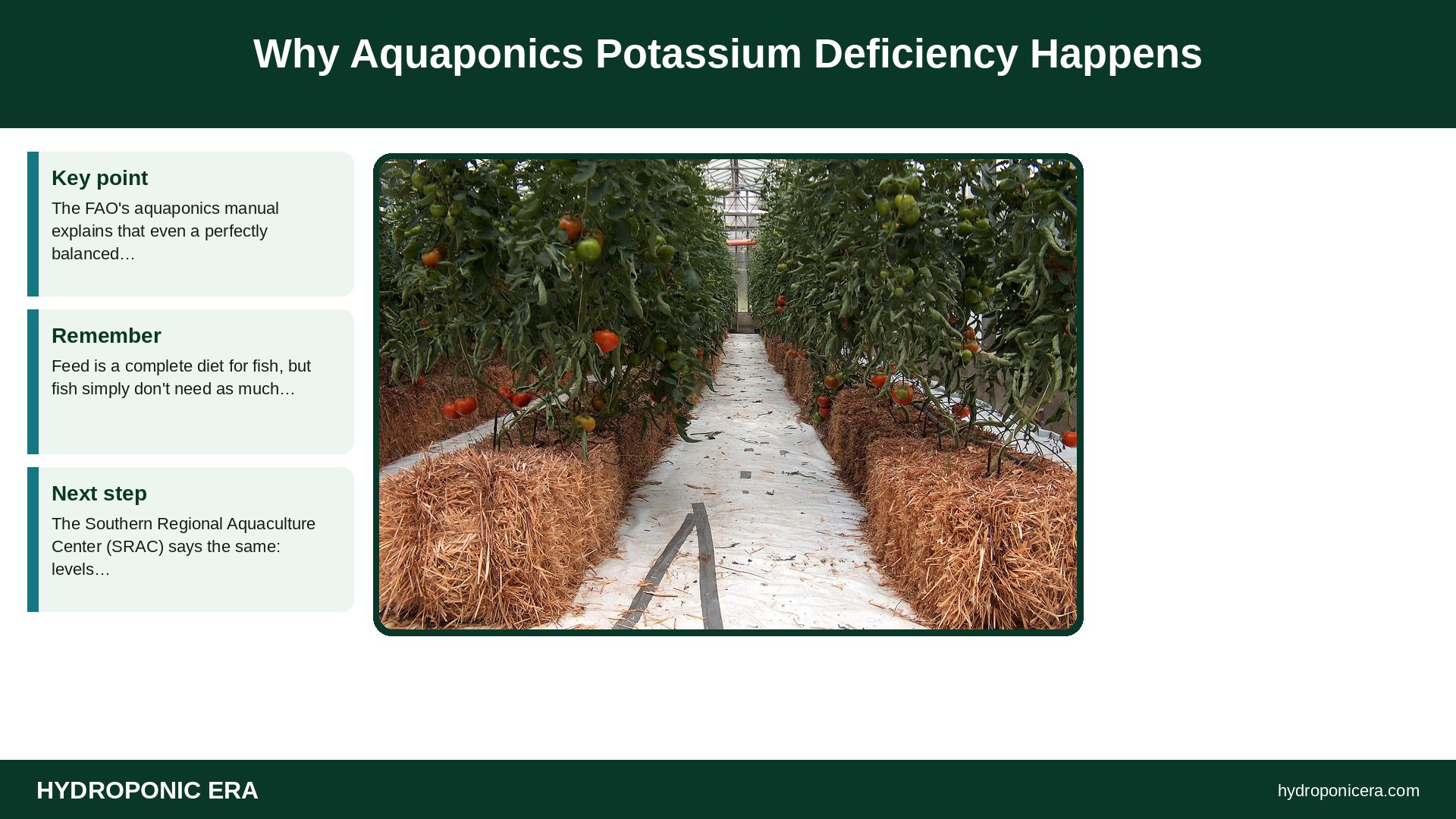
The FAO’s aquaponics manual explains that even a perfectly balanced system may become deficient in iron, potassium or calcium over time because of the composition of fish feed. Feed is a complete diet for fish, but fish simply don’t need as much potassium as plants do. The Southern Regional Aquaculture Center (SRAC) says the same: levels of nitrate, phosphate and sulfate are usually sufficient in aquaponics, while potassium and calcium are generally insufficient.
Demand matters too. Fruiting crops take up much more potassium than lettuce or herbs, so a system that grew greens perfectly can show aquaponics potassium deficiency as soon as tomatoes start to set fruit. Too many plants for the fish load, or reduced feeding in winter, make it worse. See aquaponics fish to plant ratio.
Symptoms to Look For
Potassium is mobile inside the plant, so plants move it from old leaves to new growth. The FAO describes deficiency as burned spots on older leaves with poor vigor and turgor, sometimes with yellowing between the veins near the margins, and notes that flowers and fruits won’t develop correctly without it. In practice, look for:
- Scorched or bronzed edges on lower leaves.
- Yellow tissue between veins near leaf margins.
- Weak, floppy stems and plants that wilt easily.
- Uneven ripening and small fruit on tomatoes and peppers.
- Slower growth even when nitrate is in range.
Compare symptoms with the general guide to potassium deficiency in hydroponics and the visual nutrient deficiency chart.
Check pH Before You Add Anything
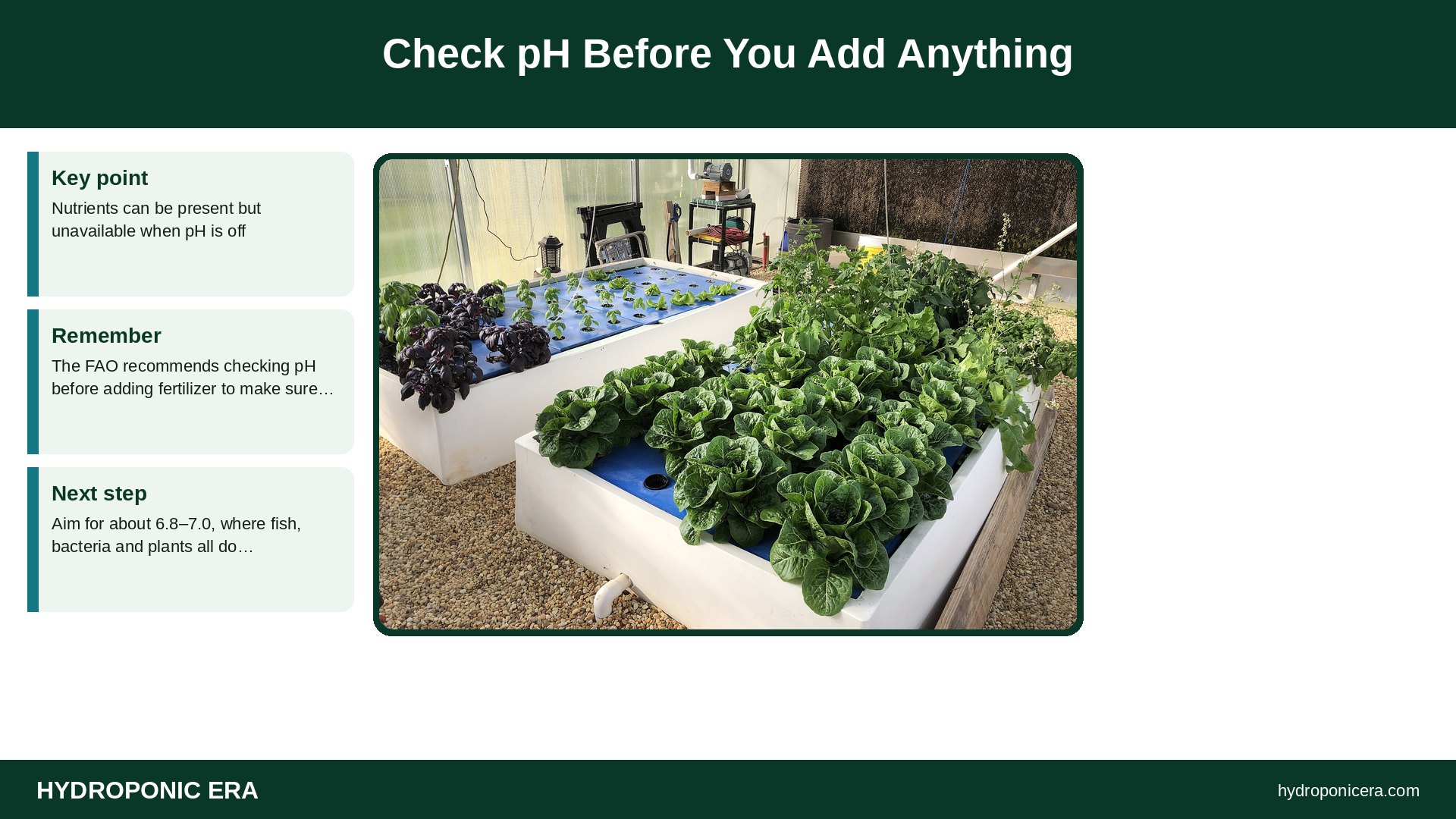
Nutrients can be present but unavailable when pH is off. The FAO recommends checking pH before adding fertilizer to make sure there is no lockout, and treats pH as the most important plant parameter in aquaponics. Aim for about 6.8–7.0, where fish, bacteria and plants all do reasonably well. If pH has climbed above 7.5, fix that first; deficiency symptoms may clear without supplements. See aquaponics pH and nutrient lockout.
How to Fix Aquaponics Potassium Deficiency
Nitrification is acid-producing, so most systems need regular base additions to hold pH. Using a potassium base solves two problems at once. SRAC explains that in the UVI commercial system, potassium is added as potassium hydroxide (KOH) and calcium as calcium hydroxide, alternated several times a week to keep pH near 7.0; this both supplies nutrients and neutralizes acid. The FAO lists the same bases, plus calcium carbonate and potassium carbonate, and notes that fruiting plants benefit from choosing more potassium.
- Test pH, nitrate and EC. Record them so you can see the effect of changes.
- Pick a potassium base. Potassium hydroxide works quickly but is caustic; potassium carbonate or bicarbonate is gentler.
- Dissolve and dilute. Mix a small amount in a bucket of system water first, never pour dry powder near fish.
- Add slowly. Pour into the sump or biofilter, away from fish, and retest pH after an hour.
- Stay under pH 7.5. Small, frequent doses beat one big dose.
- Alternate with calcium. Rotate potassium and calcium bases so neither builds up.
- Watch new growth. Damaged leaves won’t recover; new leaves should come in clean in one to two weeks.
Never use sodium bicarbonate (baking soda) for pH control. SRAC warns that high sodium is toxic to plants and interferes with potassium and calcium uptake.
Organic Options
The FAO recommends seaweed tea, noting seaweed is rich in potassium and iron, which are often lacking in aquaponics; rinse off residual salt first. Commercial liquid kelp extracts are a convenient alternative. Use them as a foliar spray or in small doses in the water, and start with small amounts while you watch plants and fish. See kelp and seaweed extract and foliar feeding.
Mineralizing captured fish solids also recycles some potassium back into the system. See aquaponics mineralization.
What Not to Do
- Don’t add hydroponic bloom nutrients blindly. Many contain ingredients and concentrations that can harm fish or push EC too high.
- Don’t overshoot pH. A spike above 8 can raise toxic free ammonia.
- Don’t confuse it with iron. Pale new leaves with green veins point to iron. See aquaponics iron deficiency.
- Don’t treat every yellow leaf the same. Work through aquaponics plants turning yellow to rule out other causes.
Preventing Aquaponics Potassium Deficiency

Prevention is mostly routine. Buffer pH with potassium and calcium bases instead of only one, keep plant numbers in line with feed input, and plan crops: leafy greens need less potassium than fruiting plants. When you transition a bed from lettuce to tomatoes, increase potassium dosing as flowering begins. Log every addition with the date, amount and pH result so you can spot patterns over a season.
Crops Most Likely to Show It
| Crop | Potassium demand | Notes |
|---|---|---|
| Tomatoes | High | FAO notes potassium is needed from flowering for fruit set |
| Cucumbers | High | FAO lists large nitrogen and potassium needs |
| Peppers | High at fruiting | Needs more K and P for flowering |
| Eggplant | High | FAO lists high N and K requirements |
| Lettuce, herbs | Low to moderate | Rarely deficient in balanced systems |
Quick Aquaponics Potassium Deficiency Checklist
- Are symptoms on older, lower leaves first? If not, look at iron or calcium instead.
- Is pH between about 6.8 and 7.2? If higher, correct pH before treating aquaponics potassium deficiency.
- Is nitrate normal? Normal nitrate with scorched leaf edges points to potassium, not nitrogen.
- Are you growing fruiting crops? Tomatoes, cucumbers and peppers raise potassium demand sharply.
- Have you used only calcium or sodium-free bases lately? Rotating in a potassium base usually solves aquaponics potassium deficiency within a few weeks.
Take photos of the same leaves before and after each change. A simple log is the fastest way to confirm a fix and avoid overdosing.
FAQs
What causes aquaponics potassium deficiency?
Fish feed provides less potassium than plants, especially fruiting crops, need.
What does it look like?
Burned or yellow edges on older leaves and weak fruit development.
Is potassium hydroxide safe for fish?
Yes, when diluted and added slowly while keeping pH below about 7.5.
Can I use potash fertilizer?
Use simple, pure potassium sources; avoid blends with unknown additives.
Does seaweed help?
Yes; seaweed is rich in potassium and iron.
How fast will plants recover?
New growth usually improves within one to two weeks; damaged leaves stay marked.
Sources
- FAO — Small-scale aquaponic food production
- Southern Regional Aquaculture Center — SRAC 454: Aquaponics—Integrating Fish and Plant Culture
- UF/IFAS Extension — Nutrient Solution Formulation for Hydroponic Tomatoes in Florida
- Photo credits (Wikimedia Commons, edited with titles): Tomate Blatt Kalimangel by Goldlocki (CC BY-SA 3.0); Hydroponic g12 by Giancarlo Dessì (CC BY-SA 3.0); Deepwater Aquaponics Floating Rafts Growing Lettuce, Basil and Arugula by Alabama Extension (CC0); Electrical conductivity meter by Nuno Nogueira (Nmnogueira) (CC BY-SA 2.5); AQUAPONIE by Hopeballa (CC BY-SA 4.0)