
Quick Answer: EC and TDS in hydroponics
EC and TDS in hydroponics is easier to manage when you use EC as the shared unit and treat TDS/ppm as a meter estimate.
EC (electrical conductivity) measures how strongly your hydroponic nutrient solution conducts electricity—which rises as dissolved fertilizer salts increase.
TDS (total dissolved solids) on most home meters is estimated from EC and shown as ppm. For day-to-day control, prefer EC in mS/cm (same numeric value as dS/m). Use crop targets as a starting band, then adjust with plant response, growth stage, and water quality—not with a single “magic” ppm number.
Read EC and TDS in hydroponics together with hydroponic pH control and a calm nutrient mixing routine. When strength climbs or becomes unstable, review your reservoir change schedule.
Key Takeaways
- EC is the most reliable beginner unit for nutrient strength; TDS/ppm depends on your meter’s conversion scale (often 500 or 700).
- A higher EC means more dissolved salts; too high can stress plants, too low often means weak feeding.
- Calibrate the meter, stir the solution, wait for a stable reading, then log the result.
- Oklahoma State University publishes crop EC bands (for example lettuce about 1.2–1.8 mS/cm; tomato about 2.0–4.0 mS/cm)—treat them as guidance, not fixed laws.
- Set strength (EC) first, then adjust pH. Dilute with water if EC is high; add hydroponic nutrients carefully if EC is low.
- EC does not reveal which nutrients are imbalanced—pair meter checks with root and leaf observation.
- Small reservoirs change fastest; warm rooms and heavy fruiting crops need more frequent checks.
Related HydroponicEra guides
- How to control pH in hydroponics
- How to use hydroponic nutrients for beginners
- How often to change hydroponic water
- Why hydroponic roots turn brown
- How to grow lettuce hydroponically
- Deep water culture for beginners

EC and TDS in hydroponics: what the readings mean
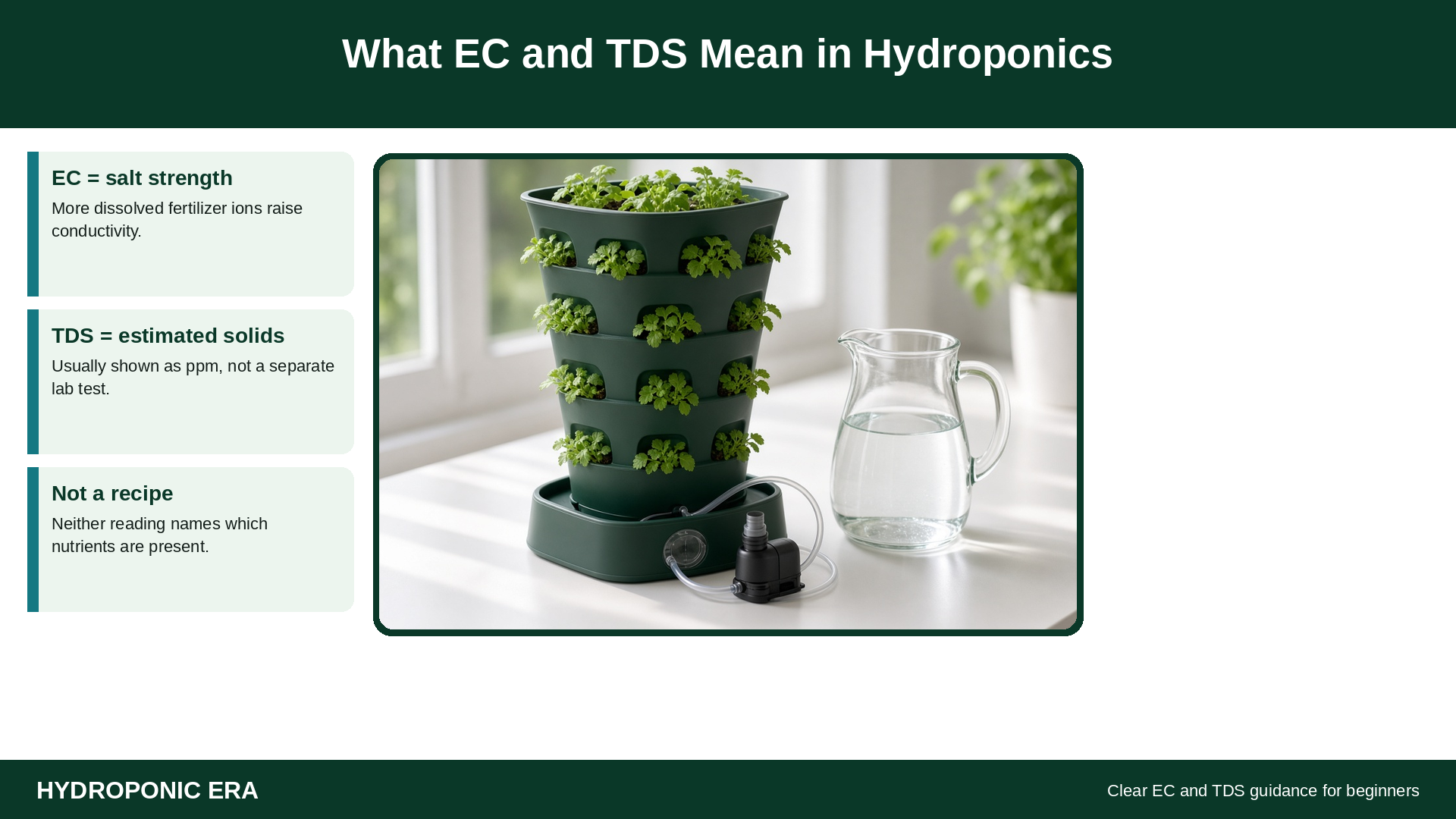
In hydroponics, plants take minerals from a liquid nutrient solution instead of soil. Those minerals are dissolved salts. When salts dissolve, they form ions that carry electrical charge.
Electrical conductivity (EC) is a practical measure of that saltiness: the more dissolved ions in the water, the higher the conductivity reading. Oklahoma State University Extension explains that EC is a good measure of the amount of salts in solution—higher EC means higher salt concentration, lower EC means lower salt concentration. Excessively high levels can contribute to osmotic stress, ion toxicity, and nutrient imbalance; excessively low levels are often linked with deficiency and slower growth.
Total dissolved solids (TDS) refers to the amount of dissolved material in water. On many beginner meters, the “TDS” or “ppm” display is not a separate laboratory assay—it is usually a calculated estimate from the EC reading using a conversion factor (scale).
Important distinction:
- What meters tell you well: overall nutrient strength trend (is the solution getting stronger or weaker?).
- What meters do not tell you: whether nitrogen, calcium, iron, or another specific nutrient is high or low. Penn State Extension emphasizes managing the composition of hydroponic nutrition—not only total concentration.
Think of EC as a speedometer for “how concentrated,” not a full ingredients list.
How EC and TDS Meters Work
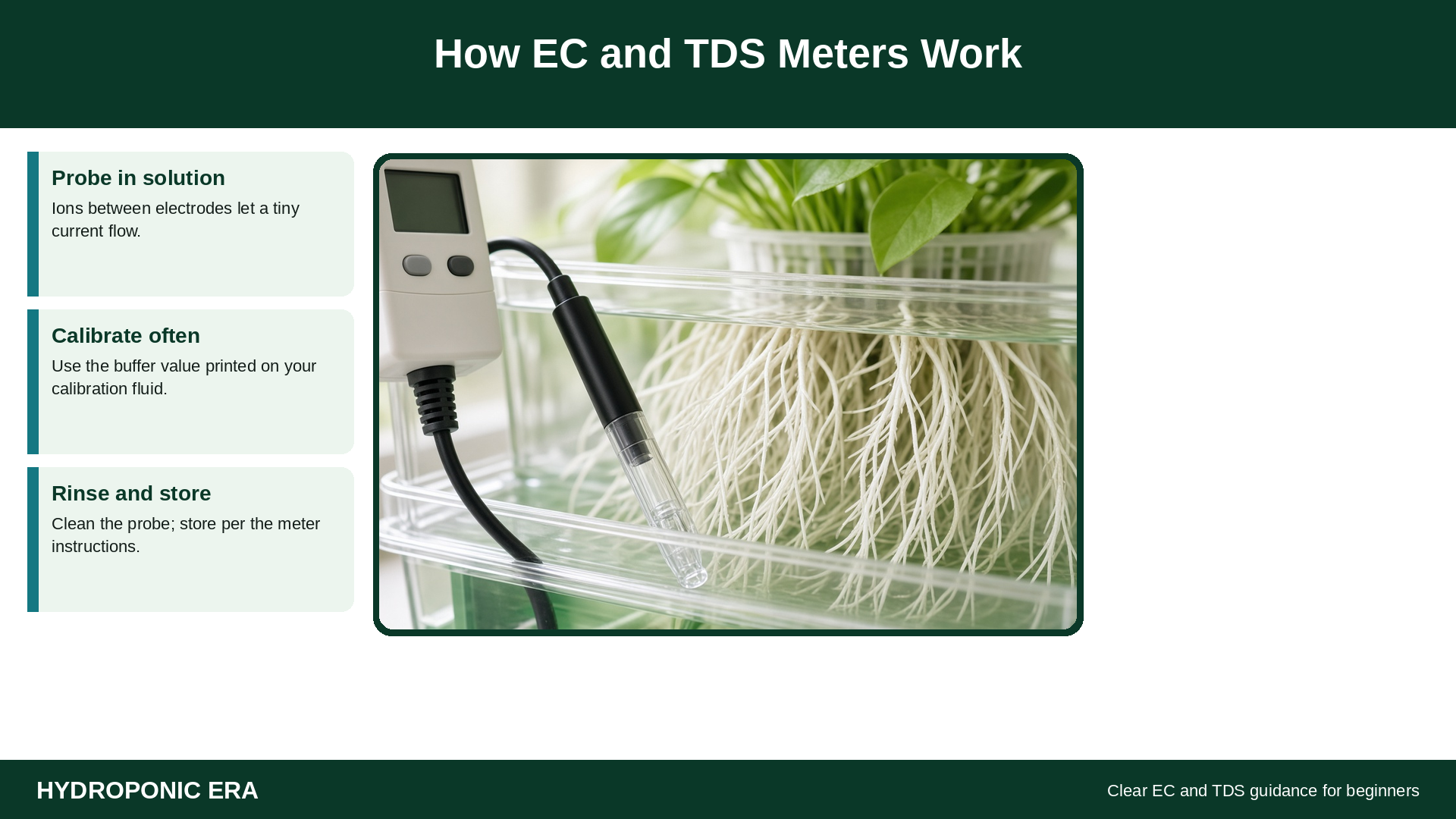
An EC meter places electrodes in the nutrient solution and measures how easily electricity moves between them. More dissolved fertilizer ions usually means a higher reading.
Many handheld meters also show a TDS/ppm value. Internally, they still measure conductivity, then convert it. That is why two meters can disagree on ppm even when they agree on EC.
What you need for reliable EC and TDS in hydroponics readings
- A meter that displays EC in mS/cm (preferred) and/or TDS/ppm
- Calibration solution (buffer) matched to your meter’s instructions—Oklahoma State notes a common EC buffer value around 1.41 mS/cm
- Clean water for rinsing the probe
- A simple logbook or notes app (date, EC, pH, top-ups, plant notes)
Calibration (typical guidance)
- Rinse the probe.
- Place it in the calibration solution and allow the reading to stabilize.
- Set the meter to the buffer’s labeled value (follow your model’s steps).
- Rinse again before measuring your reservoir.
Practical tip: Recalibrate when readings seem “off,” after long storage, or on a regular habit (for example weekly if you measure daily). Exact intervals vary by meter quality and use. When tracking EC and TDS in hydroponics, use the same clean sample method each time.
EC and TDS in hydroponics: EC vs TDS vs PPM Scales
This section causes most beginner confusion. For EC and TDS in hydroponics, the science measurement is conductivity; PPM is often a convenience display.
| Term | What it usually means | Typical unit | Beginner note |
|---|---|---|---|
| EC | Measured electrical conductivity of the solution | mS/cm or dS/m (same number) | Best shared language for guides and crop tables |
| CF | Conductivity factor (related EC wording used in some regions) | Often discussed with mS/cm or µS/cm | 1 mS/cm = 1000 µS/cm |
| TDS | Estimated dissolved solids from EC on most home meters | ppm (mg/L approximation) | Depends on conversion scale |
| 500-scale ppm | Approx. EC (mS/cm) × 500 | ppm | Common on many inexpensive meters |
| 700-scale ppm | Approx. EC (mS/cm) × 700 | ppm | Also common; not interchangeable with 500-scale |
Example (conversion math only—not a crop recommendation): an EC of 1.6 mS/cm is about 800 ppm on a 500-scale meter (1.6 × 500) and about 1120 ppm on a 700-scale meter (1.6 × 700). Same solution, different ppm labels.
Typical guidance: record which scale your meter uses, or switch the display to EC and stay there. Comparing a friend’s “1000 ppm” to your “1000 ppm” is meaningless if the scales differ.
How to Measure EC and TDS in hydroponics (Step by Step)

- Mix the reservoir so the sample represents the whole solution (pumps or a stir help).
- Calibrate if due.
- Rinse the probe with clean water, shake off excess.
- Insert the probe into the nutrient solution (or a cup sample) to the depth your manual requires.
- Wait for the reading to stabilize—Oklahoma State notes this may take a couple of minutes.
- Write down EC (and TDS only if you also note the scale).
- Rinse and store the probe as directed.
When to measure
- After mixing a fresh nutrient solution
- After top-ups with water or nutrients
- On a regular check schedule (many small home systems are checked daily or every few days)
- Whenever leaves, roots, or growth suddenly change
Practical tip: For EC and TDS in hydroponics, measure EC and pH as a pair. Strength and acidity both affect how plants use nutrients. If you run a deep water culture bucket, small volume means numbers can drift quickly.
During EC and TDS in hydroponics checks, compare the number with crop, growth stage, and source-water baseline.
Typical EC Ranges by Crop Type (Variables Matter)
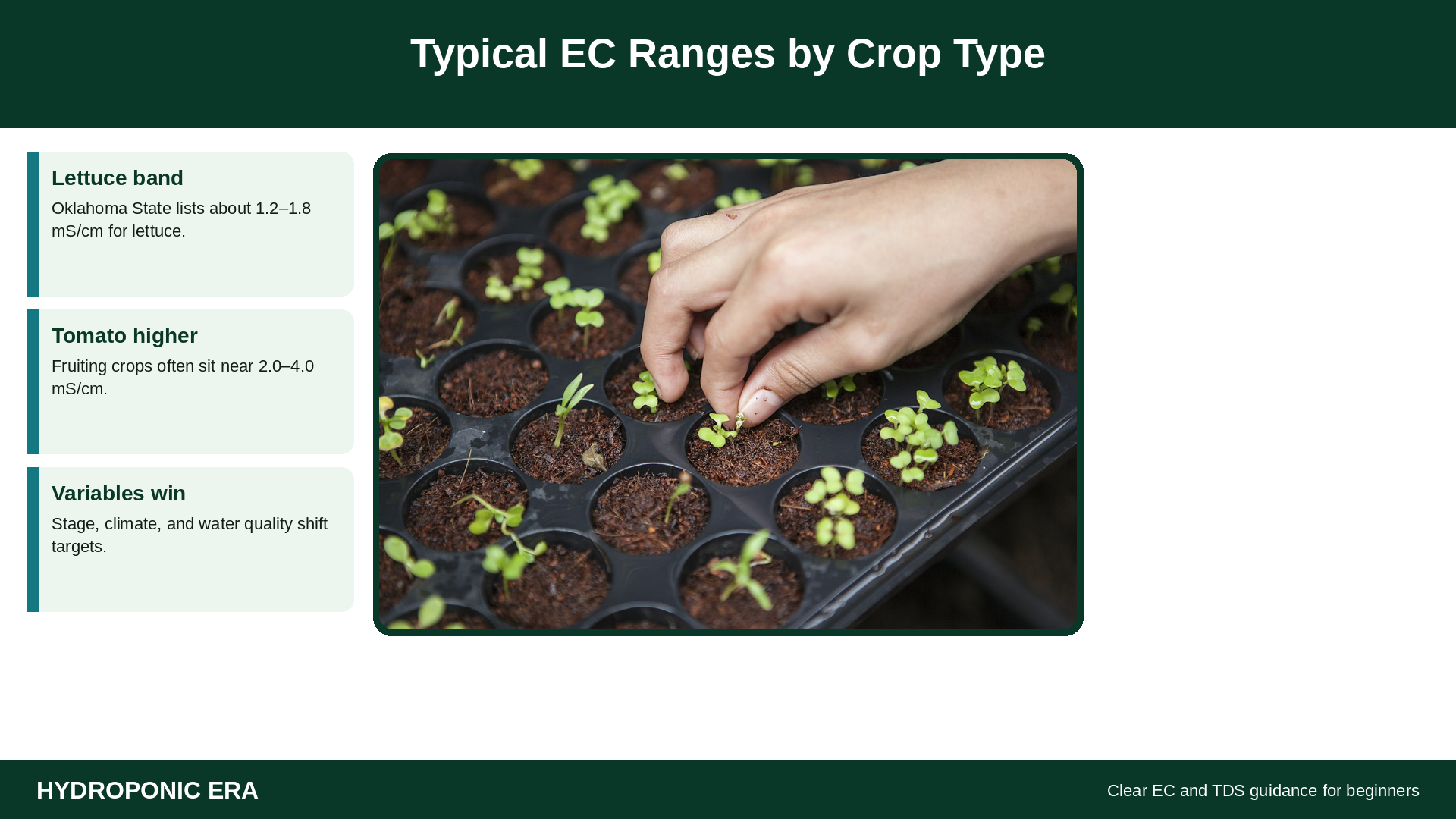
For EC and TDS in hydroponics, the table below summarizes Oklahoma State University Extension optimum EC ranges (mS/cm) for selected hydroponic crops from their Electrical Conductivity and pH Guide for Hydroponics. These are extension starting bands—not HydroponicEra farm trials, and not a promise for every room or system.
| Crop | EC (mS/cm) — OSU table | Notes for beginners |
|---|---|---|
| Lettuce | 1.2–1.8 | Good leafy starting band; see our lettuce hydroponics guide |
| Basil / sage | 1.0–1.6 | Herbs often prefer moderate strength |
| Spinach | 1.8–2.3 | Often a bit stronger than lettuce |
| Strawberry | 1.8–2.2 | Watch pH closely alongside EC |
| Cucumber | 1.7–2.0 | Fruiting crop; monitor as plants load fruit |
| Peppers | 0.8–1.8 | Wide published band—start lower for seedlings |
| Tomato | 2.0–4.0 | Higher end is for established fruiting plants, not seedlings |
| Bean | 2.0–4.0 | Upper values need careful observation |
Oklahoma State also lists other crops (for example eggplant 2.5–3.5; broccoli 2.8–3.5; parsley 1.8–2.2). Always cross-check the current fact sheet if you grow something unusual.
Good EC and TDS in hydroponics decisions use a range as a starting point, then confirm plant response.
Variables that change the “right” number
- Growth stage: seedlings usually need weaker solution than mature fruiting plants.
- Source water: tap water already contains salts that raise baseline EC. OSU recommends water analysis for pH, EC, and alkalinity before you start.
- Climate: heat and high light can increase water use, concentrating salts if you only top up with nutrient-heavy water.
- System type: NFT, DWC, drip, and media beds do not buffer the same way.
- Product label: manufacturer feed charts are another starting point—still verify with your meter.
General starting ranges (practical tip, not a university table): many home growers begin seedlings near the low end of a crop band (sometimes roughly half-strength of the adult target), then raise gradually while watching leaf color and tip burn. If you are unsure, err weaker and increase slowly.
Adjusting EC and TDS in hydroponics safely
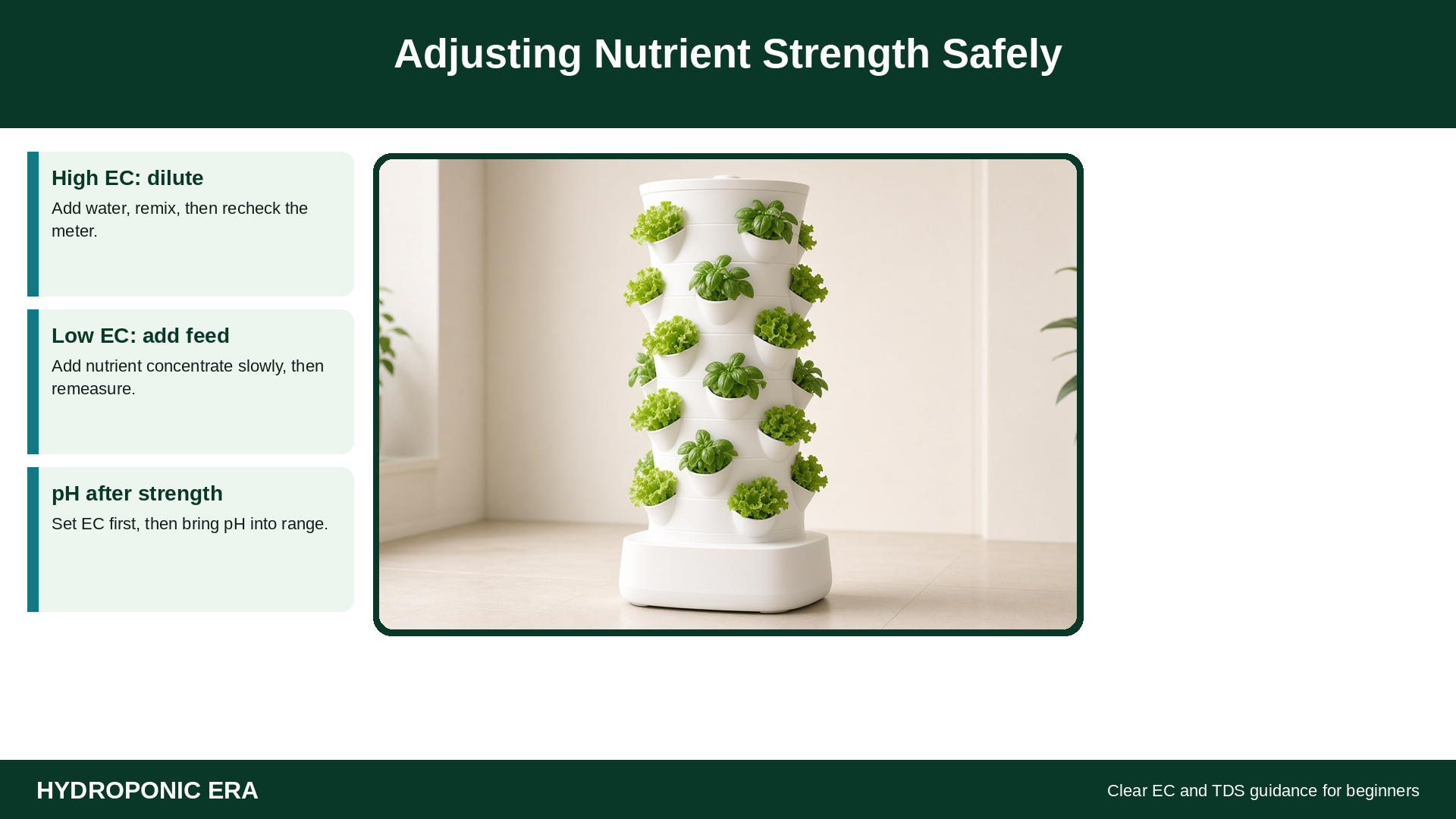
For EC and TDS in hydroponics, Oklahoma State’s EC management steps are a clear beginner pattern:
- Fill with water, then add fertilizer based on manufacturer guidance.
- Calibrate the meter.
- Stir, measure, and wait for a stable reading.
- If EC is above your target, dilute with water, then recheck.
- If EC is below your target, add nutrient concentrate carefully, then recheck.
- Rinse and store the probe properly.
For EC and TDS in hydroponics, then adjust pH into the crop’s range—OSU notes soilless nutrient solutions are often managed so root-zone pH stays near the slightly acidic window where nutrients stay available (their guide discusses nutrient-solution pH commonly around 5–6 to help keep the root environment near about 6–6.5). Use our pH beginner guide for the adjustment routine.
Safe adjustment checklist
- Change one variable at a time when possible (dilute or add feed—not both in big swings).
- Remix and remeasure after each change.
- Avoid dumping large amounts of concentrate into a small tank.
- Never mix concentrated Part A and Part B together before dilution in water.
- If EC keeps climbing after plain-water top-ups, plan a full solution change—see how often to change hydroponic water.
Common Mistakes Beginners Make with EC and TDS
- Treating ppm as universal. 500-scale and 700-scale numbers are not the same strength.
- Skipping calibration. A confident wrong number is worse than no number.
- Measuring unmixed solution. Stagnant corners mislead.
- Chasing leaf color with more feed only. Yellow leaves can be lockout, pH, roots, or light—not always “hunger.”
- Ignoring source water EC. Hard water raises the floor before you add nutrients.
- Topping up with full-strength nutrients every time. Plants often take up water faster than some nutrients, so EC can climb.
- Never changing the reservoir. EC can look “fine” while ratios drift. Composition still matters (Penn State).
- Using garden soil fertilizer charts as EC targets. Hydroponic solutions and soil feeding are different systems.
Troubleshooting EC and TDS Problems
| What you notice | Likely meaning | What to check / do |
|---|---|---|
| EC rising over days | Water use concentrating salts | Top up with plain water (or lower-EC water), recheck; consider full change if still high |
| EC falling while plants grow fast | Nutrient uptake or underfeeding | Add hydroponic nutrients gradually; confirm meter calibration |
| EC jumps after mixing | Dose too strong or poor mixing | Dilute, stir thoroughly, remeasure |
| ppm disagrees with a friend’s meter | Different conversion scales | Compare EC (mS/cm) instead |
| Tip burn / dark leathery leaves with high EC | Possible salt stress | Dilute toward crop band; improve airflow/humidity balance; inspect roots |
| Pale growth with low EC | Possible underfeeding | Raise EC slowly within crop guidance; check pH and light |
| EC stable but plants decline | Imbalance, oxygen, disease, or pH issue | Inspect roots (brown roots guide), pH, temperature, cleanliness |
| Readings bounce wildly | Dirty probe, air bubbles, or failing meter | Clean/calibrate; replace batteries; try a fresh sample cup |
For troubleshooting EC and TDS in hydroponics, pause before adding concentrate and work through the evidence in order.
Decision framework — “What to check in your own system”:
- Is the meter calibrated and rinsed?
- What is EC in mS/cm (not only ppm)?
- What is pH right now?
- Did you recently top up with water, nutrients, or both?
- Are roots pale and healthy, or brown/slimy?
- Is the reservoir warm, cloudy, or light-leaking?
- Is this seedling stage or heavy fruiting?
Answer those before you double the nutrient dose.
Measurement checklist for EC and TDS in hydroponics
Use this routine whenever you sample a reservoir. For EC and TDS in hydroponics, consistency matters more than chasing a perfect number from one reading. Keep the same cup, probe depth, and wait time.
- Label context. For EC and TDS in hydroponics, record crop, growth stage, reservoir size, water source, and last top-up.
- Mix first. Run the pump or stir gently, then sample away from a concentrated nutrient stream.
- Stabilize tools. Rinse the probe, check calibration, and wait for the display to settle. Note whether it reports EC or 500/700-scale TDS.
- Make one change. If EC is high, dilute and recheck; if low, add concentrate in small steps.
Worked example: If lettuce reads 1.4 mS/cm today, record the value and crop stage rather than chasing a mystery ppm target. When you compare EC and TDS in hydroponics tomorrow, the trend shows whether water use or nutrient uptake is shifting the solution.
Before changing feed, use EC and TDS in hydroponics as a trend, then confirm pH, roots, temperature, and leaf condition. This keeps decisions calm and repeatable.
EC and TDS in hydroponics FAQs
Is EC or TDS better for hydroponics beginners?
For EC and TDS in hydroponics, EC in mS/cm is usually clearer because it avoids 500 vs 700 ppm confusion. If your meter only shows TDS, learn its scale and convert back to EC when reading crop charts.
What EC should I use for lettuce?
When managing EC and TDS in hydroponics, Oklahoma State University lists lettuce at about 1.2–1.8 mS/cm. Start toward the lower end for young plants and adjust with growth and leaf quality.
Why did my EC go up after I only added water?
If you added nutrient-containing water, or if previous top-ups left salts behind while plants drank, concentration can rise. Plain low-mineral water top-ups usually lower EC; track what you actually add.
Can EC be perfect while plants still look sick?
Yes. For EC and TDS in hydroponics, EC is a total. Individual nutrients, pH, oxygen, temperature, pests, and light can still be wrong. Treat the meter as one instrument, not the whole diagnosis.
How often should I check EC?
Typical home guidance is frequent checks on small reservoirs—often daily or every few days—plus after every mix or major top-up. Larger, stable systems may drift slower, but you still need a routine.
Do I adjust pH or EC first?
Practical order for most beginners: mix nutrients → set strength (EC) → then adjust pH. Nutrients change pH, so pH-first often wastes time.
What if my tap water EC is already high?
Get a water test if possible (OSU recommends analyzing source water). High baseline salts leave less room for fertilizer. Some growers use reverse osmosis or blended water; choose based on your test results and budget.
Sources
- Dunn, B., & Singh, H. (2017). Electrical Conductivity and pH Guide for Hydroponics (HLA-6722). Oklahoma State University Extension. https://extension.okstate.edu/fact-sheets/electrical-conductivity-and-ph-guide-for-hydroponics.html
- Penn State Extension. Hydroponics Systems and Principles Of Plant Nutrition: Essential Nutrients, Function, Deficiency, and Excess. https://extension.psu.edu/hydroponics-systems-and-principles-of-plant-nutrition-essential-nutrients-function-deficiency-and-excess
- Parkell, N., et al. UF/IFAS. Leafy Greens in Hydroponics and Protected Culture for Florida (HS1279). https://edis.ifas.ufl.edu/publication/HS1279
Last reviewed for source URLs: September 2026. Crop EC numbers in the table are from Oklahoma State University Extension HLA-6722; always verify the live fact sheet for updates.
17 thoughts on “EC and TDS in Hydroponics: 7 Essential Beginner Tips”