
Quick Answer
Grow rosemary hydroponically only if you can provide strong light, a well-oxygenated root zone, careful moisture balance in media systems, and patient woody growth. University of Minnesota Extension lists rosemary as a warm-season herb that prefers warmer soils than cool-season herbs and needs abundant sunlight. Hydroponic rosemary is possible, but it is less forgiving than basil, mint, or lettuce—woodier stems establish more slowly, and chronically wet, low-oxygen roots fail quickly.
If you want an easy first herb, start with basil or mint. Use rosemary when irrigation timing, light metering, and sanitation are already solid.
Key Takeaways
- UMN Extension groups rosemary with warm-season herbs (basil, lavender, oregano) rather than cool-season parsley types.
- Full sun outdoors translates indoors to relatively high light—weak LEDs make spindly rosemary.
- Root-zone oxygen and wet-dry media cycles matter more than dumping extra nutrients.
- Cuttings often establish faster than seed for home growers.
- Prune for bushiness; do not expect lettuce-speed harvests.
- Dutch bucket or well-managed media systems often suit woody herbs better than deep warm rafts.
- Be honest: soil containers remain easier for many hobbyists—and that is okay.
Related HydroponicEra guides
- Basil hydroponics
- Mint hydroponics
- Cilantro hydroponics
- Growing media
- Dutch bucket beginners
- Grow lights
- PPFD/DLI
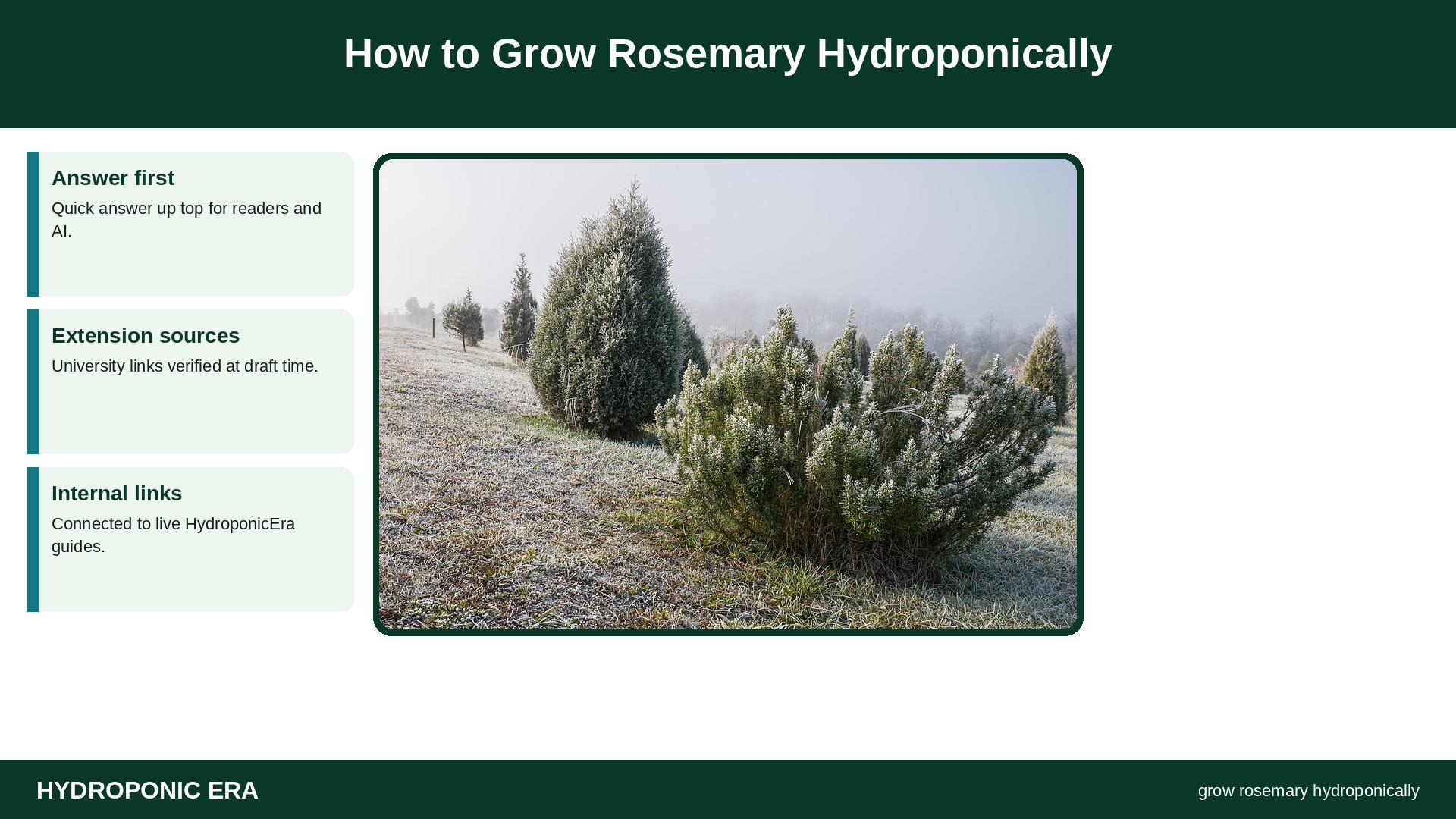
Why Rosemary Is Harder Than Basil
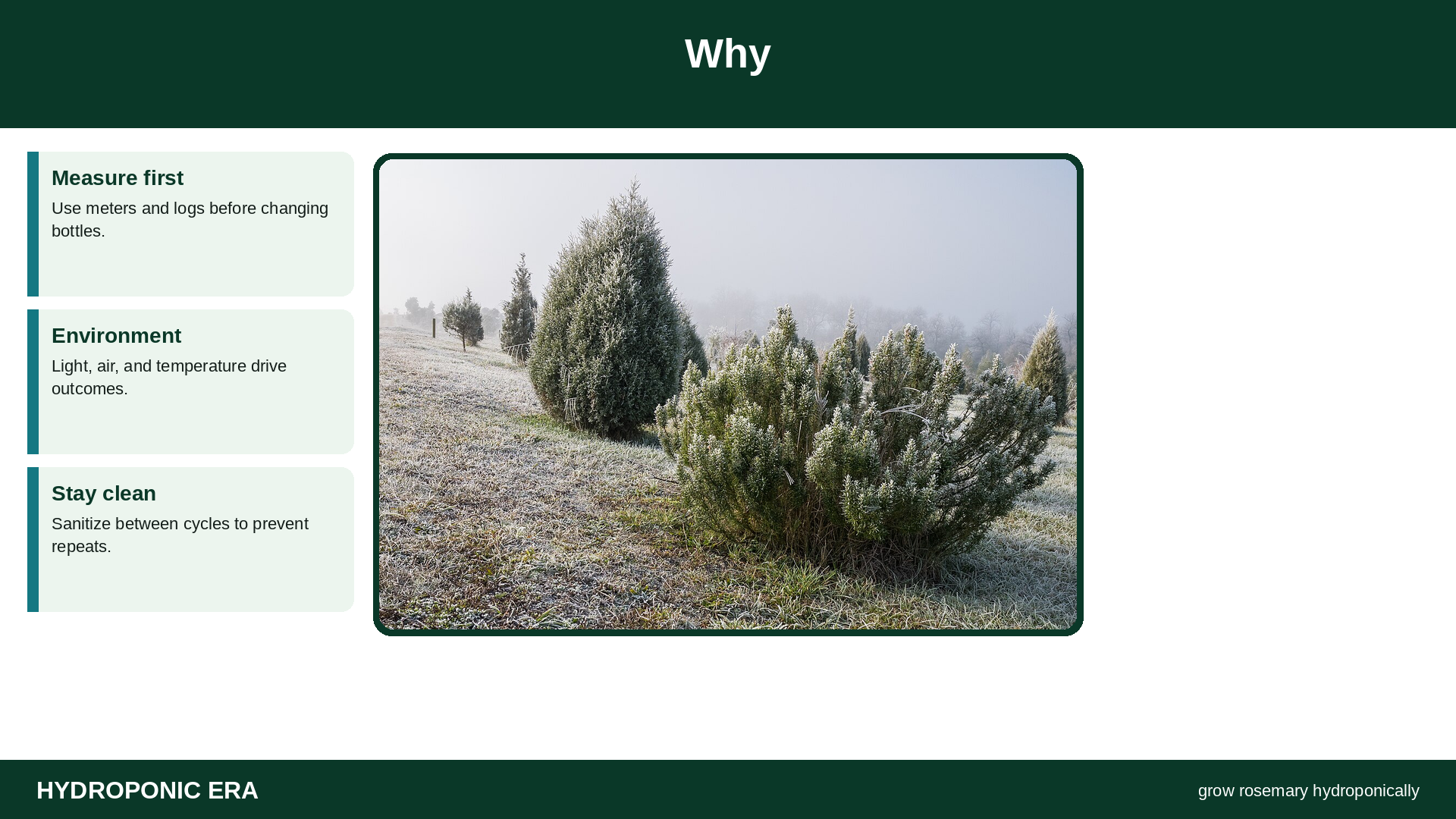
Rosemary (Salvia rosmarinus / Rosmarinus officinalis) is a woody perennial herb. UMN Extension’s herbs guide places it in the warm-season group and emphasizes drainage and sunlight for garden herbs generally. Soft herbs like basil forgive beginner mistakes; rosemary remembers wet feet.
In hydroponics, that means strong light, oxygenated roots, and avoiding stagnant warm water around a woody crown. Penn State’s hydroponic nutrition primer still applies—complete nutrition matters—but environment usually fails first.
Many successful home growers start rosemary from cuttings rather than seed, then transition rooted cuttings into net pots with airy media. See also this batch’s cuttings/cloning guide once published, and the seedlings/transplanting article for handling young plants.
Choose a System
| System | Beginner fit for rosemary | Watch-outs |
|---|---|---|
| Dutch bucket / drip media | Best common fit | Do not keep media soggy |
| Media bed | Good | High oxygen; careful irrigation timing |
| NFT | Advanced | Woody roots and channel issues |
| Deep warm DWC | Poor beginner fit | Low oxygen + wet crowns |
| Kratky jar | Risky demo | Often declines after early growth |
Compare systems in DWC vs NFT vs Dutch bucket.
Step-by-Step
- Prefer cuttings from healthy plants when possible.
- Root cuttings in clean media with humidity and bright light, then harden.
- Transplant into net pots with airy media (media guide).
- Provide strong light (lights, DLI).
- Use a complete nutrient solution at moderate strength; do not overfeed early.
- Set pH near 5.5–6.5 and monitor weekly (pH guide).
- Irrigate for wet-dry balance in media systems—roots need oxygen between pulses.
- Prune tips to encourage branching; harvest lightly at first.
- Watch mildew and pests in stagnant humid corners (pests).
- Sanitize between plantings (cleaning).
Variables
| Variable | Guidance | Notes |
|---|---|---|
| Light | High relative to leafy greens | Weak light = weak plants |
| Root oxygen | Critical | Woody herbs hate stagnation |
| Irrigation | Pulse media; avoid swamp | Dutch/drip friendly |
| pH | ~5.5–6.5 | Lockout shows on new growth |
| EC | Moderate, not tomato-max | EC/TDS logging helps |
| Pruning | Regular tip cuts | Builds bushiness |
Common Mistakes
- Starting rosemary as your first hydroponic plant
- Deep-water culture in a warm cabinet with weak light
- Keeping media permanently saturated
- Expecting basil-speed harvests
- Never pruning, then wondering why it is a single tall stick
- Ignoring root smell until collapse
- Chasing deficiencies with bottles while roots are anaerobic
Troubleshooting
| Symptom | Likely causes | What to do |
|---|---|---|
| Needle drop / decline | Low light / root stress | Increase light; inspect roots; improve oxygen |
| Brown mushy roots | Low DO / disease | Brown roots; sanitize; rethink system |
| Yellow new growth | pH lockout / Fe issues | Lockout; verify pH |
| Spindly growth | Insufficient DLI | Raise light carefully |
| Powdery film on leaves | Humidity + poor airflow | Improve airflow; see powdery mildew article |
| Woody bare stems | No pruning / low light | Tip prune; improve light; restart from cutting |
What to Check
- PPFD at canopy vs leafy-green habits
- Media moisture cycle (wet then air)
- Root color and smell
- pH/EC weekly
- Pruning schedule
- Whether DWC was the wrong tool for this herb
Schedule
| Stage | Focus | Actions |
|---|---|---|
| Cutting root | Callus and roots | Humidity + bright light |
| Establish | Root oxygen | Gentle feed; strong light |
| Bush building | Prune tips | Light harvests only |
| Production | Steady woody growth | Hold environment |
| Reset | Sanitation | Clean; take fresh cuttings |
Honest Limits
Hydroponic rosemary can work, especially in drip/media systems with strong light. It is still one of the harder culinary herbs for beginners. If your goal is weekly kitchen herbs with minimal drama, basil, mint, and parsley teach better habits first.
For nutrient principles, see Penn State Extension’s hydroponic nutrition page and HydroponicEra’s nutrients, pH, and yellow leaves guides. For oxygen failures, use dissolved oxygen and air pumps articles even if you eventually move rosemary off deep water culture.
Decision tree: If roots smell sour and needles drop, stop adding fertilizers. Fix oxygen, temperature, and sanitation—or move the plant to a better-aerated media system.
Final Checklist
- Strong light capability
- Oxygen-first root zone design
- Media/drip preferred over warm deep rafts
- Cuttings over slow seed when possible
- Pruning for bushiness
- Patient harvest expectations
Mother Plants and Cutting Pipeline
Once you have one healthy rosemary, tip cuttings become your expansion method. Keep a mother in the best-lit, best-drained site and take modest cuttings rather than stripping the plant bare. Woody cuttings need longer rooting windows—label dates so you do not discard them prematurely.
If indoor hydroponic rosemary keeps failing, a well-lit container with careful watering may be the honest better tool for your space. Hydroponics is not mandatory for every herb. Use hydroponics where it shines (leafy greens, basil, mint) and choose the system that keeps rosemary alive.
Prune after a flush of growth by tip-pinching. Long bare sticks rarely become lush without light and pruning discipline.
Media Moisture Cycle Detail
In drip systems, aim for media that is wet after a pulse and then pulls air as it drains. Constant puddling around a woody stem is a decline pathway. If you cannot feel confident about pulse timing, reduce irrigation frequency before increasing nutrient strength. Rosemary problems are usually water/air balance and light—not a missing magic bottle.
FAQs
Is rosemary good for hydroponic beginners?
Usually no. Learn with basil or lettuce first.
Seed or cuttings?
Cuttings are typically faster and more predictable for home growers.
Can rosemary grow in DWC?
It is a poor beginner choice. Media-based drip or Dutch bucket styles are safer.
How much light?
More than typical leafy greens. Use the PPFD/DLI guide and observe internodes—stretch means more light needed.
Why did my rosemary collapse suddenly?
Root oxygen failure and disease are common. Inspect roots and rethink system choice.
Sources
- University of Minnesota Extension — Growing herbs in home gardens
- Penn State Extension — Hydroponics Systems and Principles of Plant Nutrition
- Oklahoma State University Extension — Hydroponics
- Oklahoma State University Extension — EC and pH Guide for Hydroponics
- Virginia Cooperative Extension — SPES-720 DLI
- University of Florida IFAS — HS1279
- University of Florida IFAS — HS184 Floating Hydroponic Garden