
Quick Answer: nutrient lockout in hydroponics
Nutrient lockout in hydroponics means roots cannot take up one or more nutrients effectively—even if fertilizer is present in the water. The most common beginner driver is a pH that has drifted out of range, often after repeated top-ups, unequal nutrient uptake, or high-alkalinity source water. pH swings make lockout more likely because nutrient availability changes as pH moves. Fix lockout by confirming symptoms, measuring pH and strength, correcting pH into a plant-available band, and resetting the reservoir when the solution has become unstable—not by endlessly adding more bottles of “extra” nutrients.
Start with the pH control guide and a steady nutrient mixing routine. When leaves yellow for unclear reasons, also compare notes with the yellow leaves troubleshooting article.
Key Takeaways
- Lockout is an uptake problem, not always an empty reservoir.
- Oklahoma State University Extension explains that nutrient-solution pH influences nutrient availability; soilless solutions are often managed near pH 5–6 (commonly about 5.5) so the root environment stays near roughly 6.0–6.5.
- Penn State Extension stresses managing nutrient composition—not only total concentration—and shows how pH relates to relative nutrient availability.
- Correct EC/strength first, then bring pH into range (Oklahoma State guidance).
- Chronic top-ups without water changes often create imbalance and wider pH swings.
- Iron and some micronutrients become harder to access when pH climbs too high; other issues appear when pH crashes too low.
- If roots are damaged, fix oxygen and hygiene—healthy membranes are required for uptake.
Related HydroponicEra guides
- How to control pH in hydroponics
- How to use hydroponic nutrients
- How often to change hydroponic water
- Why hydroponic leaves turn yellow
- Why hydroponic roots turn brown
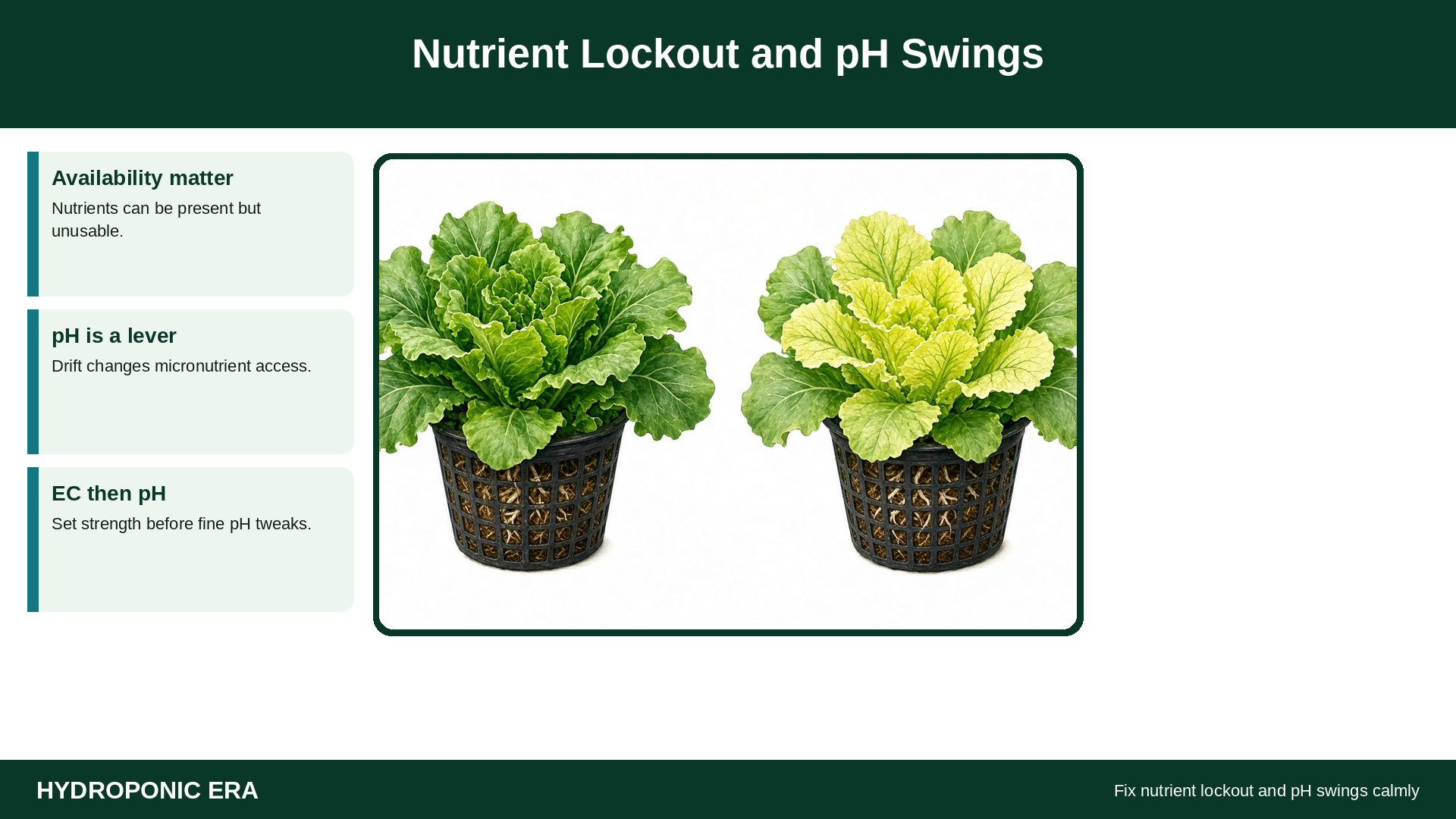
What nutrient lockout in hydroponics means
Deficiency means the solution truly lacks enough of a nutrient. Lockout means the nutrient may be present, but plant roots cannot access it well because of pH, antagonism between ions, root damage, or a poorly mixed/imbalanced solution.
Beginners often “see yellow leaves” and add more fertilizer. If the real problem is lockout, adding strength can worsen burn and imbalance. Penn State Extension documents hydroponic basil severely affected by iron deficiency symptoms that improved when iron availability was addressed—reminding us that micronutrient problems are common when management drifts.
Use this distinction:
- Likely true shortage: EC is very low, plants are pale overall, growth is slow, and you underfed for a long time.
- Likely lockout / availability issue: EC looks “normal” or high, pH is out of range or swinging, and symptoms look like specific shortages (for example interveinal yellowing on new leaves).
Why pH Swings Happen in Hydroponics
When troubleshooting nutrient lockout in hydroponics, stabilize pH before adding more fertilizer.
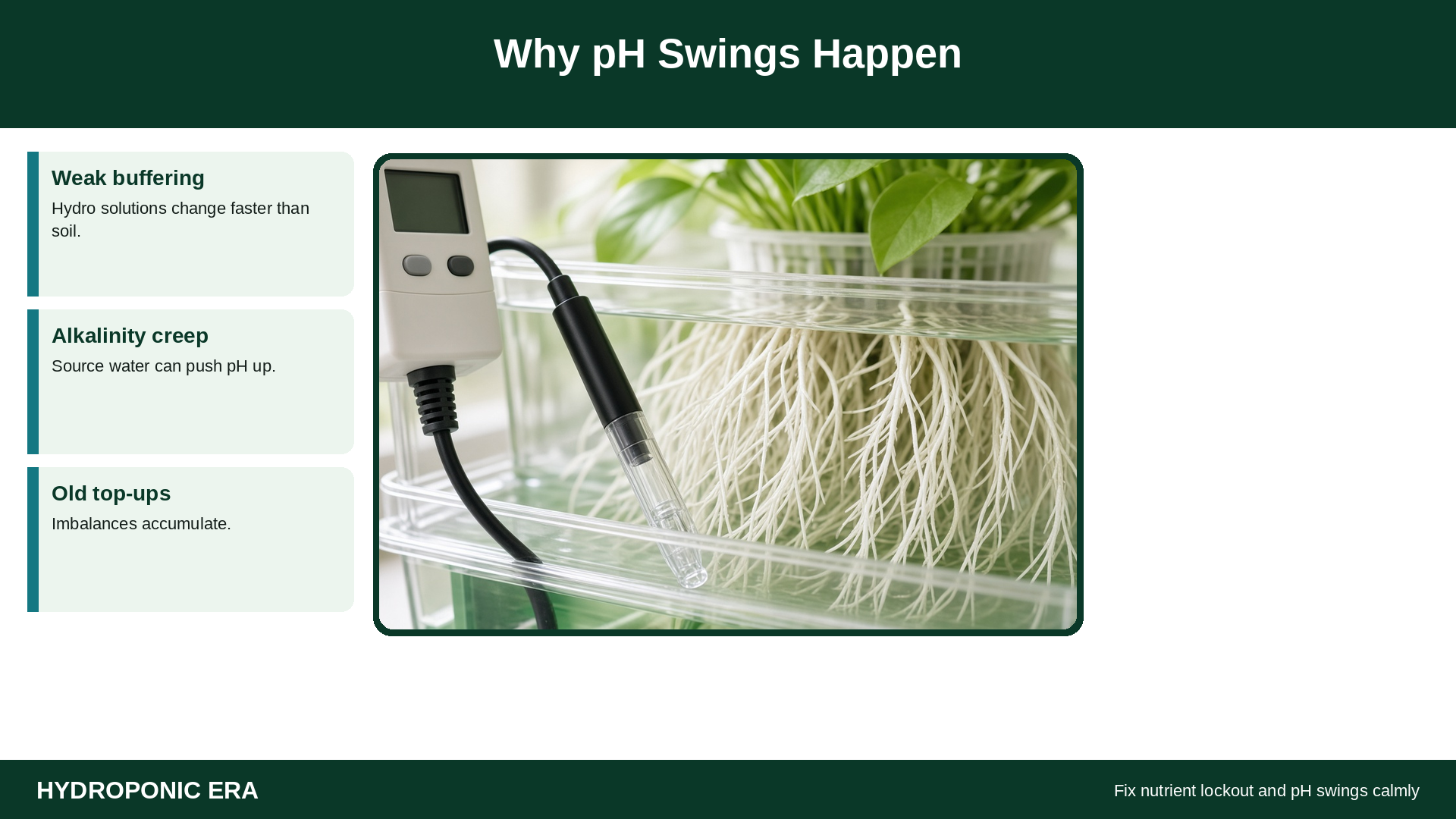
In soil, buffers slow pH change. In hydroponics, that buffer is weaker. Oklahoma State notes that alkalinity (bicarbonates) in source water can push pH upward, and high-alkalinity water (>75 ppm alkalinity in their discussion) requires more frequent pH checks.
Common swing drivers:
- Uneven plant uptake of cations vs anions as crops grow
- Topping up with plain water or nutrient water without rebalancing
- Algae photosynthesis changing daytime chemistry
- Concentrated pH adjusters dumped too quickly
- Small reservoirs that change composition fast
- Root problems reducing uptake predictability
Oklahoma State also recommends checking pH and EC daily, at a consistent time of day, and refreshing nutrient solution on a regular cadence (their guide discusses complete refresh about every two weeks as a management example—adjust to your system size and crop).
Nutrient Lockout in Hydroponics: Step-by-Step Fix
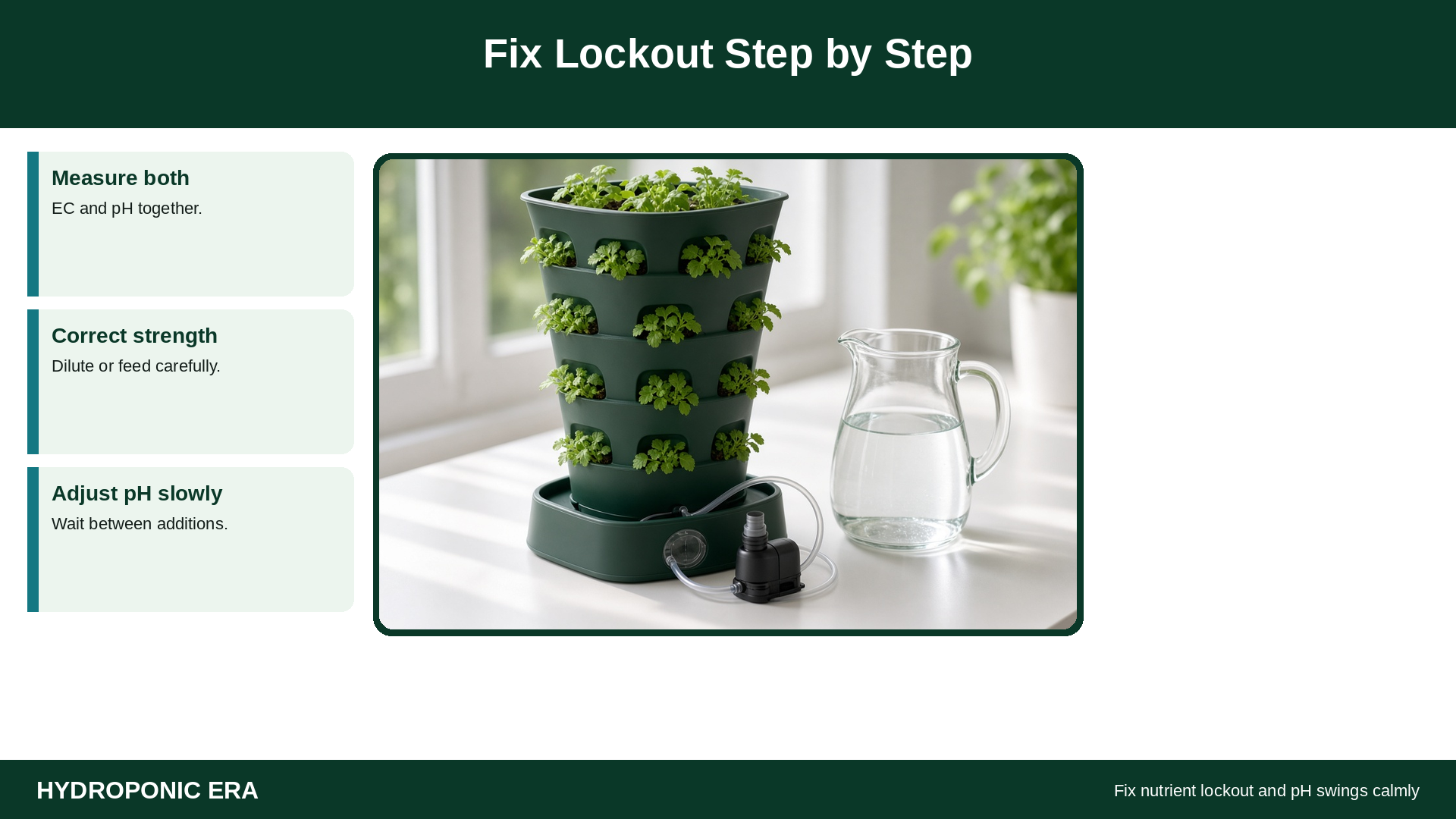
- Observe plants and roots. Note which leaves are affected (new vs old), and whether roots are white/cream vs brown/slimy.
- Measure EC (or TDS) and pH in a stirred sample. Prefer EC units when possible.
- If EC is extremely high, dilute with water, remix, and remeasure before chasing pH.
- If EC is extremely low, add hydroponic nutrients gradually to a sensible crop band, then remeasure.
- Adjust pH slowly into your target band after strength is reasonable.
- Oklahoma State describes using pH-down materials (such as phosphoric/citric approaches or commercial pH down) when high, and pH-up materials when low—added gradually with waiting time between additions.
- If the solution has been topped up for a long time or readings will not stabilize, perform a full reservoir change.
- Resume a logging habit: date, EC, pH, top-ups, and plant notes.
- Only then consider specific additives (for example iron) if symptoms and crop stage still justify it—and follow label rates.
Important Variables
These variables help explain nutrient lockout in hydroponics without guessing.
| Variable | Why it matters | Beginner target mindset |
|---|---|---|
| Solution pH | Controls relative nutrient availability | Often managed ~5.0–6.0 in solution (extension guidance) |
| EC / strength | Too high stresses; too low underfeeds | Crop band + plant response |
| Alkalinity of source water | Pushes pH up over time | Test water; check pH more often if alkaline |
| Reservoir size | Small volumes swing faster | Measure more often in small bins |
| Root health | Damaged roots uptake poorly | White roots + oxygen + moderate temp |
| Top-up vs change | Imbalances accumulate | Periodic full resets |
Symptom and Action Table
Use this table when nutrient lockout in hydroponics appears as pale leaves or stalled growth.
| Pattern | Possible meaning | Check first | Action |
|---|---|---|---|
| New leaves yellow, veins greener; pH high | Micronutrient availability issue (often iron-related) | pH, EC, root color | Correct pH; consider reservoir reset |
| Tips burnt; EC high | Excess salts / overfeeding | EC trend | Dilute or change water |
| pH climbs every day | Alkalinity / uptake / algae | Source water, algae, plant stage | More frequent checks; fix alkalinity drivers |
| pH crashes | Over-acidifying or root/microbial issues | Recent adjuster dose, roots | Raise gently; inspect roots |
| Symptoms with “perfect” EC but dead roots | Uptake failure from root damage | Oxygen, temperature, smell | Treat as root emergency |
| Mixed deficiency looks after long top-ups | Imbalanced old solution | Age of reservoir | Full nutrient change |
Common Mistakes
- Adding more nutrients when pH is wrong
- Adjusting pH before correcting extreme EC
- Pouring large pH doses at once
- Never testing source water alkalinity
- Chasing every leaf symptom with a new bottle
- Ignoring root health while staring only at leaves
- Using uncalibrated pens and trusting fantasy numbers
Troubleshooting Flow
A calm nutrient lockout in hydroponics check starts with roots, pH, EC, and water temperature.
- Calibrate meters if readings seem unbelievable.
- Stir and remeasure EC + pH.
- If EC out of band → correct strength.
- If pH out of band → correct slowly.
- If unstable for days → change reservoir.
- If roots poor → oxygen, temperature, hygiene.
- If still unsure → compare yellow-leaf and brown-root guides before adding specialty products.
pH Swing Prevention Routine (Beginner)
For nutrient lockout in hydroponics, log pH at the same time each day.
Use this calm weekly rhythm for small home reservoirs:
- Day 0 (fresh mix): Mix nutrients to target strength, stir, measure EC, then set pH. Write both numbers down.
- Daily or every other day: Stir, measure EC and pH at the same time of day. Oklahoma State recommends consistent timing.
- If water level drops: Top up thoughtfully. Plain water top-ups can change strength and pH; nutrient top-ups can concentrate imbalances if overdone. When in doubt, measure after top-ups.
- If pH drifts the same direction for several days: Correct gently and ask why (alkalinity, algae, crop stage, old solution).
- Scheduled reset: Change the reservoir before the solution becomes a chemistry mystery. Smaller tanks usually need more frequent resets than large ones.
- After any major correction: Recheck 12–24 hours later. Lockout symptoms on leaves may take longer to show clean new growth.
Original value framework — “Lockout likelihood score” (self-check): Give yourself one point for each yes: (1) pH outside your target band, (2) EC much higher than crop needs, (3) reservoir older than your planned change interval, (4) uncalibrated meter, (5) brown/slimy roots, (6) visible algae, (7) you added multiple corrective bottles this week. Score 0–2: monitor. Score 3–4: correct basics today. Score 5+: prioritize a clean reset and root inspection before more additives.
Penn State’s nutrient availability discussion is a reminder that pH is not a vanity number—it changes which nutrients plants can access. Oklahoma State’s guidance to set EC first, then pH, prevents a common loop where growers chase pH inside an over-concentrated soup.
Source Water, Alkalinity, and Meter Discipline
Source water can trigger nutrient lockout in hydroponics when alkalinity pushes pH out of range.
Oklahoma State emphasizes testing source water for pH, EC, and alkalinity because poor-quality water complicates hydroponic management. If your tap water is highly alkaline, pH may creep upward even when plants are healthy. That creep can slowly lock out micronutrients.
Meter discipline checklist:
- Calibrate pH and EC pens on a schedule you can remember
- Rinse probes; store as the manufacturer directs
- Stir before measuring
- Wait for stable readings
- Log numbers with clock time
When symptoms mimic lockout but are not: overwatering media systems, low light, cold shock, pests, or genetic variegation can confuse diagnosis. Always include root inspection and light history in the same troubleshooting pass as pH.
If you recently changed nutrient brands, remember formulas differ. Recalibrate your expectations for EC bands and follow the new label rather than forcing old habits onto a new bottle set.
Reset rehearsal: nutrient lockout in hydroponics without guesswork
When you suspect nutrient lockout in hydroponics, rehearse the reset before you dump expensive bottles into a confused tank.
- Confirm the story: recent pH drift, unequal top-ups, or a sudden EC jump matter more than a single yellow leaf.
- Measure, then decide: note pH and EC/TDS, root color/smell, and whether new growth or old growth is affected.
- Choose the lightest fix: often a pH correction and time beats a full dump—unless the reservoir is foul or wildly out of range.
- If you dump: scrub biofilm, refill with fresh water + nutrients at a mild strength, set pH in a soilless band, then watch 24–48 hours.
- Stabilize habits: top up with pH-aware water, avoid stacking “more Cal-Mag + more bloom boost” without measuring.
| Symptom cluster | More likely | First move |
|---|---|---|
| Many nutrients look “off” at once after pH swing | Lockout / uptake block | Correct pH; review EC; inspect roots |
| One classic pattern (e.g., interveinal yellowing) with stable pH | True shortage or recipe gap | Confirm recipe completeness; adjust carefully |
| Crispy tips after “I added more nutes” | Strength burn | Dilute / reset; do not add more fertilizer |
nutrient lockout in hydroponics FAQs
What pH should hydroponic nutrients be?
Oklahoma State recommends nutrient solutions for soilless culture generally between about pH 5 and 6 (often around 5.5) so the root environment stays near roughly 6.0–6.5, where nutrients are more readily available. Crop tables can refine this.
Can lockout happen at the “right” EC?
Yes. EC measures overall salt strength, not whether each nutrient is available or balanced.
How fast should I fix a pH swing?
Correct steadily, not in one huge dose. Wait between additions and remeasure.
Do I need a full water change for lockout?
Not always—but if the solution is old, repeatedly topped up, or refuses to stabilize, a reset is often the cleanest beginner fix.
Is nutrient lockout the same as nutrient burn?
No. Burn is usually excess strength or salt stress. Lockout is failed uptake. They can appear in the same neglected reservoir.
For nutrient lockout in hydroponics, check pH, EC, root health, and water quality together before changing feed strength. This calm sequence prevents overcorrection.
A Calm Seven-Day Recovery Protocol
When nutrient lockout in hydroponics is suspected, avoid changing several variables at once. A simple seven-day record is more useful than a dramatic dose of fertilizer. On day one, inspect roots, reservoir temperature, pH, EC, water level, light leaks, and the source water. Write down symptoms and take a photo of leaves in consistent light.
- Day 1: Calibrate meters, remove dead material, and confirm that pumps and aeration run. Do not chase a single leaf color with extra nutrients.
- Days 2–3: Measure pH and EC at the same time each day. If pH drifts, correct gradually within the crop-appropriate range and note the amount used.
- Days 4–5: Review temperature and water-level trends. A warm, concentrated reservoir can mimic nutrient problems. Top up with suitable water only when your readings and crop plan support it.
- Days 6–7: Compare new growth with the original photo. If symptoms improve, keep the stable routine. If they worsen, inspect roots and source-water alkalinity before increasing feed strength.
This protocol helps separate true deficiency from nutrient lockout in hydroponics caused by pH, salt buildup, cold roots, poor oxygenation, or inaccurate meters. It also gives beginners a repeatable record to share with an extension adviser or experienced grower.
Keep adjustments conservative: plants respond on their own schedule, and older damaged leaves may not recover even after the root zone is corrected. Look for healthy new growth, steadier readings, and normal water use. If a reservoir repeatedly develops extreme pH swings, test the source water and clean the system between crops rather than masking the pattern with frequent additives.
For nutrient lockout in hydroponics, the most reliable order is observe, measure, correct one variable, and remeasure. That sequence protects roots and keeps the final diagnosis clear.
Use plant response as the final check. A steady pH and EC reading is encouraging, but roots, leaf texture, new growth, and water uptake matter too. Record whether leaves remain firm, whether tips burn, and whether roots stay light-colored and well oxygenated. If only older leaves show damage while new growth is normal, avoid an aggressive reset.
- Keep the reservoir covered and free of light.
- Rinse measuring tools after every use and calibrate on schedule.
- Change solution according to crop demand and reservoir size.
- Never combine concentrated pH adjusters or nutrients directly.
Consistent notes also prevent unnecessary reservoir resets. Make one measured change, wait for a meaningful interval, and compare new growth before deciding on another intervention.
Before each refill, check that the lid, collars, lines, and return path block light. This small habit supports stable roots and makes later pH and EC readings easier to trust. Keep the routine simple enough to follow every week.
How to Prevent a Repeat Lockout
Once the crop is recovering, prevention is mostly consistency. Keep a simple reservoir card with the fill date, water volume, crop stage, target pH and EC, source-water notes, and the last meter calibration. This makes nutrient lockout in hydroponics easier to spot before leaves show severe symptoms.
- Start with clean equipment: Rinse reservoirs, pumps, tubing, and air stones between crops. Residue can change the chemistry of a fresh solution.
- Mix safely: Add water first, then nutrients one at a time according to the label.
- Never combine concentrated supplements in the same cup, and allow the solution to mix before measuring.
- Watch the root zone: Keep solution temperature steady, protect the reservoir from light, and confirm that aeration reaches the whole root area.
- Use a consistent sampling routine: Take readings from the same well-mixed area, rinse the probe, and wait for a stable number. Compare like with like.
- Respect crop stage: Seedlings, leafy greens, fruiting plants, and herbs do not all need the same EC. Follow a crop guide and adjust gradually.
These habits reduce false alarms and help distinguish a true deficiency from pH-driven nutrient lockout in hydroponics. They also keep the system gentler for beginners who are still learning how water quality, temperature, oxygen, and fertilizer strength interact.
Practical Notes for Stable Nutrient Uptake
nutrient lockout in hydroponics — After symptoms improve, keep the same measurement routine for at least one more week. Stable prevention depends on repeatable sampling, not perfect numbers.
Record reservoir temperature, pH, EC, water level, light exposure, and new growth together.
- Rinse meters after every reading and calibrate them on schedule.
- Mix fresh solution in the correct order and allow it to circulate before testing.
- Keep roots oxygenated and the reservoir covered from grow-light leaks.
- Change solution when crop demand, water age, or contamination makes a top-up unreliable.
- Compare new leaves rather than expecting damaged older leaves to recover.
For nutrient lockout in hydroponics, the safest sequence remains observe, measure, change one variable, and remeasure.
This protects roots, limits overfeeding, and leaves a clear record for the next reservoir service.
A repeatable routine also helps when several plants show different symptoms at once.
Check whether the affected plants share the same reservoir, line, light gap, or root temperature before changing the recipe.
A shared environmental cause is more likely than several unrelated deficiencies appearing together.
Keep a small maintenance calendar. Mark meter calibration, filter rinsing, air-stone inspection, reservoir changes, and crop-stage transitions.
These notes make nutrient lockout in hydroponics easier to prevent and make unusual readings easier to explain.
If source water changes seasonally, record its baseline pH, EC, and alkalinity so later comparisons are fair.
When a correction is needed, make it in small steps and let the system mix.
Avoid stacking pH adjuster, extra nutrients, and a full refill at the same time unless the plants are in immediate danger.
Waiting for the next reading may feel slow, but it protects roots and shows which change actually helped.
Healthy new growth is the best long-term signal. Leaf color, root texture, water use, and stable measurements should improve together.
Continue the calm routine until those signals agree, then keep the same schedule rather than returning to guesswork.
Nutrient lockout in hydroponics often begins with a pH drift.
For nutrient lockout in hydroponics, measure before adding feed.
Light leaks can worsen nutrient lockout in hydroponics.
Cold roots may look like nutrient lockout in hydroponics.
Stable aeration helps prevent nutrient lockout in hydroponics.
Use new growth to judge nutrient lockout in hydroponics recovery.
Record each correction when treating nutrient lockout in hydroponics.
A clean reservoir reduces nutrient lockout in hydroponics risk.
Calibrated meters clarify nutrient lockout in hydroponics decisions.
Sources
- Oklahoma State University Extension — Electrical Conductivity and pH Guide for Hydroponics
- Oklahoma State University Extension — Hydroponics (recommended pH 5.0–6.0 for availability)
- Penn State Extension — Hydroponics Systems and Principles of Plant Nutrition
- University of Florida IFAS — HS1422: Growing Lettuce in Small Hydroponic Systems (monitor pH, DO, EC)
18 thoughts on “Nutrient Lockout and pH Swings in Hydroponics: How to Fix Them”