
How do you care for a banana plant in an aquarium? Rest the banana plant’s tubers on the substrate or press them about 0.25 in (6 mm) deep. Aquarium Co-Op says it is hardy, needs no CO2, and grows in low to high light at 68–82°F (20–28°C). Add liquid fertilizer and a root tab every three to four months.
Key takeaway: The banana plant (Nymphoides aquatica) is a native southeastern US floating-heart named for its cluster of banana-shaped tubers. It is an easy, slow-to-moderate grower that eventually sends lily-pad leaves to the surface. Keep tubers uncovered, feed the roots, and propagate it from a single floating leaf.
| Need | Detail | Source |
|---|---|---|
| Temperature | 68–82°F (20–28°C) | Aquarium Co-Op |
| Light | Low to high; faster in brighter light | Aquarium Co-Op |
| CO2 | Not required | Aquarium Co-Op |
| Substrate | At least 2 in (5 cm) | Aquarium Co-Op, Purdue |
| Tuber depth | On top or about 0.25 in (6 mm) deep | Aquarium Co-Op |
| Height | About 6 in (15 cm) before surface shoots | Aquarium Co-Op |

What Is a Banana Plant?
It is Nymphoides aquatica, a floating-heart in the Menyanthaceae family. UF/IFAS calls it the banana lily and says its name comes from the cluster of thick, banana-shaped roots near the leaves. Its rounded, notched leaves resemble small water lily pads, green above and dull purple below, with small white five-petaled flowers.
UF/IFAS reports it in quiet ponds, lakes and swamps nearly throughout Florida, blooming from spring to summer. Purdue Extension’s aquarium planting guide lists the banana plant among recommended water plants to try.
How Do You Plant a Banana Plant?
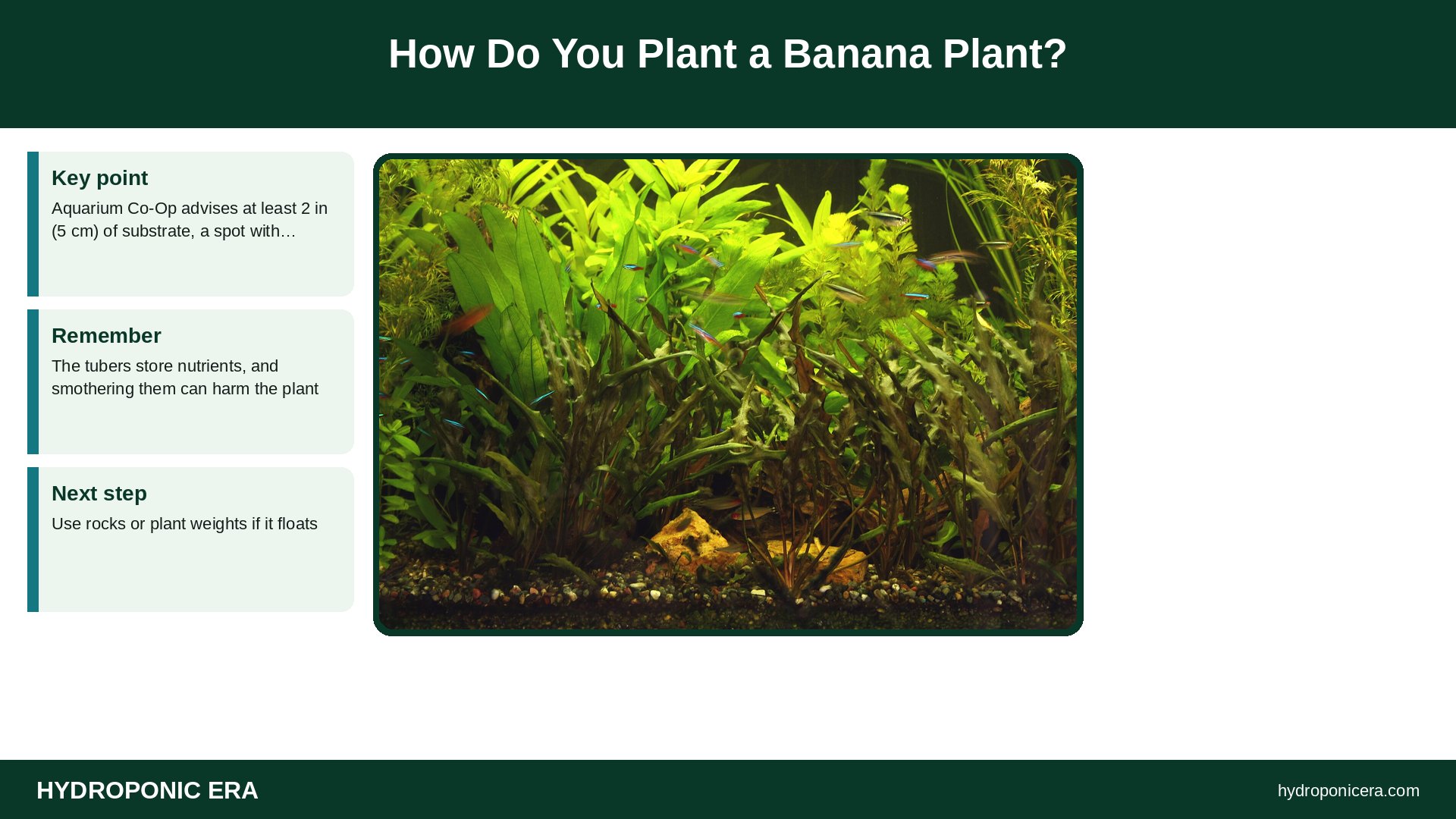
Do not bury the tubers. Aquarium Co-Op advises at least 2 in (5 cm) of substrate, a spot with good light and gentle flow, and resting the banana-shaped tubers on top or about 0.25 in (6 mm) into the substrate. The tubers store nutrients, and smothering them can harm the plant. Use rocks or plant weights if it floats.
- Choose a bright spot with gentle water movement.
- Set the tubers on the substrate surface.
- Weigh the plant down lightly if it drifts.
- Wait for long roots to anchor it, which Aquarium Co-Op says happens eventually.
How Much Light Does a Banana Plant Need?
Low light is enough, but more light speeds growth. Aquarium Co-Op says banana plants survive in low to high light and grow faster with more of it. Purdue Extension recommends an aquarium spot receiving at least 8 to 10 hours of light a day. Because the plant may send leaves to the surface, watch for shading of neighbors.
- Pick a fixture with our grow light for aquarium guide.
- Pair with low-light plants such as Anubias.
What Fertilizer Does a Banana Plant Need?
Feed both water and roots. Aquarium Co-Op says no CO2 injection is needed, but the plant appreciates an all-in-one liquid fertilizer plus a root tab under it every three to four months. Aquarium Co-Op explains that the tubers are used for nutrient storage, which helps the plant while its roots establish.
- See our fertilizer for plants in water guide for nutrient basics.

Why Are My Banana Plant Tubers Disappearing?
It is often normal. Aquarium Co-Op notes that the tubers sometimes melt away after planting, possibly because the plant no longer needs them once roots supply enough nutrients. If leaves look healthy and new growth continues, there is no cause for concern. The real mistake, per Aquarium Co-Op, is suffocating the tubers, so keep them exposed or barely covered.
Where Should a Banana Plant Go in the Tank?
Use it in the foreground or midground. Aquarium Co-Op says that at about 6 in (15 cm) tall, it works as a foreground or midground plant, or even a background plant in a 5-gallon (19 L) nano tank. Purdue Extension advises placing tall, dense plants in the rear corners and planting groups of the same type together.
| Tank zone | Plant height | Example |
|---|---|---|
| Foreground | Low, compact | Banana plant, dwarf Cryptocoryne |
| Midground | Medium | Banana plant, Vallisneria |
| Background | Tall, dense | Anacharis, sword plants |
Purdue notes beginners do well starting small, with a 5–10 gallon (19–38 L) tank and about a 2 in (5 cm) gravel bed. For a fish-and-plant system, see our aquarium aquaponics guide.
Purdue’s height guide helps with layout: Cryptocoryne grows 1–8 in (2.5–20 cm), Vallisneria 7–12 in (18–30 cm), sword plants 3–20 in (8–51 cm), and Anacharis 4–36 in (10–91 cm). Set the banana plant in front of taller stems so its tubers stay visible.
How Do You Propagate a Banana Plant?
Grow new plants from leaves. Aquarium Co-Op says to cut off one leaf and let it float in the tank; new roots and small leaves eventually appear, and you can plant the young plant into the substrate. Established plants also send long shoots toward the surface that form lily-pad leaves and sometimes small white flowers.
- Snip a healthy leaf with a short stem.
- Let it float in the tank.
- Plant it once roots and new leaves form.
- Trim surface leaves that block light for other plants.
Is the banana plant good for beginners?
Yes. Aquarium Co-Op calls it hardy and beginner-friendly with no CO2 needed.
Should I bury banana plant tubers?
No. Rest them on the substrate or press them in about 0.25 in (6 mm).
Why does my banana plant grow lily pads?
Established plants send shoots to the surface that form floating leaves.
What temperature suits banana plants?
Aquarium Co-Op lists 68–82°F (20–28°C).
Is the banana plant native?
Yes. UF/IFAS records it in quiet waters nearly throughout Florida.
Sources
- Aquarium Co-Op. Banana Plant Care Guide.
- University of Florida IFAS. Nymphoides aquatica, banana lily.
- Purdue Extension. HO-24: Planting Your Aquarium.
- Photo credits (Wikimedia Commons, edited with titles): Nymphoides aquatica by Show_ryu (Public domain); Planted Tank 03 – Flickr – The Wandering Angel by The Wandering Angel from Makati City, Philippines (CC BY 2.0); Glow light tetra by Jim Zamichieli (CC BY-SA 3.0); Fish farming on Øksfjorden in Loppa, Troms og Finnmark, Norway, 2022 August by Ximonic (Simo Räsänen) (CC BY-SA 4.0)