
How do you lower ammonia in a fish pond? To lower pond ammonia, cut feeding first and test total ammonia nitrogen (TAN), pH and temperature. SRAC says toxic un-ionized ammonia rises about tenfold for each one-unit pH increase. Aerate well, remove waste and dead plants, and let bacteria and algae absorb it.
Key takeaway: Pond ammonia comes from fish waste and decaying feed, algae and plants. Only the un-ionized form (NH3) is toxic, and its share climbs with pH and warmth. SRAC lists about 0.6 mg/L of un-ionized ammonia as dangerous within days, and 0.06 mg/L as harmful over time. Prevention through light feeding works best.
| Step | Action | Source |
|---|---|---|
| 1. Test | Measure TAN, pH and temperature | SRAC 463 |
| 2. Calculate | Multiply TAN by the table fraction | SRAC 463 |
| 3. Cut feed | Reduce feeding until TAN drops | SRAC 463 |
| 4. Aerate | High oxygen slightly reduces toxicity | SRAC 463 |
| 5. Build biology | Bacteria convert ammonia to nitrate | K-State, SRAC 4502 |

What Causes Pond Ammonia?
Fish and decay produce pond ammonia. SRAC explains that ammonia is the main end product of protein breakdown in fish, excreted through gills and feces, and that the amount rises with feeding rates. Bacterial decomposition of uneaten feed, dead algae and aquatic plants adds more. Algae die-offs can cause very high ammonia concentrations in ponds.
SRAC adds that ammonia often increases in fall and winter, because algae populations shrink and cold water slows the bacteria that convert ammonia.
Which Form of Pond Ammonia Is Toxic?
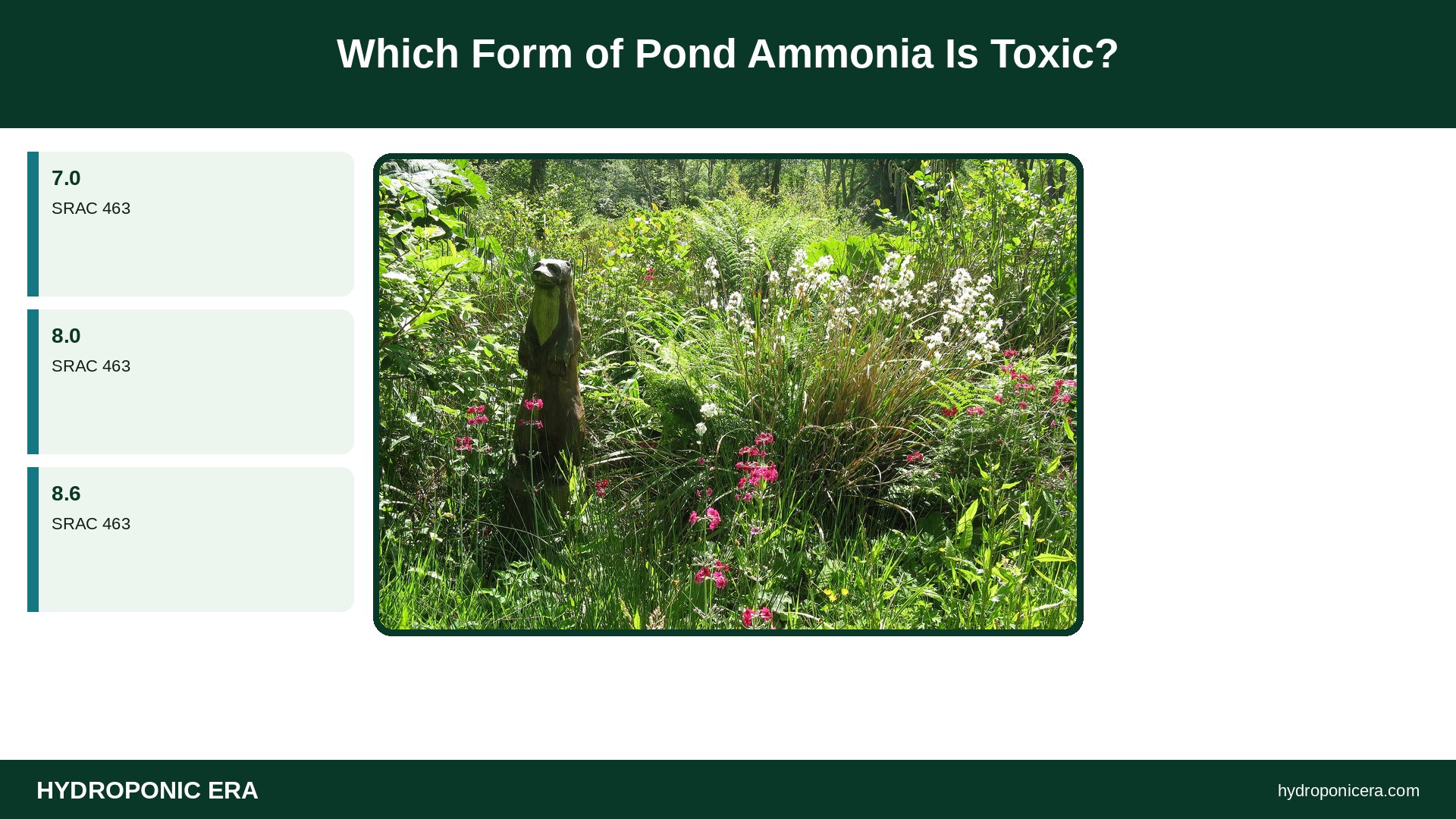
Un-ionized ammonia (NH3) is the toxic form. SRAC says total ammonia nitrogen combines toxic NH3 and nontoxic ionized ammonium (NH4+), and the toxic share increases as temperature and pH rise. For each one-unit pH increase, toxic ammonia rises about 10 times. That is why the same TAN reading can be safe one day and dangerous the next.
| pH at 86°F (30°C) | Toxic fraction of TAN | Source |
|---|---|---|
| 7.0 | 0.0080 | SRAC 463 |
| 8.0 | 0.0743 | SRAC 463 |
| 8.6 | 0.2422 | SRAC 463 |
| 9.0 | 0.4453 | SRAC 463 |
How Do You Test Pond Ammonia?
Test pond ammonia with a TAN kit plus pH and temperature readings. SRAC instructs pond owners to measure TAN, find the toxic fraction for their pH and temperature in its table, and multiply. Its example: at pH 8.6, 86°F (30°C) and TAN of 3 mg/L (ppm), multiplying 0.2422 by 3 gives 0.73 mg/L of toxic un-ionized ammonia.
- Test TAN with a freshwater kit.
- Record pH and water temperature at the same time.
- Look up the fraction in SRAC’s Table 1.
- Multiply the fraction by TAN to get un-ionized ammonia.
Track pH buffering with our GH and KH water tests guide.
What Pond Ammonia Level Is Dangerous?
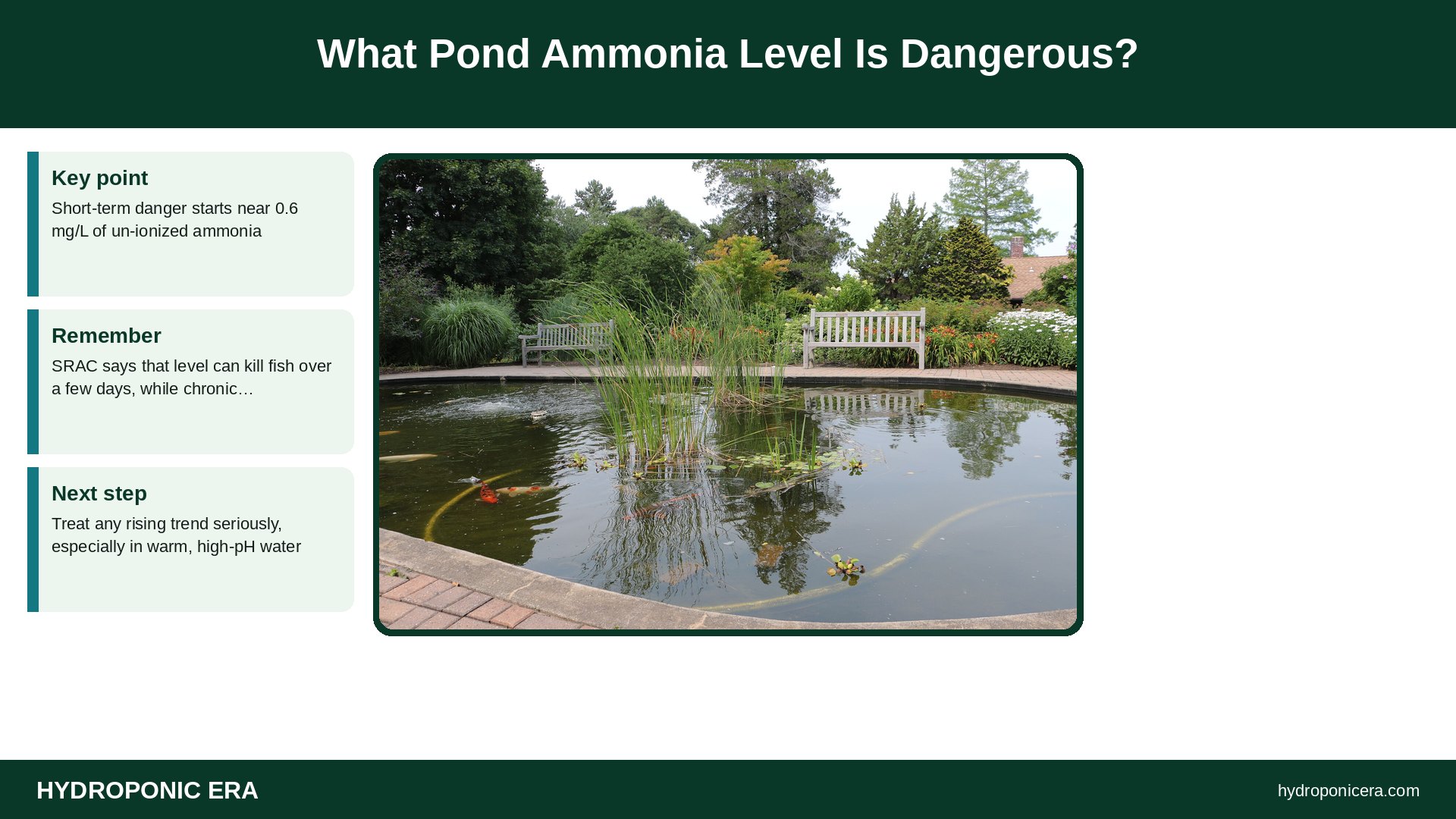
Short-term danger starts near 0.6 mg/L of un-ionized ammonia. SRAC says that level can kill fish over a few days, while chronic exposure as low as 0.06 mg/L can cause gill and kidney damage, reduced growth, possible brain malfunction and lower oxygen-carrying capacity. Treat any rising trend seriously, especially in warm, high-pH water.
- Watch for gasping, lethargy or loss of appetite; see aquaponics fish dying for troubleshooting.
- Algae die-offs lower pH, which SRAC notes reduces the toxic share.
How Do You Lower Pond Ammonia Quickly?
To cut pond ammonia fast, reduce feeding and boost oxygen. SRAC recommends temporarily cutting feeding until TAN falls, and says maintaining high dissolved oxygen through aeration slightly reduces ammonia’s toxic effect while supporting aerobic bacteria. Pumping in fresh water rarely treats a whole large pond, but SRAC notes it creates a relief zone near the inflow where fish can gather.
- Stop or reduce feeding.
- Run aerators or fountains; see our aquaponics air pump guide.
- Remove dead fish, sludge and rotting plants.
- Dechlorinate any top-up water; K-State notes city and well water can contain chemicals toxic to fish.
In small garden ponds, partial water changes are easier. Use our dechlorinate water guide first.
How Do Bacteria Remove Pond Ammonia?
Two groups of nitrifying bacteria do the work. SRAC 4502 explains that Nitrosomonas oxidize toxic ammonia to nitrite, which is also toxic, and Nitrobacter then convert nitrite to nitrate, which is far less toxic at usual levels. Both steps need oxygen. Plankton algae also absorb ammonia directly, which SRAC 463 calls important for protecting fish.
| Stage | Converted by | Toxicity |
|---|---|---|
| Ammonia to nitrite | Nitrosomonas | Both toxic |
| Nitrite to nitrate | Nitrobacter | Nitrate far less toxic |
| Ammonia uptake | Plankton algae, plants | Removes it directly |
K-State notes that as a pond matures, small aquatic organisms colonize submerged surfaces, and beneficial bacteria among them break down organic wastes from fish, plants and debris.
How Do You Prevent Pond Ammonia?
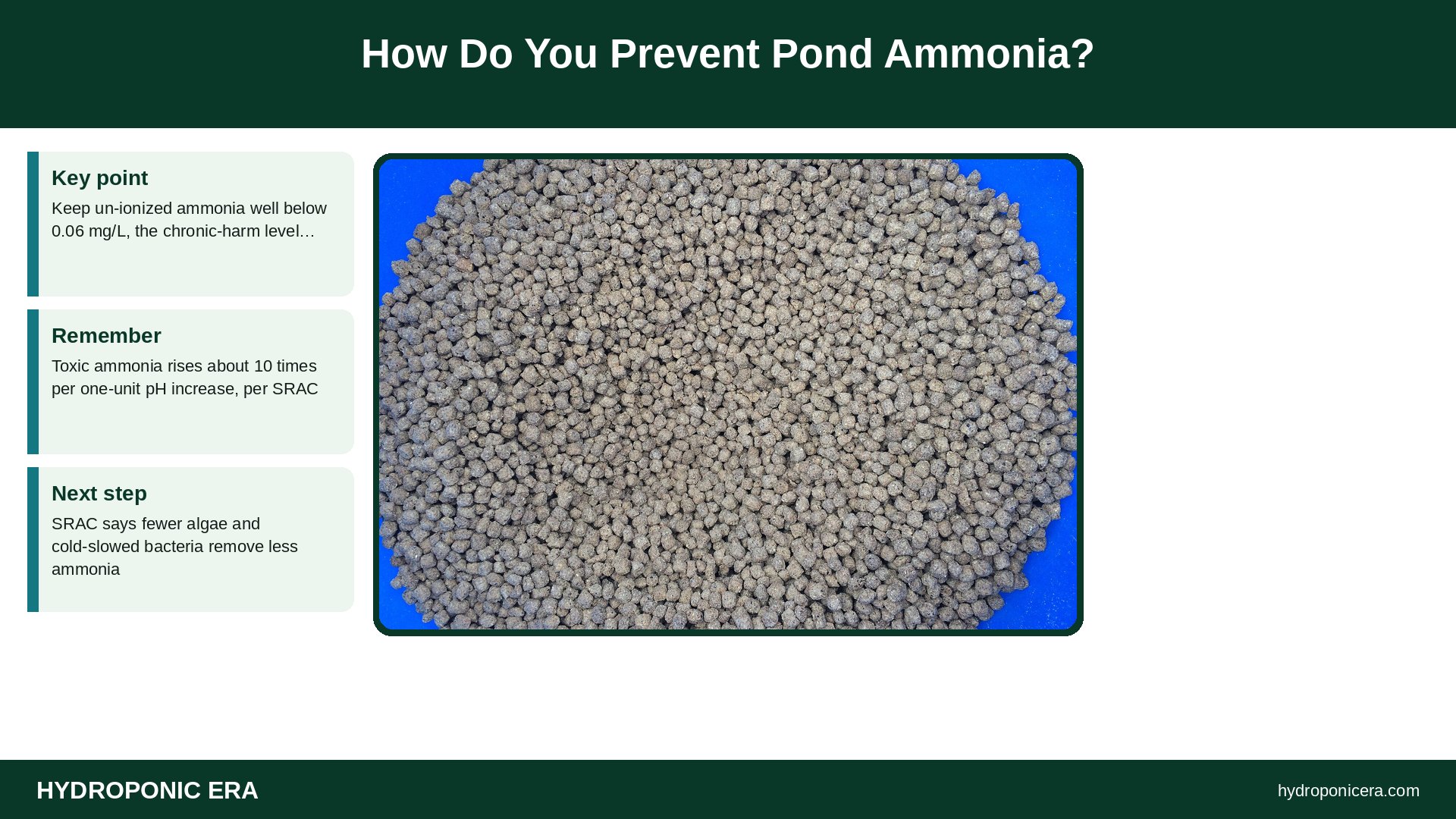
Prevent pond ammonia by feeding carefully and supporting the nitrogen cycle. SRAC says prevention beats treatment; problems can be expected when feeding exceeds 100 lb (45 kg) of feed per acre (0.4 ha) per day or feed is wasted. K-State explains that beneficial bacteria convert toxic ammonia and nitrite into nontoxic nitrate, which plants and algae then use as food.
- Offer only what fish eat; SRAC stresses confirming fish consume feed offered.
- Plant 50–75% of the surface, per K-State.
- Add a planted filter; see aquaponics biofilter for nitrifying bacteria basics.
- SRAC 4502 notes nitrifying bacteria need oxygen to oxidize ammonia.
What is a safe pond ammonia level?
Keep un-ionized ammonia well below 0.06 mg/L, the chronic-harm level SRAC cites.
Does pH affect pond ammonia?
Yes. Toxic ammonia rises about 10 times per one-unit pH increase, per SRAC.
Why is ammonia high in winter?
SRAC says fewer algae and cold-slowed bacteria remove less ammonia.
Will aeration remove ammonia?
It slightly reduces toxicity and supports bacteria, per SRAC.
Should I stop feeding fish?
Temporarily reduce feeding until TAN falls, as SRAC recommends.
Sources
- Southern Regional Aquaculture Center. SRAC 463: Ammonia in Fish Ponds.
- Kansas State University Research and Extension. MF2911: Water Gardening, Biological Balance.
- Southern Regional Aquaculture Center. SRAC 4502: How to Start a Biofilter.
- Photo credits (Wikimedia Commons, edited with titles): Aeration systems in an Aqua pond near Eluru by iMahesh (CC BY-SA 4.0); Pond-edge plants at Achamore Garden – geograph.org.uk – 5446824 by M J Richardson (CC BY-SA 2.0); Deep Cut Gardens Koi Pond by FossilDS (CC0); Fish Feed Pellets by Narek75 (CC BY-SA 4.0)