
What is a recirculating aquaculture system? A recirculating aquaculture system (RAS) raises fish in tanks and continuously cleans and reuses the same water. SRAC says every such system removes solids, converts ammonia with a biofilter, strips carbon dioxide and adds oxygen before water returns to the fish. It uses a fraction of a pond’s water and far less land.
Key takeaway: A recirculating aquaculture system lets growers produce fish year-round close to markets with little water, but it is capital-intensive and depends on constant power and oxygen. SRAC warns that aeration failure in a heavily stocked system can kill the whole crop in half an hour or less. Start small and learn water chemistry first.
| Parameter | Target | Source |
|---|---|---|
| Un-ionized ammonia | Below 0.05 mg/L | SRAC 451 |
| Nitrite-nitrogen | Usually below 1 mg/L | SRAC 451 |
| Nitrate-nitrogen | Tolerated above 200 mg/L | SRAC 451 |
| Free CO2 | Below 20 mg/L | SRAC 451 |
| pH | Above 7.0 for nitrifying bacteria | SRAC 451 |
| Chloride to nitrite ratio | About 10:1 | SRAC 451 |
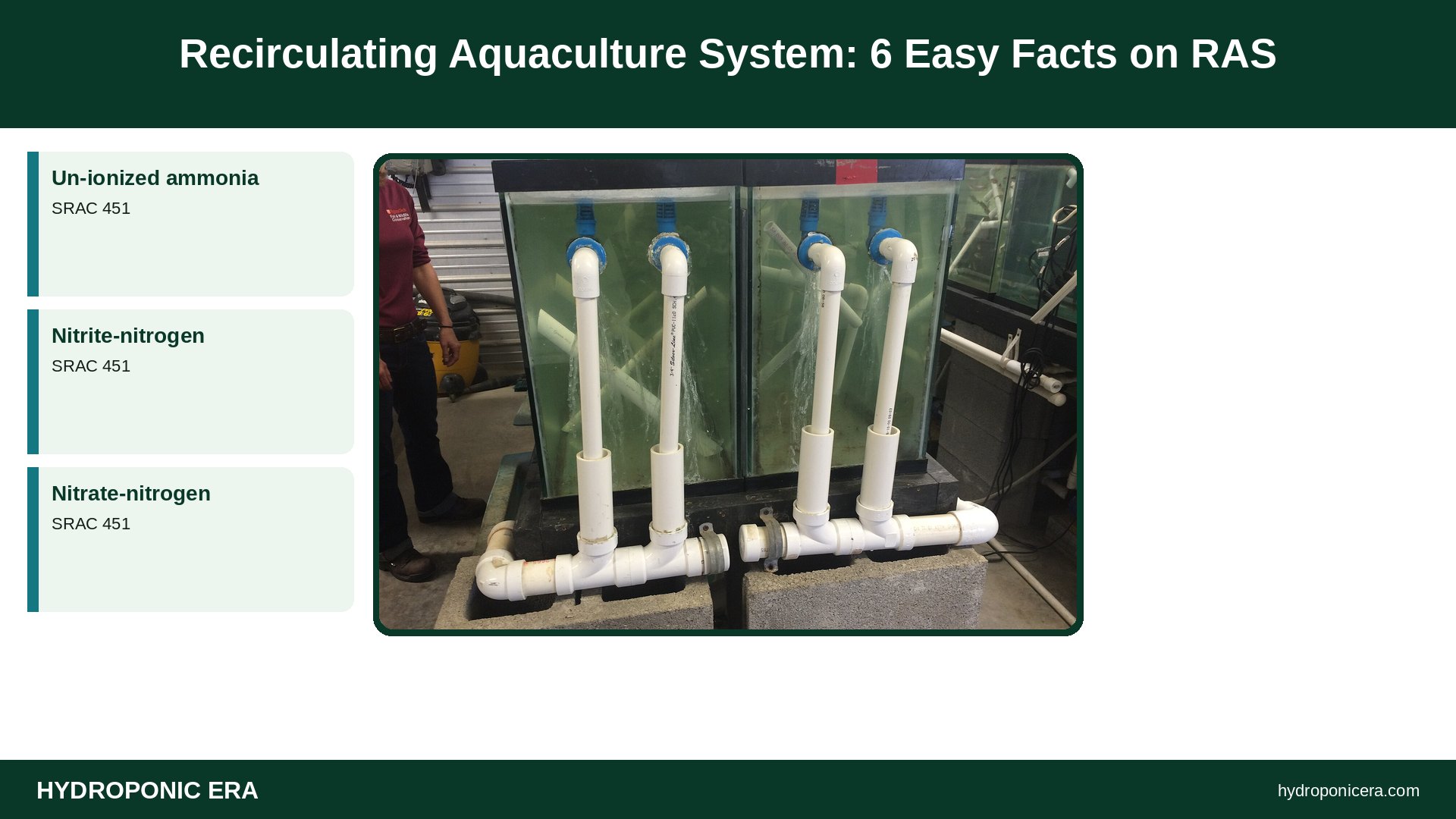
How Does a Recirculating Aquaculture System Work?
In a recirculating aquaculture system, water loops from fish tanks through treatment and back. SRAC 451 lists the required unit processes: waste solids removal, biological filtration for nitrification, carbon dioxide removal, and aeration or oxygenation. Intensive systems may add fine solids removal through foam fractionation and disinfection with ultraviolet light or ozone.
- Fish culture tank: round, octagonal, rectangular or D-ended.
- Solids removal: settling, swirl separators, screen or bead filters.
- Biofilter: trickling, fluidized bed, mixed bed or rotating contactors.
- CO2 stripping and aeration: packed columns or diffusers.
- Optional UV or ozone disinfection.
Why Choose a Recirculating Aquaculture System Over Ponds?
A recirculating aquaculture system saves water and land. Ponds need about 1 million gallons per acre (9,350 cubic meters per hectare) to fill, plus as much yearly for evaporation and seepage, or roughly 100 gallons (379 L) for every pound (0.45 kg) of fish. Recirculating systems use a fraction of that water to produce similar yields, on far less land.
SRAC 4503 adds that, compared with ponds, recirculating systems offer improved biosecurity, water-use efficiency and land-use efficiency.
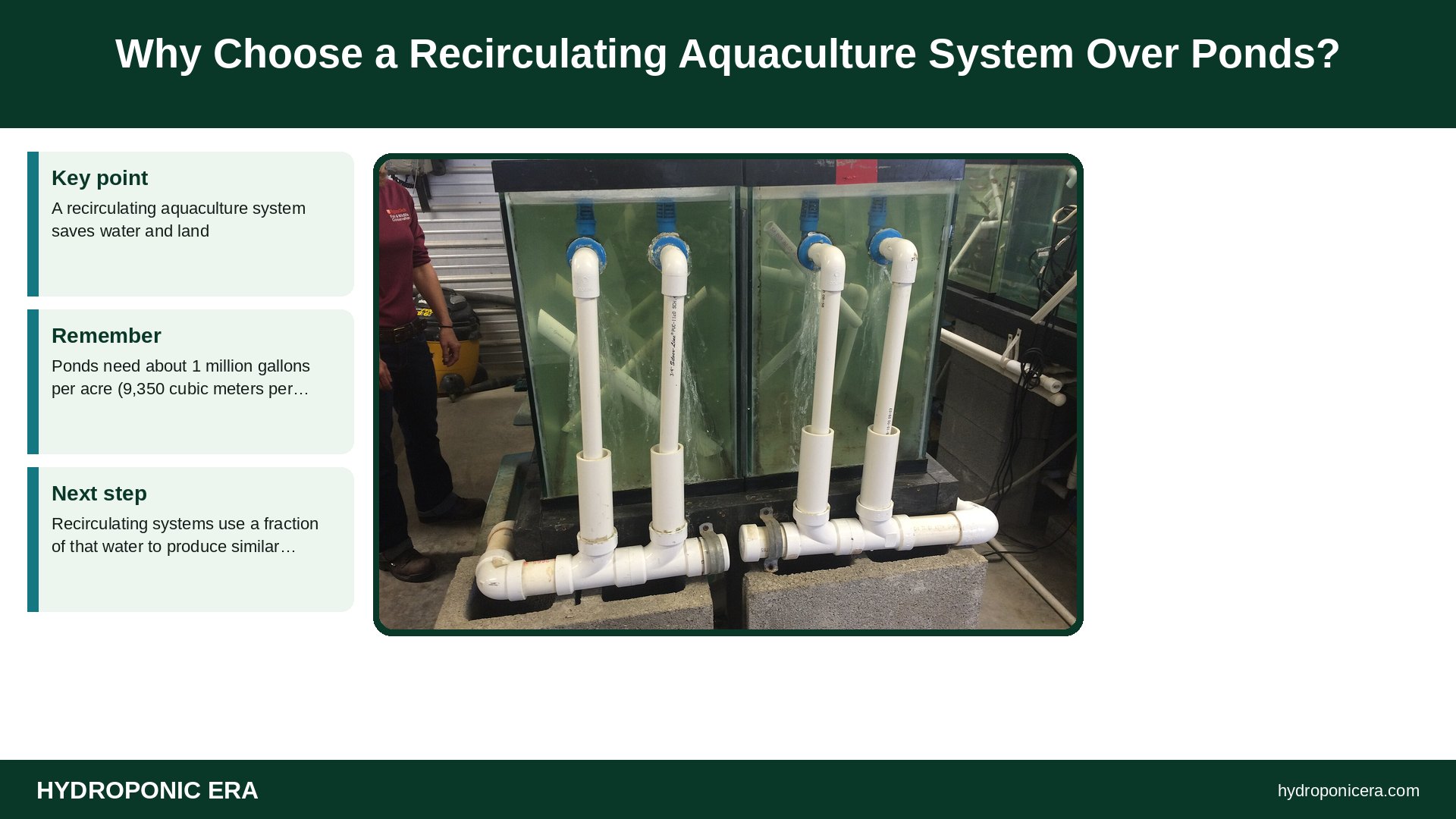
What Does the Biofilter Do in a Recirculating Aquaculture System?
The biofilter in a recirculating aquaculture system turns toxic ammonia into nitrate. SRAC 4502 explains that Nitrosomonas bacteria oxidize ammonia to nitrite and Nitrobacter oxidize nitrite to nitrate, both using oxygen. SRAC 451 lists gravel, sand, plastic beads, rings, tubes and plates as common biofilter media. Starting a biofilter means managing the seeding of these bacteria before full stocking.
Learn the basics at home scale in our aquaponics biofilter guide.
How Much Oxygen Does a Recirculating Aquaculture System Need?
Oxygen is usually the first stocking limit. SRAC 451 says a recirculating aquaculture system’s ability to add oxygen often caps fish carrying capacity. Each recirculating aquaculture system consumes about 0.3 to 0.75 part oxygen per part feed by weight, depending on solids retention and biofilter type. Pure oxygen raises the saturation level nearly fivefold, to 43 mg/L at standard pressure.
- Aerate the return flow just before it re-enters the tank, where SRAC says it is most efficient.
- Keep backup aeration and alarms; failure can kill fish in half an hour.
- Size small systems with our aquaponics air pump and aquaponics pump size guides.
How Do You Control pH in a Recirculating Aquaculture System?
Add bases as nitrification consumes alkalinity in a recirculating aquaculture system. SRAC 451 explains that nitrification is acid-producing, so alkalinity falls and pH drops over time. A pH below 7.0 slows nitrifying bacteria, and levels below 4.5 are dangerous to fish. Common bases include hydrated lime, quicklime and sodium bicarbonate, added when source water is low in alkalinity.
See our alkalinity and bicarbonate guide for buffering basics.
What Water Quality Does a Recirculating Aquaculture System Need?
Ammonia, nitrite, oxygen and carbon dioxide all need tight control. SRAC 451 says un-ionized ammonia should not exceed 0.05 mg/L, nitrite should stay below 1 mg/L in most mature systems, and free carbon dioxide below 20 mg/L. At pH 7.0 most ammonia is ionized, but at pH 8.75 up to 30 percent is toxic.
For nitrite, SRAC notes a chloride-to-nitrite ratio of about 10:1 generally protects fish, because nitrite otherwise binds hemoglobin and starves fish of oxygen.
How Do You Manage Solids in a Recirculating Aquaculture System?
Remove solids from a recirculating aquaculture system fast. SRAC 451 says feces and uneaten feed consume oxygen and generate ammonia as they break down, so they should leave the system as quickly as possible. Settleable solids drop out within about an hour, while fine solids under 30 micrometers can make up more than half of suspended solids and irritate gills.
- Use drains and swirl separators for settleable solids.
- Use screen or granular filters for suspended solids.
- Use foam fractionation for fine and dissolved solids.
Feed rates matter: SRAC says fish eat 1.5 to 15 percent of body weight daily, depending on size and species. It also notes that foam fractionation waste can be five times more concentrated in solids than the culture tank.
Is a recirculating aquaculture system good for beginners?
Small systems can be, but SRAC warns of real technical and economic risks.
What fish are grown in a recirculating aquaculture system?
Tilapia and many other species; see our tilapia aquaponics guide.
How safe is nitrate in RAS?
SRAC says species tolerate levels above 200 mg/L.
What is the biggest RAS risk?
Oxygen failure, which SRAC says can kill a crop in 30 minutes or less.
Does RAS use less water?
Yes, a fraction of the water ponds need, per SRAC.
Sources
- Southern Regional Aquaculture Center. SRAC 451: Recirculating Aquaculture Tank Production Systems, An Overview of Critical Considerations.
- Southern Regional Aquaculture Center. SRAC 4502: How to Start a Biofilter.
- Southern Regional Aquaculture Center. SRAC 4503: Biofloc Production Systems for Aquaculture.
- Photo credits (Wikimedia Commons, edited with titles): Recirculating Aquaculture System 1 by Narek75 (CC BY-SA 4.0); Recirculating Aquaculture System 1 by Narek75 (CC BY-SA 4.0); Fish farming on Øksfjorden in Loppa, Troms og Finnmark, Norway, 2022 August by Ximonic (Simo Räsänen) (CC BY-SA 4.0); Aeration tank activated sludge process STP Bengaluru India by Vraj Acharya, WELL Labs (CC BY-SA 4.0)