
How do you get rid of cyanobacteria in an aquarium? Fix the causes, not the symptoms. Aquarium Science says aquarium cyanobacteria usually follow low water movement, high temperature, high phosphates and low oxygen. Add flow and surface agitation, lower the heat a little, do large water changes, and feed less. Tropica says coatings usually fade once feeding drops.
Key takeaway: Cyanobacteria, often called blue-green algae, are bacteria that form slimy sheets in tanks. Aquarium Science says aquarium types are unsightly but safe around fish. Most outbreaks clear when you improve circulation and oxygen, reduce phosphate and feeding, and keep up water changes. Antibiotics work only temporarily, and algicides can kill fish.
| Step | Action | Source |
|---|---|---|
| 1. Add flow | Wavemaker or pump across the tank | Aquarium Science |
| 2. Agitate surface | Choppy surface or air stone | Aquarium Science |
| 3. Lower heat | Many tropicals do fine above 70°F (21°C) | Aquarium Science |
| 4. Cut phosphate | Large water changes | Aquarium Science |
| 5. Feed less | Reduce feeding intensity | Tropica |
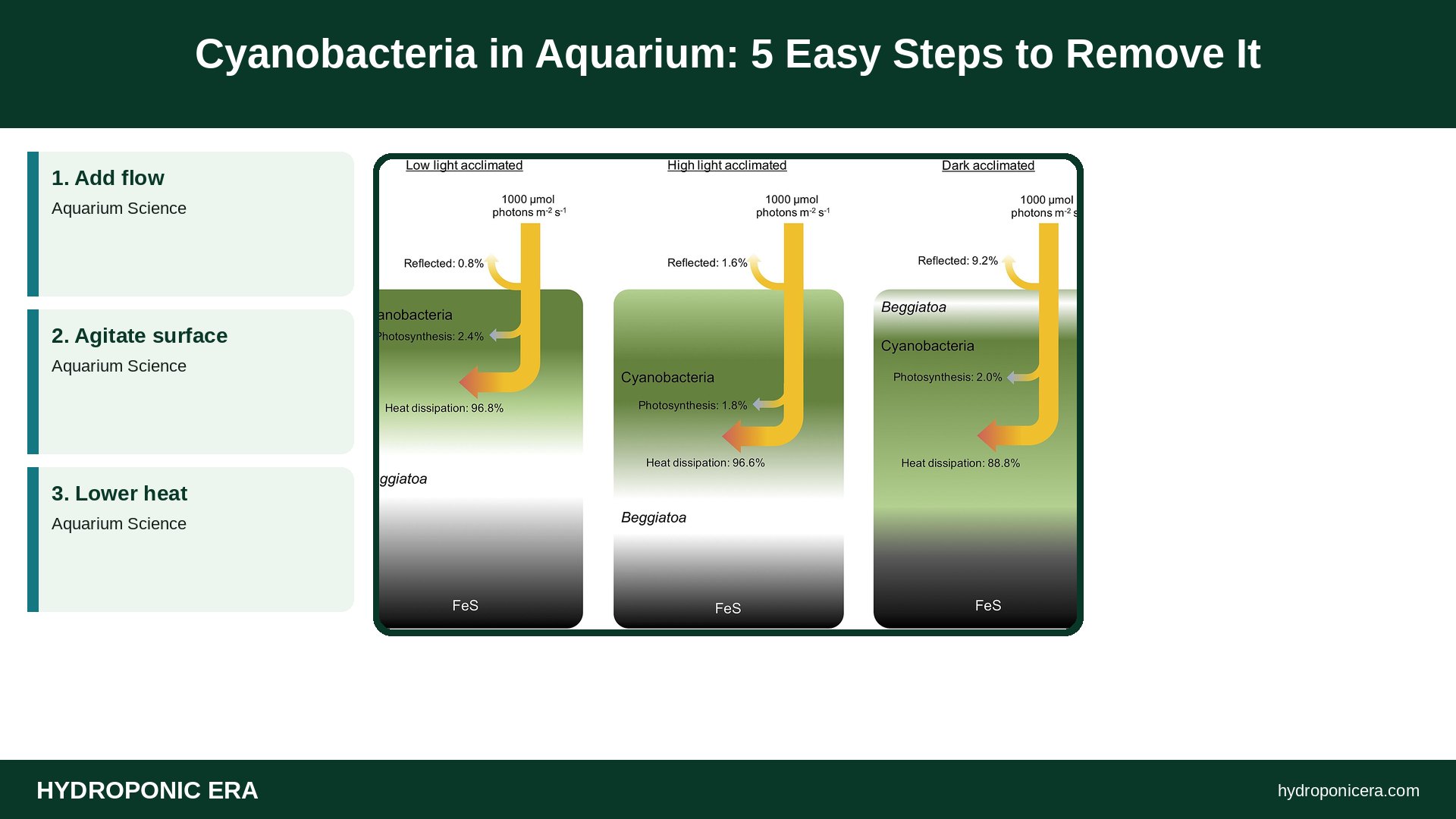
What Is Cyanobacteria in an Aquarium?
It is a photosynthetic bacterium, not a true alga. Aquarium Science explains that “blue-green algae” is a form of bacteria called cyanobacteria, usually blue-green but sometimes yellow-green, reddish brown or purple. The U.S. EPA says cyanobacteria live in fresh, estuarine and marine waters, make their own food from sunlight, and many species fix nitrogen.
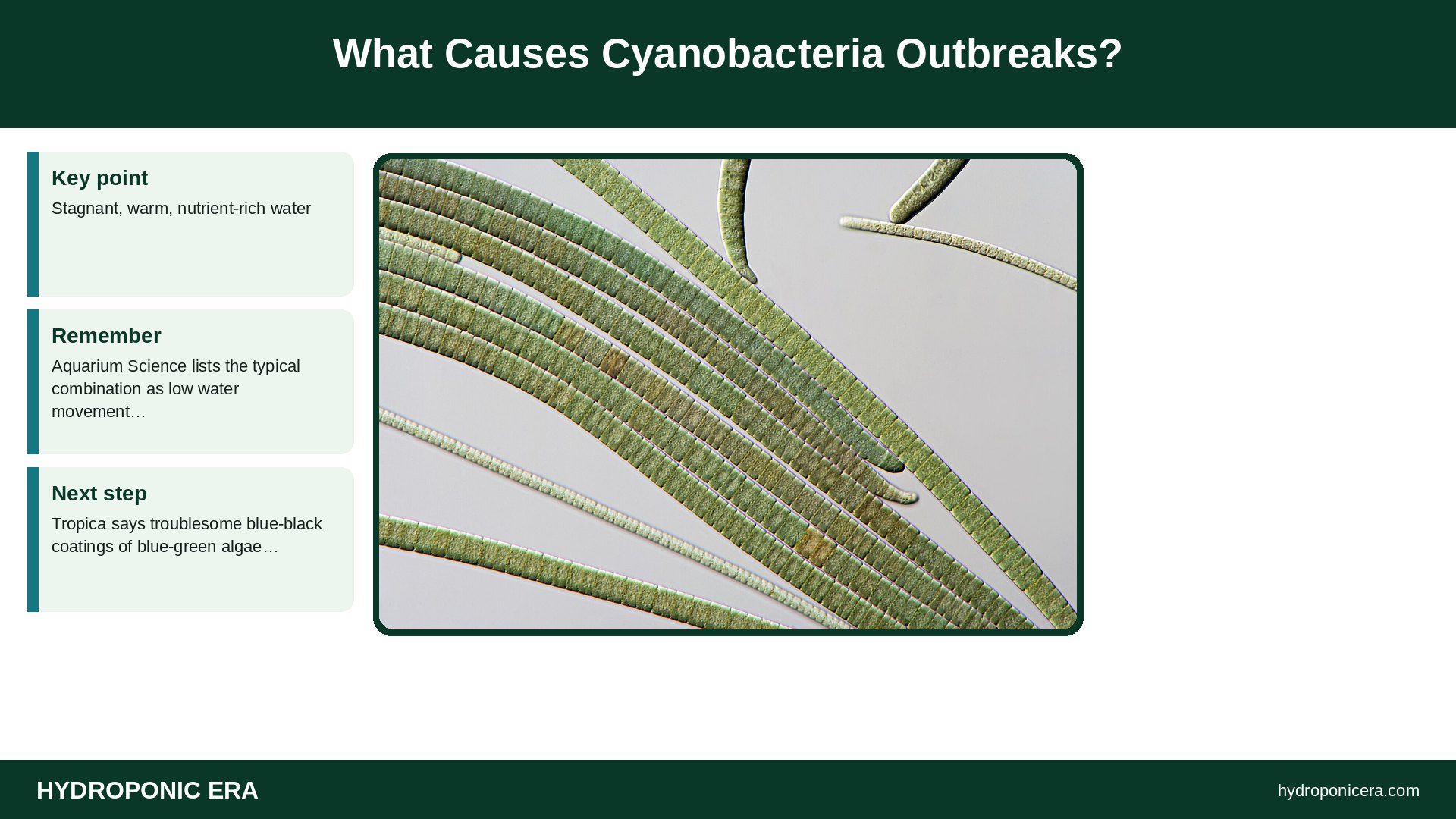
Aquarium Science notes colonies can look like blue-green sheets, thread-like filaments or hollow balls, and they often, but not always, have a distinctive smell.
What Causes Cyanobacteria Outbreaks?
Stagnant, warm, nutrient-rich water. Aquarium Science lists the typical combination as low water movement, high water temperature, high phosphates and low oxygen. Tropica says troublesome blue-black coatings of blue-green algae usually appear from excessive feeding in fish tanks. Spores are almost everywhere, Aquarium Science adds, even in dust and chlorinated tap water.
- Excess fish food raises nutrients; see our aquaponics fish food guide.
- Aquarium Science notes some outbreaks occur even when these factors are absent.
How Do You Tell Cyanobacteria From Other Algae?
Check texture and color. Cyanobacteria usually form slimy sheets that peel away, in blue-green, reddish or purple shades, per Aquarium Science. Tropica describes thin algal coatings of diatoms, red algae and green algae as different, and rarely a problem with enough algae-eating fish and shrimp. The EPA notes green algae and cyanobacteria blooms are often confused.
| Growth | Look | Typical cause |
|---|---|---|
| Cyanobacteria | Slimy sheets, sometimes smelly | Low flow, phosphate, overfeeding |
| Diatoms | Soft brown film | New tanks (Aquarium Science 16.8) |
| Green algae coating | Thin green film | Light and nutrients |
The EPA explains a key difference outdoors: green algae are not generally known to produce toxins, while some cyanobacteria do.
How Do You Remove Cyanobacteria Naturally?
Attack all four causes together. Aquarium Science recommends adding water movement with a wavemaker, lowering the temperature, doing large water changes to reduce phosphates, and aiming flow at the surface for choppy waves or adding a pump and air stone. It says all four steps are often needed and usually control blue-green algae.
- Siphon visible mats during each water change.
- Add a wavemaker or reposition the filter outlet.
- Increase surface agitation; see our aquaponics air pump guide.
- Lower the heater setting slightly if fish allow.
- Feed less, as Tropica recommends.
Is Cyanobacteria Harmful to Fish?
Aquarium types are generally safe but ugly. Aquarium Science says the cyanobacteria found in aquariums lack the conditions to form toxins, so they are safe to work around and safe with fish. Outdoors is different: the EPA warns that some cyanobacteria produce potent cyanotoxins causing abdominal, neurological and skin problems in people and animals.
The EPA adds that large blooms can contribute to oxygen depletion and odor problems.

Should You Use Antibiotics or Algicides?
Only with caution, and they do not fix the cause. Aquarium Science says antibiotics such as erythromycin work against cyanobacteria but only temporarily, and can harm biofilter bacteria, spiking ammonia or nitrite. It recommends taking the filter offline during treatment. It warns never to use other algae-killing chemicals, because chemicals that kill algae can also kill fish.
- Test ammonia and nitrite daily during any treatment.
- Expect regrowth unless flow, oxygen and nutrients change.
- Aquarium Science calls “secret natural mix” slime removers snake oil.
How Do You Keep Blue-Green Algae From Returning?
Keep the conditions that discourage it. Aquarium Science says it is impossible to keep the spores out of an aquarium, so prevention means steady flow, good oxygen and controlled nutrients. Tropica notes that less intense feeding usually makes blue-green coatings disappear again, and a varied population of algae-eating fish and shrimp keeps other coatings in check.
- Keep filter outlets clear and flow reaching the substrate.
- Stick to a regular water-change routine.
- Feed small portions fish finish quickly.
Does Lighting Cause Cyanobacteria?
Light color changes its tint more than its growth. Aquarium Science explains that some cyanobacteria shift pigments with light color, turning redder under green-yellow-orange light, which is why purple mats often appear under cheap LEDs. It calls special anti-cyano LEDs a myth, since cyanobacteria mainly use the same blue and red spectrum as plants.
Choose a balanced fixture with our grow light for aquarium guide, and compare other systems in aquaponics algae control and algae in hydroponic reservoirs.
Is blue-green algae really algae?
No. Aquarium Science and the EPA describe it as cyanobacteria, a type of bacteria.
Will blue-green algae kill my fish?
Aquarium Science says aquarium types are safe with fish, though chemicals used against them can harm fish.
Why does it keep coming back?
Antibiotics and chemicals give only temporary relief unless root causes are fixed.
Does a blackout help?
Fixing flow, oxygen, phosphate and feeding is the approach Aquarium Science recommends.
Why is my slime red or purple?
Some species shift pigments under green-yellow-orange light, per Aquarium Science.
Sources
- Aquarium Science. 16.4 Blue-Green Algae.
- Aquarium Science. 16.8 Brown Algae.
- Tropica Aquarium Plants. Types of algae.
- U.S. Environmental Protection Agency. Learn About Cyanobacteria and Cyanotoxins.
- Photo credits (Wikimedia Commons, edited with titles): Biomass distribution in a bacteria mat under different conditions by Mads Lichtenberg, Paulo Cartaxana and Michael Kühl (CC BY-SA 4.0); Oscillatoria filaments by Wiedehopf20 (CC BY-SA 4.0); Glow light tetra by Jim Zamichieli (CC BY-SA 3.0); Planted Tank 03 – Flickr – The Wandering Angel by The Wandering Angel from Makati City, Philippines (CC BY 2.0)