
How do you grow an aponogeton bulb? Press the aponogeton bulb into the substrate so the sprout tip stays at the surface, then give it medium light and a root nutrient capsule. Tropica says most Madagascar species need a large tank and rest between growth periods, so a leafless bulb is often dormant, not dead.
Key takeaway: Aponogeton is a genus of bulb plants grown in aquariums and ponds. Tropica lists several Madagascar species with long, fluted leaves, low CO2 needs and regular dormancy. The RHS profiles the pond species water hawthorn, Aponogeton distachyos, with floating leaves and fragrant white flowers for sun or partial shade.
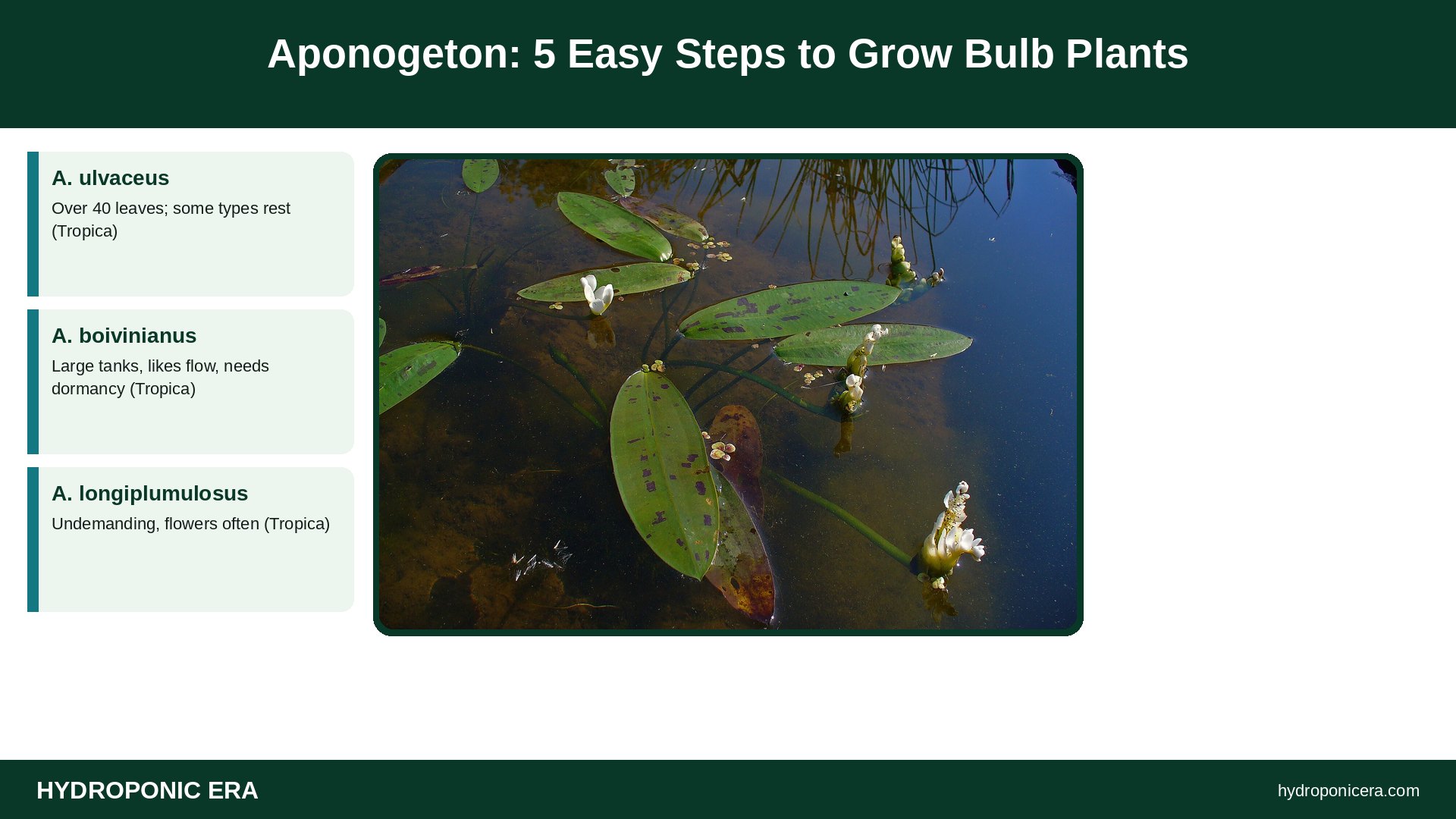
| Species | Leaf size | Notes (source) |
|---|---|---|
| A. ulvaceus | 12–24 in (30–60 cm) long | Over 40 leaves; some types rest (Tropica) |
| A. boivinianus | Up to 31 in (80 cm) long | Large tanks, likes flow, needs dormancy (Tropica) |
| A. longiplumulosus | 14–24 in (35–60 cm) long | Undemanding, flowers often (Tropica) |
| A. madagascariensis | Plant 10–20 in (25–50 cm) | Demanding, frequent water changes (Tropica) |
| A. distachyos | Spread 20–39 in (0.5–1 m) | Pond plant, sun to part shade (RHS) |
What Is an Aponogeton Bulb?
It is the storage root of a bulb-forming aquatic plant. Tropica lists its aponogeton species as type “bulb/onion,” mostly from Madagascar, and says a single root of A. ulvaceus can produce more than 40 leaves. The bulb stores energy, which lets the plant regrow after a resting phase when it drops its leaves.
The genus covers both aquarium and pond plants. Tropica sells tropical species for tanks, while the RHS describes water hawthorn as a deciduous or partially evergreen aquatic perennial with elliptic or lance-shaped floating leaves.
How Do You Plant an Aponogeton Bulb?
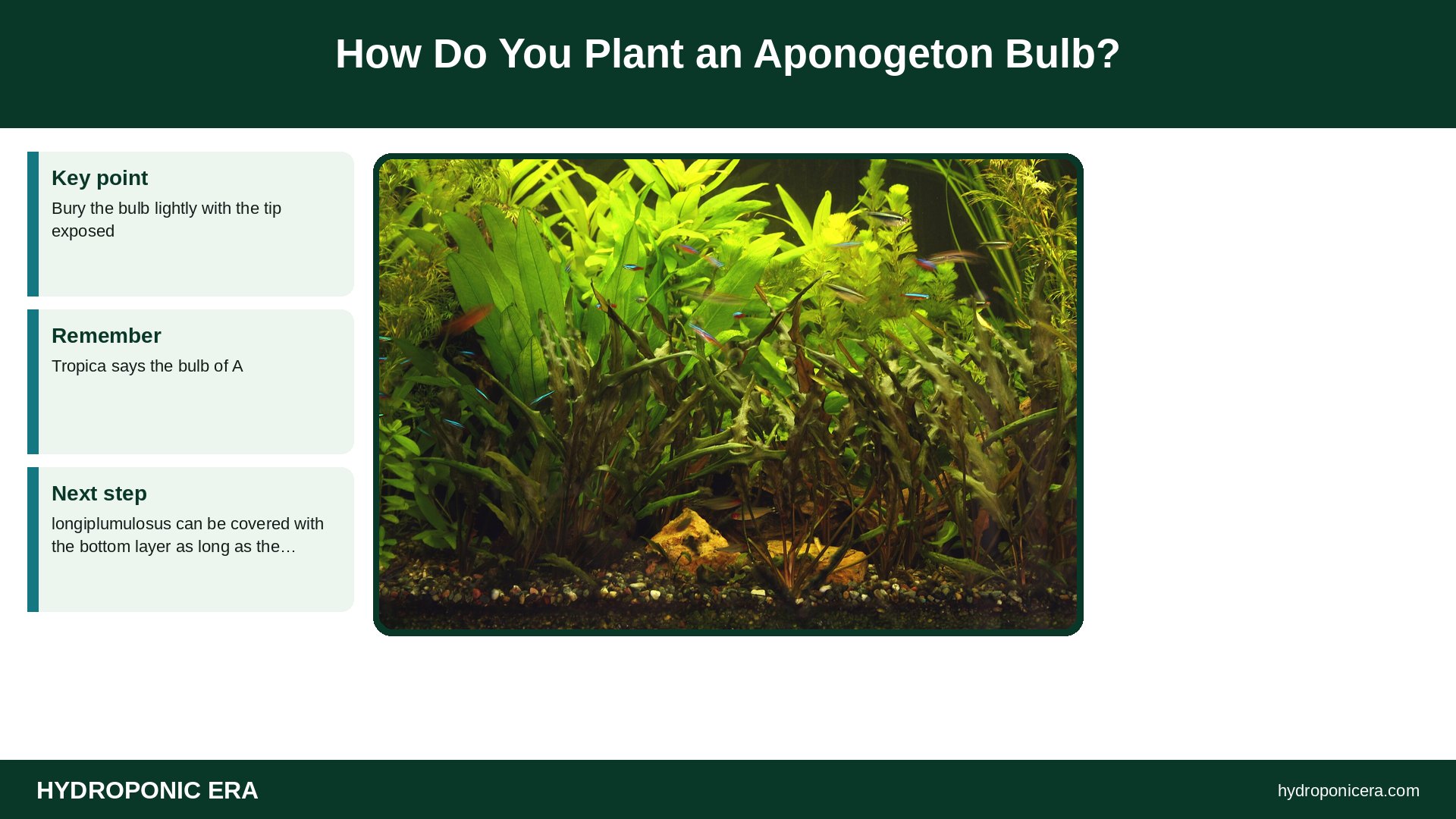
Bury the bulb lightly with the tip exposed. Tropica says the bulb of A. boivinianus, A. madagascariensis and A. longiplumulosus can be covered with the bottom layer as long as the sprout tip is at the soil surface. A nutrition capsule placed under the bulb, Tropica adds, enhances growth considerably.
- Find the pointed sprout tip on the bulb.
- Push a root capsule into the substrate first.
- Set the bulb above it and cover the base only.
- Leave the sprout tip level with the substrate surface.
- Weigh it down if it floats while roots form.
- Read our fertilizer for plants in water guide for nutrient basics.
Which Aponogeton Species Should You Choose?
Choose by tank size and effort. Tropica calls A. longiplumulosus relatively undemanding with no special water-quality needs, and A. ulvaceus relatively tolerant in soft or hard water. A. boivinianus suits only large aquariums, while A. madagascariensis is recommended only for large, specialized tanks with frequent water changes.
Every aponogeton in Tropica’s range is listed with low CO2 demand, and Tropica notes A. ulvaceus grows particularly well if CO2 is added. Tropica lists an average height of 20–30+ cm (8–12+ in) after two months in the tank.
How Big Does an Aponogeton Get?
Most grow large enough for a solitary spot. Tropica says A. ulvaceus leaves reach 12–24 in (30–60 cm), with the plant up to 20 in (50 cm) wide. A. boivinianus can form leaves up to 31 in (80 cm) long and 3 in (8 cm) wide, so plan for a big, open tank and room at the surface.
Tropica describes A. longiplumulosus as a plant that becomes 10–16 in (25–40 cm) wide with large, fluted leaves, and says it flowers frequently, making it a good feature plant for a large open aquarium.
How Much Light and CO2 Does an Aponogeton Need?
Medium light and low CO2 suit most species. Tropica lists A. ulvaceus, A. boivinianus and A. madagascariensis at medium light demand, which it defines as about 0.5 W per liter of tank water. A. longiplumulosus is listed as low light. Tropica rates low CO2 need for all four, below its medium band of 6–14 mg/L.
- Compare fixtures in our grow light for aquarium guide.
- Learn how gas dosing works in our CO2 enrichment guide.
- Pair it with shade-tolerant Anubias under the large leaves.

Why Is My Aponogeton Losing Leaves?
It may be entering dormancy. Tropica says A. boivinianus needs a dormant period when the bulb loses all its leaves, after which growth starts again. Some A. ulvaceus varieties also need a rest when the root makes no leaves, and A. longiplumulosus stops growing at intervals but normally restarts after a few weeks.
- Check that the bulb is firm, not soft or smelly.
- Leave a firm bulb in place and keep tank conditions steady.
- Remove dead leaves so they do not rot in the water.
- Watch for new shoots after the rest period.
A soft, mushy bulb is different from a resting one. Remove any rotting tissue promptly to protect water quality, and keep the substrate around the bulb loose rather than compacted.
Can You Grow Aponogeton in a Pond?
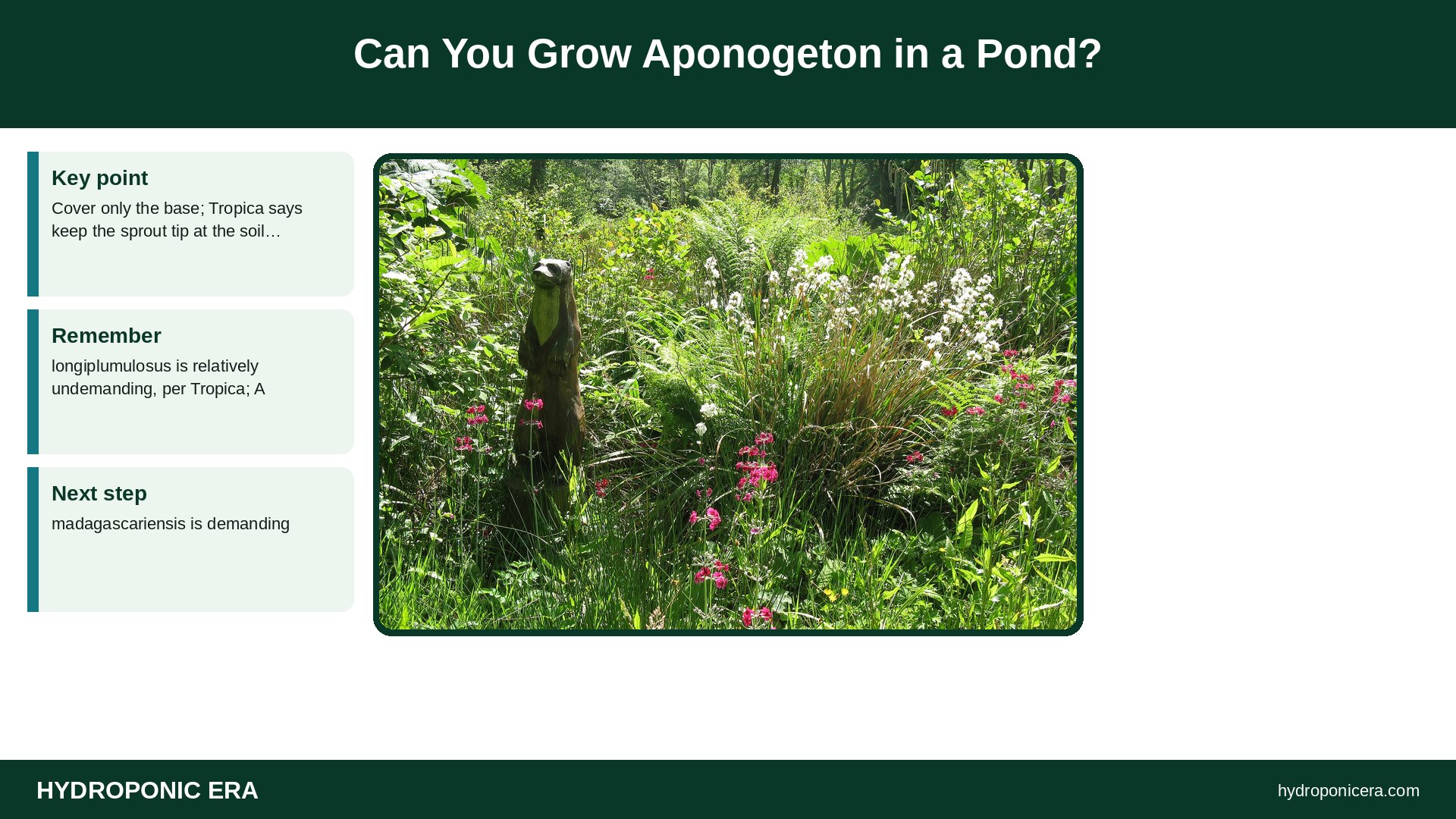
Yes, with the hardy pond species. The RHS profiles Aponogeton distachyos, water hawthorn, as an aquatic plant with small fragrant white flowers held just above the water on forked stems. It grows in full sun or partial shade, in clay, loam or sand, reaching about 4 in (10 cm) above the water and spreading 20–39 in (0.5–1 m).
The RHS lists other common names including Cape pondweed and Cape asparagus, and gives five to ten years to reach maturity. For more pond options, see our koi pond plants guide or our aquarium aquaponics setup.
Should I bury an aponogeton bulb?
Cover only the base; Tropica says keep the sprout tip at the soil surface.
Is aponogeton easy for beginners?
A. longiplumulosus is relatively undemanding, per Tropica; A. madagascariensis is demanding.
Why did my aponogeton stop growing?
Many species rest between growth periods and normally restart after a few weeks.
Does aponogeton need CO2?
Tropica rates its CO2 need as low, though A. ulvaceus grows better with added CO2.
Which aponogeton grows in ponds?
Water hawthorn, Aponogeton distachyos, profiled by the RHS for sun or partial shade.
Sources
- Tropica Aquarium Plants. Aponogeton ulvaceus/4533).
- Tropica Aquarium Plants. Aponogeton boivinianus.
- Tropica Aquarium Plants. Aponogeton longiplumulosus.
- Royal Horticultural Society. Aponogeton distachyos, water hawthorn.
- Photo credits (Wikimedia Commons, edited with titles): Aponogeton distachyos 001 by H. Zell (CC BY-SA 3.0); Planted Tank 03 – Flickr – The Wandering Angel by The Wandering Angel from Makati City, Philippines (CC BY 2.0); Glow light tetra by Jim Zamichieli (CC BY-SA 3.0); Pond-edge plants at Achamore Garden – geograph.org.uk – 5446824 by M J Richardson (CC BY-SA 2.0)