
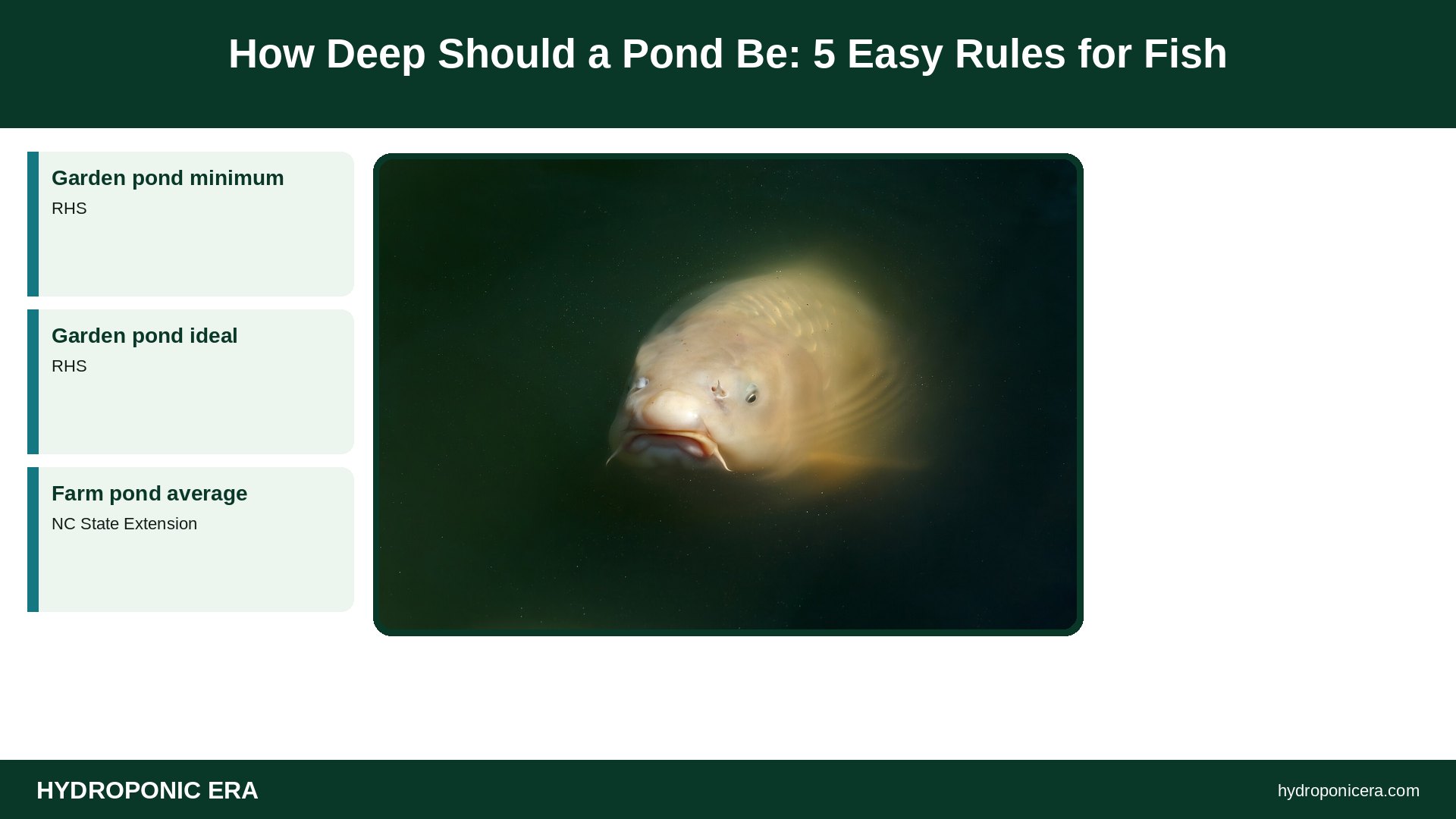
What is the right pond depth for fish? For a garden pond, the RHS says the minimum pond depth for fish and other pondlife is 15 in (38 cm), and ideally 30 in (75 cm). For a farm fishing pond, NC State Extension advises an average of 6–8 ft (1.8–2.4 m), with a maximum of 10–12 ft (3–3.7 m).
Key takeaway: The right pond depth for fish depends on pond type. Small garden ponds need depth to resist overheating and freezing. Larger fishing ponds need deep zones as a winter refuge and to limit weeds, but water that is too deep raises the risk of summer oxygen depletion. Aeration and stocking matter as much as pond depth for fish.
| Pond type | Recommended depth | Source |
|---|---|---|
| Garden pond minimum | 15 in (38 cm) | RHS |
| Garden pond ideal | 30 in (75 cm) | RHS |
| Farm pond average | 6–8 ft (1.8–2.4 m) | NC State Extension |
| Farm pond maximum | 10–12 ft (3–3.7 m) | NC State Extension |
| Deep zone | 8–10 ft (2.4–3 m) over a quarter of the pond | K-State Research and Extension |
| Deep zone | At least 8 ft (2.4 m) over 5–10% of area | Missouri Dept. of Conservation |
What Is the Minimum Pond Depth for Fish in a Garden?
Aim for at least 15 in (38 cm). The RHS says all ponds should be at least that deep, otherwise they overheat in summer, causing algae and deoxygenation that harm fish, and they are more likely to freeze in winter. If space is tight, the RHS says make sure at least part of the pond is deep.
The RHS adds that water ideally should be at least 30 in (75 cm) deep to allow the widest range of plants. For fish, it recommends a surface area of at least 38 sq ft (3.5 square meters) to keep water well aerated and clear.
How Deep Should a Koi or Goldfish Pond Be?
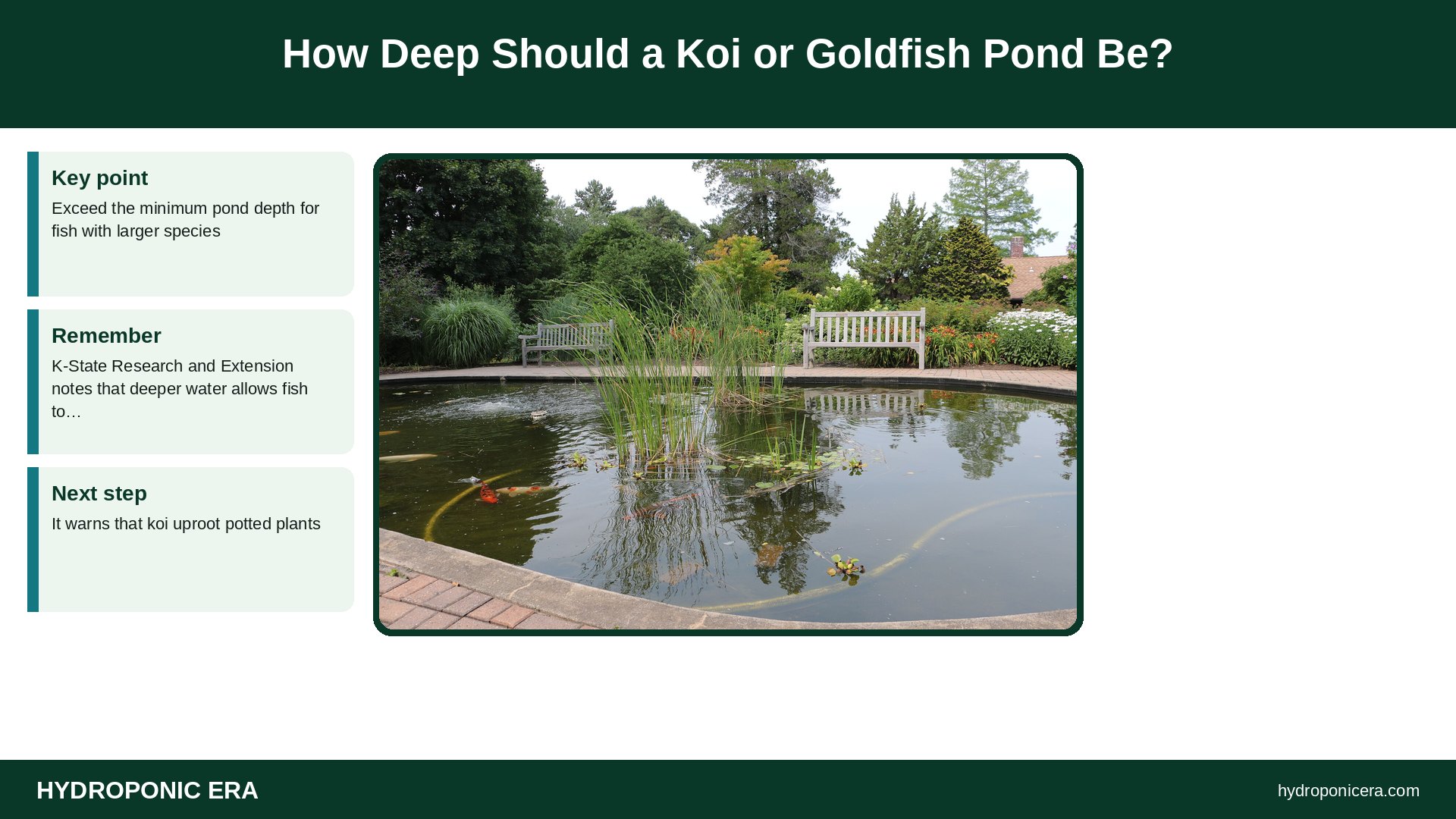
Exceed the minimum pond depth for fish with larger species. K-State Research and Extension notes that deeper water allows fish to exercise and accommodates more filtration and aeration equipment. It warns that koi uproot potted plants. Use 30 in (75 cm) from the RHS as a practical starting pond depth for fish.
- See fish choices in our goldfish aquaponics and koi aquaponics guides.
- Protect plants using ideas from our koi pond plants guide.
What Pond Depth for Fish Prevents Winterkill?
Deep zones protect fish in ice-covered winters. K-State Research and Extension says at least a quarter of a fishing pond should be 8–10 ft (2.4–3 m) deep to buffer temperature and reduce winterkill. The Missouri Department of Conservation says shallow ponds are prone to low-oxygen fish kills during winter ice cover or hot, dry weather.
Missouri’s pond depth for fish rule is that 5–10% of a pond should be at least 8 ft (2.4 m) deep to prevent this type of fish kill. In small garden ponds, the RHS points to the same risk at a smaller scale: shallow water freezes more easily.
Can a Pond Be Too Deep for Fish?
Yes, for larger ponds. NC State Extension says depths greater than 12 ft (3.7 m) are not necessary for good fish production and increase the chance of fish kills from summertime oxygen depletion. It recommends a 1-acre (0.4 ha) or larger fish pond average 6–8 ft (1.8–2.4 m) deep, with a maximum of 10–12 ft (3–3.7 m).
NC State notes that an average depth under 6 ft (1.8 m) greatly increases the chance of aquatic vegetation and leaves no margin for drought. Balanced pond depth for fish keeps deep refuges without creating stagnant bottom water.
How Should Edges Support Pond Depth for Fish?
Slope the edges so shallow water stays limited. NC State Extension says banks should drop 1 ft (0.3 m) for every 2–3 ft (0.6–0.9 m) toward the center, and reach at least 3 ft (0.9 m) deep. That shape limits nuisance weeds and discourages burrowing muskrats.
NC State adds that rooted weeds usually cause problems only where water is less than 24 in (61 cm) deep, because sunlight reaches the bottom. For garden ponds, the RHS recommends slightly sloping sides of about 20 degrees to reduce ice pressure in cold winters.
How Do You Calculate Pond Volume From Depth?
Multiply dimensions by a shape factor. K-State Research and Extension gives these formulas with measurements in feet: square or rectangle, length × width × depth × 7.5; round, diameter × diameter × depth × 5.9; oval or odd shapes, length × width × depth × 6.7. The result is approximate gallons, which helps size pumps and treatments.
- Measure length, width and average depth in feet.
- Pick the formula for your pond shape.
- Multiply to estimate gallons; multiply gallons by 3.785 for liters.
- Size equipment with our aquaponics pump size guide.
Does Depth Replace Aeration and Stocking Limits?
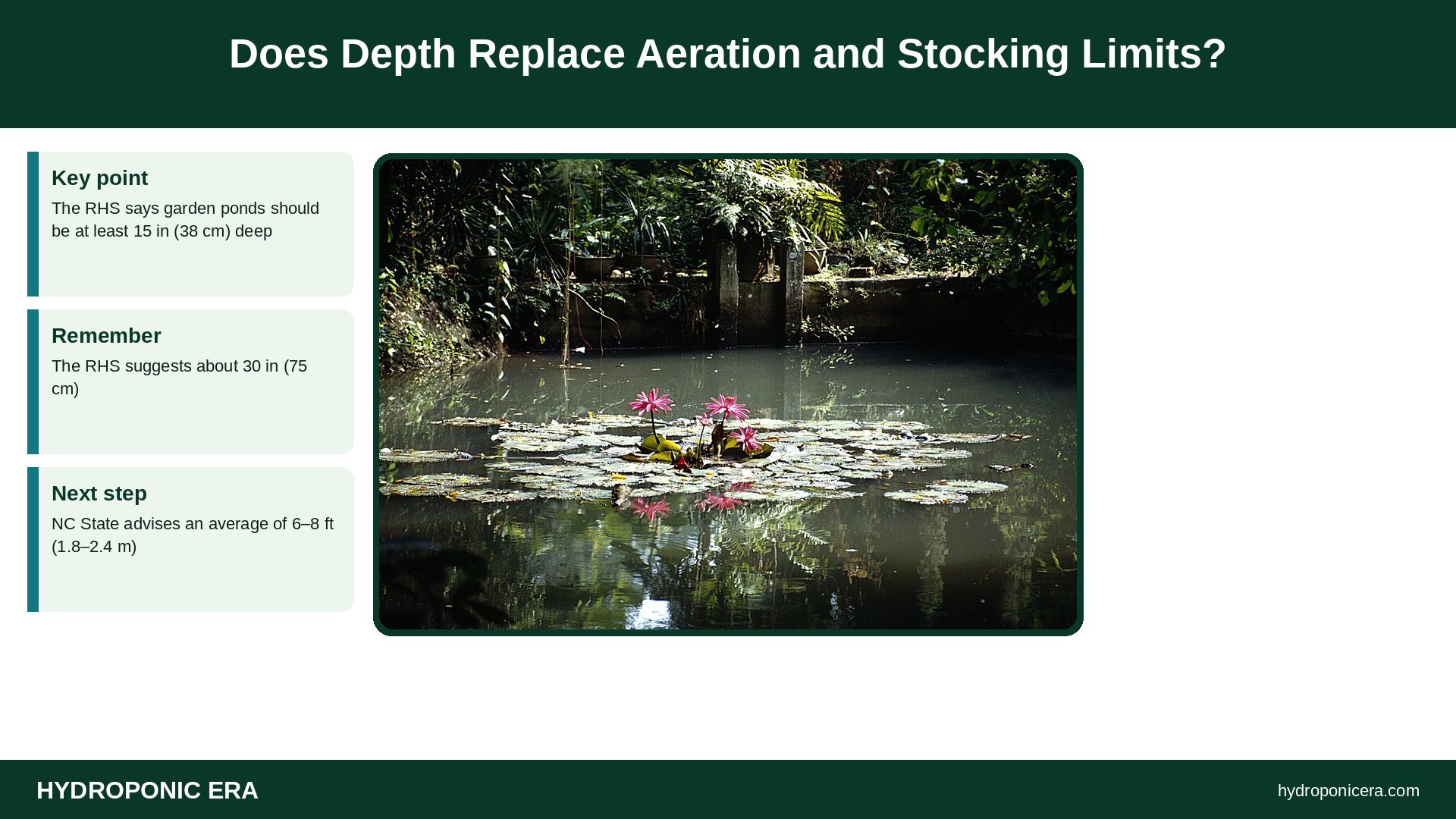
No. K-State says depth matters, but water also needs to keep moving, and aeration plays a big role. Its water garden guide advises keeping less than 1 in (2.5 cm) of fish per sq ft (0.09 m²) of pond surface. Even the best pond depth for fish cannot fix overstocking, so plan both together.
- Add oxygen with our aquaponics air pump guide.
- Improve clarity with a bog filter.
What is the minimum pond depth for fish?
The RHS says garden ponds should be at least 15 in (38 cm) deep.
What is the ideal pond depth for fish in a garden?
The RHS suggests about 30 in (75 cm).
How deep should a farm pond be for fish?
NC State advises an average of 6–8 ft (1.8–2.4 m).
Is a deeper pond depth for fish always better?
No. NC State says over 12 ft (3.7 m) raises summer oxygen-depletion risk.
How much of a pond should be deep?
K-State says about a quarter at 8–10 ft (2.4–3 m); Missouri says 5–10% at 8 ft (2.4 m).
Sources
- Royal Horticultural Society. How to make a new pond.
- NC State Extension. Pond Management Guide.
- Kansas State University Research and Extension. Pond Management.
- Missouri Department of Conservation. Stocking Fish in Your Pond.
- Kansas State University Research and Extension. MF2911: Water Gardening, Biological Balance.
- Photo credits (Wikimedia Commons, edited with titles): Koi in a garden pond in Tuntorp 3 by W.carter (CC BY-SA 4.0); Deep Cut Gardens Koi Pond by FossilDS (CC0); Pond-edge plants at Achamore Garden – geograph.org.uk – 5446824 by M J Richardson (CC BY-SA 2.0); RIBogorSeerose by Ziegler175 (CC BY-SA 4.0)
1 thought on “How Deep Should a Pond Be: 5 Easy Rules for Fish”