
Is jade perch good for aquaponics? Yes, in warm, well-aerated systems. Jade perch (Scortum barcoo) is a hardy Australian omnivore, and a 2025 CSIRO-led study found it grew as well in aquaponics with lettuce as in a fish-only recirculating system. Business Queensland advises dissolved oxygen of at least 4 mg/L and warns growth falls rapidly at 68°F (20°C) or below.
Key takeaway: Jade perch is the market name for Barcoo grunter, a native fish of central Australia’s Lake Eyre and Bulloo-Bancannia catchments. It is hardy, omnivorous, fast-growing and rich in omega-3 fats, which makes it attractive for aquaponics. It needs warm water, strong aeration and careful feeding, because it is voracious and easily overfed.
| Factor | Guideline | Source |
|---|---|---|
| Dissolved oxygen | 4 mg/L or more | Business Queensland |
| pH | Tolerates 6–9; ideal 6.5–8.5 | Business Queensland |
| Growth slows | At or below 68°F (20°C) | Business Queensland |
| Feeding often stops | Below 61°F (16°C) | Business Queensland |
| Mass deaths possible | At or below 55°F (13°C) | Business Queensland |
| Study temperature | About 79°F (26°C) | Animals, 2025 |

What Is Jade Perch?
It is Scortum barcoo, sold as jade perch. Business Queensland says Barcoo grunter is native to the Lake Eyre and Bulloo-Bancannia catchments and is farmed in tanks or ponds. Native Fish Australia lists a size of up to 14 in (35 cm), commonly 10 in (25 cm), with dark side blotches that separate it from the similar silver perch.
Native Fish Australia says the species lives in turbid or muddy waters of large, low-gradient rivers and waterholes and tolerates water temperatures up to 104°F (40°C). It calls jade perch good eating and high in omega-3 fatty acids.
Why Use Jade Perch in Aquaponics?
It is hardy and grows well with plants. The 2025 Animals study tested coupled aquaponics with jade perch and butterhead lettuce over 9 weeks in twelve units totaling about 190 gallons (720 L). Fish in aquaponics, with or without mineral supplements, grew as well as fish in a recirculating system, though hydroponics produced more plant biomass.
The authors describe jade perch as recognized for robust health, rapid growth, high feed conversion efficiency and adaptability, which they call appealing traits for aquaponics. Compare it with other species in our best fish for aquaponics guide.

What Water Temperature Does Jade Perch Need?
Keep jade perch warm. In the Animals study, water was held near 79°F (26°C). Business Queensland warns growth declines rapidly at 68°F (20°C) or below, handling can cause deaths at 63°F (17°C), farmers often stop feeding at 61°F (16°C), and mass deaths can occur at 55°F (13°C). Above 86°F (30°C), increase aeration and water exchange.
Native Fish Australia gives a recommended range of 64–81°F (18–27°C) for aquariums and aquaculture. In cool climates, plan on a heater sized for your tank and an insulated fish room.
What Water Quality Does Jade Perch Need?
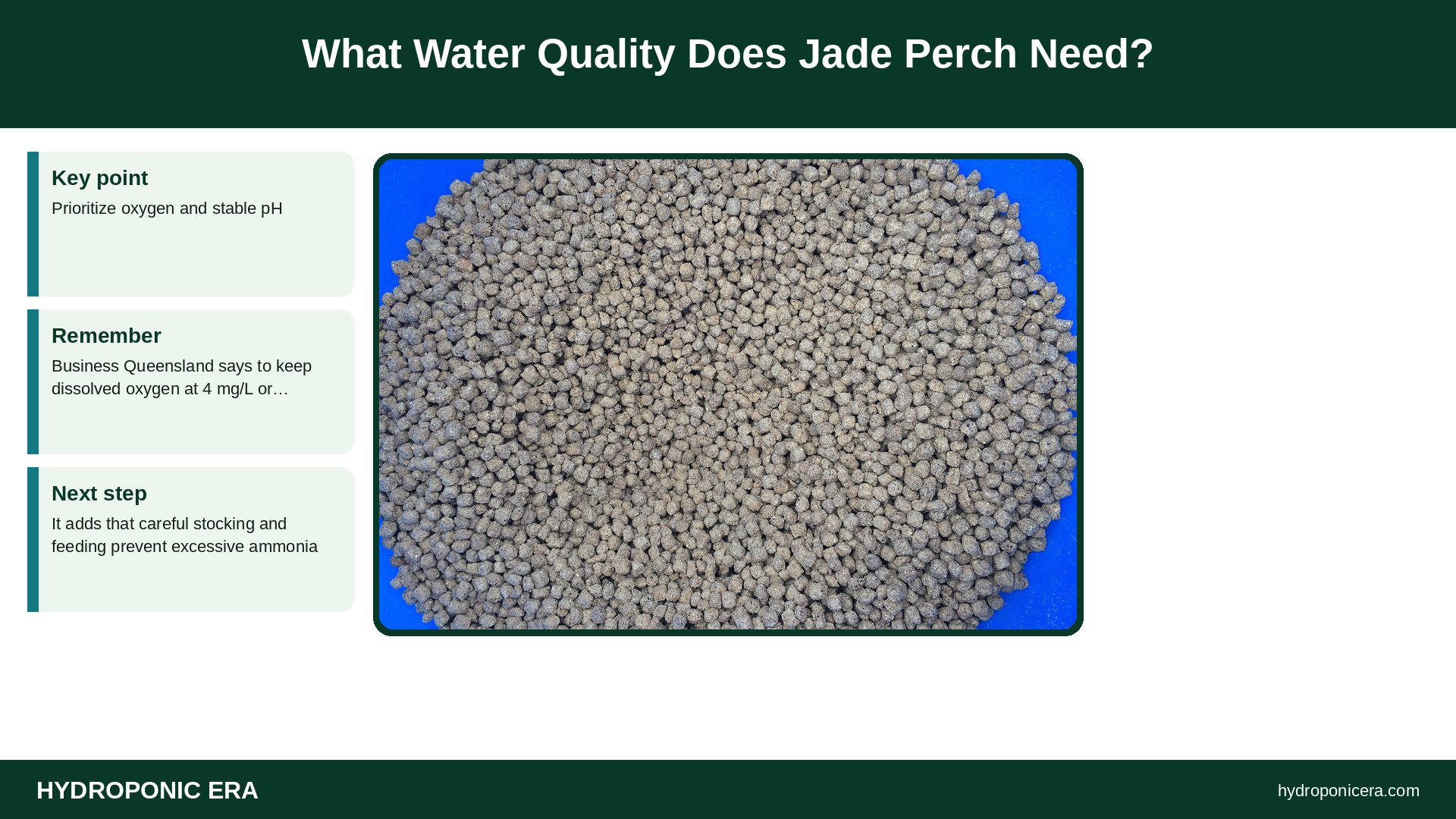
Prioritize oxygen and stable pH. Business Queensland says to keep dissolved oxygen at 4 mg/L or greater, calls aeration essential, and gives a tolerated pH of 6 to 9 with an ideal range of 6.5 to 8.5. It adds that careful stocking and feeding prevent excessive ammonia. The Animals study kept its holding system above 8 mg/L oxygen.
- Plan aeration with our aquaponics air pump guide.
- Process ammonia with a working aquaponics biofilter.
- Business Queensland accepts salinity of 5 g of salt per liter for long-term exposure and disease treatment.
What Do Jade Perch Eat?
They are omnivores that accept pellets. Business Queensland lists zooplankton, algae, small crustaceans, aquatic insects, molluscs and plant material, and says jade perch accept commercial diets at fingerling and adult stages. Feed conversion runs about 1.2:1 for fingerlings and 1.6:1 for grow-out. Feed carefully, because the fish is voracious and easily overfed.
- Match pellet size to fish size.
- Feed small portions the fish clear quickly.
- Cut feeding as water cools toward 61°F (16°C).
- Watch ammonia after any feed increase.
Native Fish Australia adds that jade perch may be fed barramundi pellets, lettuce and other plant leaves. See our aquaponics fish food guide for feed basics.
How Fast Do Jade Perch Grow?
Fast in warm, managed systems. Business Queensland says in recirculating systems they can reach about 1 lb (450 g) in 4 months and 1.8 lb (800 g) in 7 months from advanced fingerlings, with maximum density usually 2.5–3.1 lb (1.1–1.4 kg) per cu ft (28 L). Native Fish Australia reports reaching 12 in (30 cm) in about 18 months.
Business Queensland recommends grading fingerlings into size classes to avoid large size differences and inefficient feeding. Before harvest, it advises purging fish in clean, salted water for 7 to 14 days to remove off-flavors. For another warm-water option, see our tilapia aquaponics guide.
Can You Breed Barcoo Grunter at Home?
It is usually left to hatcheries. Business Queensland says wild Barcoo grunter spawn in summer floods when water is above 73°F (23°C), while captive broodstock are induced with a hormone injection that needs veterinary advice and a prescription. Larvae become fingerlings in 3 to 4 weeks and reach 1.2–2 in (30–50 mm) at 8 to 12 weeks.
Is jade perch good for aquaponics?
Yes. A 2025 study found similar growth in aquaponics and fish-only recirculating systems.
What temperature do jade perch need?
Keep it near 79°F (26°C); growth falls at 68°F (20°C) or below.
What do jade perch eat?
Omnivorous foods and commercial pellets, per Business Queensland.
How big do jade perch get?
Up to 14 in (35 cm), commonly 10 in (25 cm), per Native Fish Australia.
How much oxygen do jade perch need?
At least 4 mg/L dissolved oxygen, with aeration.
Sources
- Business Queensland, Queensland Government. Barcoo grunter (jade perch) aquaculture.
- Native Fish Australia. Barcoo grunter.
- Animals (MDPI), via PubMed Central. Mineral Supplementation in Jade Perch Aquaponics with Lettuce.
- Photo credits (Wikimedia Commons, edited with titles): Scortum barcoo Jade Perch feeding Tropical Dome Brisbane Botanic Gardens Mt Coot-tha L1080356 by John Robert McPherson (CC BY-SA 4.0); Fish farming on Øksfjorden in Loppa, Troms og Finnmark, Norway, 2022 August by Ximonic (Simo Räsänen) (CC BY-SA 4.0); Fish Feed Pellets by Narek75 (CC BY-SA 4.0); Aeration tank activated sludge process STP Bengaluru India by Vraj Acharya, WELL Labs (CC BY-SA 4.0)