
What grow light color temperature is best? A grow light color temperature of about 5000K to 6500K is a good default for white lights. University of Vermont Extension calls 6500K ideal, and University of Maryland suggests 5000K to 6500K for single fluorescent tubes. Missouri Extension notes Kelvin describes how light looks to people, so check PAR and PPFD too.
Key takeaway: Grow light color temperature (Kelvin) describes how white light looks; pick 5000–6500K, then check PPFD.
| Kelvin rating | How it looks | Typical example | Source |
|---|---|---|---|
| About 2000s K | Red, orange | Low-angled sunshine | University of Maryland |
| About 2700K | Warm white | Warm-white fluorescent | University of Maryland |
| About 5000K | Neutral daylight | Direct sunlight | University of Maryland |
| About 6500K | Cool white | Cool-white fluorescent | University of Maryland, UVM |
| About 10,000K | Blue sky | Upper end of the scale | University of Maryland |
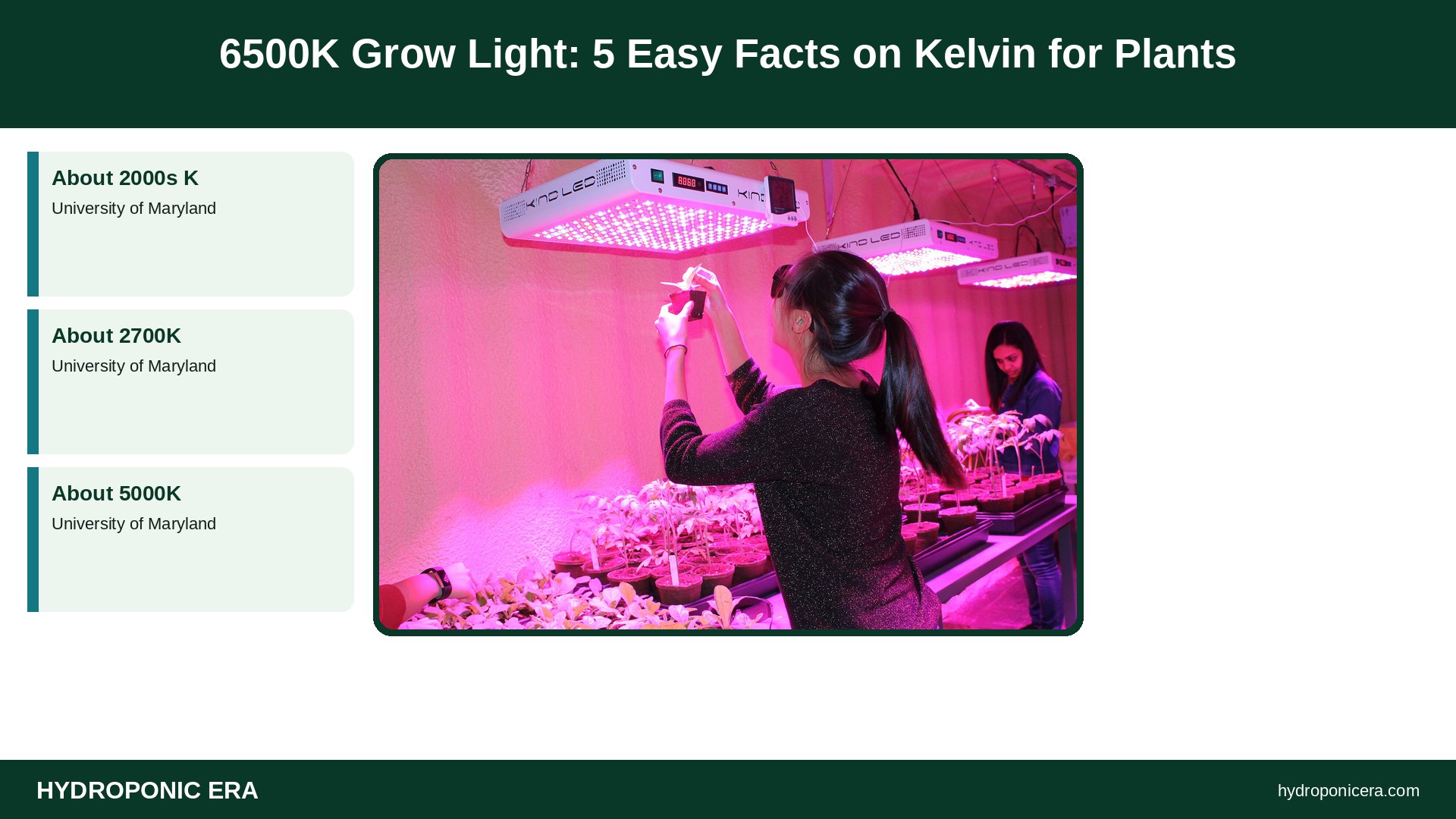
What Does Grow Light Color Temperature Mean?
Grow light color temperature describes the color of white light. University of Vermont Extension says correlated color temperature, measured in kelvins (K), describes a light as warm, meaning yellow, or cool, meaning blue. University of Maryland Extension stresses that the term does not relate to heat; the lower the Kelvin rating, the warmer the light appears.
Is 6500K or 3000K Better for Plants?
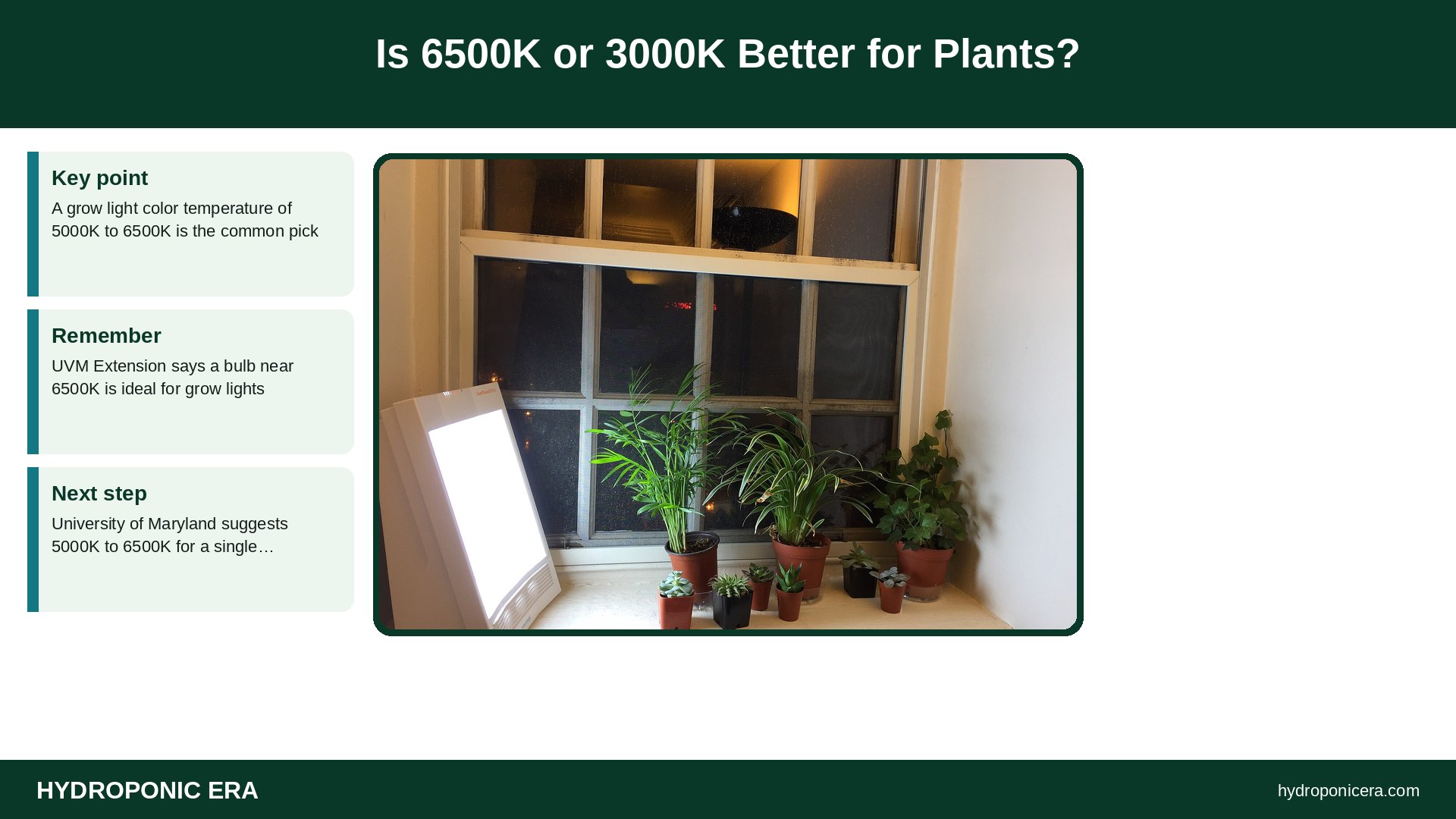
A grow light color temperature of 5000K to 6500K is the common pick. UVM Extension says a bulb near 6500K is ideal for grow lights. University of Maryland suggests 5000K to 6500K for a single fluorescent tube, and says mixing cool and warm tubes in multi-tube fixtures evens out their slightly different red and blue output.
Learn how colors affect growth in our red vs blue light for plants guide.
Does Grow Light Color Temperature Measure Plant Light?
No. Grow light color temperature is a human-vision measure. Missouri Extension says lumens and Kelvin color temperature describe light human eyes perceive, not the light plants use to grow. It advises focusing on photosynthetically active radiation (PAR), from 400 to 700 nanometers, and checking a spectrum graph. It even suggests avoiding lights listing only lumens, lux or Kelvin.
Does Kelvin Matter for LED Grow Lights?
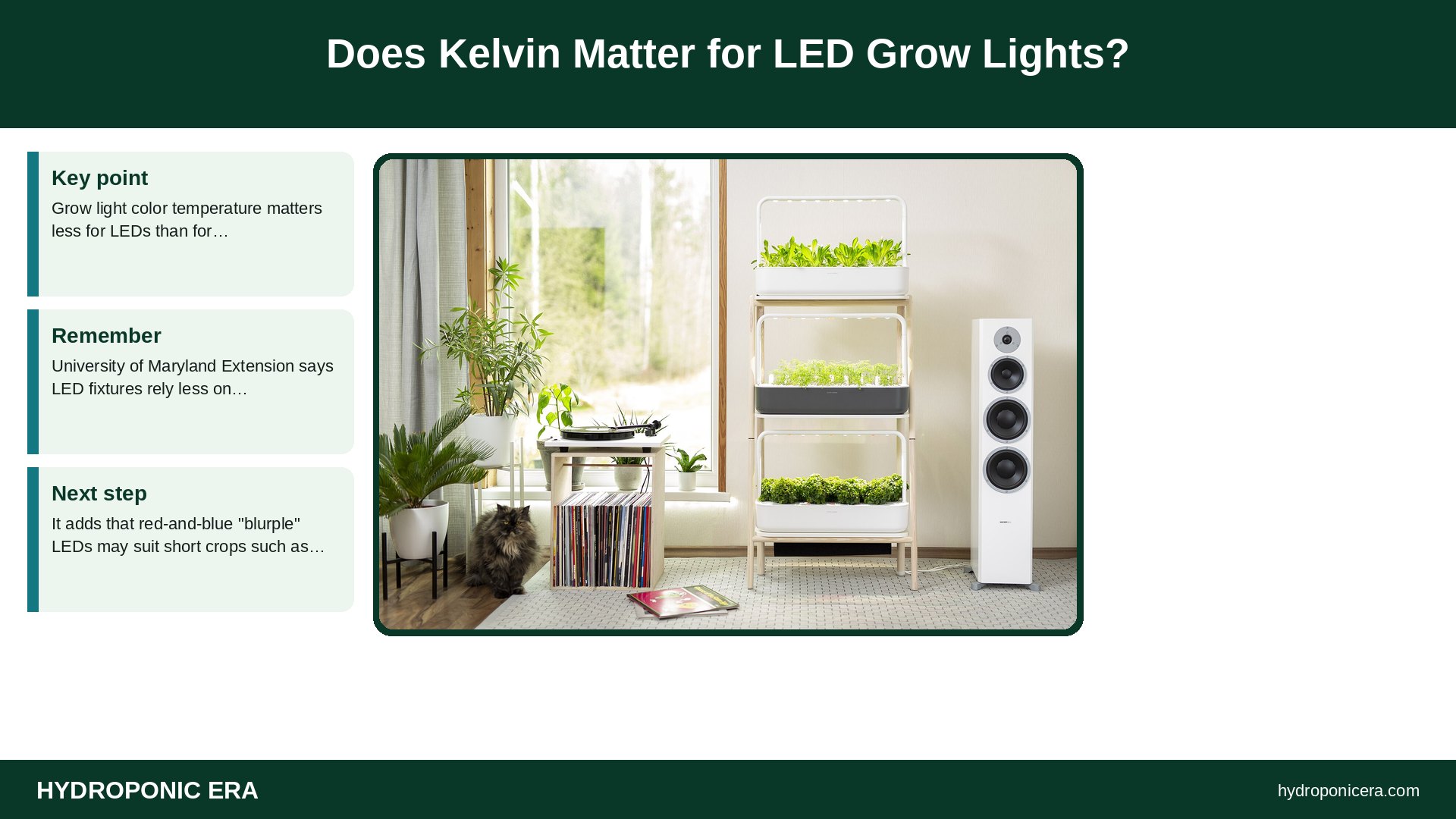
Grow light color temperature matters less for LEDs than for fluorescents. University of Maryland Extension says LED fixtures rely less on Kelvin ratings because their output is more easily customized. It adds that red-and-blue “blurple” LEDs may suit short crops such as sprouts or lettuce, but a balanced white light is easier on the eyes.
Compare lamp types in our T5 vs LED grow lights guide.
What Should You Check Besides Grow Light Color Temperature?
Spectrum, intensity, CRI and efficiency. Missouri Extension says to check for a spectrum graph, a PPFD map at your hanging height and efficiency in micromoles per joule, noting current LEDs exceed 2.5 µmol/J. UVM says good full-spectrum lights have a color rendering index (CRI) above 85.
- Pick a white light near 5000K to 6500K.
- Confirm a spectrum graph covers 400 to 700 nm.
- Check the PPFD map at your hanging height.
- Compare efficiency in µmol/J.
- Look for a CRI above 85 for natural color.
Plan intensity with our PPFD and DLI hydroponics guide.
Why Does Grow Light Color Temperature Affect How Plants Look?
It changes how colors render. University of Maryland says the closer a light gets to daylight, the more natural plants look, and that full-spectrum white light makes viewing plants easier and reduces eye strain compared with harsh red-blue light. UVM adds that CRI measures how closely a light matches visible sunlight, with 100 as the maximum.
How Much Light Intensity Do Plants Need?
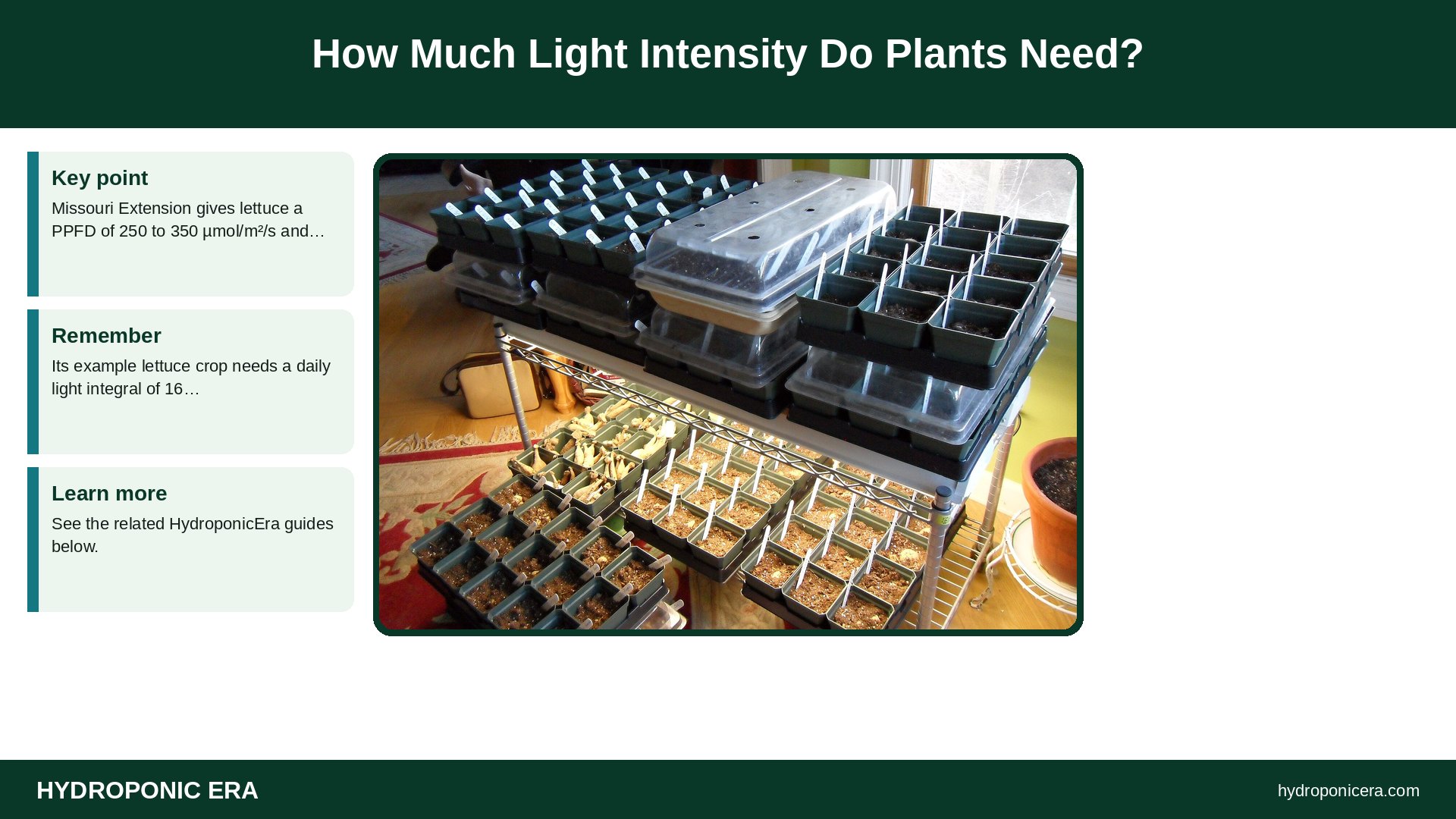
It depends on the crop. Missouri Extension gives lettuce a PPFD of 250 to 350 µmol/m²/s and says more than 350 wastes energy without a significant yield gain, while excessive light can cause photoinhibition. Its example lettuce crop needs a daily light integral of 16 mol/m²/day, reached in about 8.6 hours at 517.6 µmol/m²/s.
How Far Should Grow Lights Hang Above Seedlings?
Follow the maker’s height guide. UVM Extension says to buy adjustable fixtures, since browning on leaves or edges may mean lights are too close, while lanky seedlings suggest lights are too high. It recommends 16 to 18 hours of light daily at 65 to 75°F (18 to 24°C), with dark periods, using a timer.
Build a rack with our seed starting shelf with grow lights guide.
Can Light Color Change How Plants Grow?
Yes, beyond photosynthesis. Missouri Extension says red and far-red light promote growth and tissue expansion, and roughly equal red and far-red can trigger flowering in some long-day plants. Blue and ultraviolet light boost phytonutrients, but excessive blue light stunts growth, so a balanced spectrum is the safer choice.
FAQ About Grow Light Color Temperature
Is daylight 5000K or 6500K?
Sources differ: University of Maryland lists direct sun near 5000K, while UVM uses 6500K for natural light.
Is a warm grow light color temperature bad?
Not harmful, but University of Maryland suggests 5000K to 6500K for single tubes and mixing warm and cool in multi-tube fixtures.
Should lights run all night?
No. UVM says plants require periods of darkness.
What CRI is best?
UVM says above 85, and closer to 100 is better.
Sources
- University of Vermont Extension — Tips for Choosing Grow Lights
- University of Maryland Extension — Fine-Tuning Your Indoor Plant Lighting Choices
- University of Missouri Extension — Controlled Environment Agriculture: Understanding Grow Lights (G6987)
- Photo credits (Wikimedia Commons, edited with titles): Terramera scientists working in a climate-controlled growth chamber located in Vancouver, BC. The space uses LED lighting, which supports plant growth. (50188965171) by Simon Fraser University – Communications & Marketing (CC BY 2.0); Potted plants succulents under grow light Nov 2016 by Asdfjrjjj (CC BY-SA 4.0); Click & Grow Smart Garden 27 by Janar Raidla (CC BY-SA 4.0); Dahlias started indoors by F. D. Richards from Clinton, MI (CC BY-SA 2.0)