
How do you grow fenugreek sprouts? To grow fenugreek sprouts, soak 3 tablespoons (45 mL) of sprouting seed in cool water for 6 to 12 hours, then rinse and drain twice or three times daily. Short sprouts are ready in 2 to 3 days, leafy ones in 5 to 6. FDA and EFSA warn raw sprouts carry risk.
Key takeaway: Fenugreek sprouts need a 6–12 hour soak, regular rinses and 2–6 days; buy sprouting seed and handle safely.
| Step | Timing | Detail | Source |
|---|---|---|---|
| Soak | 6–12 hours | Cool water; 8–12 hours suggested | Organic Heirloom Seed, Sprouting.com |
| Rinse and drain | 2–3 times a day | Every 8–12 hours, drain well | Organic Heirloom Seed, Sprouting.com |
| Light | From day 3 | Bright spot to green the leaves | Organic Heirloom Seed |
| Harvest | 2–6 days | Short sprouts early; leafy sprouts day 5–6 | Sprouting.com, Organic Heirloom Seed |
| Yield | About 5 to 1 | 1 pound (0.45 kg) seed gives about 5 pounds (2.3 kg) | Organic Heirloom Seed |
How Long Should You Soak Fenugreek Sprouts Seed?
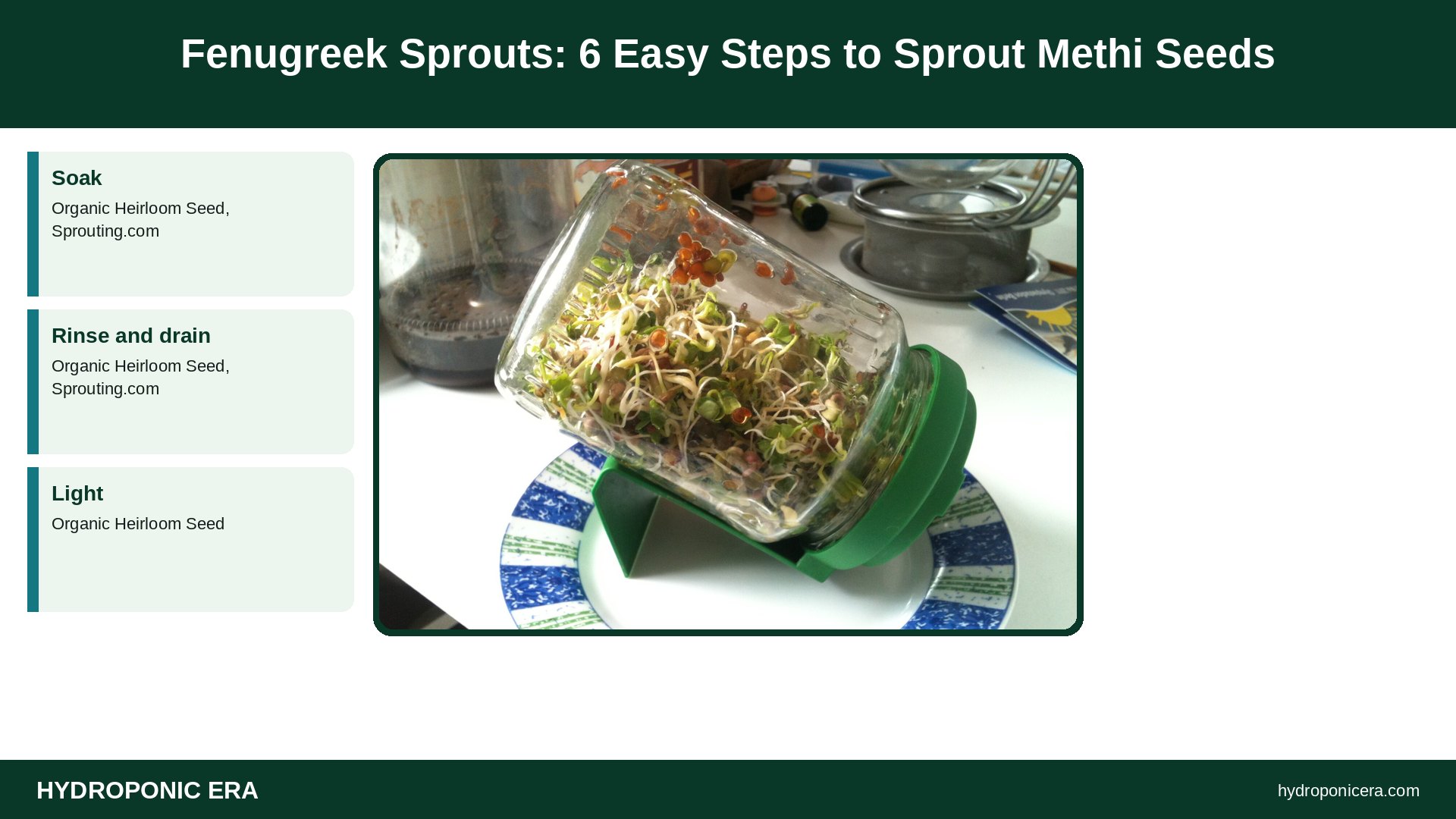
About 6 to 12 hours. Organic Heirloom Seed lists a 6 to 12 hour soak and suggests 8 to 12 hours in cool water for 3 tablespoons (45 mL) of seed. Sprouting.com soaks about 1/4 cup (60 mL) of seed for 6 to 12 hours in a wide-mouth jar, then drains and inverts it at an angle.
What Equipment Do Fenugreek Sprouts Need?
Very little. Sprouting.com uses a wide-mouth jar with a sprouting lid, set upside down at an angle on a sprouting rack, in a bowl or on a drain rack so water runs off. Organic Heirloom Seed notes trays also work and can take direct sun later. For a tray setup, see our sprouting tray guide.
How Often Should You Rinse Fenugreek Sprouts?
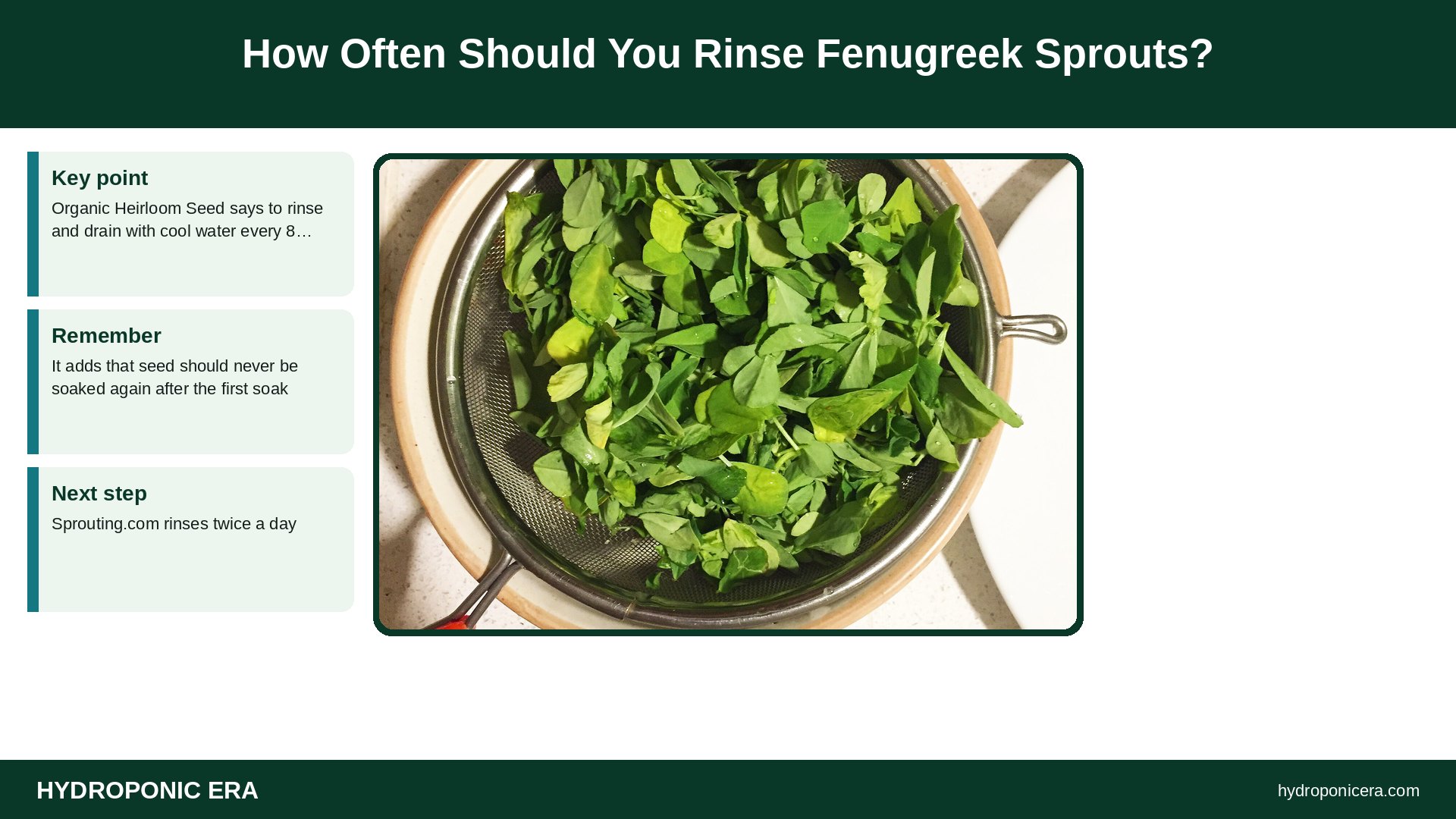
Two or three times a day. Organic Heirloom Seed says to rinse and drain with cool water every 8 to 12 hours, and notes that rinsing thoroughly and draining as much water as possible are key to good sprouts. It adds that seed should never be soaked again after the first soak. Sprouting.com rinses twice a day.
A tilted jar works well; see our how to grow sprouts in a jar guide.
When Are Fenugreek Sprouts Ready to Eat?
In 2 to 6 days. Sprouting.com says fenugreek sprouts are ready in 2 to 3 days for short, sweet sprouts. Organic Heirloom Seed harvests on day 5 or 6, once the leaves open and most turn green, after moving the sprouter to a well-lit spot on day 3. Both suggest tasting often to find your preference.
Why Are Some Fenugreek Seeds Still Hard?
Some seeds absorb water slowly. Sprouting.com says that if you notice hard seed after soaking, soak longer next time or use hot water at 125°F (50°C) and let it cool during a 4 to 12 hour soak. It encourages experimenting to see what works best with your seed lot.
Are Fenugreek Sprouts Safe to Eat Raw?
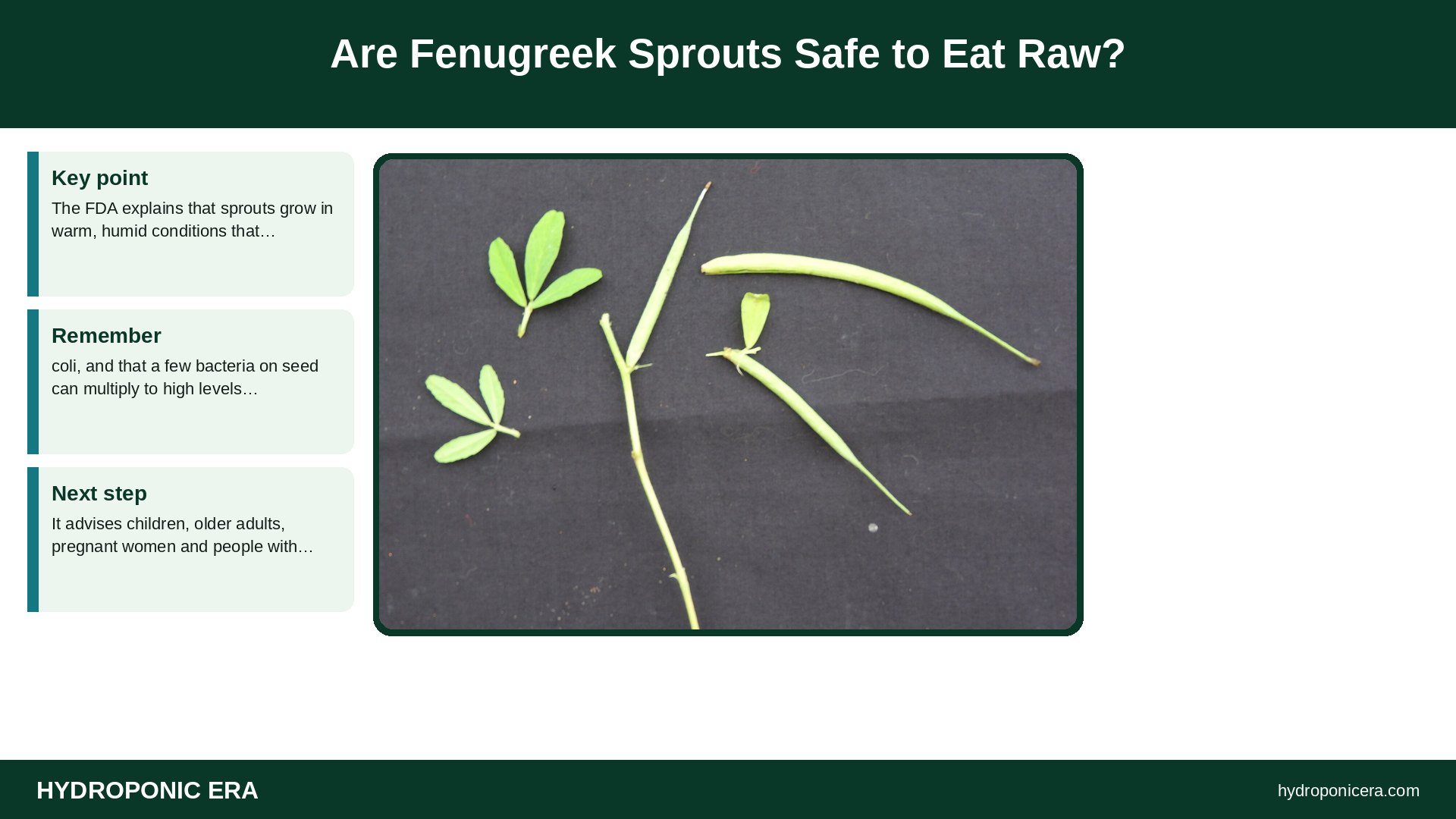
They carry real risk. The FDA explains that sprouts grow in warm, humid conditions that also suit Salmonella, Listeria and E. coli, and that a few bacteria on seed can multiply to high levels even under sanitary home conditions. It advises children, older adults, pregnant women and people with weakened immunity to avoid raw or lightly cooked sprouts.
What Happened With Fenugreek Sprouts in 2011?
A deadly outbreak. EFSA’s task force concluded that one lot of fenugreek seeds imported from Egypt and used to grow sprouts was the most likely common link between E. coli O104:H4 outbreaks in Germany and France. EFSA reported 48 deaths in Germany and one in Sweden, with 4,178 cases in the EU, Norway and Switzerland at that time.
EFSA also noted that negative seed tests cannot prove a lot is free of the bacteria.
How Can You Lower the Risk With Fenugreek Sprouts?
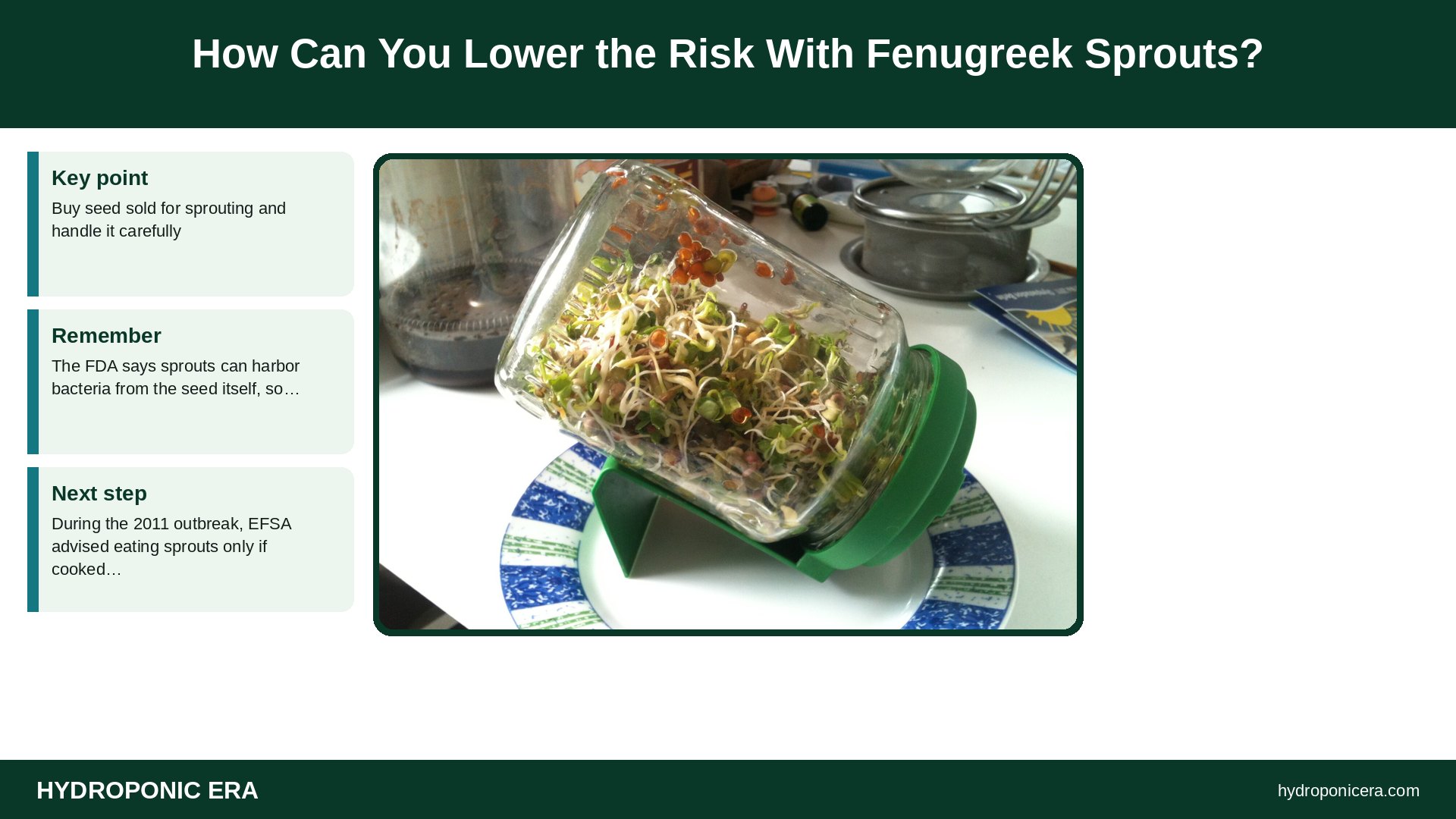
Buy seed sold for sprouting and handle it carefully. The FDA says sprouts can harbor bacteria from the seed itself, so even clean home sprouting cannot remove all risk. During the 2011 outbreak, EFSA advised eating sprouts only if cooked thoroughly. Cooking fenugreek sprouts thoroughly, for example in dal, is the safest choice.
- Buy seed labeled for sprouting.
- Wash hands, jars and lids before starting.
- Rinse with cool, clean water every 8 to 12 hours.
- Drain well so seeds never sit in water.
- Refrigerate finished sprouts promptly.
- Cook sprouts for vulnerable eaters.
Store harvests as in our sprouting seeds guide.
Are Fenugreek Sprouts the Same as Fenugreek Microgreens?
No. Sprouts are eaten whole, seed and root included, after a few days in a jar. Sprouting.com notes the same seed can also grow green, leafy microgreens in trays, which are cut above the root after longer growth under light. Our fenugreek microgreens guide covers the tray method.
FAQ About Fenugreek Sprouts
How do you store them?
Sprouting.com says to refrigerate finished sprouts.
Do they taste bitter?
Sprouting.com describes short sprouts as sweet; Organic Heirloom Seed suggests tasting at each rinse.
Do they need sunlight?
Not to sprout. Organic Heirloom Seed adds light from day 3, using direct sun only for trays.
How much do they yield?
About 5 to 1 by weight, per Organic Heirloom Seed.
Sources
- U.S. Food and Drug Administration — Selecting and Serving Produce Safely
- European Food Safety Authority — Task Force Report on E. coli O104:H4 Outbreaks
- Sprouting.com (Mumm’s Sprouting Seeds) — Fenugreek Sprouting Directions
- Organic Heirloom Seed — Fenugreek Sprouting Instructions
- Photo credits (Wikimedia Commons, edited with titles): Growing bean sprouts by User:tlcoles (CC BY-SA 3.0); Washed fenugreek leaves for cooking methi-chadachadi by Subhashish Panigrahi (CC BY-SA 4.0); Trigonella foenum graecum-3-bangalore-India by Yercaud-elango (CC BY-SA 4.0); Growing bean sprouts by User:tlcoles (CC BY-SA 3.0)