
What causes hydrogen sulfide in aquaponics? Hydrogen sulfide forms when fish waste and uneaten feed pile up in places with no oxygen. Sulfate-reducing bacteria in that sludge release the gas, which smells like rotten eggs and is very toxic to fish. The Southern Regional Aquaculture Center says deep sludge deposits decompose anaerobically and produce both methane and hydrogen sulfide. Removing solids and keeping water moving prevents it.
Key takeaway: Hydrogen sulfide (H2S) is one of the few aquaponics problems you can often smell before you can test for it. It shows up in dead spots: the bottom of a clogged media bed, a forgotten sump corner, or a mechanical filter that has not been cleaned. The fix is mostly plumbing and maintenance rather than chemicals.
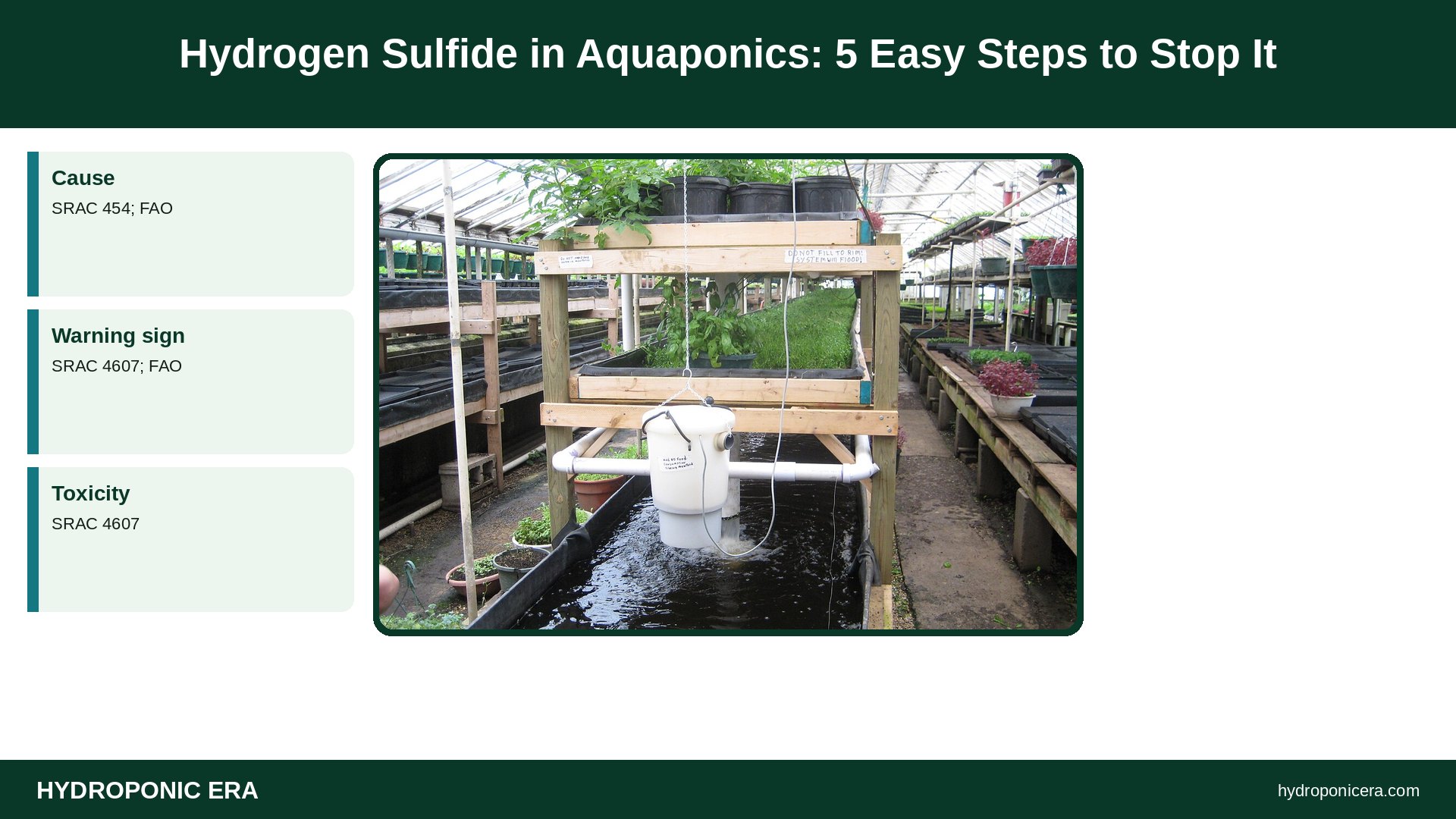
| Question | Short answer | Source |
|---|---|---|
| Cause | Anaerobic bacteria breaking down sludge | SRAC 454; FAO |
| Warning sign | Rotten egg smell | SRAC 4607; FAO |
| Toxicity | Any detectable amount can harm fish | SRAC 4607 |
| Removal | Volatile; aeration and splashing degas it | SRAC 4607 |
| Prevention | Remove solids, avoid dead zones | SRAC 454; FAO |
What Is Hydrogen Sulfide in an Aquaponics System?
It is a toxic gas made by bacteria living without oxygen. SRAC Publication 4607 explains that hydrogen sulfide forms under very low oxygen when bacteria use sulfate as an energy source and release H2S as a byproduct. It warns that the gas can occur inside an aquaculture system, not only in well water, and that any detectable amount can harm or kill many aquatic animals.
What Causes Hydrogen Sulfide in Aquaponics?
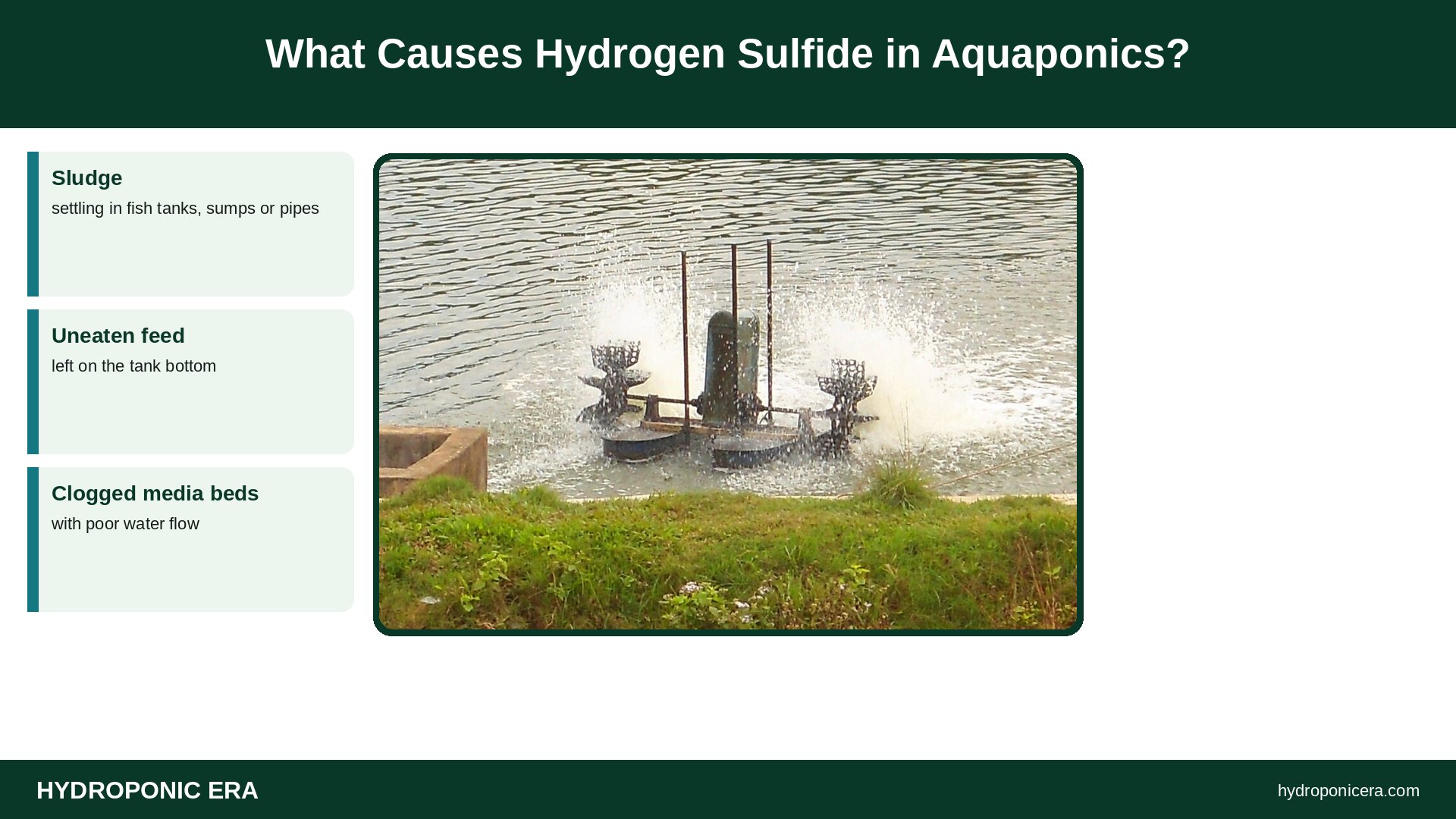
Trapped solids cause it. The FAO small-scale aquaponics manual says unfiltered waste creates anaerobic spots that can harbor bacteria producing H2S from fermenting solids. SRAC 454 adds that if organic matter accumulates it lowers dissolved oxygen as it decays, and deep sludge decomposes anaerobically into methane and hydrogen sulfide.
- Sludge settling in fish tanks, sumps or pipes.
- Uneaten feed left on the tank bottom.
- Clogged media beds with poor water flow.
- Stagnant water during pump failures.
How Do You Know If You Have Hydrogen Sulfide?
The first sign of hydrogen sulfide is usually smell. SRAC 4607 notes that H2S has a characteristic rotten egg odor and says that if the odor is detected the gas should be dealt with immediately. The FAO manual also describes the rotten egg smell from anaerobic spots. Black, foul sludge when you disturb gravel or a filter is another clue.
- Sniff the sump, filter and media bed drains.
- Stir a corner of the media bed and watch for black sludge.
- Check fish for gasping or crowding at the surface.
- Test dissolved oxygen, since low oxygen drives the problem.
Our aquaponics fish dying checklist covers other causes of sudden losses.
Is Hydrogen Sulfide Toxic to Fish?
Yes, very. SRAC 4607 says hydrogen sulfide is toxic to fish even at low levels and essentially makes the animal unable to breathe. SRAC 454 calls the methane and H2S from decomposing sludge very toxic to fish, and the FAO manual describes it as a very toxic and lethal gas for fish. Treat any rotten egg smell as an emergency.
Can Hydrogen Sulfide Harm Plant Roots?
The same dead zones hurt plants too. SRAC 454 explains that suspended solids reaching the hydroponic component can coat roots and create anaerobic zones that block nutrient uptake, because active transport needs oxygen. The FAO manual adds that unmanaged solids block water flow and consume oxygen, leading to anoxic conditions. See our aquaponics root rot guide for root symptoms.
How Do You Remove Hydrogen Sulfide From Aquaponics?
Get oxygen in and remove hydrogen sulfide’s source. SRAC 4607 says H2S is relatively volatile and easy to degas; splashing water onto the surface plus aeration is typically enough agitation to release it into the air. Removing the sludge that makes it is just as important, or the gas will keep forming.
- Increase aeration with extra air stones.
- Let return water splash into the tank or sump.
- Siphon sludge from tank bottoms and sumps.
- Rinse clogged filters and clear the media bed inlet.
- Do a partial water change if fish show stress.
Our aquaponics dissolved oxygen guide explains oxygen targets.
How Do You Prevent Hydrogen Sulfide Buildup?
Stop solids from settling where water cannot reach. The FAO manual recommends never leaving uneaten feed in the fish tank and warns that long media beds collect solids at the inlet, raising anaerobic risk. It notes that clarifiers can remove up to 60 percent of total removable solids and must be rinsed. Our aquaponics solids filter guide compares filter types.
- Feed carefully: remove uneaten feed.
- Filter solids: use a clarifier or swirl filter.
- Place air stones wisely: FAO says avoid stirring up settling solids.
- Watch stocking: FAO notes filters can be overwhelmed above about 0.94 lb/ft3 (15 kg/m3).
Which Parts of an Aquaponics System Are Most at Risk?
Anywhere water slows down. The FAO manual warns that without water flow, media beds and deep water culture units stagnate and turn anoxic, and that longer media beds collect solids near the inlet. It also notes that heavily stocked systems can overwhelm mechanical filters and clog media. Check these spots first when you smell rotten eggs.
- Media bed inlets where solids land first.
- Sump corners and low points in pipes.
- DWC canals that act as settling tanks for fine waste.
- Any tank after a pump or power failure.
Does Hydrogen Sulfide Come From Well Water?
It can. SRAC 4607 says H2S is often present in groundwater, and decaying organic matter near the source affects how much is present. If tap or well water smells of rotten eggs before it enters the system, aerate it in a separate container first. The same degassing approach used for ponds, splashing plus aeration, works for top-up water.
FAQ About Hydrogen Sulfide in Aquaponics
What does hydrogen sulfide smell like?
Rotten eggs, per SRAC and FAO.
What causes hydrogen sulfide in aquaponics?
Anaerobic bacteria breaking down trapped sludge and feed.
Can hydrogen sulfide kill fish?
Yes; SRAC says any detectable amount can harm or kill.
How do I get rid of hydrogen sulfide fast?
Aerate hard, splash return water, and remove sludge.
Do media beds cause hydrogen sulfide?
Clogged beds with poor flow can.
What is the earliest warning sign?
A rotten egg smell, often with low dissolved oxygen.
Sources
- Southern Regional Aquaculture Center — Groundwater Treatment Before Use in Aquaculture (SRAC 4607)
- Southern Regional Aquaculture Center — Aquaponics: Integrating Fish and Plant Culture (SRAC 454)
- Food and Agriculture Organization of the United Nations — Small-scale aquaponic food production (Fisheries Technical Paper 589)
- Photo credits (Wikimedia Commons, edited with titles): Aquaponics at Growing Power, Milwaukee by ryan griffis from Urbana, USA (CC BY-SA 2.0); Fish farm water aeration system in operation – 01 by Anna Frodesiak (CC0); The small aquaponics system 2 by dalli58 (CC BY-SA 2.0)