
Why are my aquarium plants making bubbles? Aquarium plants making bubbles are usually pearling: during photosynthesis, leaves release oxygen faster than the water around them can dissolve it, so tiny bubbles form. Aqua Leaf Aquatics ties it to strong light, enough CO2 and nutrients. Bubbles right after a water change may instead be gas leaving cold tap water.
Key takeaway: Silver bubbles on leaves look striking, and most of the time they are a good sign. Photosynthesis is the main process driving dissolved oxygen in water, the U.S. Geological Survey (USGS) explains. This guide covers what pearling is, whether it helps fish, why it shows up after water changes and when bubbles mean trouble.
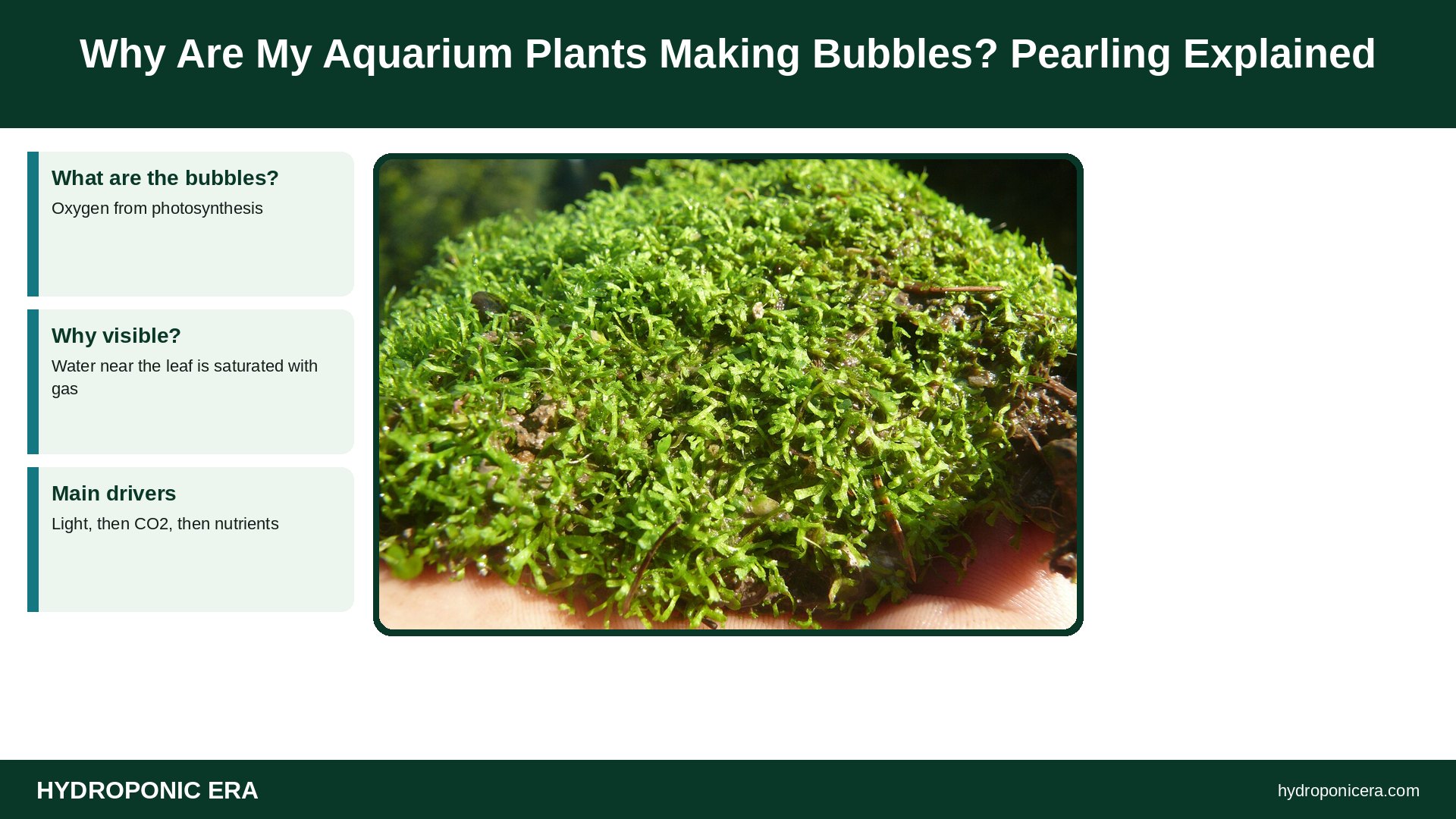
| Question | Short Answer | Source |
|---|---|---|
| What are the bubbles? | Oxygen from photosynthesis | Aqua Leaf Aquatics; Buce Plant |
| Why visible? | Water near the leaf is saturated with gas | Buce Plant |
| Main drivers | Light, then CO2, then nutrients | Aqua Leaf Aquatics |
| When it peaks | A few hours after lights on | Aqua Leaf Aquatics |
| After water change | Gas leaving cooler tap water | Aqua Leaf; USGS |
| Cold vs warm water | Cold water holds more dissolved oxygen | USGS |
| No bubbles? | Plants can still be healthy | Aqua Leaf; Buce Plant |
Why Are My Aquarium Plants Making Bubbles?
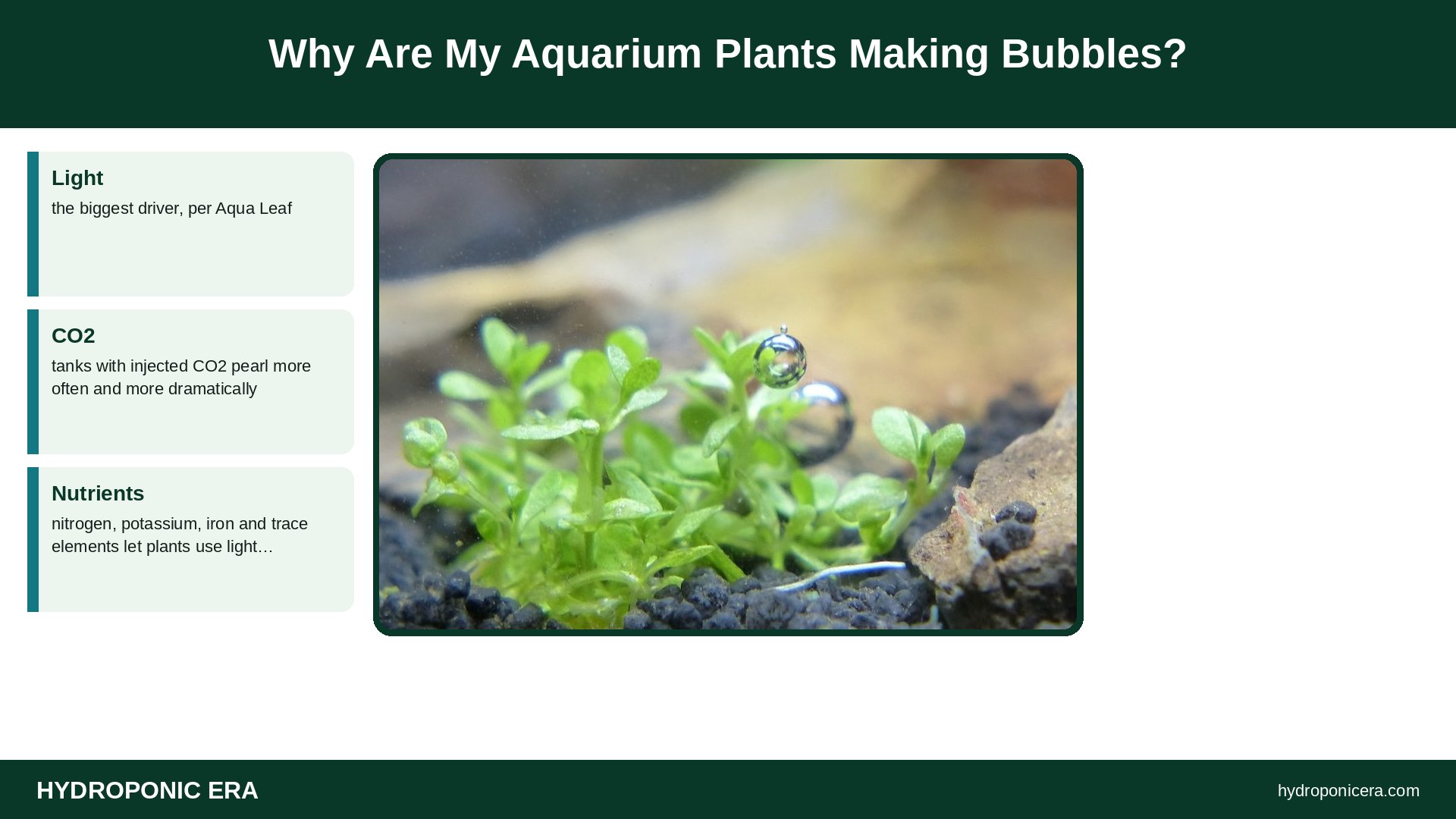
Aquarium plants making bubbles are releasing oxygen made in photosynthesis. Aqua Leaf Aquatics explains that pearling happens when plants produce oxygen faster than the water can absorb it; once water near the leaves is saturated, extra oxygen forms bubbles on leaves, stems, hardscape or substrate. Buce Plant adds that visible pearls depend on how saturated the water already is.
- Light: the biggest driver, per Aqua Leaf.
- CO2: tanks with injected CO2 pearl more often and more dramatically.
- Nutrients: nitrogen, potassium, iron and trace elements let plants use light fully.
- Flow: gentle flow lets bubbles cling; strong flow carries them away.
Is Pearling Good for Plants and Fish?
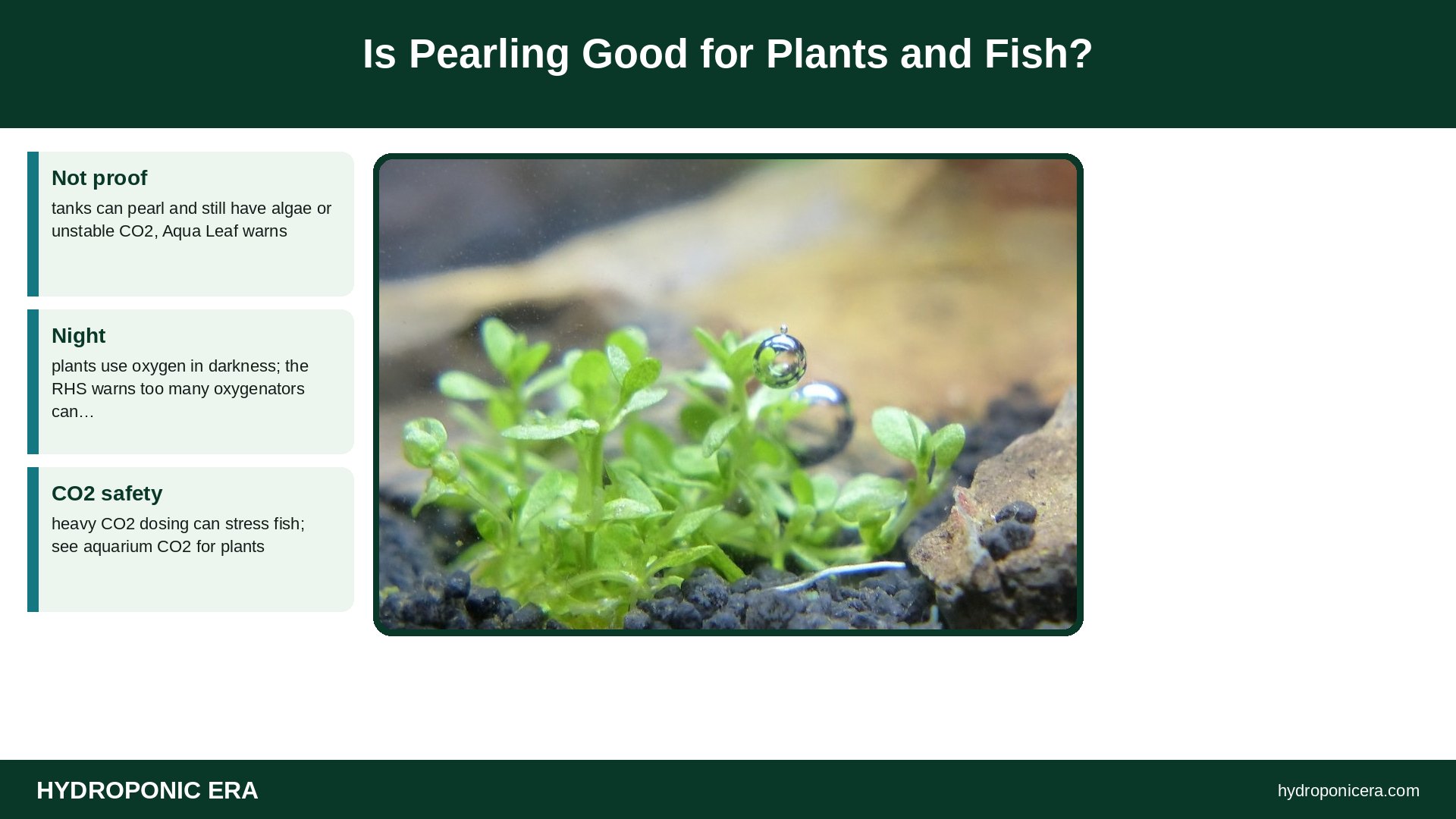
Usually, yes. Aqua Leaf Aquatics says pearling often suggests plants are photosynthesizing actively and that at least some conditions are favorable, but it is not the only measure of success. Buce Plant agrees: pearling plants are likely healthy, but not every healthy plant pearls. Aquarium plants making bubbles also add oxygen fish use during the day (our guidance).
- Not proof: tanks can pearl and still have algae or unstable CO2, Aqua Leaf warns.
- Night: plants use oxygen in darkness; the RHS warns too many oxygenators can cut oxygen at night in ponds.
- CO2 safety: heavy CO2 dosing can stress fish; see aquarium CO2 for plants.
- Goal: steady growth and color matter more than bubbles.
Why Do My Aquarium Plants Pearl Only After a Water Change?
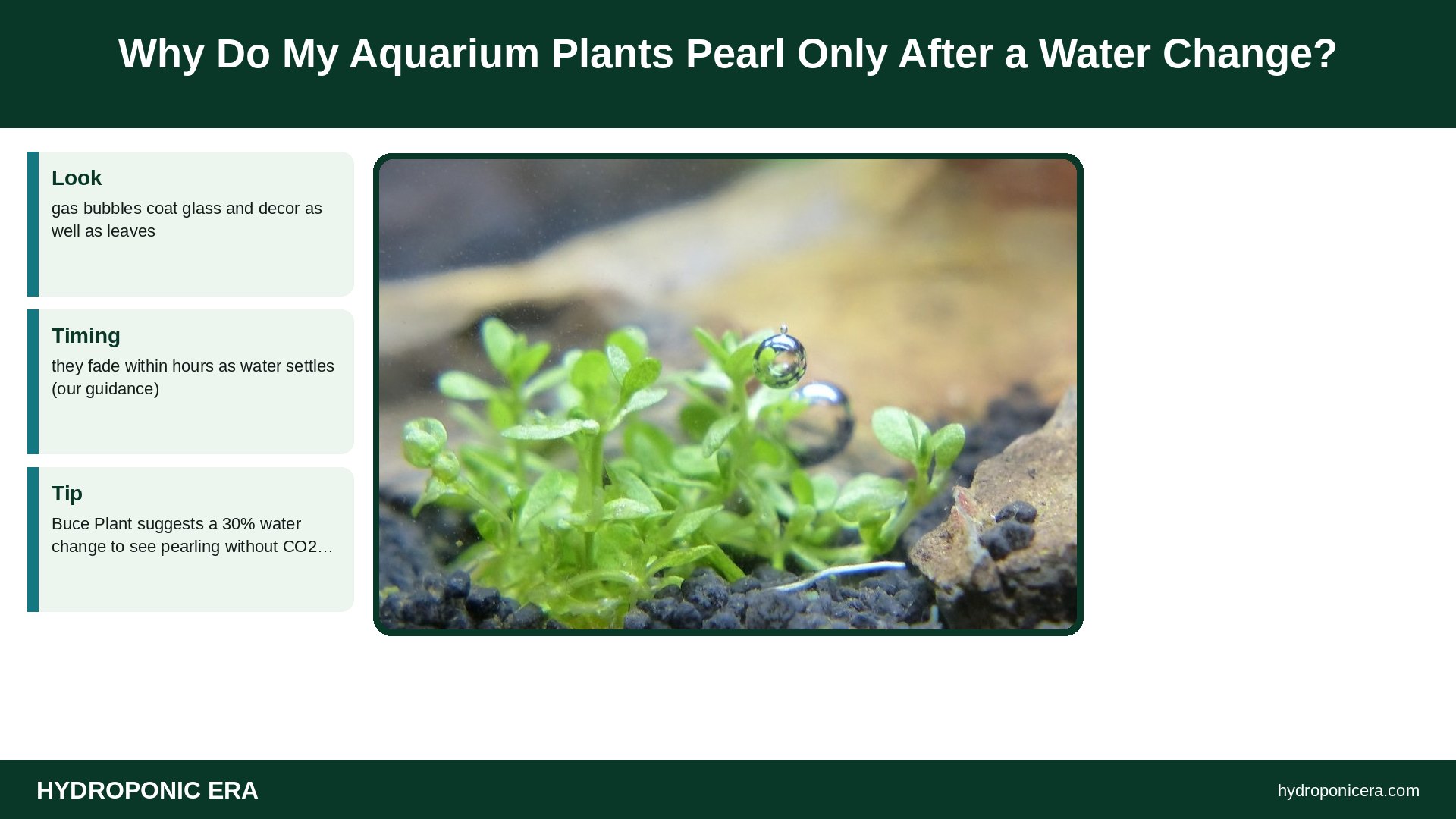
Fresh tap water often carries extra dissolved gas. The USGS says cold water holds more dissolved oxygen than warm water, so as cool tap water warms in the tank, gas comes out of solution. Aqua Leaf notes that not every bubble after a water change is true pearling. Buce Plant says the effect is real either way, since saturated water lets plant oxygen form visible pearls.
- Look: gas bubbles coat glass and decor as well as leaves.
- Timing: they fade within hours as water settles (our guidance).
- Tip: Buce Plant suggests a 30% water change to see pearling without CO2 injection.
- Trimming: gas streaming from cut stems is not pearling, per Buce Plant.
Which Aquarium Plants Pearl the Most?
Fast stem plants and fine-leaved plants pearl most visibly. Aqua Leaf names Rotala, Ludwigia, Hygrophila and some carpeting species, while Buce Plant highlights Mayaca fluviatilis, pearlweed and Riccia fluitans. Aqua Leaf adds that Anubias, Java fern, many mosses and other slow growers may look healthy for months with very little visible bubbling. Aquarium plants making bubbles near the surface often pearl first, Buce Plant notes, because water there is saturated sooner.
- Riccia: see Riccia fluitans care.
- Carpets: see dwarf baby tears.
- Mosses: see Christmas moss.
How Can You Get Aquarium Plants Making Bubbles More Often?
Raise photosynthesis gradually and keep conditions steady. Buce Plant lists more CO2, stronger light, more plants, lower flow and, if your livestock tolerate it, slightly warmer water, since warm water holds less gas. Aqua Leaf cautions that more light without enough CO2 and nutrients feeds algae faster than plants, and that stable CO2 matters more than high output.
- Raise light intensity in small steps.
- Dose CO2 consistently through the photoperiod.
- Feed a complete fertilizer with iron and potassium.
- Add fast stem plants to boost total photosynthesis.
- Reduce surface churn while lights are on (our guidance).
To measure your tank light, see lux to PPFD conversion. Change one thing at a time and watch new growth for two weeks before the next change (our guidance).
When Are Bubbles a Problem?
Aquarium plants making bubbles are rarely a problem, but some bubbles have other causes. Aqua Leaf says microbubbles from a filter outlet, spray bar, air stone or powerhead can coat plants and look like pearling, though they are random and not tied to the light cycle. In aquaculture, the University of Florida notes that gas supersaturation from pump cavitation can cause gas bubble disease in fish.
- Fish gasping: check CO2 levels and aeration first (our guidance).
- Foam at surface: often protein or dissolved organics (our guidance).
- New tank: air trapped after planting is not pearling, per Aqua Leaf.
FAQ About Aquarium Plants Making Bubbles
Are aquarium plants making bubbles healthy?
Usually; it signals active photosynthesis.
Is pearling oxygen?
Yes, mostly oxygen released by photosynthesis.
Can plants pearl without CO2 injection?
Yes, but usually less often.
Why are bubbles on the glass after a water change?
Gas is leaving cooler tap water as it warms.
Why are my aquarium plants making bubbles only in the afternoon?
Pearling builds a few hours after lights come on.
Is no pearling bad?
No; healthy plants may not pearl visibly.
Sources
- Aqua Leaf Aquatics — What Is Aquarium Plant Pearling?
- Buce Plant — How to Achieve Pearling Plants in the Aquarium
- U.S. Geological Survey, Water Science School — Dissolved Oxygen and Water
- University of Florida IFAS Extension — An Introduction to Sizing Centrifugal Pumps in Aquaculture
- Royal Horticultural Society — Aquatic plants: planting
- Photo credits (Wikimedia Commons and Flickr, edited with titles): Riccia fluitans 030911 by BerndH (CC BY-SA 3.0); Oxygen production by Joel Carnat via Flickr (CC BY 2.0)