
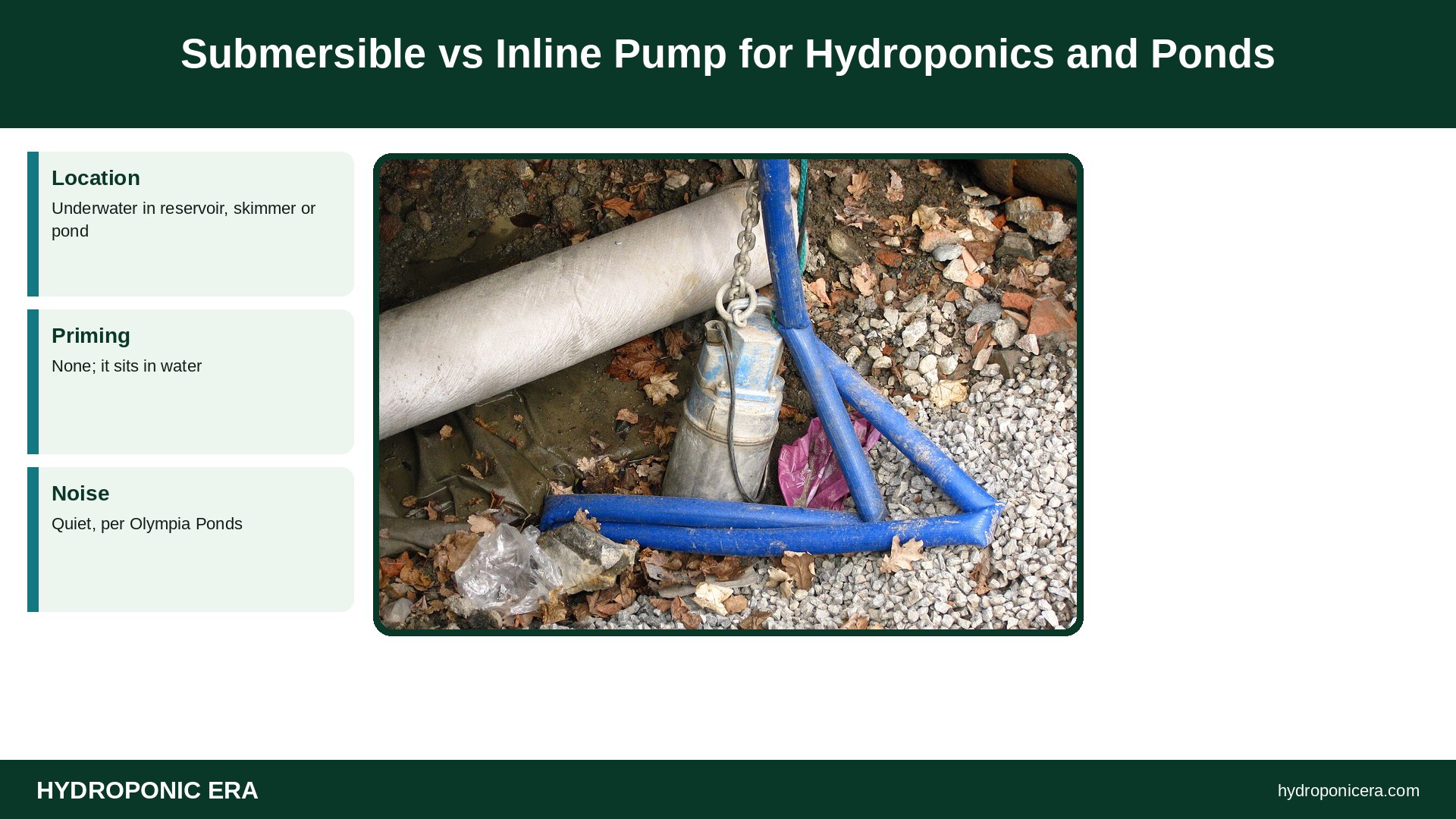
What is the difference between submersible and inline pumps? In the submersible vs inline pump choice, a submersible pump sits underwater in the reservoir or pond, while an inline (external) pump sits outside and pulls water through plumbing. Olympia Ponds says submersibles are cost-effective and quiet, while external pumps suit large volumes, high head and bottom drains.
Key takeaway: Both pump types move water with a spinning impeller, but where the motor sits changes noise, heat, priming and maintenance. Olympia Ponds says submersible pumps are ideal for most pond applications. This guide compares the two for hydroponic reservoirs and ponds, and shows which one fits a small system.
| Feature | Submersible Pump | Inline (External) Pump |
|---|---|---|
| Location | Underwater in reservoir, skimmer or pond | Outside, in a dry, protected spot |
| Priming | None; it sits in water | Gravity-fed below water level, or self-priming |
| Noise | Quiet, per Olympia Ponds | Tends to be noisier |
| Best for | Small to medium systems | Large volumes, high head, bottom drains |
| Install | Simple drop-in | More plumbing, more complex |
| Motor heat | Goes into the water (our guidance) | Stays in the air (our guidance) |
| Service | Lift it out to clean | Reach it without wading in |
What Is the Difference Between Submersible and Inline Pumps?
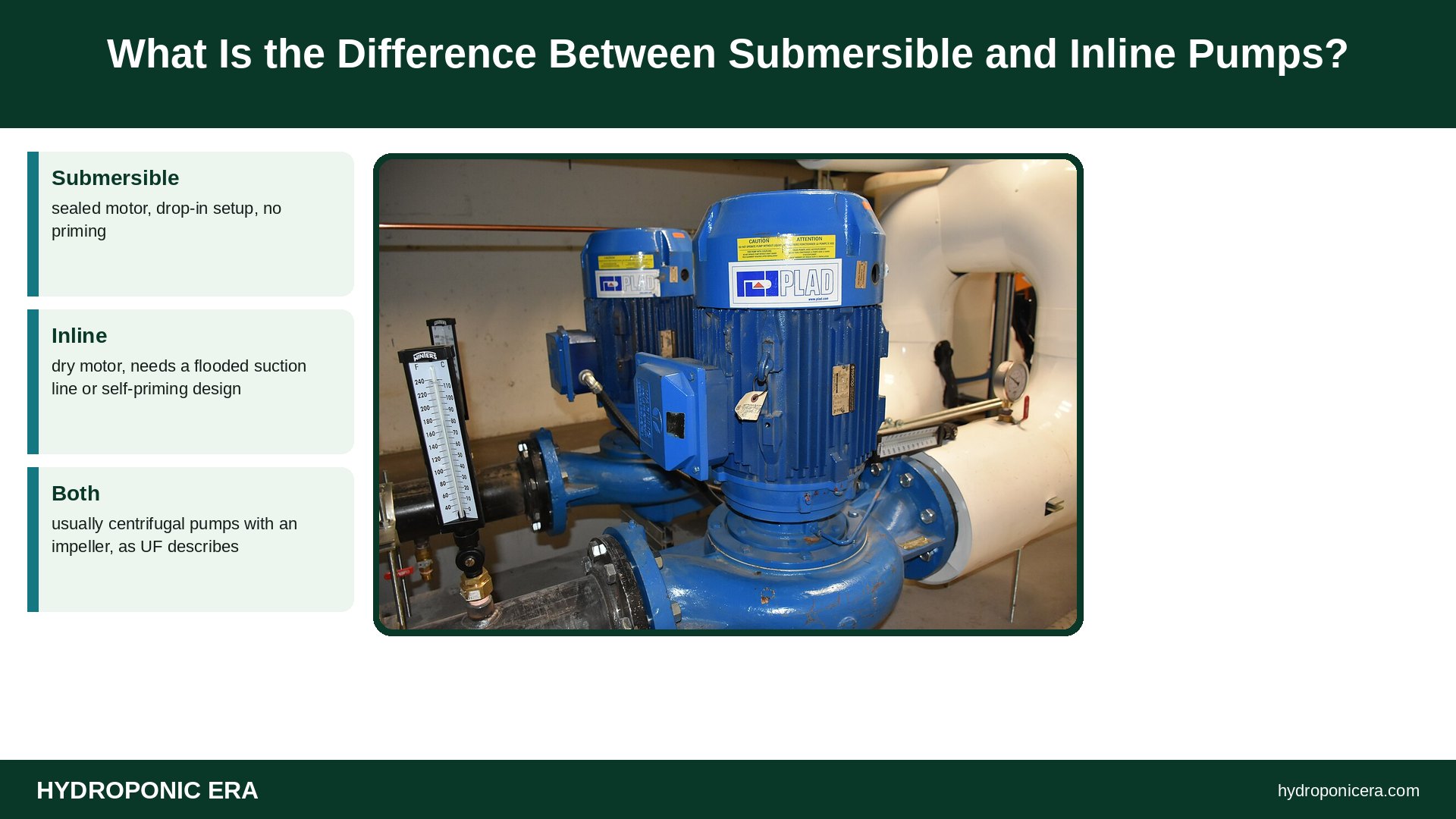
The submersible vs inline pump difference is mainly placement. Olympia Ponds explains that submersible pumps sit fully underwater inside a skimmer, pump vault or directly in the pond with intake protection, while external or inline pumps sit outside the pond in a dry, protected location such as a covered box. Some submersibles can also run inline, outside the water.
- Submersible: sealed motor, drop-in setup, no priming.
- Inline: dry motor, needs a flooded suction line or self-priming design.
- Both: usually centrifugal pumps with an impeller, as UF describes.
- Sizing: see pond pump size.
Which Is Quieter and Runs Cooler?
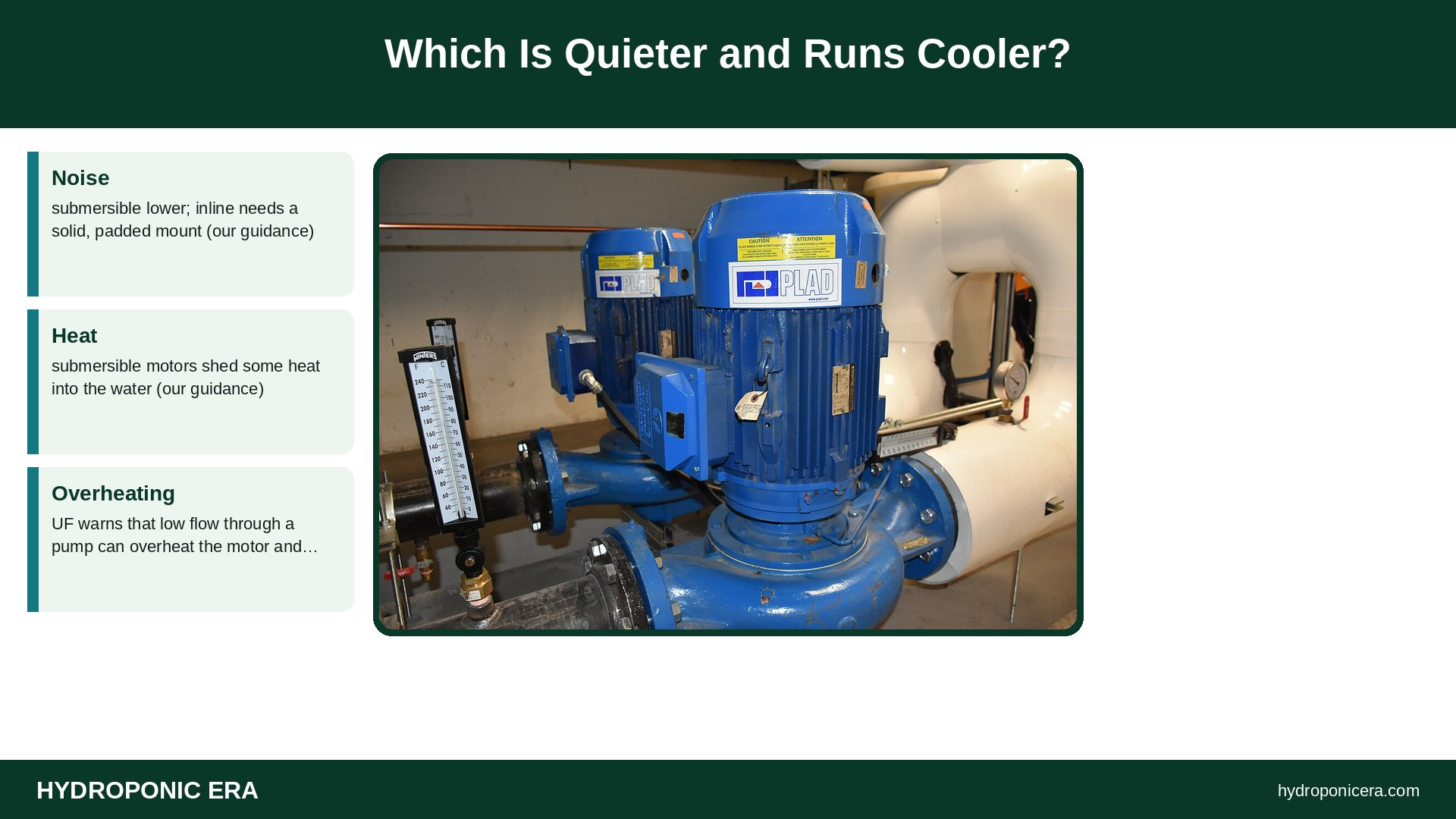
For noise, the submersible vs inline pump contest usually goes to the submersible, because water muffles the motor. Olympia Ponds says submersibles operate quietly, while external pumps tend to be noisier and more complicated to install and maintain. For heat, an inline pump keeps motor warmth out of the water, which matters in warm grow rooms where reservoir temperature climbs (our guidance).
- Noise: submersible lower; inline needs a solid, padded mount (our guidance).
- Heat: submersible motors shed some heat into the water (our guidance).
- Overheating: UF warns that low flow through a pump can overheat the motor and bearings.
- Cavitation: UF lists excess noise and vibration among the signs.
In the submersible vs inline pump debate for hydroponics, check reservoir temperature with a thermometer before blaming the pump (our guidance). See reservoir temperature for hydroponics.
Which Should a Small System Use?
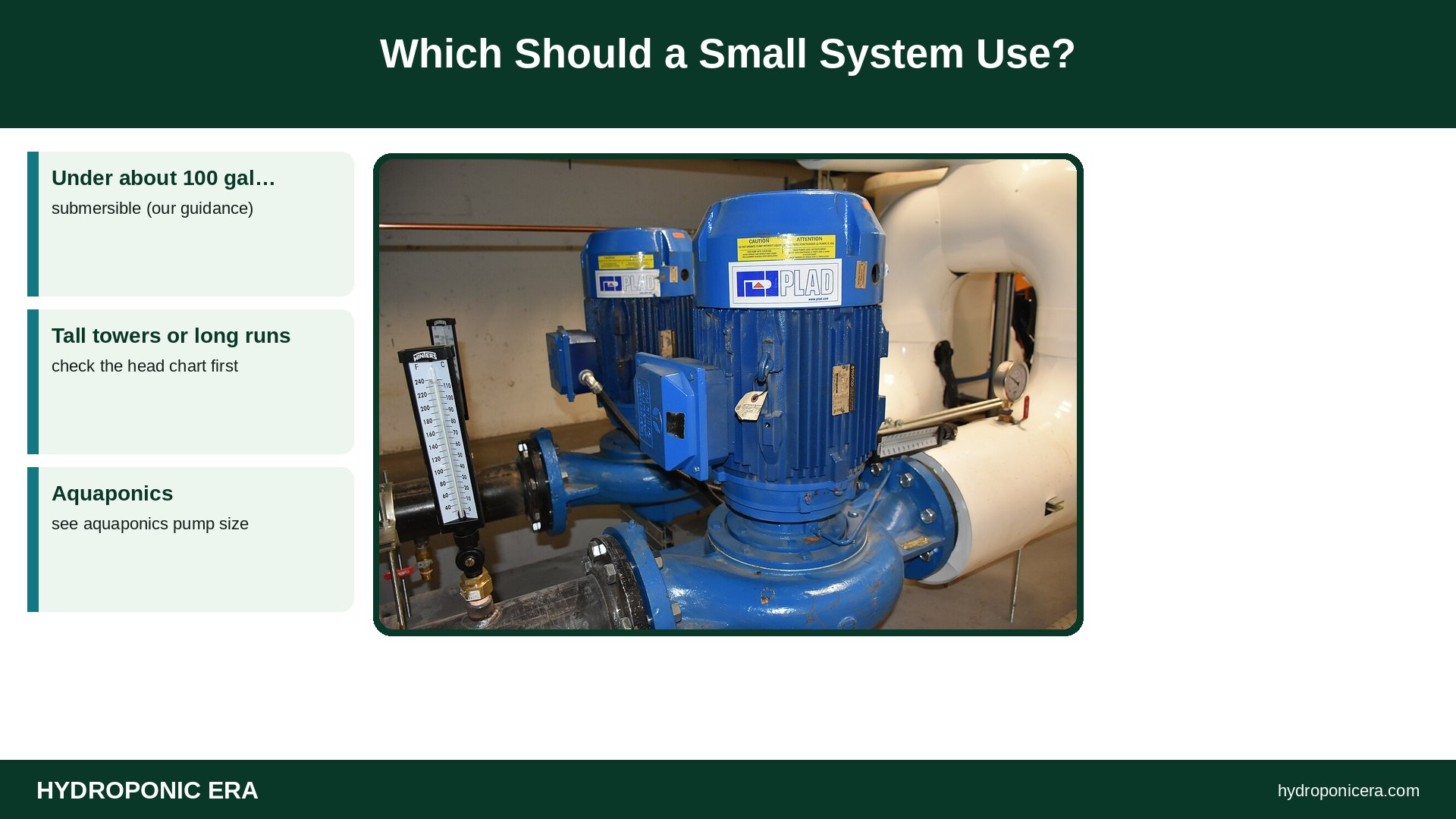
In a small submersible vs inline pump decision, the submersible usually wins. Olympia Ponds says submersibles are cost-effective and efficient for most pond applications, and they need no priming. In small hydroponic reservoirs, a submersible is the simplest choice. An inline pump makes sense for large systems, high head, or ponds with bottom drains, where Olympia says external pumps do better.
- Under about 100 gal (380 L): submersible (our guidance).
- Tall towers or long runs: check the head chart first.
- Aquaponics: see aquaponics pump size.
- Aeration: a pump is not an air pump; see air stone vs air pump sizing.
What Is Priming, and Why Does It Matter for Inline Pumps?
Priming is a big submersible vs inline pump difference. It means filling the pump and suction line with water so it can pull. Southern Regional Aquaculture Center (SRAC) Publication 372 explains that a centrifugal pump must be submerged in its water source or be filled with water and connected through a water-filled, airtight pipe. Olympia Ponds notes external pumps are either gravity-fed, placed below water level, or self-priming.
- Gravity-fed: place the inline pump below the water line.
- Suction lift: SRAC says about 15 ft (4.6 m) of vertical lift is the practical maximum.
- Suction pipe: UF advises a straight run at least five times the inlet diameter.
- Leaks: an air leak on the suction side stops flow (our guidance).
Which Is More Efficient and Easier to Maintain?
In any submersible vs inline pump setup, efficiency depends on running each pump near its best efficiency point. UF explains that a pump at its best efficiency point gives the best mix of flow and pressure for the least power, and that running far from it can cause bearing failure, overheating and cavitation. For submersible vs inline pump upkeep and energy use, Olympia says external pumps are less energy efficient and more complicated to maintain than submersibles.
- Submersible: clean the intake screen often (our guidance).
- Inline: check the strainer basket and seals (our guidance).
- Undersized pipe: raises friction head and wastes power, per UF.
What Are Common Mistakes With Submersible vs Inline Pumps?
Most mistakes come from wrong sizing and poor plumbing. UF lists blocked suction lines, clogged filters and poor piping design among common causes of cavitation. Olympia Ponds warns that undersized pumps get overworked, overheat and shut off or trip the breaker. Pick a submersible vs inline pump based on head height and flow, not price alone.
- Running dry: never run a submersible out of water (our guidance).
- No check of head: each 10 ft (3 m) of pipe adds about 1 ft (0.3 m) of head, per Olympia.
- No GFCI: plug water pumps into a GFCI outlet (our guidance).
FAQ About Submersible vs Inline Pump Choices
Is a submersible or inline pump better for hydroponics?
Submersible for small systems; inline for large ones.
Do inline pumps need priming?
Yes, unless gravity-fed or self-priming.
Which is quieter, submersible vs inline pump?
Usually the submersible.
Does a submersible pump heat the water?
Some motor heat goes into the water (our guidance).
Can a submersible pump run inline?
Some models can, per Olympia Ponds.
Which is better for a pond with a bottom drain in the submersible vs inline pump choice?
An external, inline pump.
Sources
- Olympia Ponds — Selecting Pond Pumps
- University of Florida IFAS Extension — An Introduction to Sizing Centrifugal Pumps in Aquaculture
- Southern Regional Aquaculture Center — Selecting the Proper Pump (SRAC 372)
- Photo credits (Wikimedia Commons, edited with titles): Submersible pump in action by Kemikungen (CC BY 3.0); Centrifugal Pump by Saud (CC BY-SA 4.0)