
What pond pump size do I need? For a fish pond, choose a pump that moves the full pond volume about once per hour at your real head height. Pond pump size starts with volume: length × width × average depth in feet × 7.48 gives US gallons. Ponds without fish may need half that flow.
Key takeaway: Getting pond pump size right is simple: calculate pond volume, set a turnover target, then add head height and pipe losses before you buy. A pump rated at zero head delivers less once it lifts water. Keep the pump running so filter bacteria survive; RHS says they can die after 24 hours off.
| Step | What to do | Source |
|---|---|---|
| 1. Measure | L × W × average depth (ft) × 7.48 = gallons | EasyPro |
| 2. Adjust shape | Rounded or sloped ponds: × 0.8 | EasyPro |
| 3. Set turnover | Fish: 1× per hour; no fish: 1× per 2 h | EasyPro |
| 4. Add head | Lift height plus pipe and fittings | EasyPro |
| 5. Match filter | Pump flow within filter rating | RHS, EasyPro |
How Do You Calculate Pond Pump Size From Volume?
Start with gallons. EasyPro’s pump sizing guide multiplies length × width × average depth in feet by 7.48 to get US gallons, and multiplies by 0.8 for rounded, oval or sloped ponds. RHS gives the same method in cubic meters: multiply by 1,000 for liters. Pond pump size then follows from turnover.
| Pond (L × W × avg depth) | Volume | Fish turnover target |
|---|---|---|
| 6 × 4 × 1.5 ft (1.8 × 1.2 × 0.46 m) | About 270 gal (1,020 L) | About 270 GPH (1,020 L/h) |
| 10 × 6 × 2 ft (3 × 1.8 × 0.6 m) | About 900 gal (3,400 L) | About 900 GPH (3,400 L/h) |
| 18 × 13 × 2 ft (5.5 × 4 × 0.6 m), × 0.8 | About 2,800 gal (10,600 L) | About 2,800 GPH (10,600 L/h) |
The last row is EasyPro’s own worked example. The first two are simple calculations for rectangular ponds; round them up, not down.
What Turnover Rate Sets Pond Pump Size?
Turnover is the core of pond pump size. For ponds with fish, EasyPro recommends moving the full volume through filtration about once per hour, and once every two hours may be enough without fish. Koi ponds should stay close to once per hour because koi produce more waste. Heavier stocking means more waste, so do not undersize the pump or filter.
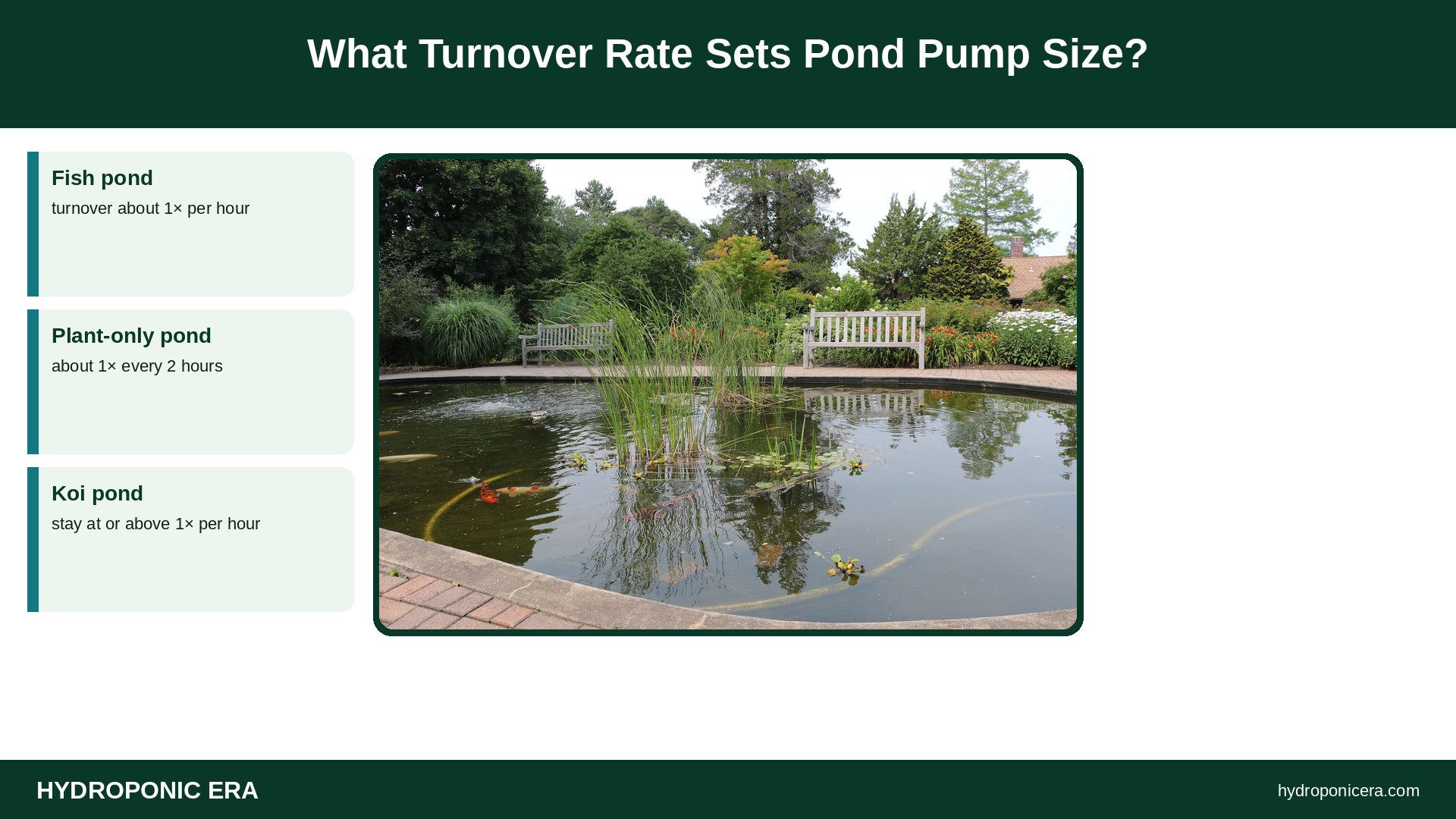
- Fish pond: turnover about 1× per hour.
- Plant-only pond: about 1× every 2 hours.
- Koi pond: stay at or above 1× per hour.
- Waterfall: size for the spillway width too, then use the larger number.
Pair a well-sized pump with pond plants that absorb nutrients; see koi pond plants.
How Does Head Height Change Pond Pump Size?
Head height reduces flow, so it changes the pond pump size you need. EasyPro explains that a pump rated for 5,000 GPH at zero feet of head may not deliver that flow once it pushes water uphill and through plumbing. Total dynamic head combines the vertical lift with friction from pipe length and fittings, so check the pump’s flow chart at your actual head.
- Measure the vertical lift from pond surface to outlet.
- Add friction for pipe length, elbows and valves.
- Find that total head on the pump’s flow curve.
- Confirm the flow at that head meets your turnover target.
- Use wider pipe to reduce friction losses.
The same physics applies in hydroponics; see our water pump sizing guide.
How Should Pond Pump Size Match the Filter?
Match pond pump size to your filter’s rated flow. RHS says filter choice should be based on pond volume and stocking, and notes that some filter types should not be used for heavily stocked ponds or large koi. EasyPro adds that pump, skimmer and filter should all be matched so none is overwhelmed.
| Filter type (RHS) | How water moves | Pump notes |
|---|---|---|
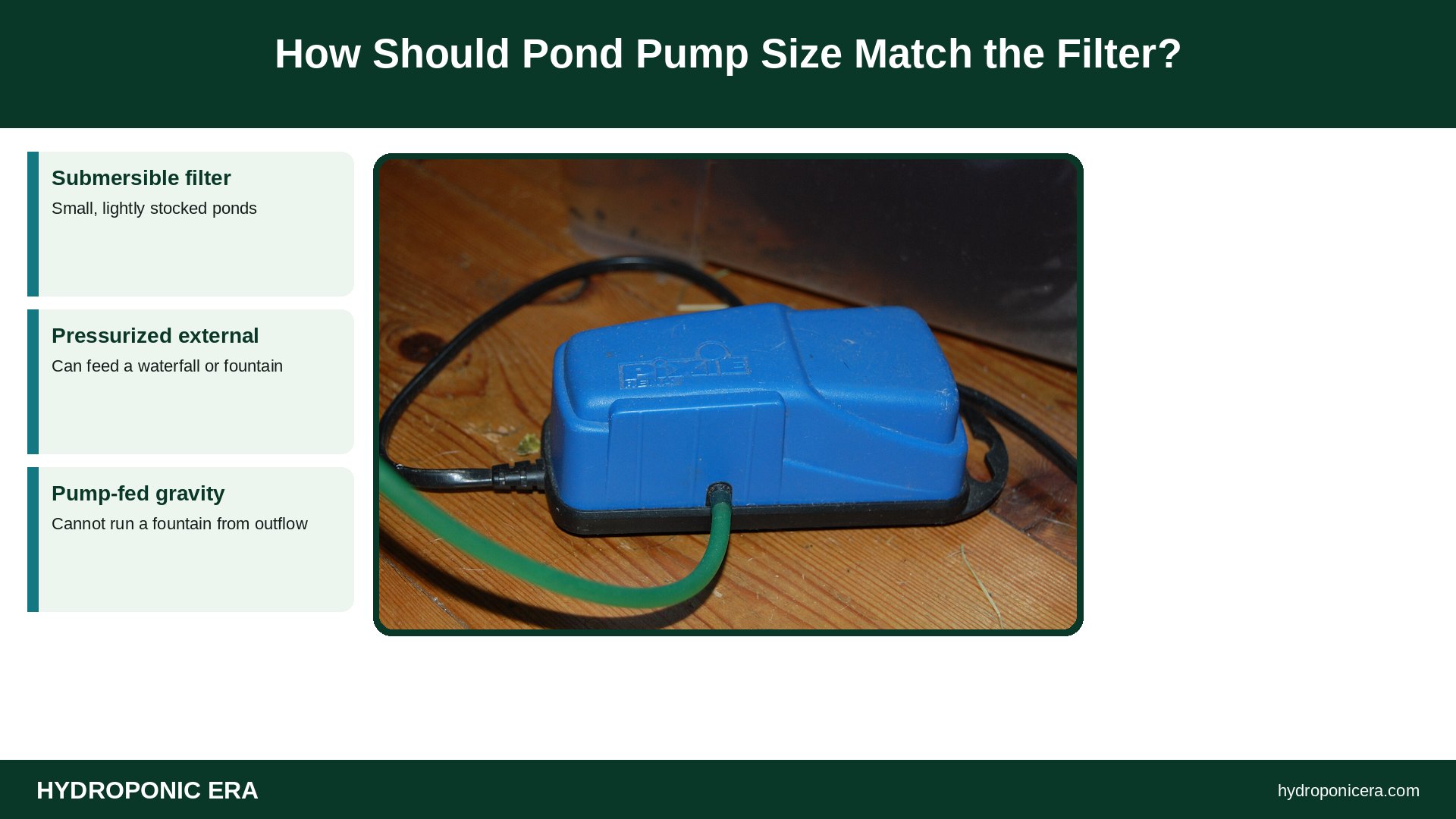
| Submersible filter | Pump pushes water through media | Small, lightly stocked ponds |
| Pressurized external | Pumped in and out under pressure | Can feed a waterfall or fountain |
| Pump-fed gravity | Pumped in, drains by gravity | Cannot run a fountain from outflow |
| Gravity-fed | Water flows in; pump returns it | Can power fountain or venturi |
Building your own? A planted bog filter is a natural option for many ponds.
Should a Pond Pump Run All the Time?
Yes, if it feeds a biological filter, which is another reason to choose a pond pump size you can afford to run all day. RHS explains that beneficial bacteria take about six weeks to build up and can die if the filter is switched off for 24 hours or more. Continuous circulation also moves oxygenated surface water downward, which matters on warm nights.
UF IFAS notes that low oxygen, or hypoxia, can follow algae decomposition in nutrient-rich ponds, and that fountains and aerators can help. In very warm weather, add an air pump; see aquaponics air pumps.
What Are Common Pond Pump Size Mistakes?
The most common pond pump size mistake is buying by the box rating at zero head. Others include ignoring the 0.8 shape factor, overrunning a filter and forgetting waterfall width. Each one either starves the filter or leaves the waterfall weak. Measure first, then pick the pond pump size whose flow curve fits.
- Zero-head rating: real flow will be lower.
- Too big for the filter: water bypasses media.
- Too small for fish: waste builds up; water clouds.
- Narrow pipe: extra friction steals flow.
For deeper troubleshooting, read about pump cavitation and air locks.
How Does Pond Pump Size Work for Pond Aquaponics?
In pond aquaponics, the pump also lifts water to grow beds, so add that lift to your head calculation. Aim for the same fish turnover, then check that grow beds drain back faster than the pump fills them. Our pond aquaponics guide and aquaponics pump size guide show worked layouts.
FAQ About Pond Pump Size
What size pump for a 1,000-gallon pond?
With fish, about 1,000 GPH (3,800 L/h) at your actual head; without fish, about 500 GPH.
Can a pond pump be too big?
Yes. It can overwhelm the filter and stir up debris.
Do I need a pump for a wildlife pond?
RHS notes ponds with few or no fish should not require a filter.
How do I convert cubic feet to gallons?
Multiply by 7.48 for US gallons, or 6.23 for UK gallons as RHS gives.
Sources
- Royal Horticultural Society. Choosing a Pond Filter.
- EasyPro Pond Products. How to Size a Pond Pump: GPH, Head and Waterfall Flow.
- UF IFAS Extension. SS695 Stormwater Pond Management: What You Need to Know about Aeration.
- Photo credits (Wikimedia Commons, edited with titles): Pond-edge plants at Achamore Garden – geograph.org.uk – 5446824 by M J Richardson (CC BY-SA 2.0); Deep Cut Gardens Koi Pond by FossilDS (CC0); Aquarium-air-pump by User:Corydoras-adolfoi (CC BY-SA 4.0); Koi in a garden pond in Tuntorp 3 by W.carter (CC BY-SA 4.0)