
How do you grow bacopa in an aquarium? Plant bacopa (Bacopa caroliniana) stems in groups at the back of the tank, give bright light and feed with liquid fertilizer and a nutrient-rich substrate. Tropica calls it an easy, relatively slow-growing stem plant that reaches 24 inches (60 cm) or more and does not need added CO2.
Key takeaway: Bacopa caroliniana, also called lemon bacopa or giant red rotala, is a native US marsh plant that grows submerged or emersed. It suits beginners: bright light, regular feeding and occasional trimming keep it bushy. Trimmed tops replant easily to fill the background.
| Need | Guideline | Source |
|---|---|---|
| Light | Brighter light for best health | Tropica |
| CO2 | Not essential; helps growth | Tropica |
| Height | 24 in (60 cm) or more | Tropica |
| Placement | Background, in groups | Tropica |
| Feeding | Liquid fertilizer plus rich substrate | Tropica |
| Propagation | Stem cuttings and runners | Tropica, NC State |
What Is the Bacopa Aquarium Plant?
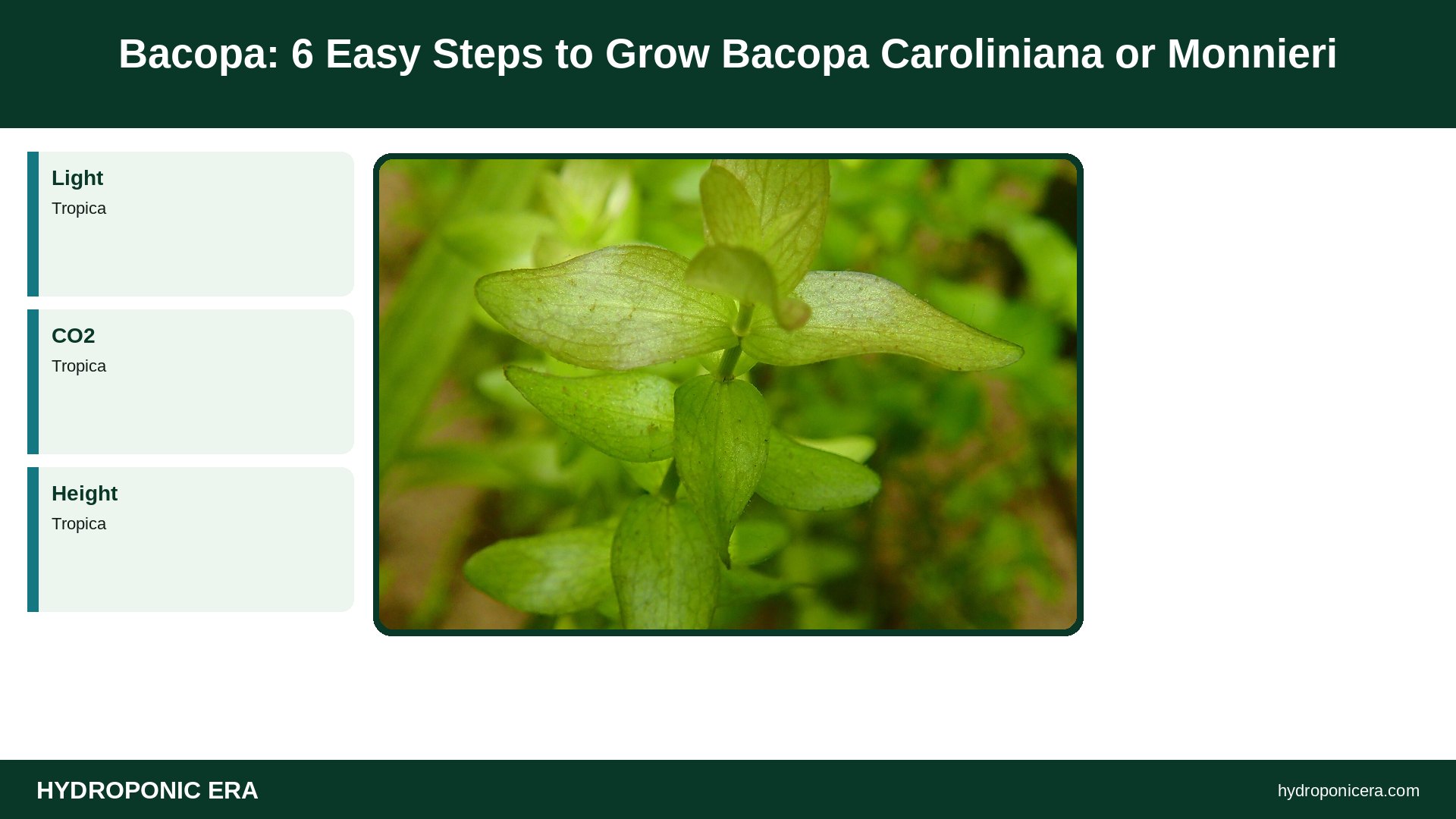
Bacopa caroliniana is a stem plant native to the southeastern United States. NC State Extension says its thick, succulent leaves smell of lemon when crushed, and that it can grow along a pond or bog as groundcover or fully submerged, including in an aquarium. Tropica notes it has been in the planted aquarium hobby for over 40 years.
In the wild it grows in marshes of the southern and eastern US and Mexico, both underwater and out of water, according to Tropica. Out of water it produces small blue flowers, which NC State says bloom from May to September.
| Trait | Detail | Source |
|---|---|---|
| Native range | Southeastern US, Cuba | NC State |
| Scent | Lemon when crushed | NC State, Tropica |
| Flowers | Blue, under 1 in (2.5 cm), emersed | NC State |
| Hardiness outdoors | USDA zones 8a to 11b | NC State |
How Much Light Does Bacopa Need in an Aquarium?
The plant needs moderate to bright light. Tropica says it needs brighter light for the best health, and that in high light new growth often turns orange. Under intense light with low nitrogen, leaves can turn bronze, and low phosphorus can give a pinkish color. Weak light gives leggy stems with widely spaced leaves.
If your tank light is weak, see our grow light for aquarium guide.

Does Bacopa Need CO2 and Fertilizer?
CO2 is not essential, Tropica says, though added nutrition improves growth. Tropica recommends feeding leaves with a good-quality liquid fertilizer and roots with a nutrient-rich substrate. Because the plant takes nutrients through both leaves and roots, a combination works best in low-tech and high-tech tanks.
- Low-tech tank: moderate light, liquid fertilizer, slower growth.
- High-tech tank: bright light and CO2 for faster, more colorful growth.
- Bronze leaves: a sign of intense light with low nitrogen.
- Pink tint: can signal low phosphorus.
For nutrient basics, see fertilizer for plants in water.
How Do You Plant Bacopa in an Aquarium?
Remove the pot and rock wool, separate the stems and plant them in groups. Tropica advises removing as much rock wool as possible, splitting the plant into as many portions as possible and pushing each into the substrate with aquascaping tweezers. Space stems so light reaches the lower leaves.
- Take the plant out of its pot.
- Pull apart and discard the rock wool.
- Separate the stems into small portions.
- Plant each stem about 1 to 2 in (2.5 to 5 cm) deep with tweezers.
- Group several stems together in the background.
Where Should Bacopa Go in a Planted Tank?
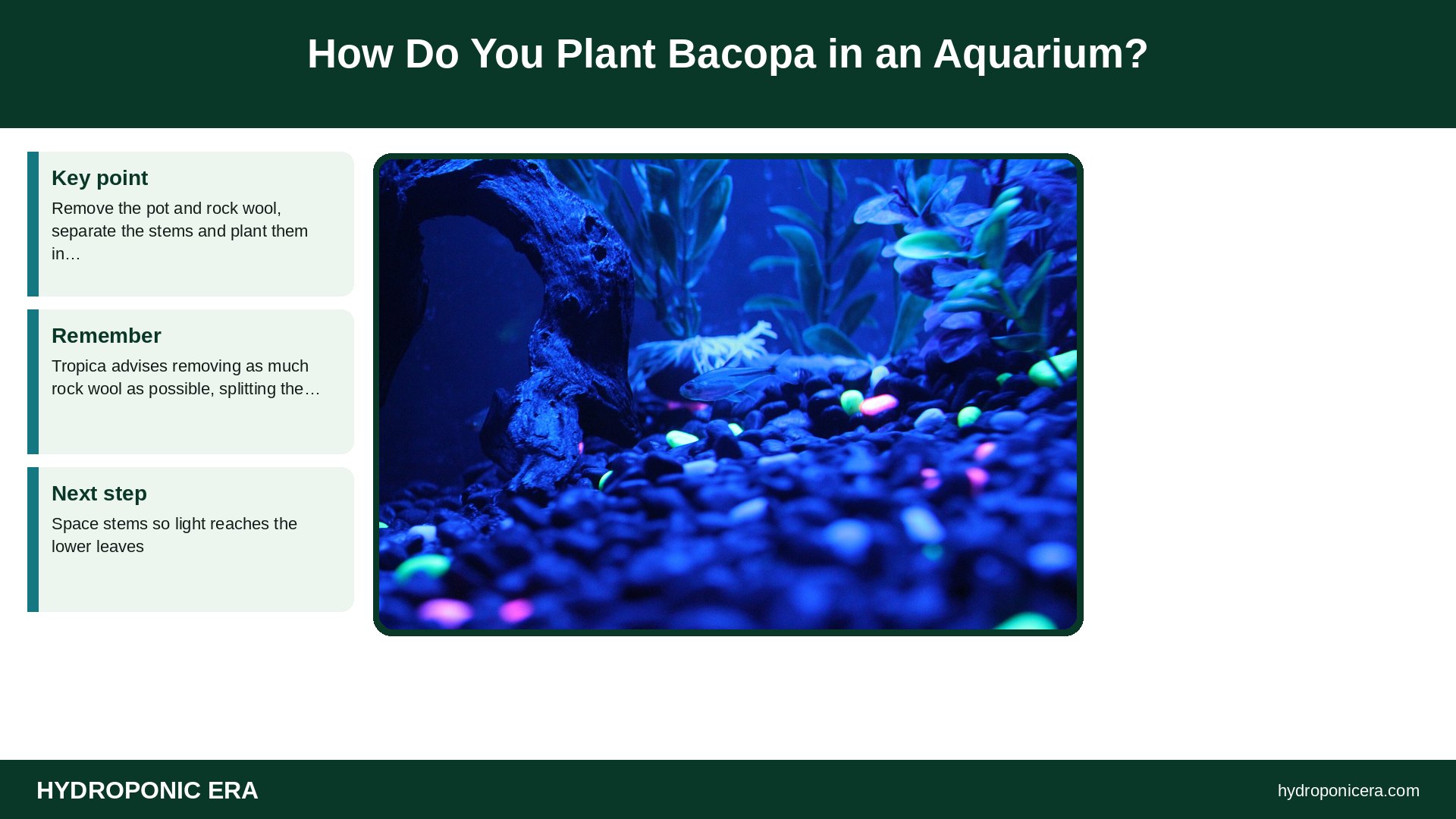
Use it in the background or midground. Tropica says it can grow 24 inches (60 cm) or more, so group it at the back, where its thick leaves contrast with finer or red plants. Its slow growth suits long-term layouts that you do not want to trim often.
For other easy tank plants, try anubias, anacharis or a marimo moss ball.
How Do You Trim and Propagate Bacopa?
Cut the tops and replant them. Tropica says healthy plants respond very well to trimming from the top or lateral shoots, and the cuttings can be replanted. It also forms runners at the base of stems that can be trimmed and replanted. NC State lists stem cuttings as the propagation strategy.
- Cut a 3 to 4 in (7.5 to 10 cm) top above a leaf pair.
- Strip the lowest leaf pair.
- Push the cut stem into the substrate.
- Leave the old base; it will branch.
- Thin runners if the group gets crowded.
How Is Bacopa Caroliniana Different From Bacopa Monnieri?
They are related water hyssops with different looks. NC State Extension describes Bacopa monnieri as a native perennial of freshwater tidal marshes, streams and muddy shores, with small succulent leaves about 1/2 inch (1.3 cm) long and white flowers tinged pink or blue. B. caroliniana has larger, lemon-scented leaves and blue flowers.
| Trait | B. caroliniana | B. monnieri |
|---|---|---|
| Leaves | Larger, lemon-scented | About 1/2 in (1.3 cm), fleshy |
| Flowers | Blue | White with pink or blue tinge |
| Origin | Southeastern US, Cuba | Tropical Americas, India, Southeast Asia |
| Propagation | Stem cuttings | Division, stem cuttings |
Both grow in wet soil in full sun to part shade, and NC State lists USDA zones 8a to 11b for each. In tanks, B. caroliniana is the more common choice.
Can Bacopa Grow Out of Water or in Aquaponics?
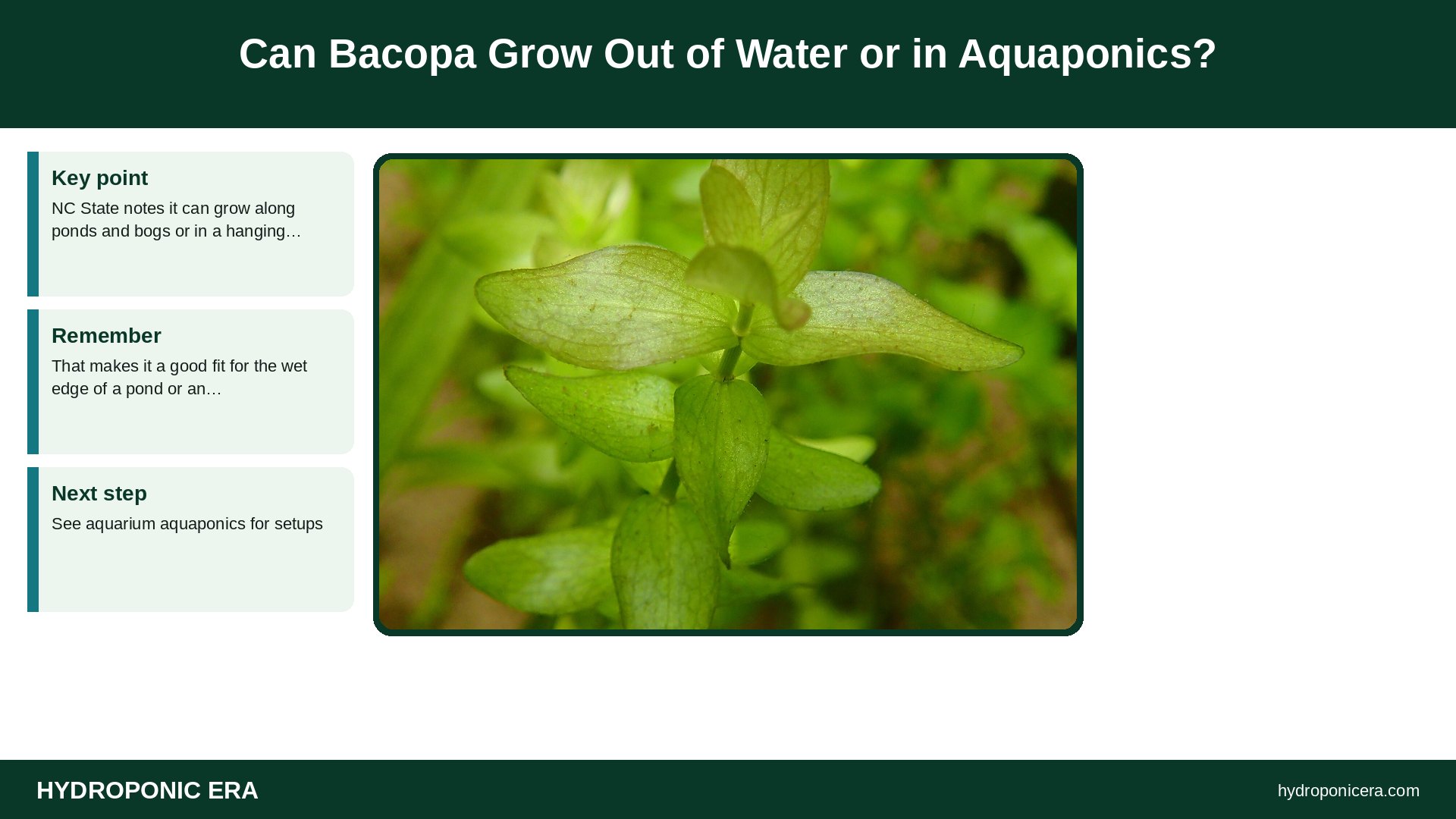
Yes. NC State notes it can grow along ponds and bogs or in a hanging container, and Tropica says it grows emersed in temperate or tropical climates, where it flowers. That makes it a good fit for the wet edge of a pond or an aquarium-topped planter. See aquarium aquaponics for setups.
FAQ About Bacopa Aquarium Plant
Is it good for beginners?
Yes. Tropica calls it easy and suitable for all levels of hobbyist.
Why are my plant’s leaves turning bronze?
Tropica links bronze leaves to intense light with low nitrogen.
Does Bacopa caroliniana need CO2?
No, but CO2 and nutrients improve growth.
Is lemon bacopa the same as Bacopa monnieri?
No. Bacopa monnieri is a related species with smaller leaves.
Sources
- Tropica Aquarium Plants (Farmer G.). Bacopa caroliniana.
- NC State Extension Gardener Plant Toolbox. Bacopa caroliniana.
- Tropica Aquarium Plants. Bacopa caroliniana plant details/4464).
- Photo credits (Wikimedia Commons, edited with titles): Bacopa caroliniana kz02 by Krzysztof Ziarnek, Kenraiz (CC BY-SA 4.0); Planted Tank 03 – Flickr – The Wandering Angel by The Wandering Angel from Makati City, Philippines (CC BY 2.0); Glow light tetra by Jim Zamichieli (CC BY-SA 3.0)