
How do you build a DIY pond filter? A DIY pond filter is a lidded bucket or tote holding coarse foam, then high-surface-area media such as lava rock or plastic string, fed by a small pump. Mechanical layers trap debris; biological media grows bacteria that turn toxic ammonia into nitrate. Run it nonstop for about six weeks to mature.
Key takeaway: A DIY pond filter works when it does two jobs: foam sieves out solids, and porous media gives nitrifying bacteria space to live. RHS says those bacteria take about six weeks to build up and can die if the filter is off for 24 hours. Size the pump to your pond volume and never clean media in tap water.
| Step | What to do | Why |
|---|---|---|
| 1. Measure pond | L × W × depth (ft) × 7.5 = gallons | K-State formula |
| 2. Pick container | Lidded bucket or tote, food-safe plastic | Non-corroding (SRAC) |
| 3. Add foam | Coarse foam or mesh first | Mechanical filtration |
| 4. Add bio media | Lava rock, plastic string or mesh | Surface area for bacteria |
| 5. Plumb and run | Pump in, gravity outflow back | Keep flow constant |
| 6. Mature | Wait about 6 weeks | Bacteria build up (RHS) |
What Does a DIY Pond Filter Need to Do?
A DIY pond filter needs both mechanical and biological filtration. RHS explains that mechanical filtration sieves out dirt, solid waste and algae through foam, sand or gravel, while biological filtration uses bacteria on the filter medium to turn fish waste and ammonia into harmless materials. Most homemade designs simply stack those two stages in one container.
RHS also notes that ponds with few or no fish should not require a filter. If your pond is mostly plants, extra plants may do more good than a new filter.
Which Materials Work Best in a DIY Pond Filter?
The best DIY pond filter materials are non-corroding and full of surface area. The Southern Regional Aquaculture Center says biofilter media should be plastic, fiberglass, ceramic or rock with large surface area for nitrifying bacteria. Kansas State University lists plastic string, lava rock and mesh as media that give beneficial bacteria room to colonize.
- Container: a 5-gallon (19 L) bucket for small ponds, or a larger tote.
- Mechanical layer: coarse filter foam or mesh.
- Biological layer: lava rock, plastic string, mesh or plastic bio media.
- Plumbing: pond tubing, a bulkhead fitting and an outlet pipe.
Avoid metal parts that can corrode in water, and rinse rock before use so dust does not cloud the pond.
How Do You Build a Bucket DIY Pond Filter Step by Step?
A bucket DIY pond filter is the simplest design to build. Water is pumped in at the top, flows down through foam and media, and drains out by gravity. RHS describes this as a pump-fed filter: it must sit with its outlet above the pond water level, and its outflow cannot run a fountain.
- Drill an outlet hole near the base and fit a bulkhead with a pipe back to the pond.
- Add a perforated plate or a layer of large rocks so the outlet does not clog.
- Fill the middle with biological media such as lava rock or plastic string.
- Lay coarse foam on top to catch solids before they reach the media.
- Run the pump tube into the top and secure the lid.
- Place the bucket higher than the pond so water returns by gravity, ideally over rocks as a small waterfall.
Check for leaks for a day before you hide the filter with plants or stones.
How Big Should a DIY Pond Filter Be?
Size a DIY pond filter from pond volume and fish load. RHS says the choice should be based on pond volume, the number and type of fish, and the space available. Kansas State University estimates gallons as length × width × depth in feet × 7.5 for square or rectangular ponds. More fish means more waste and more media.
| Pond example | Approx. volume | Suggested build |
|---|---|---|
| 6 × 4 × 1.5 ft (1.8 × 1.2 × 0.46 m) | About 270 gal (1,020 L) | One 5-gal (19 L) bucket |
| 10 × 6 × 2 ft (3 × 1.8 × 0.6 m) | About 900 gal (3,400 L) | Large tote or two buckets |
| Heavily stocked koi pond | Any size | Use a commercial filter |
Volumes are simple calculations, and build suggestions are a starting point, not a rule. For pump flow, see our aquaponics pump size guide, which uses the same turnover logic.
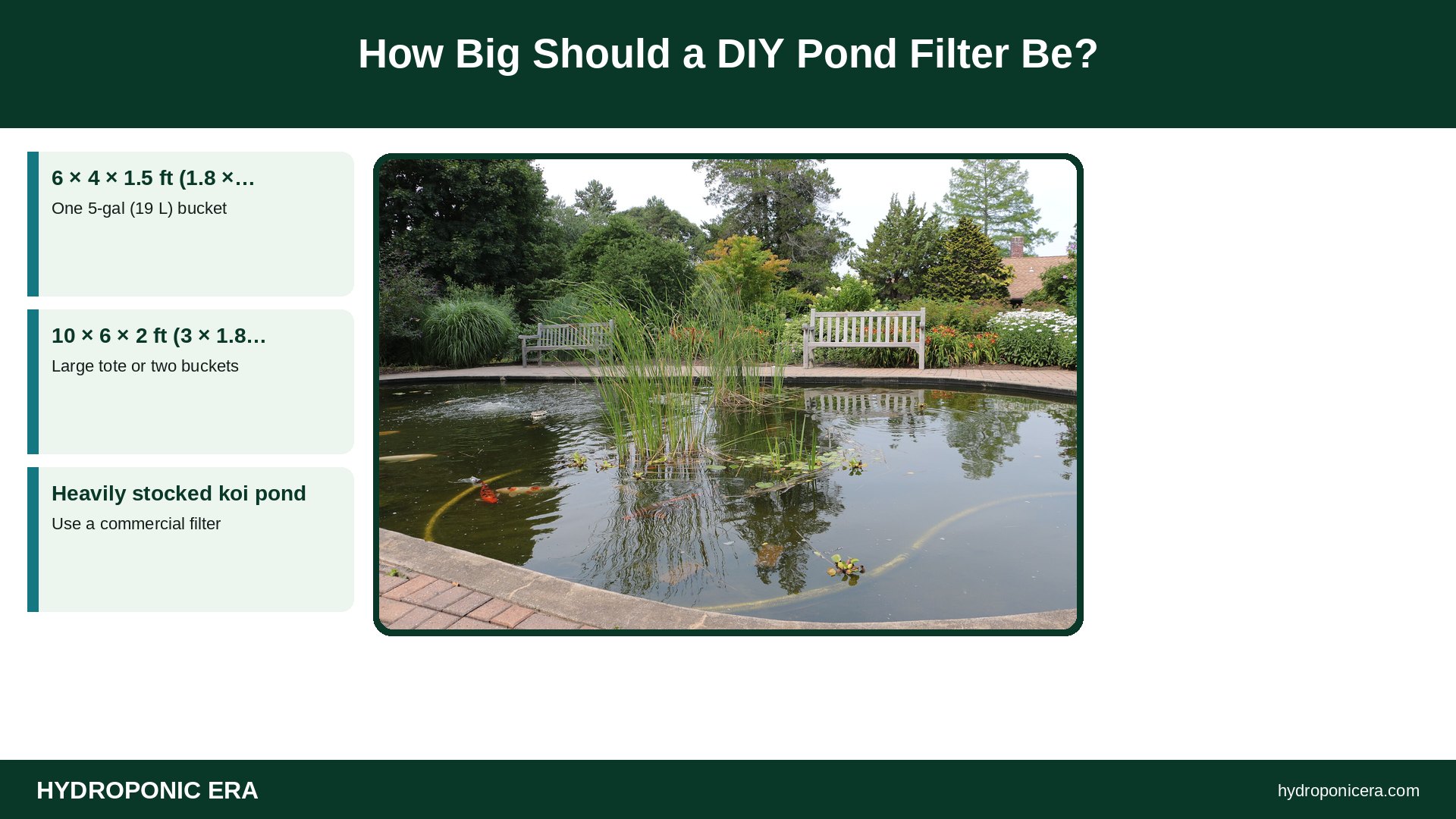
How Long Does a DIY Pond Filter Take to Work?
Mechanical filtration works as soon as the pump starts, but a DIY pond filter needs time to grow bacteria. RHS says the bacterial population takes six weeks to build up. SRAC explains that Nitrosomonas bacteria convert ammonia to nitrite, and Nitrobacter convert nitrite to nitrate, which is far less toxic to fish.
During those weeks, feed fish lightly and test ammonia and nitrite. SRAC also notes that water should be free of residual chlorine when you start a biofilter, so dechlorinate any tap water first; see dechlorinate water for aquaponics.
How Do You Maintain a DIY Pond Filter?
Maintain a DIY pond filter by rinsing the foam, not sterilizing the media. Never turn it off for long, because RHS warns the bacteria can die if the filter is off for 24 hours or more. Rinse foam in a bucket of pond water when flow slows, so you keep bacteria alive. Leave the biological media mostly untouched.
- Rinse foam when water starts to bypass it or flow drops.
- Use pond water, not chlorinated tap water, for rinsing.
- Keep the pump running all year if fish stay active.
- Test ammonia and nitrite after any big clean.
Kansas State University adds that plants, especially those near moving water such as waterfalls, help filter the pond. Floating plants like water lettuce and a bog filter can share the load.
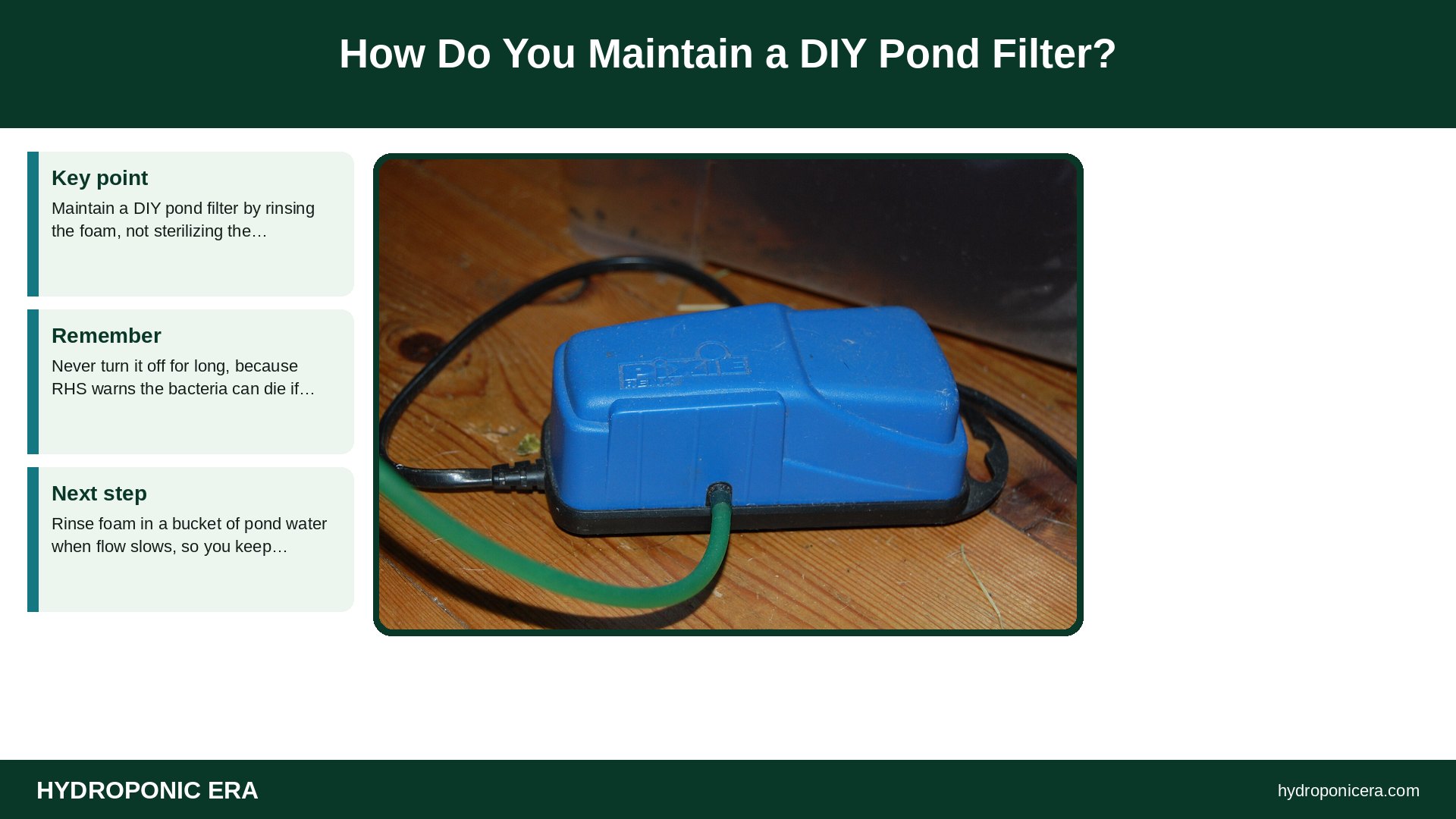
What Mistakes Ruin a DIY Pond Filter?
Most DIY pond filter failures come from flow and cleaning errors. Common mistakes include switching the pump off overnight, washing media under the tap, packing foam so tight that water overflows, and using too little media for the fish load. RHS also notes that uneven water circulation can let beneficial bacteria die.
- Overflowing lid: foam is clogged or flow is too high.
- Green water: bacteria do not remove algae; RHS suggests a UV clarifier for that.
- Ammonia spikes: media is new, too small or was over-cleaned.
Can I use a 5-gallon bucket as a pond filter?
Yes. A 5-gallon (19 L) bucket with foam and lava rock or plastic media works for a small, lightly stocked pond. Fit a gravity outlet and keep the pump running continuously so the bacteria survive.
What is the best media for a homemade pond filter?
Choose non-corroding material with lots of surface area. SRAC lists plastic, fiberglass, ceramic and rock, and Kansas State mentions plastic string, lava rock and mesh.
Does a DIY pond filter clear green water?
Not by itself. Mechanical and biological filters remove debris and ammonia, but RHS says an ultraviolet clarifier helps keep pond water clear of algae.
Can I turn my pond filter off at night?
No. RHS warns that filter bacteria can die if the filter is switched off for 24 hours or more, and stopping flow also stops filtration.
Do I need a filter for a pond with no fish?
Usually not. RHS says ponds with few or no fish should not require a filter; plants and good balance can keep water healthy.
Sources
- Royal Horticultural Society. Choosing a Pond Filter.
- Southern Regional Aquaculture Center. SRAC 4502: How to Start a Biofilter.
- Kansas State University. MF2911 Water Gardening: Biological Balance.
- Photo credits (Wikimedia Commons, edited with titles): Koi in a garden pond in Tuntorp 3 by W.carter (CC BY-SA 4.0); Pond-edge plants at Achamore Garden – geograph.org.uk – 5446824 by M J Richardson (CC BY-SA 2.0); Deep Cut Gardens Koi Pond by FossilDS (CC0); Aquarium-air-pump by User:Corydoras-adolfoi (CC BY-SA 4.0)