
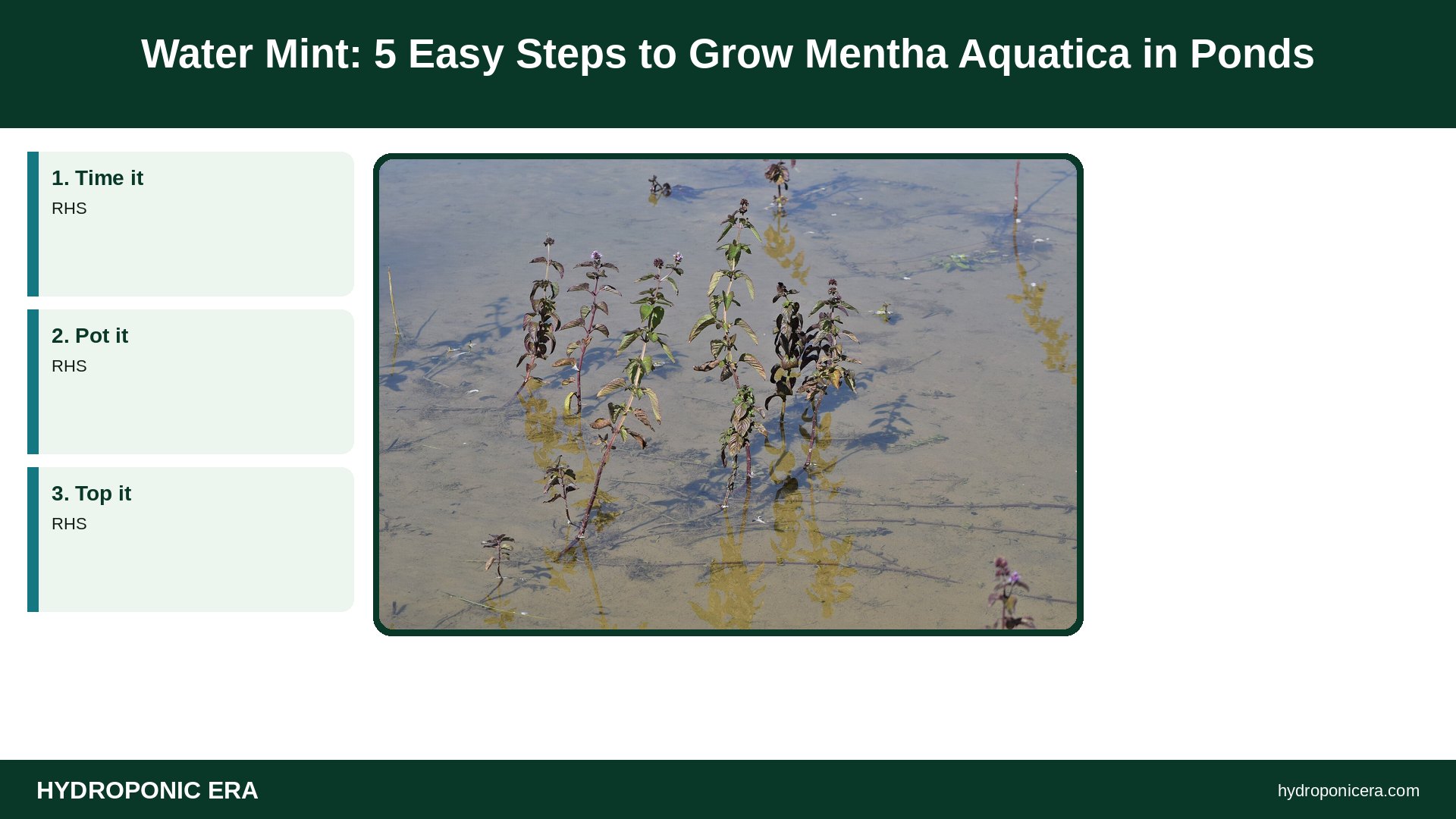
How do you grow water mint in a pond? Plant water mint (Mentha aquatica) in a lined aquatic basket at a pond’s shallow, boggy edge in full sun or light shade. RHS lists a marginal perennial to 3 feet (90 cm) that spreads by rhizomes, so a basket keeps it in check. Divide clumps in spring.
Key takeaway: Water mint is an easy, fragrant marginal plant for ponds and bog gardens. It roots fast from cuttings, grows in wet soil or shallow water, and spreads aggressively by rhizomes. In North America it is non-native; USGS tracks it as an introduced species, so keep it contained.
| Step | What to do | Source |
|---|---|---|
| 1. Time it | Mid-spring to early summer | RHS |
| 2. Pot it | Lined aquatic basket, aquatic compost | RHS |
| 3. Top it | Thin layer of grit or fine gravel | RHS |
| 4. Place it | Shallow, boggy margin; full sun | RHS, SANBI |
| 5. Control it | Divide in spring; trim after flowering | RHS |
What Is Water Mint?
Water mint is Mentha aquatica, an aromatic mint that grows at the edges of ponds, streams and marshes. RHS describes it as a marginal, aquatic or semi-aquatic perennial up to about 3 feet (90 cm) tall that spreads by long, thin rhizomes, often with reddish-purple stems and very aromatic dark green leaves.
USGS lists its native range as Eurasia, northwest Africa and southwest Asia. It is a parent of peppermint: USGS notes that crossing it with spearmint produces Mentha × piperita, a sterile hybrid.
| Trait | Detail | Source |
|---|---|---|
| Height | Up to 3 ft (90 cm) | RHS, USGS |
| Spread | Underground rhizomes | USGS |
| Light | Full sun for flowers; tolerates light shade | RHS, SANBI |
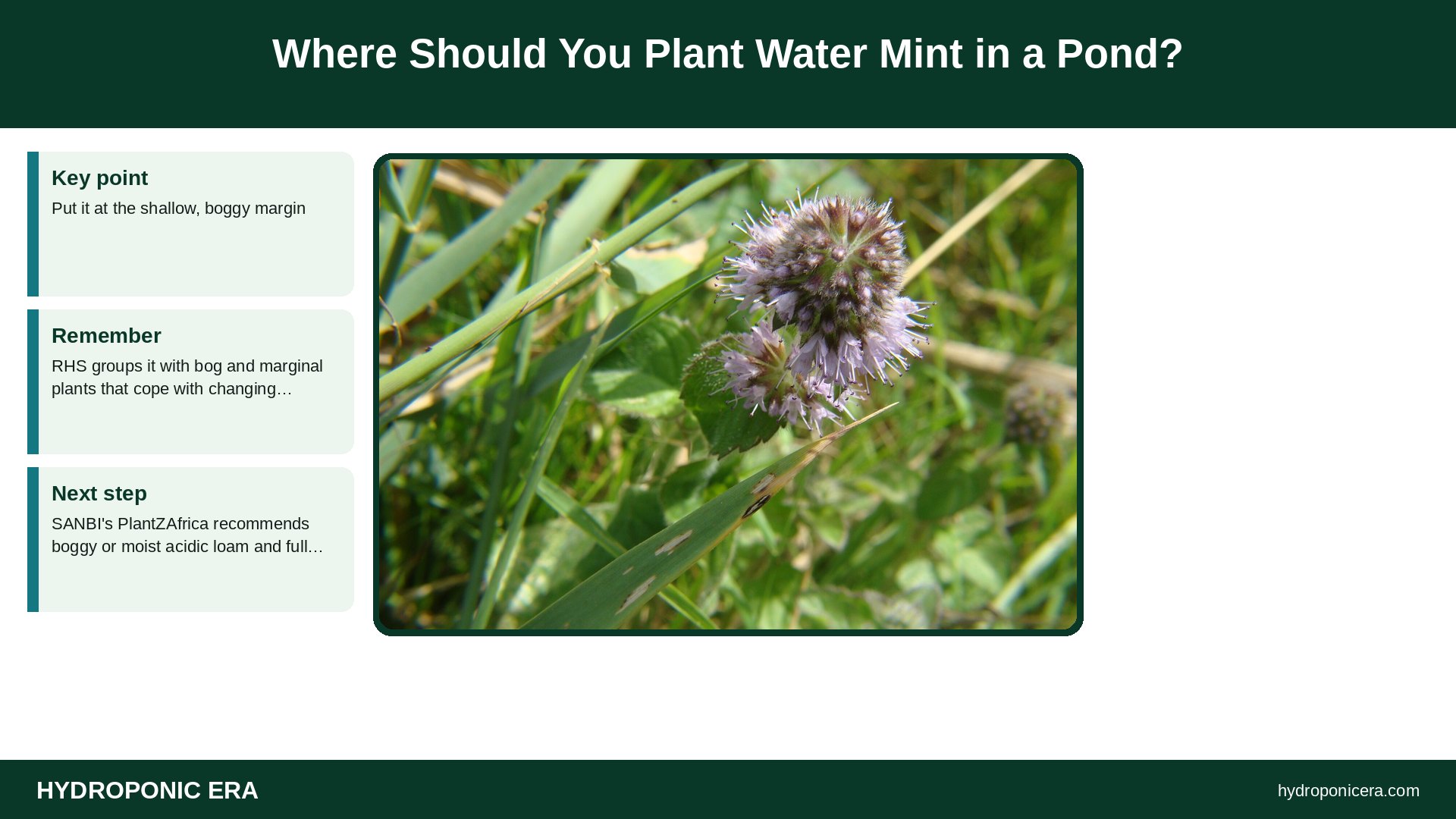
| Flowers | Purple balls in summer | SANBI |
Where Should You Plant Water Mint in a Pond?
Put it at the shallow, boggy margin. RHS groups it with bog and marginal plants that cope with changing moisture, including wet winters and dry summers. SANBI’s PlantZAfrica recommends boggy or moist acidic loam and full sun, noting it also does well in a little shade. Full sun encourages flowering.
RHS advises raising newly planted baskets on bricks so plants are not too deep, then lowering them in stages as growth reaches the surface. See bog filters for another wet-edge planting idea.
How Do You Plant Water Mint in a Basket?
Use a lined aquatic basket so soil stays put. RHS says lattice baskets should be lined with hessian or polypropylene fabric unless the mesh is very fine, and recommends fertilizer-free garden soil or peat-free aquatic compost. Finish with a thin layer of grit or fine gravel so fish do not stir up the soil.
- Line an aquatic basket with fabric.
- Part-fill it with aquatic compost or plain garden soil.
- Set the plant in and fill around the roots.
- Firm well and top with fine gravel.
- Water the basket, then lower it into the pond margin.
Planting time matters too. RHS names mid-spring to early summer as the best time to buy and plant aquatics.
Is Water Mint Invasive?
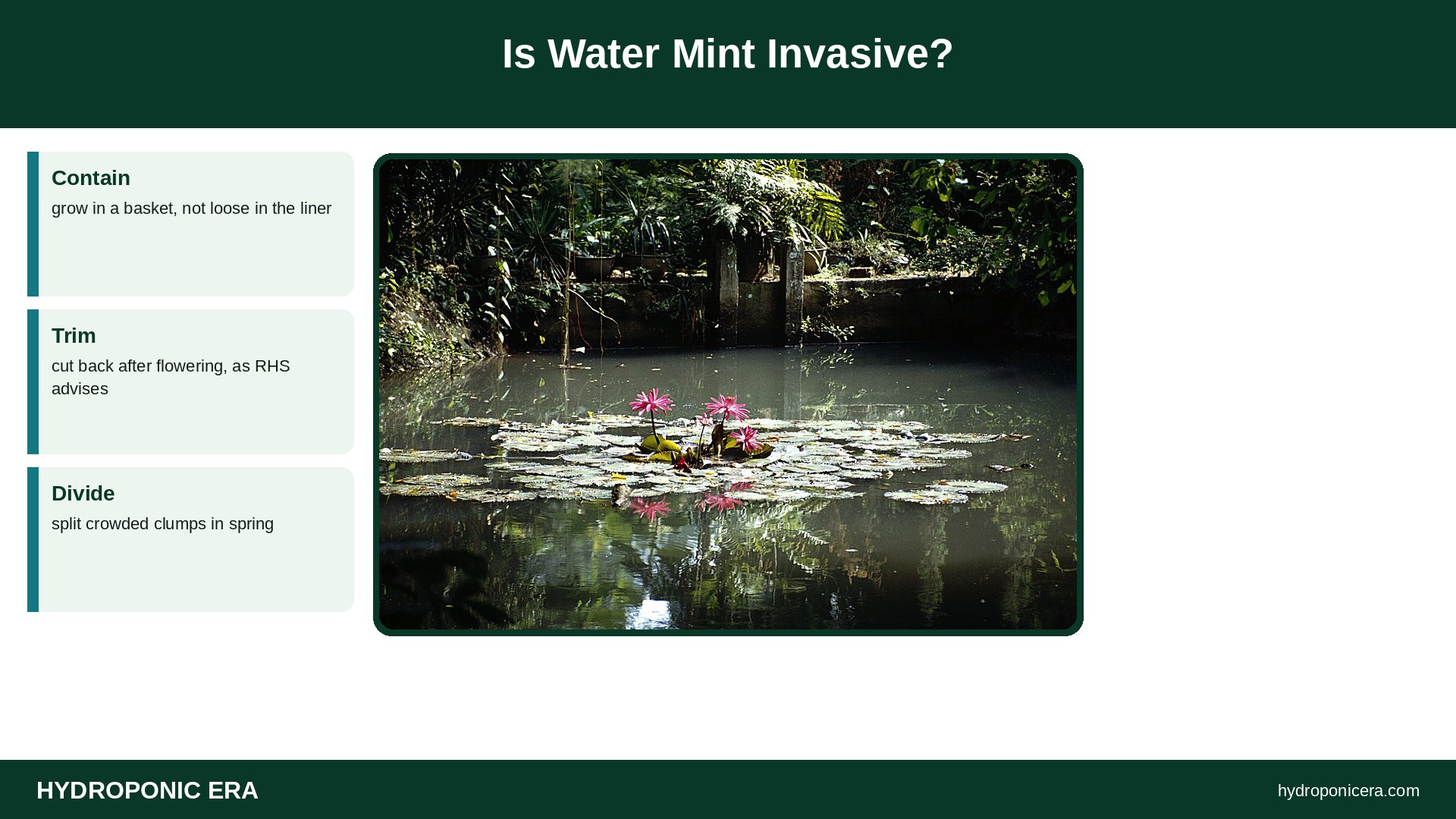
It can be. USGS records water mint as a nonindigenous species in the United States, introduced by deliberate release, and notes it spreads by underground rhizomes like other mints. Never dump plants or pond water into natural waterways. Keep it in baskets and remove runners that escape.
- Contain: grow in a basket, not loose in the liner.
- Trim: cut back after flowering, as RHS advises.
- Divide: split crowded clumps in spring.
- Dispose: bag trimmings; do not toss them in streams.
How Do You Propagate Water Mint?
Division and cuttings both work. RHS recommends dividing clumps in spring. SANBI’s PlantZAfrica says the plant can be grown from seed or cuttings: remove leaves from the lower half of a stem, and the author reports lateral roots formed by the fifth day. Plant rooted stems in boggy soil.
The method is the same as for kitchen mint; see our guide to mint cuttings in water.
Can You Grow Water Mint in Aquaponics?
This mint suits wet beds because it naturally grows with its roots in saturated soil. Many growers already raise ordinary mint in aquaponics; our best aquaponics plants guide and pond aquaponics guide explain how to use pond water to feed plants.
Keep it in its own bed or net pot so the rhizomes do not crowd other crops. Treat it like any mint: trim often to keep it bushy.
Which Plants Grow Well With Water Mint?
Pair it with other marginals that like the same wet edge and full sun. In a mixed pond, give each plant its own basket so the mint’s rhizomes cannot invade neighbors. Floating and deep-water plants can share the pond without competing for the same shelf.
| Pond zone | Plant examples | Our guide |
|---|---|---|
| Margin and bog | Water mint, irises | Koi pond plants |
| Surface floaters | Water lettuce, water hyacinth | Water lettuce |
| Submerged | Anacharis | Anacharis |
See koi pond plants, water lettuce and anacharis for more options.
What Problems Affect Water Mint?
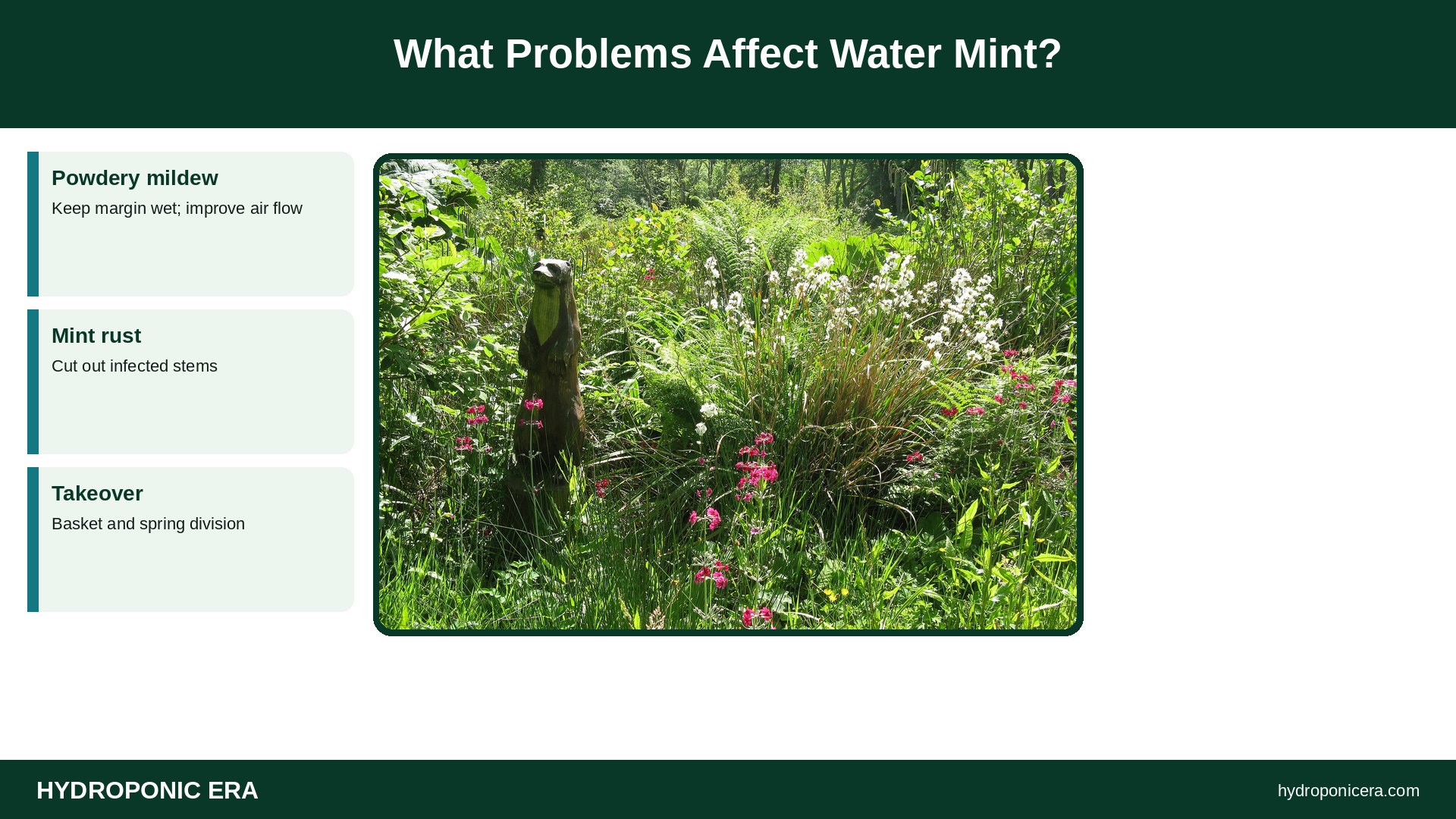
RHS rates Mentha aquatica as generally pest-free, but says it may get powdery mildew or mint rust if it is allowed to become too dry. Keep the roots wet, give it good air flow and remove affected stems. Read more in our mint rust guide.
| Problem | Cause | Fix |
|---|---|---|
| Powdery mildew | Roots too dry | Keep margin wet; improve air flow |
| Mint rust | Dry stress; spores | Cut out infected stems |
| Takeover | Rhizome spread | Basket and spring division |
| Few flowers | Too much shade | Move to full sun |
FAQ About Water Mint
Is water mint edible?
SANBI notes it is used as a traditional remedy and to flavor water; confirm the plant’s identity before eating any wild mint.
Does water mint survive winter?
It is a herbaceous perennial that dies back and regrows in spring.
Can water mint grow fully underwater?
It is a marginal plant; keep its leaves above the water surface.
Does water mint help ponds?
SANBI says bank plantings help with erosion control.
Sources
- Royal Horticultural Society. Mentha aquatica, water mint.
- Royal Horticultural Society. Aquatic Plants: Planting Guide.
- USGS Nonindigenous Aquatic Species. Water mint (Mentha aquatica) Species Profile.
- SANBI PlantZAfrica. Mentha aquatica.
- Photo credits (Wikimedia Commons, edited with titles): Mentha aquatica kz09 by Krzysztof Ziarnek, Kenraiz (CC BY-SA 4.0); Mentha aquatica 108988783 by Maria (CC BY 4.0); RIBogorSeerose by Ziegler175 (CC BY-SA 4.0); Pond-edge plants at Achamore Garden – geograph.org.uk – 5446824 by M J Richardson (CC BY-SA 2.0)