
What is the difference between LECA and perlite? In the LECA vs perlite choice, LECA is fired clay balls that are heavy, reusable and fast-draining, while perlite is light, cheap expanded volcanic glass that holds more water but floats. Oklahoma State rates both pH-neutral and reusable; LECA suits semi-hydro and ebb-and-flow, perlite suits mixes and cuttings.
Key takeaway: LECA and perlite are both porous, inert growing media, but they behave very differently in a pot or a hydroponic system. Oklahoma State University Extension (OSU) compares them in its growing media fact sheet. This guide covers cost, water and air, weight, reuse, safety and which one fits each job.
| Property | LECA (Expanded Clay) | Perlite |
|---|---|---|
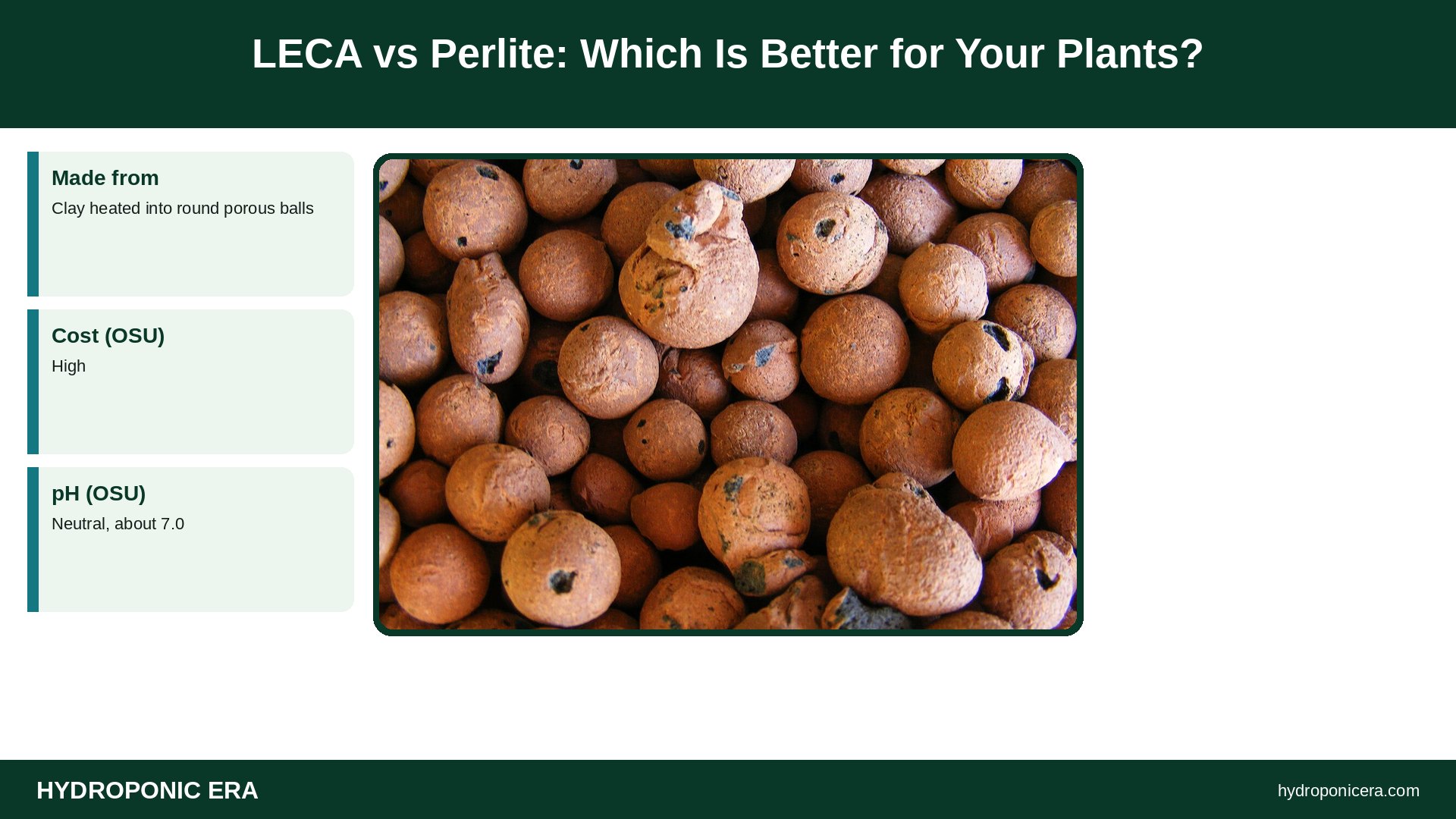
| Made from | Clay heated into round porous balls | Volcanic glass expanded by heat |
| Cost (OSU) | High | Low |
| pH (OSU) | Neutral, about 7.0 | Neutral |
| Water holding | Low; drains and dries fast | Holds 3 to 4 times its weight |
| Weight | Heavy enough to anchor plants | Very light; floats and washes away |
| Reuse | Wash, sterilize and reuse for years | Reusable after steam pasteurizing |
| Main drawback | Expensive; may float at first | Dust; algae and fungus gnats |
What Is the Difference Between LECA and Perlite?
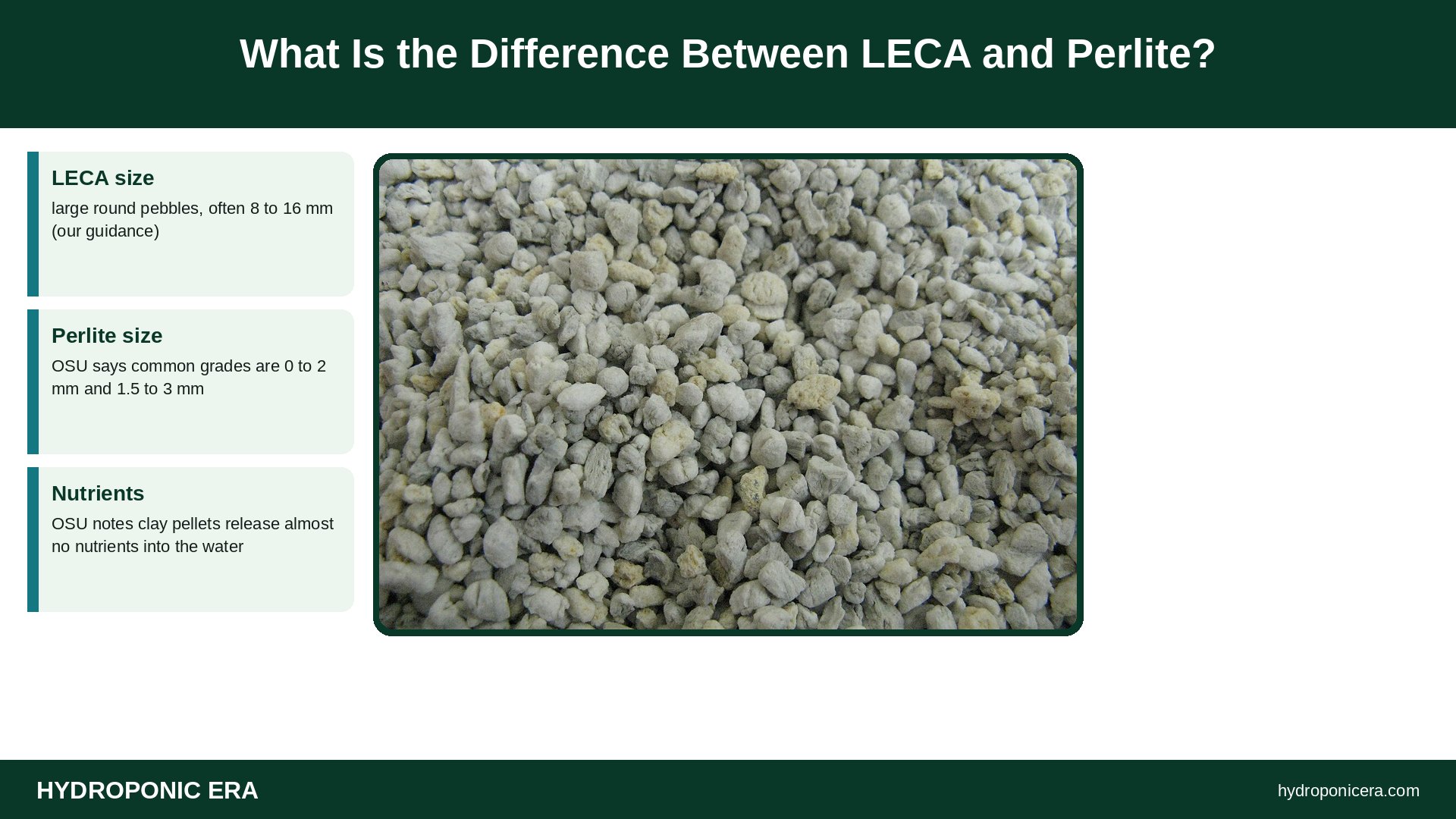
The key LECA vs perlite difference is weight and structure. OSU describes expanded clay as pellets made by heating clay into round porous balls, sold as LECA, grow rocks or Hydroton. Perlite is a volcanic mineral that expands under very high heat and becomes lightweight, porous and absorbent. Both are inert, and OSU lists both as reusable with neutral pH.
- LECA size: large round pebbles, often 8 to 16 mm (our guidance).
- Perlite size: OSU says common grades are 0 to 2 mm and 1.5 to 3 mm.
- Nutrients: OSU notes clay pellets release almost no nutrients into the water.
- Cost: OSU rates expanded clay high cost and perlite low cost.
Which Holds More Water and Air, LECA or Perlite?
On water, LECA vs perlite is not close: perlite holds more water, while LECA drains faster. OSU says perlite has one of the best oxygen retention levels of all growing media and can hold three to four times its weight of water. The same fact sheet says clay pellets have poor water-holding capacity compared with many substrates, draining and drying so fast that roots may dry out.
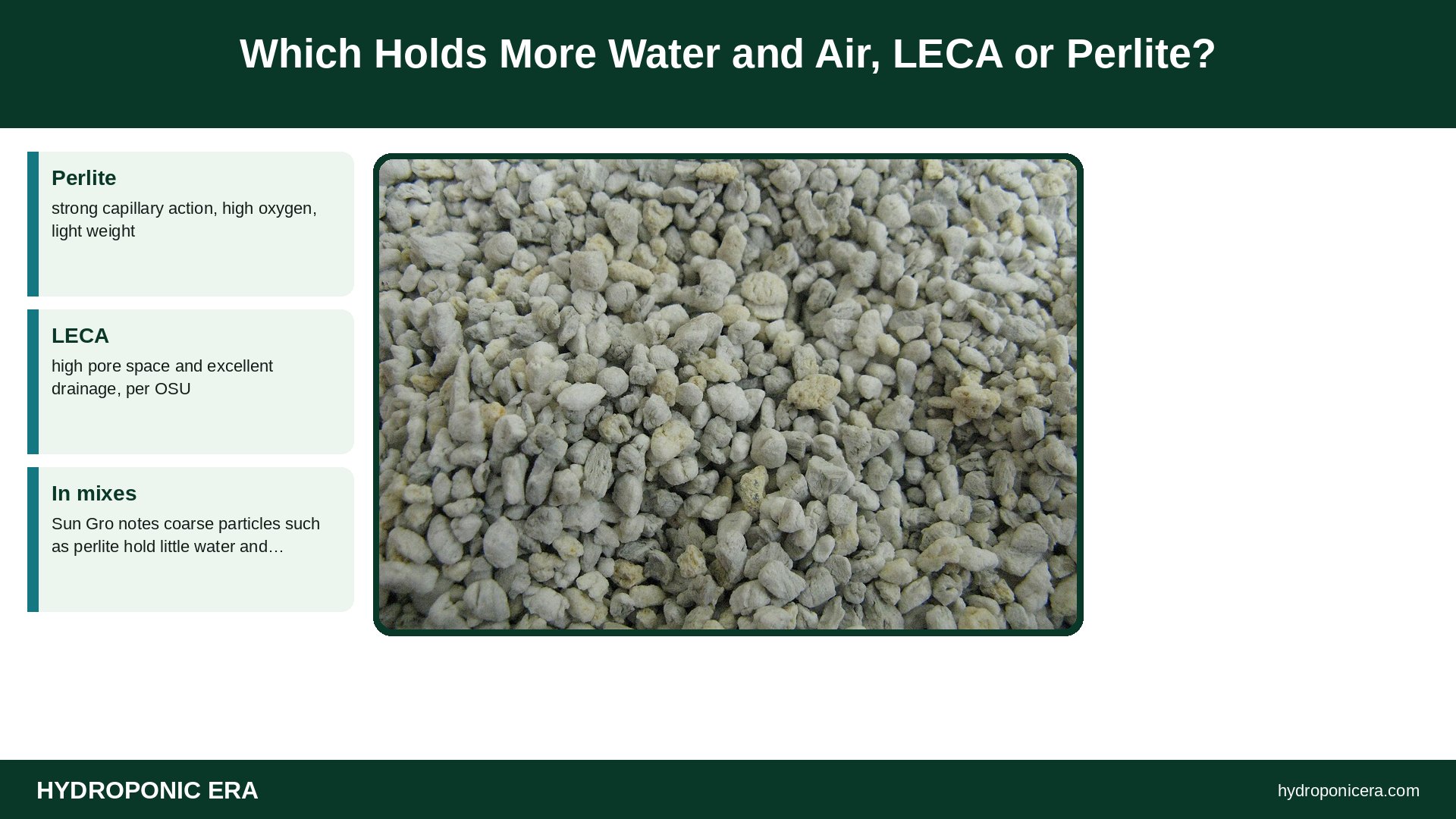
- Perlite: strong capillary action, high oxygen, light weight.
- LECA: high pore space and excellent drainage, per OSU.
- In mixes: Sun Gro notes coarse particles such as perlite hold little water and add air space.
- Air target: Sun Gro says propagation mixes should have 10 to 15% air space.
In practice, LECA vs perlite comes down to wicking height and rinse needs. For fuller detail on clay, see clay pebbles for hydroponics.
Which Is Better for Semi-Hydro and Propagation?
For semi-hydro houseplants, LECA is usually the better pick in the LECA vs perlite debate because it is heavy, stable and reusable, and it wicks water from a reservoir without floating. For seeds and cuttings, perlite wins. OSU says its sterility makes perlite highly suitable for starting seeds with little risk of root rot or damping off.
- Semi-hydro: LECA; see semi-hydroponics with LECA.
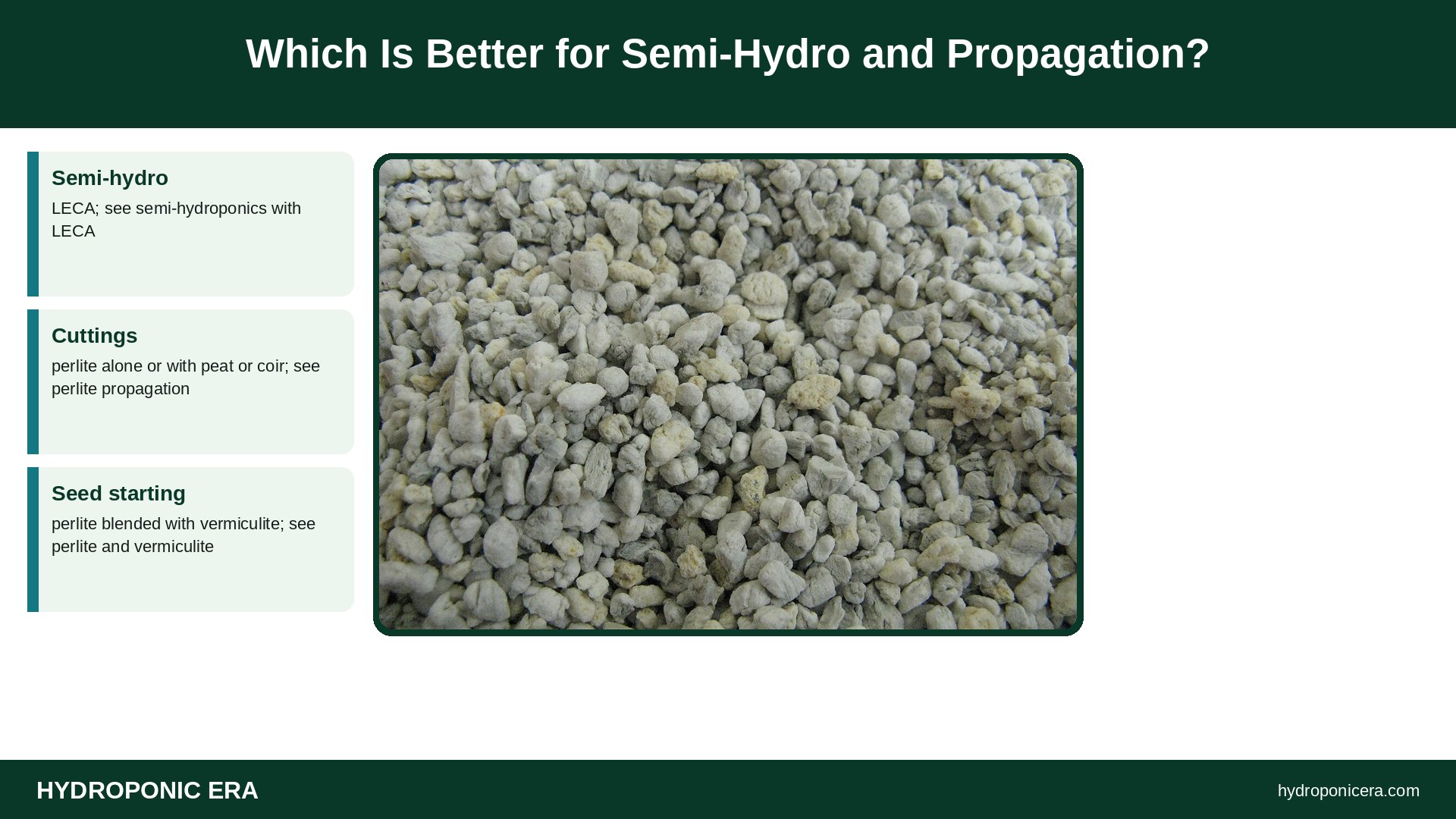
- Cuttings: perlite alone or with peat or coir; see perlite propagation.
- Seed starting: perlite blended with vermiculite; see perlite and vermiculite.
- Ebb and flow: LECA; OSU says perlite is inappropriate for flood-and-flush systems.
Which Lasts Longer, LECA or Perlite?
For lifespan, the LECA vs perlite answer favors clay: both can be reused, but LECA holds up better. OSU says expanded clay pellets are very stable, can last for many years, and can be washed and sterilized for reuse. Perlite is also reusable after steam pasteurizing and is not greatly affected by acids or microorganisms, but its light granules crush and wash away more easily (our guidance).
- LECA: rinse, soak, sterilize and reuse.
- Perlite: reuse if clean; replace when it turns powdery (our guidance).
- Other options: see pumice for hydroponics.
What Are the Downsides of LECA and Perlite?
Each side of LECA vs perlite has trade-offs. OSU says clay pellets are fairly expensive, bind tightly around roots in Dutch buckets, and float for the first few months, so they can be sucked into filters or drain lines. Perlite washes away easily, does not retain water well alone in drip systems, and is prone to algae that can lead to fungus gnat problems.
- Perlite dust: OSU says it can cause respiratory problems and eye irritation; wear goggles and a mask.
- LECA dust: rinse new clay before use (our guidance).
- pH drift: both start neutral, so check pH after setup (our guidance).
Which Works Better in Hydroponic Systems?
In active hydroponics, LECA vs perlite depends on the system type. LECA suits ebb-and-flow trays and aquaponic media beds, where OSU says its drainage and high pore space keep solution flowing. Perlite works in drip and wick systems when blended with coir, but OSU notes that alone it does not retain water well in drip systems.
- Net cups: LECA holds plants upright in deep water culture (our guidance).
- Wick systems: perlite blends wick well (our guidance).
- Media beds: OSU names clay pebbles among the most used aquaponics media.
How Do You Choose Between LECA vs Perlite for Your Setup?
Match the medium to the system. Choose LECA for semi-hydro pots, ebb-and-flow trays, net cups and long-term reuse. Choose perlite for cuttings, seed trays, soil and coir blends, and wick systems where light weight matters. Many growers use both: perlite to root, LECA once roots are established (our guidance).
- Budget: perlite is cheaper per bag, per OSU’s cost rating.
- Mess: LECA is cleaner and heavier; perlite blows and floats.
FAQ About LECA vs Perlite
Is LECA or perlite better for houseplants?
LECA for semi-hydro; perlite for soil mixes.
Can I mix LECA and perlite?
Yes, but perlite can wash through the gaps (our guidance).
Which holds more water, LECA or perlite?
Perlite, up to 3 to 4 times its weight, per OSU.
Does perlite float in hydroponics?
Yes; OSU says it suits flood-and-flush systems poorly.
Is LECA vs perlite cheaper?
Perlite is lower cost, per OSU.
Which is better for cuttings in the LECA vs perlite choice?
Perlite, because it is sterile and airy.
Sources
- Oklahoma State University Extension — Soilless Growing Mediums (HLA-6728)
- Sun Gro Horticulture — Air Porosity and Water-Holding Ability of Media Components
- Photo credits (Wikimedia Commons, edited with titles): Hydroton by Lucis (CC BY-SA 3.0); Perlite1 by KENPEI (CC BY-SA 3.0)