
How do you build a safe DIY grow light? Build a DIY grow light from parts that are already certified: a plug-in LED board or strip with a UL-listed driver, mounted on a metal or wood frame, run by a timer. Aim for about 17 mol/m²/day (DLI) for lettuce, which is roughly 300 µmol/m²/s for 16 hours. Avoid hand-wiring mains power.
Key takeaway: A DIY grow light can be as simple as plug-in LED strips or a prebuilt LED board hung on a frame above your plants, on a timer. The safest builds use only certified, plug-in parts. UL’s horticultural standard, UL 8800, covers grow-light hazards such as damp locations, dust and water ingress, and eye exposure. Size the build to a light target: Virginia Tech gives an optimum DLI of about 17 mol/m²/day for lettuce.
| Item | Target or rule | Source |
|---|---|---|
| Lettuce DLI | About 17 mol/m²/day | Virginia Tech Extension |
| Clear summer day (Virginia) | About 40–44 mol/m²/day | Virginia Tech Extension |
| Too much light | Raises leaf tip burn risk | Virginia Tech Extension |
| PPFD for 17 DLI over 16 h | About 295 µmol/m²/s (our calculation) | DLI formula |
| Grow-light safety standard | UL 8800, introduced 2017 | UL Solutions |
| Covered hazards | Damp/wet locations, ingress, eye and skin light exposure | UL Solutions |
| Installation | Per the National Electrical Code | UL Solutions |
How Do You Build a DIY Grow Light?
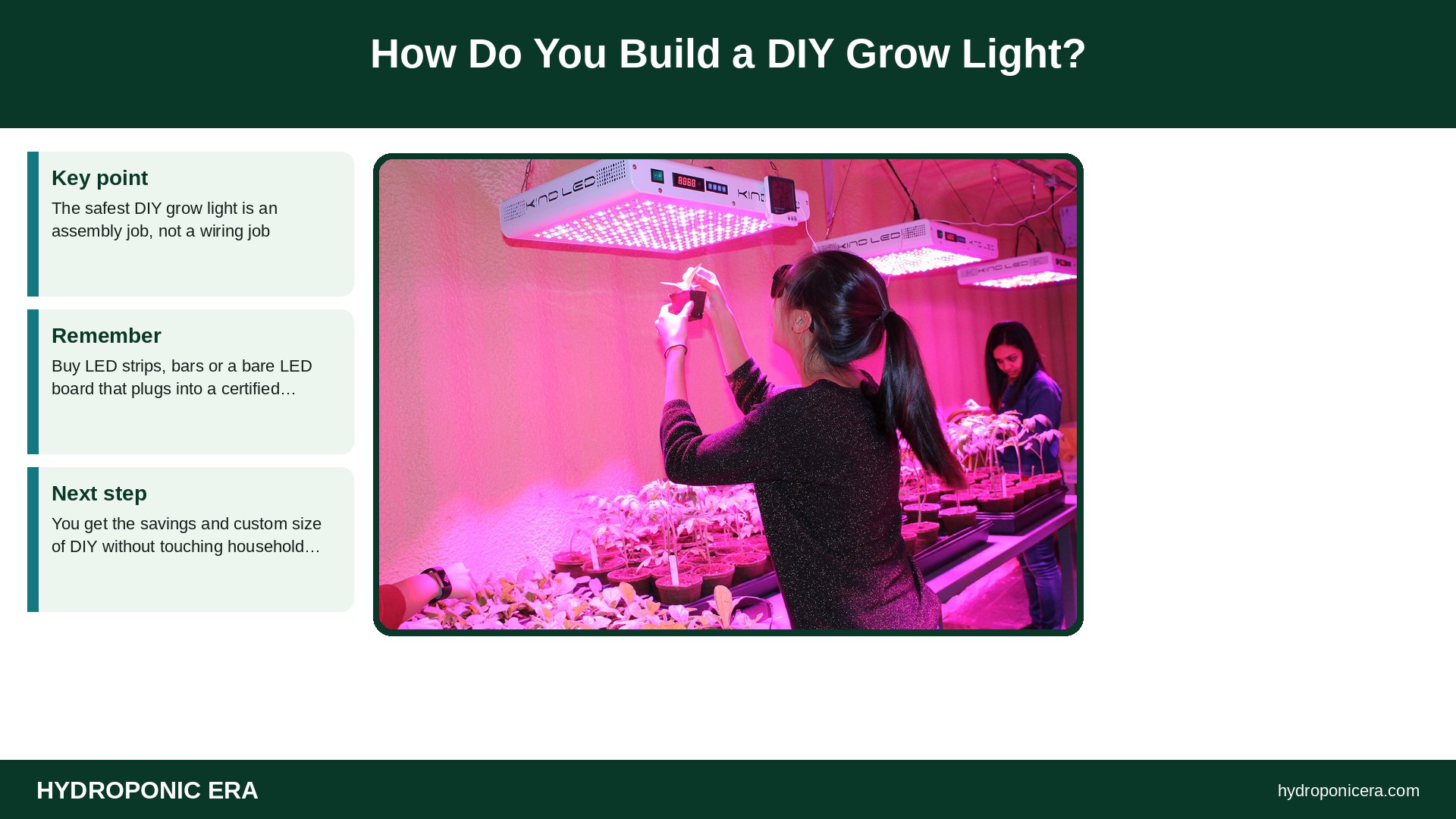
The safest DIY grow light is an assembly job, not a wiring job. Buy LED strips, bars or a bare LED board that plugs into a certified driver, then build the frame, mounting and timer yourself. You get the savings and custom size of DIY without touching household voltage, which is where the real fire and shock risks are.
- Measure your growing area, for example a 2 x 2 ft (60 x 60 cm) shelf.
- Choose plug-in LED strips or a board rated for the area, with a listed driver.
- Build a frame from aluminum angle, steel shelving or wood, with the lights adjustable in height.
- Mount the LEDs on aluminum, which spreads heat away from the chips.
- Plug the driver into a timer, then into a GFCI-protected outlet.
- Measure light at the canopy and adjust height.
For the strip approach in detail, see our LED strip grow lights guide. If you would rather buy a finished fixture, compare it with an LED grow light panel.
Which LEDs Give Enough Light for Plants?
Plants care about photons, not watts or lumens. Pick LEDs by how much usable light (PPFD, in µmol/m²/s) they deliver at your canopy, and how many hours you run them. Virginia Tech Extension gives an optimum daily light integral (DLI) of about 17 mol/m²/day for lettuce. For context, a clear summer day in Virginia delivers about 40 to 44.
You can turn a DLI target into a PPFD target for your DIY grow light. DLI equals PPFD × hours × 3,600 ÷ 1,000,000. For 17 mol/m²/day over 16 hours, you need about 295 µmol/m²/s at the canopy. Over 12 hours, you need about 395. Our PPFD and DLI guide has targets for more crops.
- Leafy greens and herbs: start near the lettuce target.
- Fruiting plants: need much more light; a small DIY grow light may fall short.
- White LEDs work: full-spectrum white LEDs grow plants; see can regular LED lights grow plants.
Virginia Tech also warns that excessive light increases leaf tip burn and other disorders, so more is not always better.
How Do You Measure a DIY Grow Light?
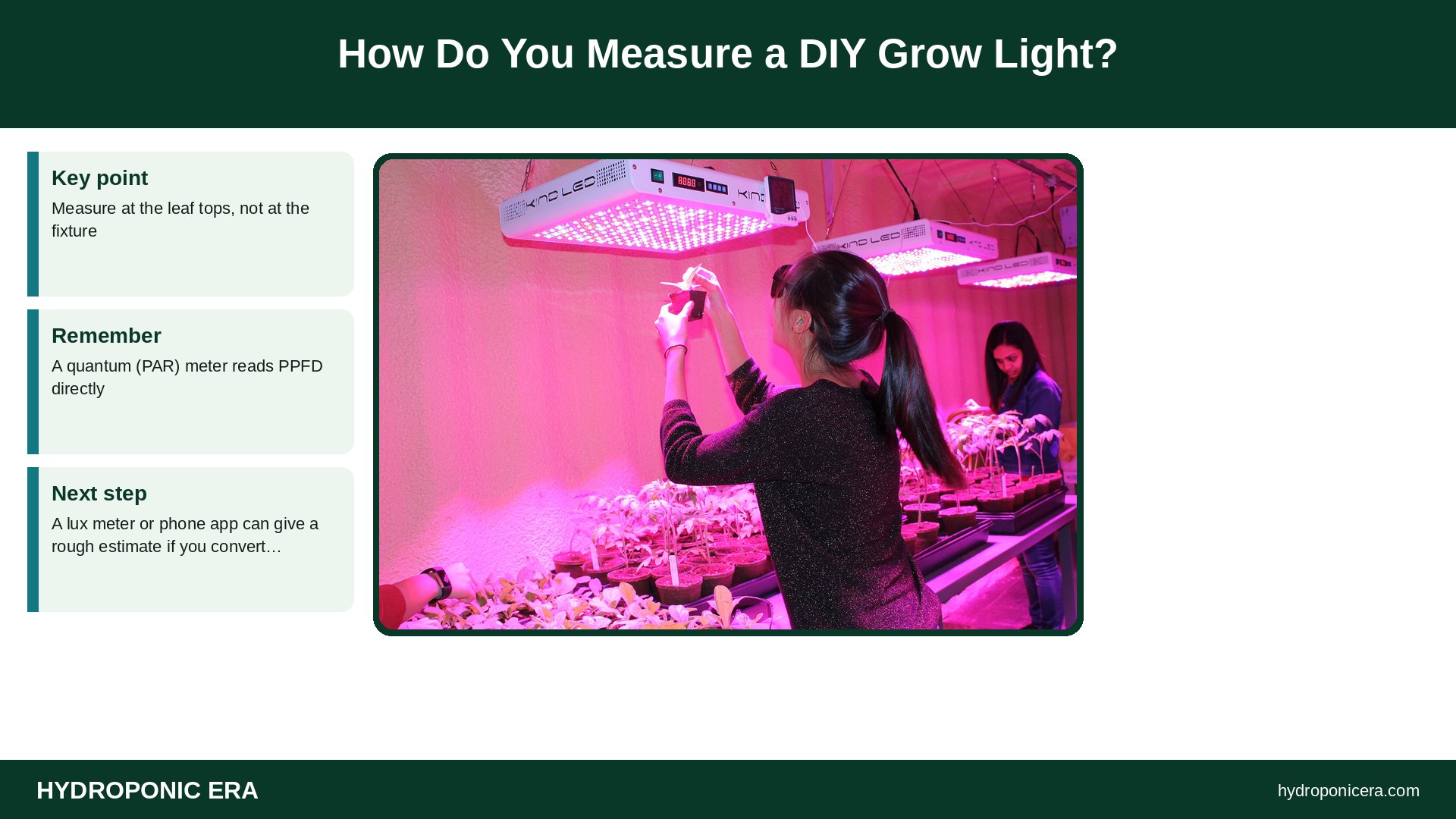
Measure at the leaf tops, not at the fixture. A quantum (PAR) meter reads PPFD directly. A lux meter or phone app can give a rough estimate if you convert with the right factor for your light type; see our lux to PPFD conversion guide. Take readings at the center and corners, because edges often get much less light.
- Set the lights at your planned height.
- Read PPFD at the center and four corners.
- Average the readings.
- Raise or lower the lights, or add strips, until you reach your target.
Our guide to measuring canopy PPFD with a phone meter shows a simple logging routine.
How Do You Keep a DIY Grow Light Safe?
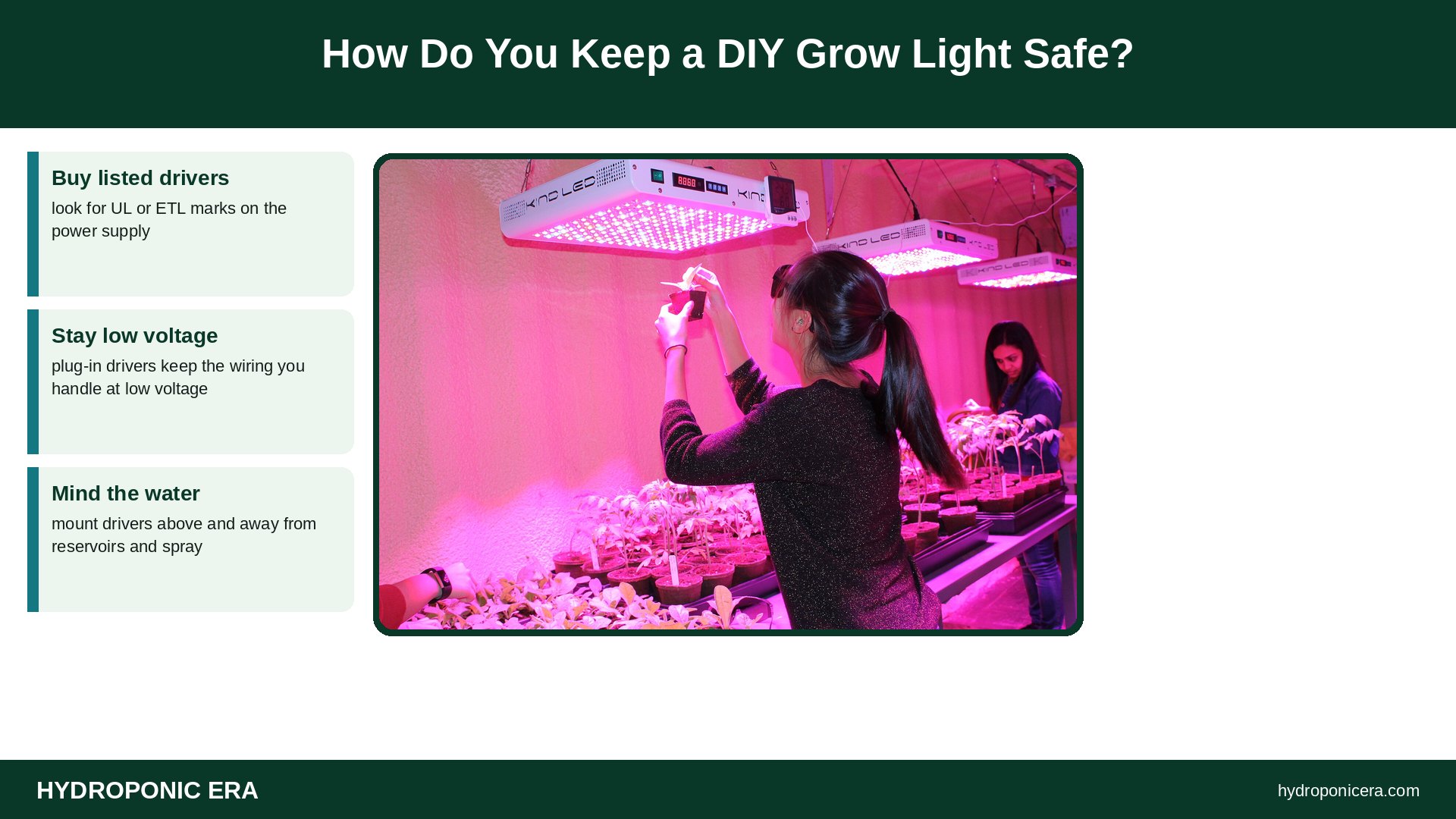
Use certified parts and keep water away from electricity. UL Solutions describes UL 8800 as the first safety standard written specifically for horticultural lighting, introduced in 2017. It evaluates grow lights and their drivers, connectors and wiring harnesses for damp or wet locations, high temperatures, dust and water ingress, and eye and skin exposure to light. Equipment is meant to be installed under the National Electrical Code.
- Buy listed drivers: look for UL or ETL marks on the power supply.
- Stay low voltage: plug-in drivers keep the wiring you handle at low voltage.
- Mind the water: mount drivers above and away from reservoirs and spray.
- Use GFCI: plug into a GFCI outlet or adapter near water.
- Protect your eyes: do not stare into bright LEDs; UL notes grow lights often emit UV, deep blue and infrared light that can harm eyes.
- Hire help: have a licensed electrician do any hardwired or mains work.
Heat matters too. LEDs run cooler than older lamps, but the chips and drivers still get hot. See do LED grow lights get hot for safe distances.
How Long Should a DIY Grow Light Stay On?
Most leafy crops do well with 14 to 16 hours of light a day, followed by darkness. Use a plug-in timer so your DIY grow light runs on a steady schedule. Longer days let you hit the same DLI with a dimmer light, which can mean fewer LEDs. Check your crop’s needs in our hydroponic light schedule guide.
- Greens and herbs: 14–16 hours.
- Seedlings: 14–18 hours at lower intensity.
- Always: give plants a dark period.
FAQ About DIY Grow Light Builds
Is a DIY grow light cheaper?
Often, if you build the frame yourself and buy plug-in LED parts.
How much light do lettuce plants need?
About 17 mol/m²/day DLI, per Virginia Tech.
Can I use regular LED strips?
Yes, white LEDs grow plants if they are bright enough.
Do I need a UL-listed driver?
Yes; use a certified driver and avoid hand-wiring mains power.
How high should the light hang?
Adjust until you reach your PPFD target at the canopy.
Is my DIY grow light safe near water?
Only with drivers kept dry, damp-rated parts and GFCI protection.
Sources
- Virginia Cooperative Extension — Hydroponic Production of Edible Crops: Management Basics (SPES-462)
- UL Solutions — UL 8800, Published Standard for Horticultural Lighting Equipment
- UL Solutions — Horticultural (Grow) Lighting Infosheet
- Photo credits (Wikimedia Commons, edited with titles): Led digital visuals-leds in grow box PNr°0082 by D-Kuru (CC BY-SA 3.0 at); Terramera scientists working in a climate-controlled growth chamber located in Vancouver, BC. The space uses LED lighting, which supports plant growth. (50188965171) by Simon Fraser University – Communications & Marketing (CC BY 2.0)