
Can you root Japanese maple cuttings? Yes. Japanese maple cuttings root best as 6 to 8 in (15 to 20 cm) softwood tips taken from late May to mid-June. Wound the base, dip in 2% IBA hormone, and keep leaves misted over 70°F (21°C) bottom heat. Roots usually form in about four to six weeks.
Key takeaway: Japanese maple (Acer palmatum) is usually grafted, but many green and red upright types grow on their own roots from cuttings. A Virginia Tech paper by Guy Phillips summarizes decades of nursery methods from James Wells, Michael Dirr and others. Here is how to root Japanese maple cuttings, and how to keep them alive through their first winter.
| Step | Target | Source |
|---|---|---|
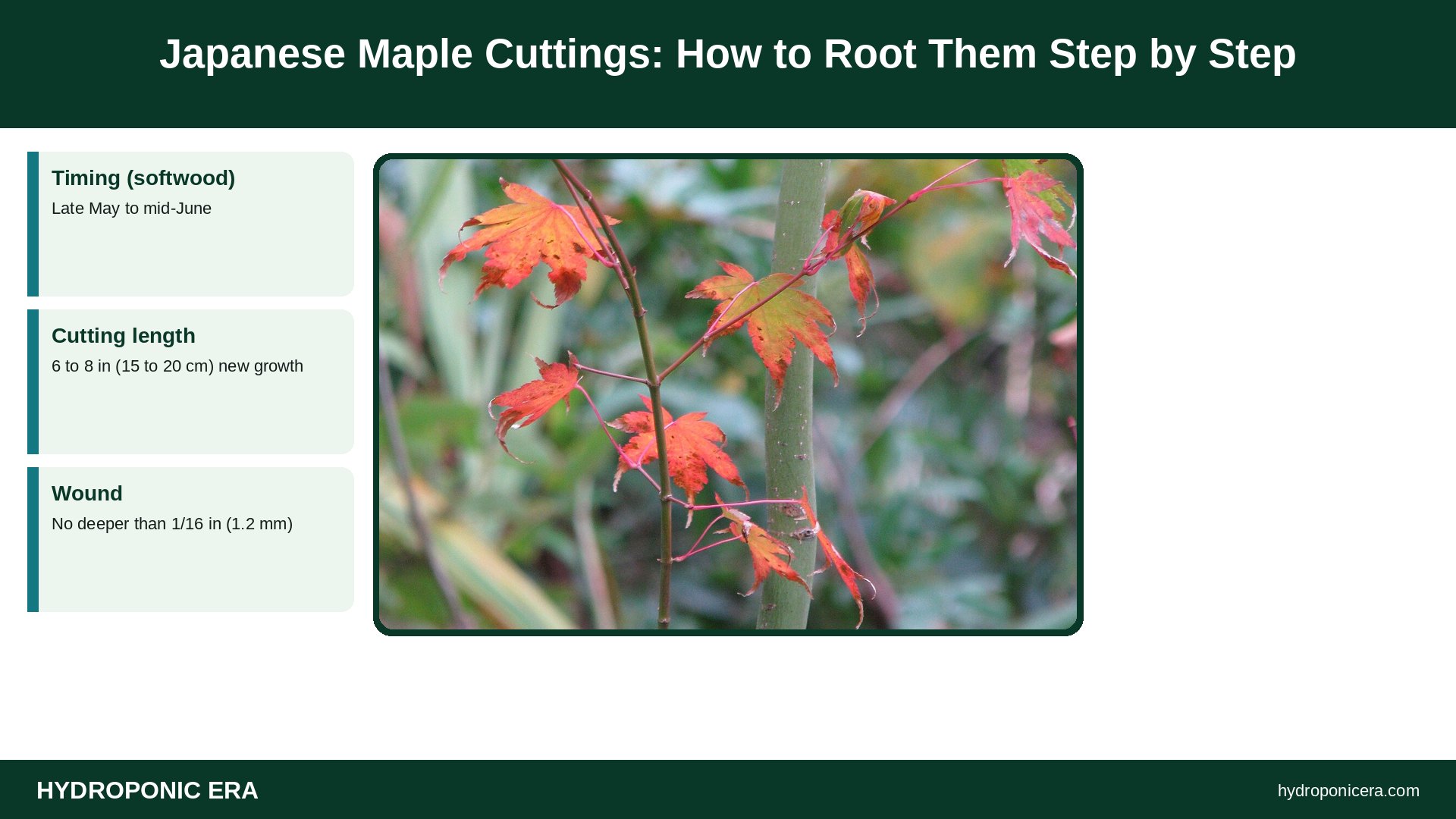
| Timing (softwood) | Late May to mid-June | Virginia Tech (Wells) |
| Cutting length | 6 to 8 in (15 to 20 cm) new growth | Virginia Tech |
| Wound | No deeper than 1/16 in (1.2 mm) | Virginia Tech (Wells) |
| Hormone | 2% IBA talc with fungicide | Virginia Tech (Wells) |
| Bottom heat | 70°F (21°C) | Virginia Tech (Wells) |
| Pot up when roots are | 2 to 3 in (5 to 8 cm) long | Virginia Tech (Dirr) |
| Hardwood option | January, roots in about 4 weeks | Virginia Tech (Carville) |
Can You Root Japanese Maple Cuttings?
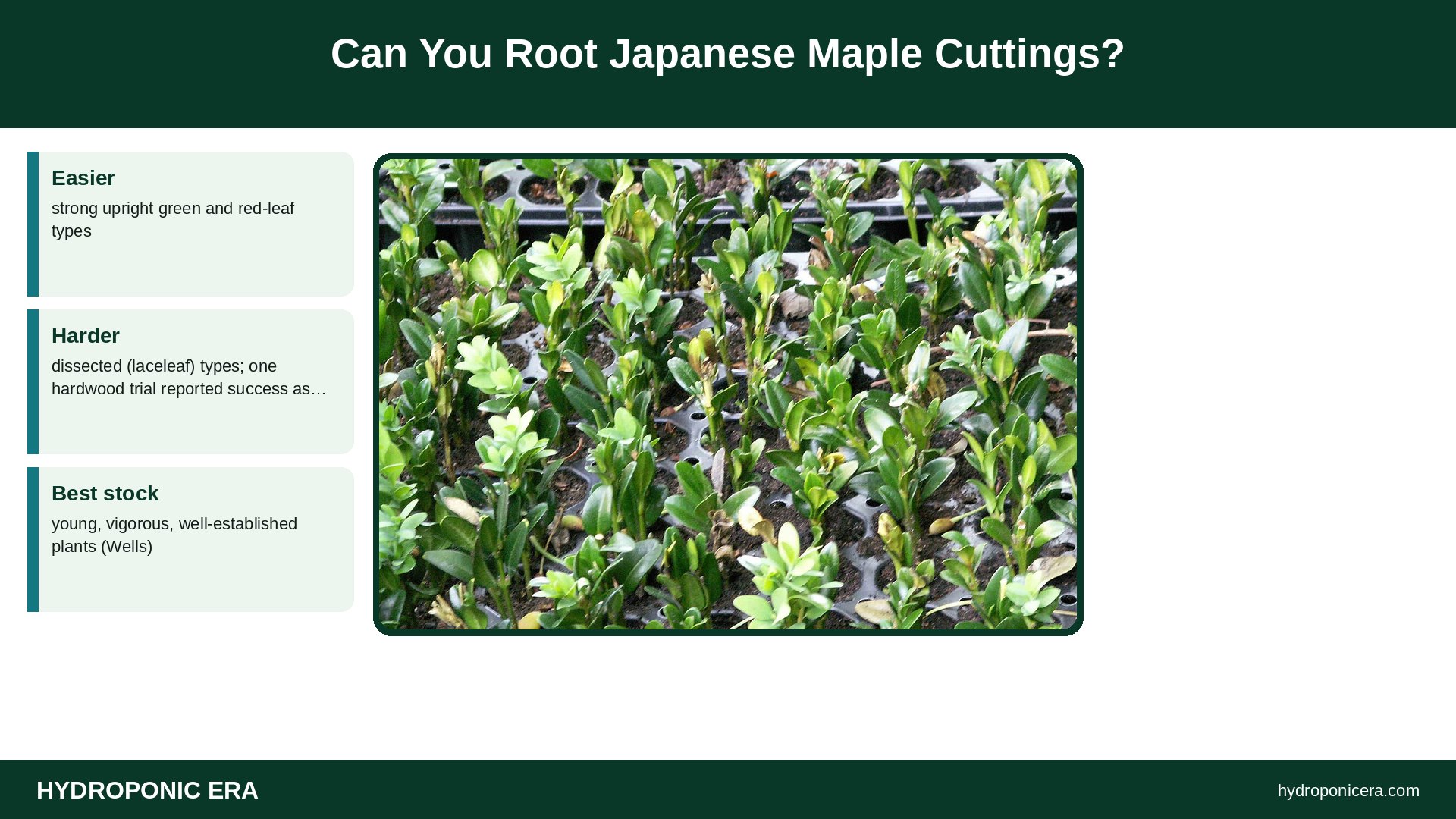
Yes, with care. The Virginia Tech paper notes that Japanese maple has a moderate ease of asexual propagation, and that most stem cutting work uses softwood cuttings. Vigorous upright green and red types root best. The paper notes that dwarfs, weeping and variegated forms can be rooted, but success rates drop. Grafting remains the most reliable way to copy fancy cultivars.
- Easier: strong upright green and red-leaf types.
- Harder: dissected (laceleaf) types; one hardwood trial reported success as low as 25%.
- Best stock: young, vigorous, well-established plants (Wells).
Want a no-cutting option? Air layering roots a branch while it stays on the tree.
How Do You Take Japanese Maple Cuttings?
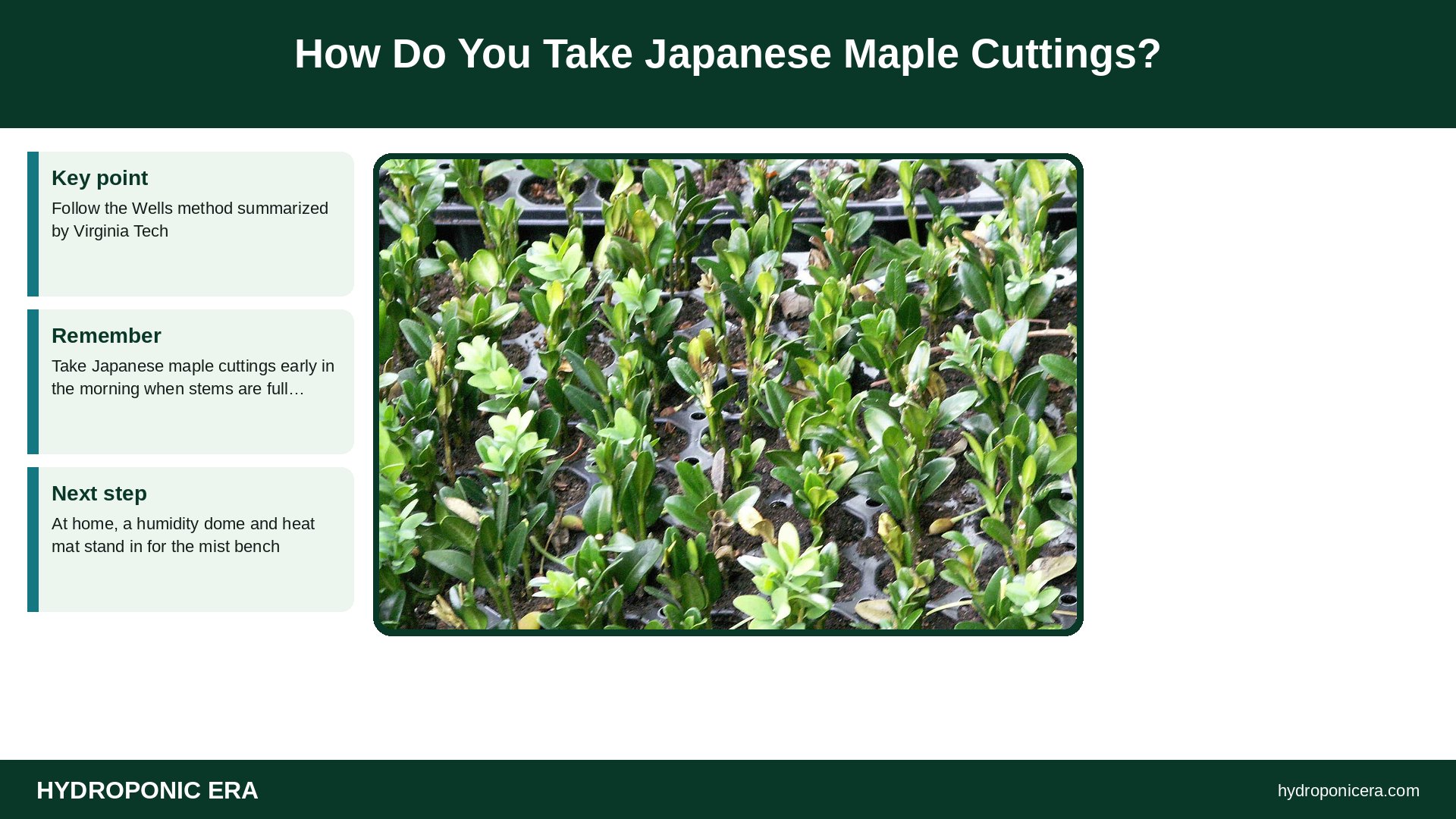
Follow the Wells method summarized by Virginia Tech. Take Japanese maple cuttings early in the morning when stems are full of water, and never let them dry out.
- Cut 6 to 8 in (15 to 20 cm) of the thickest, most vigorous terminal shoots from late May to mid-June.
- Wound the base by removing outer bark no deeper than 1/16 in (1.2 mm).
- Dip right away in a 2% IBA talc hormone; Wells advises the strongest available strength.
- Stick about 2 in (5 cm) deep, up to the top of the wound.
- Keep leaves moist all day with mist; daytime air can reach 90°F (32°C) if leaves stay wet.
- Give 70°F (21°C) bottom heat and light shade.
At home, a humidity dome and heat mat stand in for the mist bench. See humidity domes for cuttings and heat mats and domes.
How Long Do Japanese Maple Cuttings Take to Root?
About four to six weeks. The Virginia Tech paper describes softwood cuttings taken around the start of June being rooted by July. For dormant hardwood cuttings, Carville reported callus in about 15 days and roots in about 4 weeks. Japanese maple cuttings rooted in water are not covered by any source we found, so use a drained mix (our guidance).
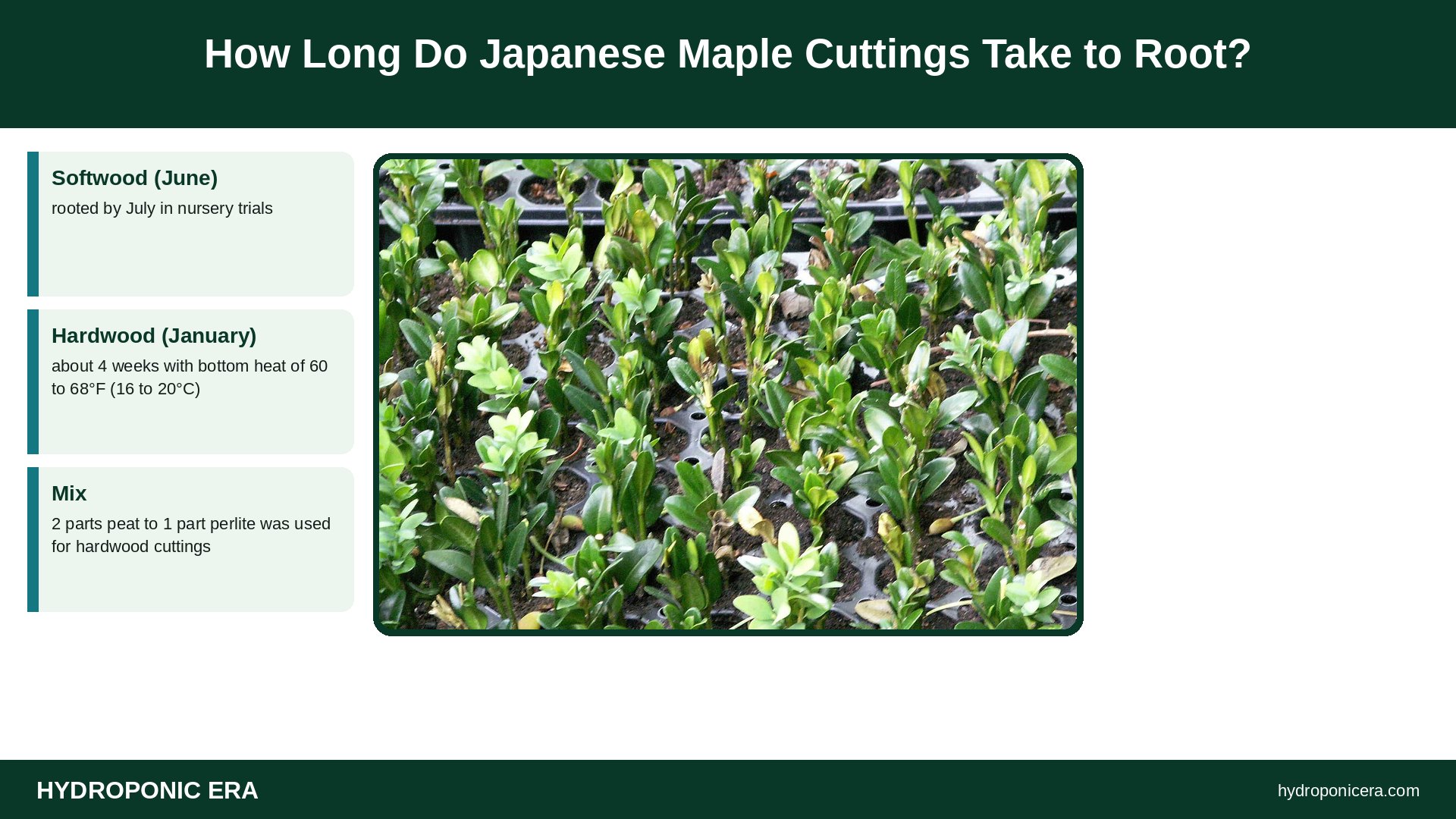
- Softwood (June): rooted by July in nursery trials.
- Hardwood (January): about 4 weeks with bottom heat of 60 to 68°F (16 to 20°C).
- Mix: 2 parts peat to 1 part perlite was used for hardwood cuttings.
Carville warned that excessive top heat or overwatering leads to complete failure, and the mix should feel almost dry to the touch. For mix tips, see perlite propagation.
When Should You Pot Up Rooted Japanese Maple Cuttings?
When roots reach 2 to 3 in (5 to 8 cm) long. Dirr and Heuser, cited by Virginia Tech, advise lifting each cutting at that point and potting it in the same mix used for rooting. Then put potted Japanese maple cuttings back under mist and wean them off over about three weeks.
- Pot when roots are 2 to 3 in (5 to 8 cm) long.
- Remove the leaf at the middle node to wake a bud.
- Return to mist or a dome, then wean over three weeks.
- Feed at one-quarter strength while new shoots grow.
How Do You Get Cuttings Through the First Winter?
Push one flush of new growth before fall. Wells said the secret is to induce new growth right after rooting. Nurseries extend the day with a 60 to 75 W incandescent bulb about 3 ft (0.9 m) above the plants, then stop the extra light in October. That gives about three months of growth.
A Wisconsin study cited in the paper warns against nitrogen, especially ammonium, before the first dormancy, because it delays cold hardening. Protect young Japanese maple cuttings from hard freezes their first winter (our guidance).
Where Should a Rooted Maple Grow Next?
Treat it like any young Japanese maple. NC State Extension advises dappled shade and evenly moist, well-drained soil, with shelter from drying winds, and warns that excess sun, wind or drought can scorch the leaves.
NC State also notes that most cultivars sold are grafted. A tree on its own roots grows slowly at first, so keep it in a container for a season or two before planting out (our guidance). Water when the top 1 in (2.5 cm) of mix starts to dry, and avoid heavy feeding.
FAQ About Japanese Maple Cuttings
Can Japanese maple cuttings root in water?
There is no tested method; use a drained peat and perlite mix (our guidance).
What hormone works best?
A 2% IBA talc, per Wells via Virginia Tech.
When should I take Japanese maple cuttings?
Late May to mid-June for softwood.
How long until roots form?
About four to six weeks.
Will a cutting look like the parent tree?
Yes, cuttings are clones of the parent.
Why did my cuttings die after rooting?
Often overwatering or a failed first winter.
Sources
- NC State Extension Gardener Plant Toolbox — Acer palmatum (Japanese Maple)
- Virginia Tech (VTechWorks), Guy Phillips — Culture and Propagation of Japanese Maple (PDF)
- Photo credits (Wikimedia Commons, edited with titles): Acer palmatum – Flickr – peganum by peganum from Small Dole, England (CC BY-SA 2.0); Softwood stemcuttings by KVDP (Public domain)