
Can you root blueberry cuttings in water? It is not a proven method. University extension guides root blueberry cuttings in moist, airy, acidic mix under mist, not in a glass. Blueberry cuttings in water often rot because still water lacks oxygen. Stick them in 1:1 peat and perlite instead; softwood cuttings root in about 6 to 8 weeks.
Key takeaway: Blueberries are grown from cuttings every year by nurseries, but none of the extension guides we found use plain water. The University of Georgia, University of Kentucky and NC State all root them in porous, acidic media with mist. Here is what that means for blueberry cuttings in water, and the method that works better at home.
| Step | What to Do | Source |
|---|---|---|
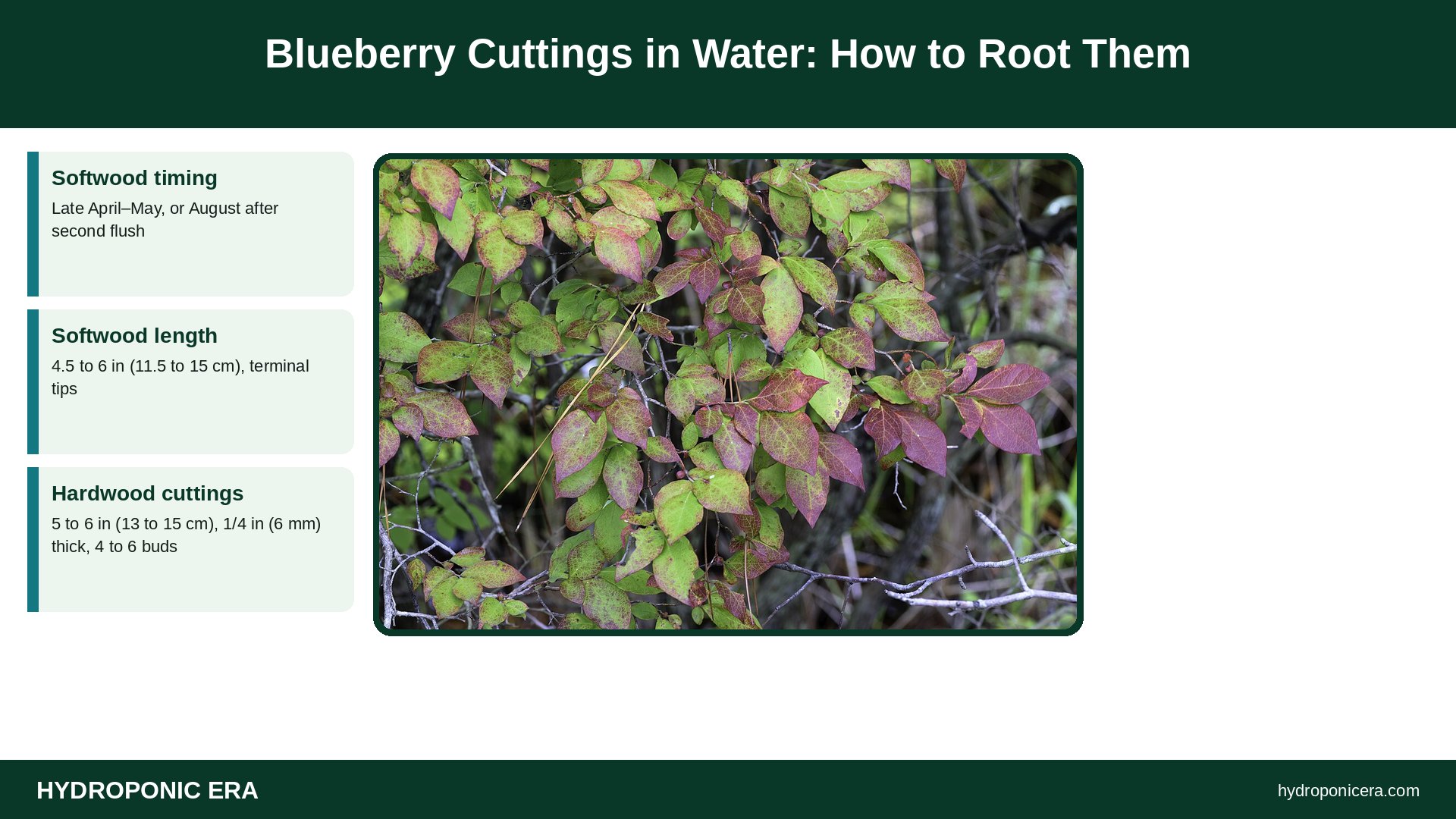
| Softwood timing | Late April–May, or August after second flush | UGA (south Georgia) |
| Softwood length | 4.5 to 6 in (11.5 to 15 cm), terminal tips | UGA |
| Hardwood cuttings | 5 to 6 in (13 to 15 cm), 1/4 in (6 mm) thick, 4 to 6 buds | Kentucky ID-210 |
| Rooting mix | Peat and perlite 1:1, or pine bark | UGA; Kentucky; Acta Hort |
| Moisture | Intermittent mist; leaves must never dry | UGA; Kentucky |
| Time to root (softwood) | About 6 to 8 weeks | Acta Horticulturae |
| Hormone | Optional; often roots without it | NC State; Kentucky |
Can You Root Blueberry Cuttings in Water?
Not reliably, and no extension source we found recommends it. UGA Extension says blueberry rooting media must be porous enough to drain, because anoxic (oxygen-poor) conditions hurt rooting. A jar of still water is exactly that kind of low-oxygen setting. So blueberry cuttings in water tend to blacken at the base before roots form (our guidance).
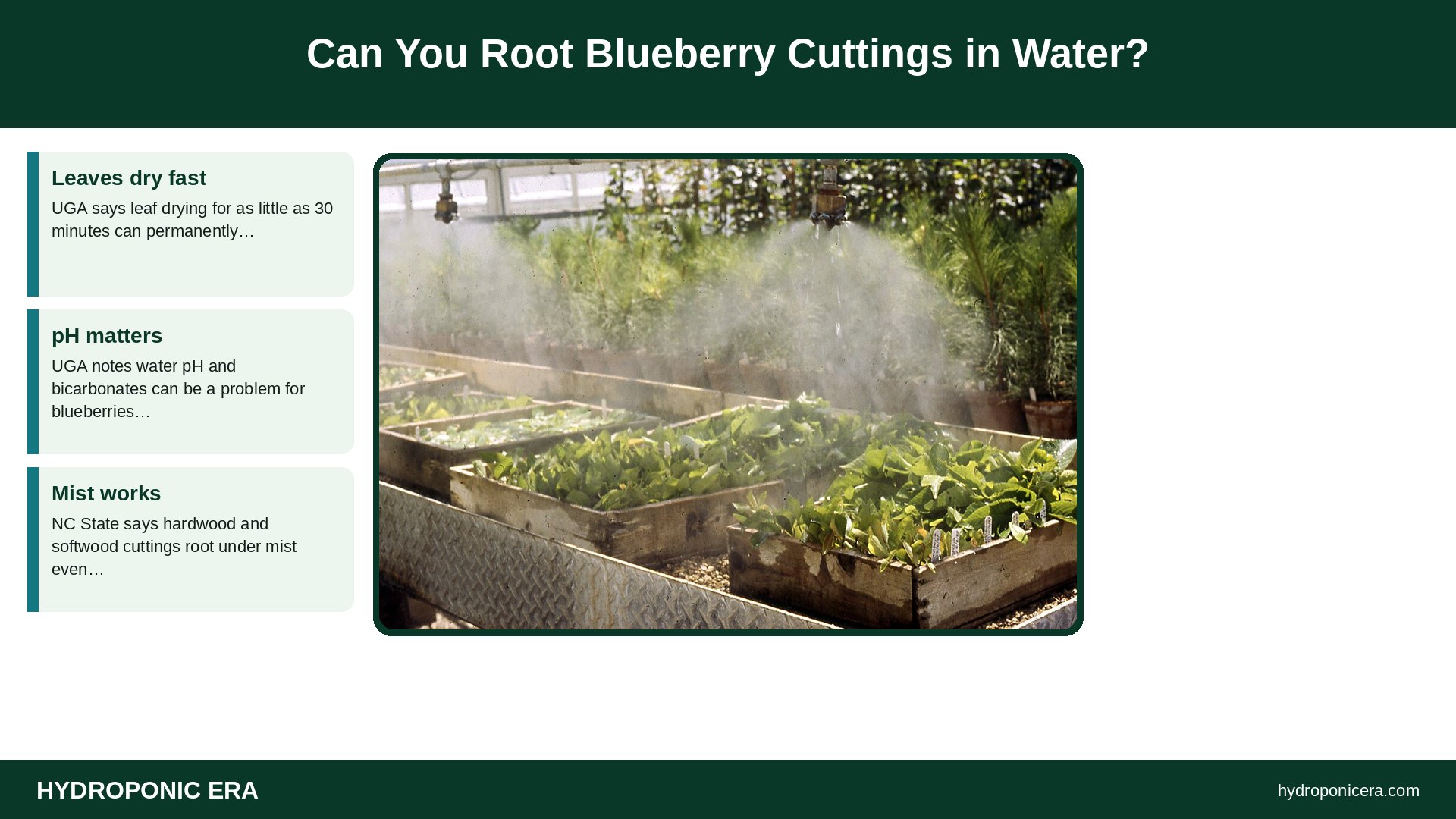
- Leaves dry fast: UGA says leaf drying for as little as 30 minutes can permanently damage unrooted cuttings.
- pH matters: UGA notes water pH and bicarbonates can be a problem for blueberries, and lime raises pH and causes poor rooting.
- Mist works: NC State says hardwood and softwood cuttings root under mist even without hormone.
If you still want to try blueberry cuttings in water, use rainwater or distilled water, change it every two days, and keep a clear bag over the cutting (our guidance). Expect low success. For the general method, see water propagation vs soil propagation.
How Long Do Blueberry Cuttings Take to Root?
About 6 to 8 weeks for softwood cuttings. A study in Acta Horticulturae notes softwood cuttings are used because of a high rooting percentage and a rooting period of 6 to 8 weeks. It found peat-based mixes improved rooting over plain pine bark. Blueberry cuttings in water, if they root at all, are usually slower (our guidance).
- Take 4.5 to 6 in (11.5 to 15 cm) tips from new growth early in the morning (UGA).
- Strip all but the top two or three leaves and pinch the soft tip (UGA).
- Dip in rooting hormone only for hard-to-root cultivars (Kentucky).
- Stick in moist peat and perlite, 1:1 (Kentucky; Acta Hort).
- Keep leaves wet with mist or under a humidity dome in bright shade.
- Tug gently after six weeks; resistance means roots (our guidance).
A dome is the home version of a mist bench; see humidity domes for cuttings.

When Do You Move Rooted Blueberry to Soil?
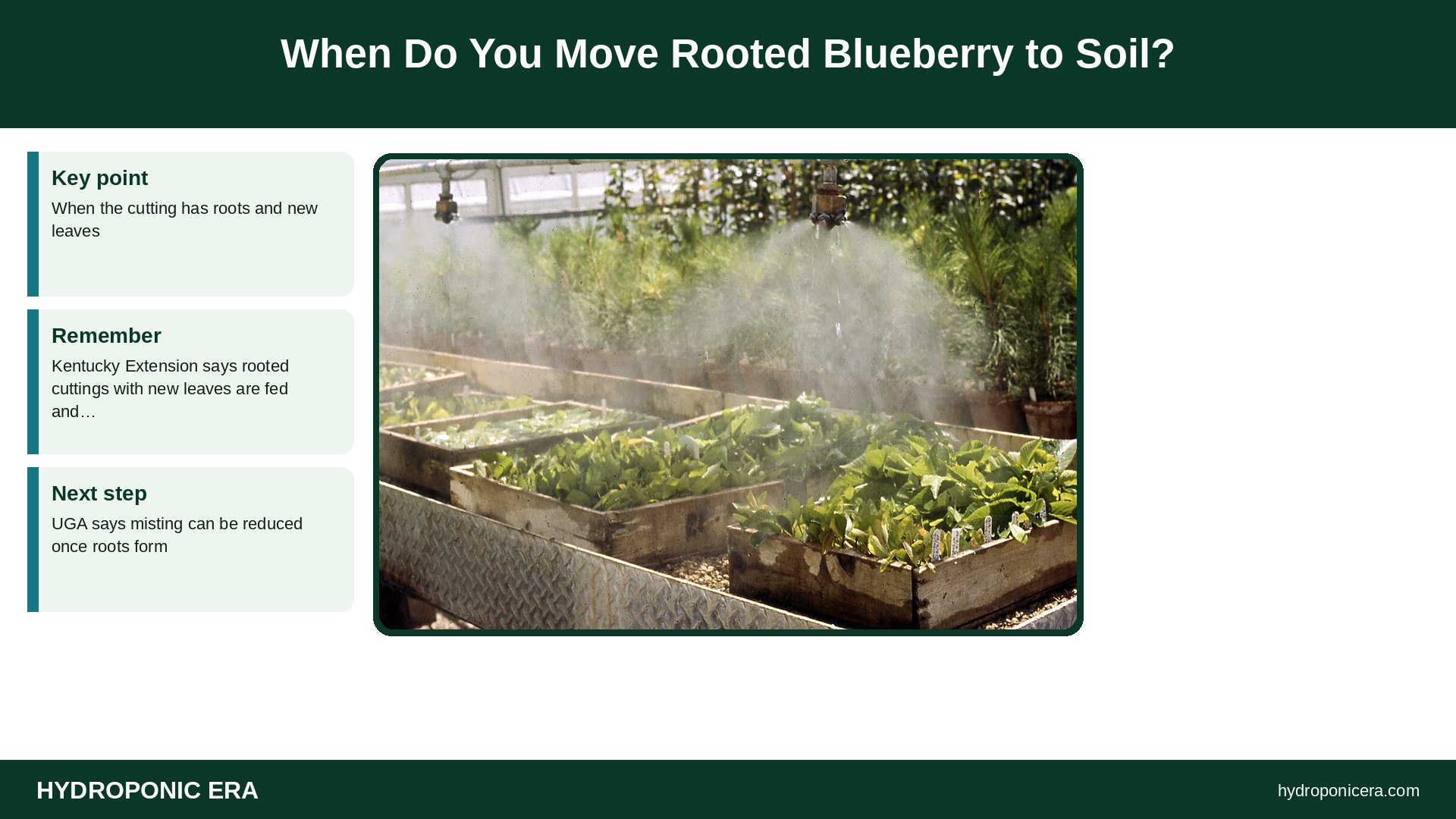
When the cutting has roots and new leaves. Kentucky Extension says rooted cuttings with new leaves are fed and grown on until ready for individual pots or the nursery row. UGA says misting can be reduced once roots form. Blueberry cuttings in water should go into acidic mix as soon as you see roots about 1 in (2.5 cm) long (our guidance).
- Pot into an acidic, peat-based mix; avoid limed potting soil (UGA).
- Wean off the dome over one to two weeks (our guidance).
- Feed lightly with an ammonium nitrogen source; Kentucky cites ammonium sulfate at 1 oz per gal (7.5 g per L) for rooted cuttings.
- Keep in bright shade the first summer, then plant out after it hardens off.
To grow them in a soilless system later, see how to grow blueberries hydroponically.
Softwood or Hardwood: Which Is Easier?
Kentucky Extension says commercial growers mostly use hardwood cuttings taken from dormant shoots in late winter. Hardwood pieces are 5 to 6 in (13 to 15 cm) long, about 1/4 in (6 mm) thick, with 4 to 6 buds, and can be stored at 35 to 40°F (2 to 4°C) for weeks. Some cultivars, such as Bluecrop, Darrow, Herbert and Stanley, root more easily from softwood.
Neither type is a good fit for blueberry cuttings in water. Both root best in drained mix under mist.
Why Do Blueberry Cuttings Fail?
UGA lists the main killers: wilting, waterlogged media, and diseases such as Pythium, Phytophthora and Rhizoctonia root rots. It advises clean tools, fresh media each round and a 10% bleach solution for work surfaces. Blueberry cuttings in water face the same rot risk, with even less oxygen.
UGA also stresses starting with healthy, disease-free mother plants, because viruses and root rots move with the cutting. Take cuttings in the cool morning when stems are turgid, keep them shaded and moist on the way home, and never let them wilt. Those three habits matter more than any rooting product (our guidance).
FAQ About Blueberry Cuttings in Water
Will blueberry cuttings in water grow roots?
Sometimes, but it is not a tested method; mist and peat mix work better.
How long do blueberry cuttings take to root?
About 6 to 8 weeks for softwood, per Acta Horticulturae.
Do blueberry cuttings need rooting hormone?
Often not, per NC State; use it for hard-to-root cultivars.
What is the best rooting mix for blueberries?
Peat and perlite 1:1, or fine composted pine bark (UGA).
When is the best time to take cuttings?
Late spring softwood or late-winter hardwood (UGA; Kentucky).
Can I keep blueberry cuttings in water overnight?
Yes, briefly, to keep them from wilting before sticking (our guidance).
Sources
- University of Georgia Extension — Propagating Disease-Free Blueberry Plants from Softwood Cuttings (B1540)
- University of Kentucky — Midwest Blueberry Production Guide (ID-210)
- NC State Extension — Growing Blueberries in the Home Garden
- Acta Horticulturae 1140 — The Effects of Auxin and Substrate on Rooting Blueberry Softwood Cuttings
- Photo credits (Wikimedia Commons, edited with titles): Vaccinium corymbosum NBG LR by PumpkinSky (CC BY-SA 4.0); Rooting of softwood cuttings of elm under the mist propagation system by Gmihail (Serbian Wikipedia) (CC BY-SA 3.0 rs)