
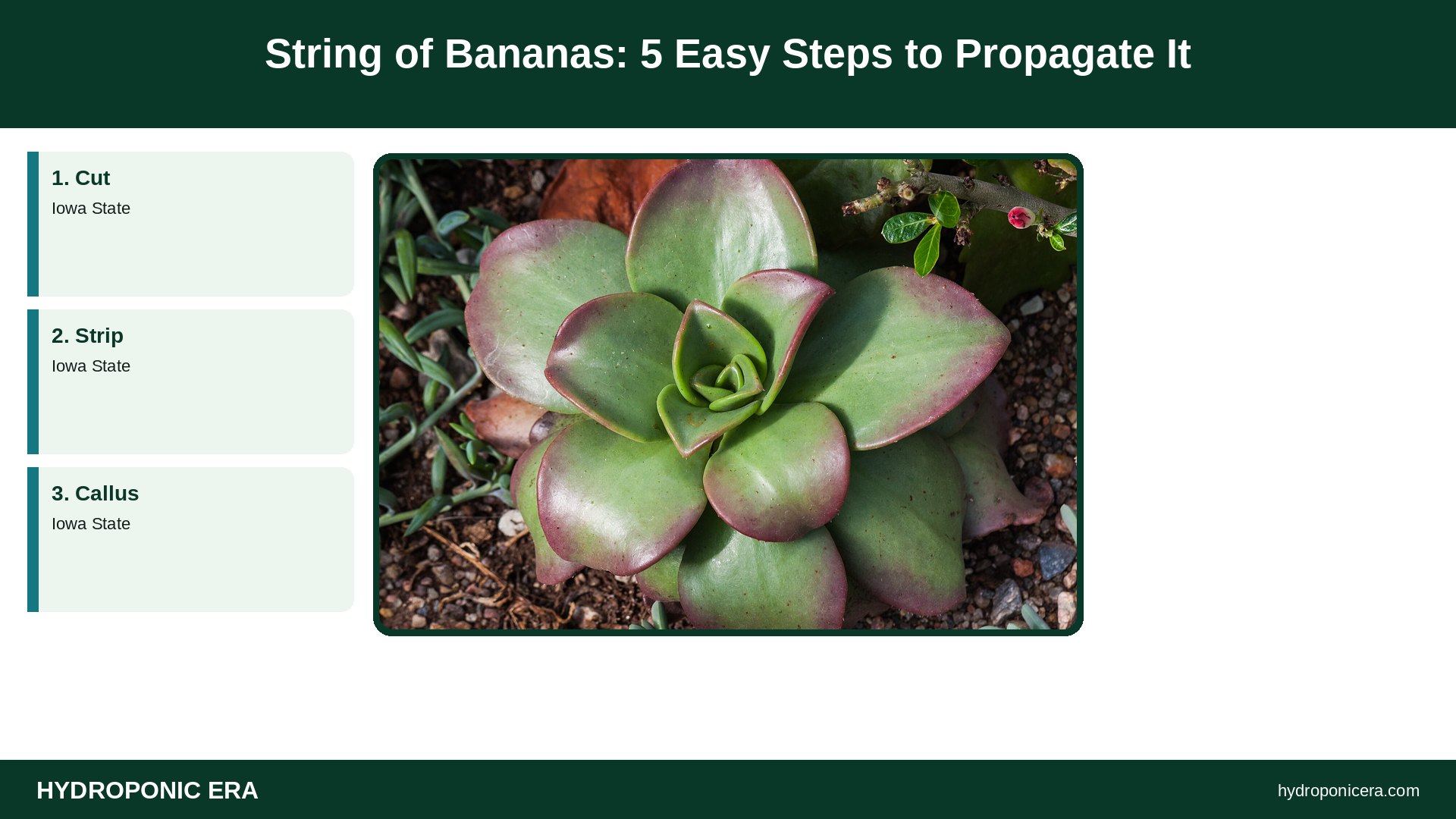
How do you propagate string of bananas? Cut a 3- to 6-inch (8 to 15 cm) string of bananas stem, remove the leaves from the lower half, let the cut end callus for several days, then lay or insert it in a well-drained cactus mix. NC State Extension says stem cuttings are the quickest method.
Key takeaway: String of bananas (Curio radicans) is a trailing succulent whose name means “taking root along the stems.” Callused stem cuttings root fast in gritty mix. Water rooting works for some growers, but soil is the safer, extension-backed route. Bright indirect light and sparse watering prevent rot.
| Step | What to do | Source |
|---|---|---|
| 1. Cut | 3 to 6 in (8 to 15 cm) healthy stem | Iowa State |
| 2. Strip | Remove leaves from the lower half | Iowa State |
| 3. Callus | Let the cut end dry for several days | Iowa State |
| 4. Plant | Well-drained cactus mix, pot with drainage | Iowa State, NC State |
| 5. Water lightly | Avoid soggy mix that rots cuttings | UC Marin Master Gardeners |
What Is String of Bananas?
String of bananas is Curio radicans, a trailing succulent in the daisy family. NC State Extension explains that the species name radicans means “taking root along the stems,” which describes how easily it spreads. Its banana-shaped leaves line stems that can trail 1 to 3 feet (30 to 90 cm) from a pot or hanging basket.
It is closely related to string of pearls and grows the same way. If you know string of pearls in water, you already know most of the basics.
How Do You Take String of Bananas Cuttings?
Choose a healthy, plump stem and cut a piece 3 to 6 inches (8 to 15 cm) long, as Iowa State Extension recommends for succulent stem cuttings. Remove the leaves from the lower half so bare nodes can contact the mix. UC Marin Master Gardeners advise sanitizing tools in a 1:9 bleach solution first.
- Sanitize scissors with a 1:9 bleach solution or rubbing alcohol.
- Cut a firm, healthy stem 3 to 6 inches (8 to 15 cm) long.
- Strip the leaves from the bottom half of the cutting.
- Set the cutting on a dry surface out of direct sun.
- Wait several days for the cut end to callus.
Callusing seals the wound and lowers the chance of rot once the cutting meets moisture. Iowa State says to let the cut end dry for several days.
How Do You Root String of Bananas in Soil?
Fill a pot that has drainage holes with well-drained cactus mix, then lay the callused string of bananas cutting on the surface or insert the bare end just below it. Iowa State recommends a well-drained cactus mix and a pot with drainage. Because the stems root along their length, pinning them to the mix helps.
- Use a gritty cactus and succulent mix.
- Coil longer stems on the surface so several nodes touch soil.
- Pin stems down with a bent paper clip if needed.
- Keep in bright indirect light while roots form.
Adding perlite improves drainage further. Our perlite propagation guide shows how.
Can You Root String of Bananas in Water?
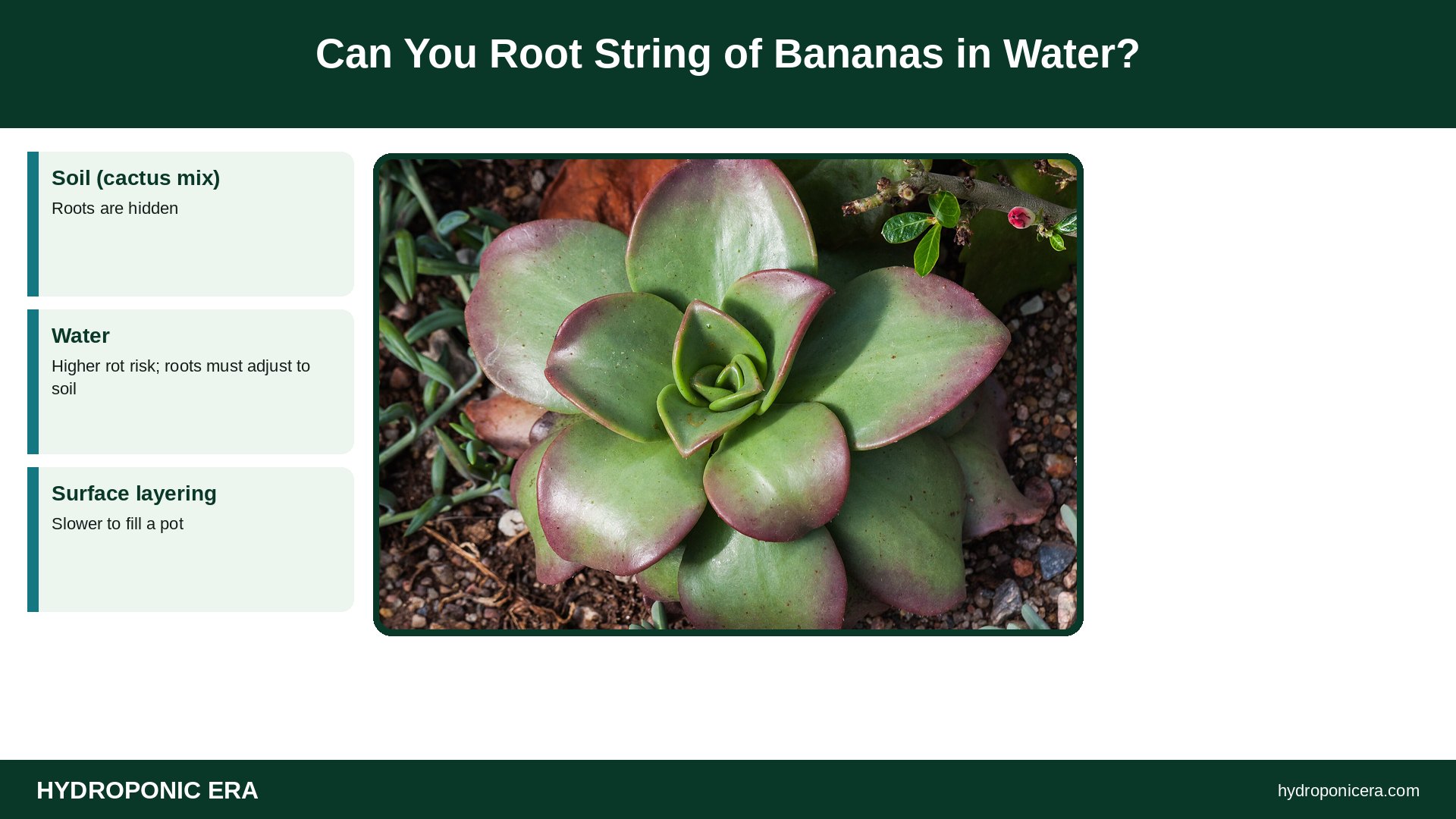
Some growers root string of bananas in water, but the extension sources we reviewed recommend dry callusing and a well-drained mix instead. Succulent stems rot easily when kept wet, and UC Marin Master Gardeners warn against overwatering cuttings for that reason. If you try water, keep only the bare stem submerged and change the water often.
| Method | Pros | Cons |
|---|---|---|
| Soil (cactus mix) | Extension-backed; no transplant shock | Roots are hidden |
| Water | Roots are visible | Higher rot risk; roots must adjust to soil |
| Surface layering | Stems root where they touch | Slower to fill a pot |
For a broader comparison, read water propagation vs soil propagation.
How Often Should You Water String of Bananas?
Water a rooted string of bananas when the top half of the soil is dry, as NC State Extension advises. The plant is drought tolerant and prone to root rot when overwatered. For fresh cuttings, keep the mix only lightly moist until new growth shows that roots have formed.
How Much Light Does String of Bananas Need?
Give it bright indirect light. NC State Extension lists bright indirect light as ideal. Avoid harsh afternoon sun through hot glass, which can scorch the leaves, and rotate hanging pots so all sides receive light evenly.
| Need | Guideline | Source |
|---|---|---|
| Light | Bright, indirect | NC State |
| Water | When the top half of soil is dry | NC State |
| Soil | Well-drained cactus mix | NC State, Iowa State |
| Hardiness | Zones 10a to 11b outdoors | NC State |
| Main risk | Overwatering and root rot | NC State |
Why Is My String of Bananas Cutting Rotting?
Rot almost always means too much moisture. The cut end may not have callused, the mix may hold too much water, or the pot may lack drainage. UC Marin Master Gardeners warn that overwatering is the main cause of cutting losses. Recut above the soft tissue, let it callus again and replant in drier mix.
- Mushy, translucent stem: overwatering; recut and re-callus.
- Shriveled leaves: underwatering once rooted; water deeply.
- Black base: pot without drainage; switch pots.
How Do You Make a Fuller Pot From Cuttings?
Plant several callused cuttings in one container instead of one long strand. Coil some stems across the surface and insert others around the rim, so roots form at many points at once. Because the species roots along its stems, each coil that touches the mix can become a new crown of growth.
- Take five to eight cuttings at the same time.
- Let all of them callus for several days.
- Insert some ends around the rim of the pot.
- Coil the rest across the surface and pin them lightly.
- Water sparingly until new growth appears.
A shallow, wide pot suits this approach better than a deep one, since the roots stay near the surface and a smaller volume of mix dries faster.
FAQ About String of Bananas
How long do string of bananas cuttings take to root?
It varies with warmth and light; look for new growth and resistance when you gently tug.
Is string of bananas the same as string of pearls?
No, but they are close relatives with very similar care.
Can I grow it outdoors?
NC State lists it as hardy in zones 10a to 11b.
Should I fertilize new cuttings?
Wait until they are rooted and growing before feeding lightly.
Can I propagate it from a single leaf?
Stem cuttings are the quickest method according to NC State.
Love trailing plants? See our string of hearts in water guide and our overview of succulents in hydroponics.
Sources
- NC State Extension Gardener Plant Toolbox. Curio radicans.
- Iowa State University Extension. How to propagate succulents.
- UC Marin Master Gardeners. Propagating succulents.
- Photo credits (Wikimedia Commons, edited with titles): Senecio radicans, jardín botánico de Tallinn, Estonia, 2012-08-13, DD 01 by Diego Delso (CC BY-SA 3.0); Echeveria A7CR 02866-90 zsp by This Photo was taken by Timothy A. Gonsalves. Feel free to use my photos, but pl (CC BY-SA 4.0)