
What are marginal pond plants? Marginal pond plants grow at the shallow edge of a pond with their roots in wet soil and their leaves and flowers above the water. Most grow best with 1 to 4 inches (2.5 to 10 cm) of water over the crown, per Colorado State Extension. Pickerelweed and blue flag iris are popular US natives.
Key takeaway: Marginal pond plants, also called shoreline or edge plants, live in the shallow zone between the bank and open water. Most do best with 1 to 4 inches (2.5 to 10 cm) of water over the crown, potted in heavy clay loam rather than light potting mix. Native choices listed by the Illinois Department of Natural Resources include pickerelweed, blue flag iris, arrowheads and arrow arum.
| Topic | What sources report | Source |
|---|---|---|
| Water over the crown | Most marginals: 1–4 in (2.5–10 cm) | Colorado State Extension |
| Shallow marginal zone | About 2 in (5 cm), mud or pond edge | Illinois DNR |
| Water lilies, for comparison | 8–12 in (20–30 cm) over the crown | Colorado State Extension |
| Potting soil | Heavy clay loam; no peat, perlite or bark | Colorado State Extension |
| Pot size | About 12 in (30 cm) across, 10 in (25 cm) deep | Colorado State Extension |
| Sun | Full sun, 6 hours minimum | Illinois DNR |
| Native fertilizing | Do not fertilize native plants | Illinois DNR |
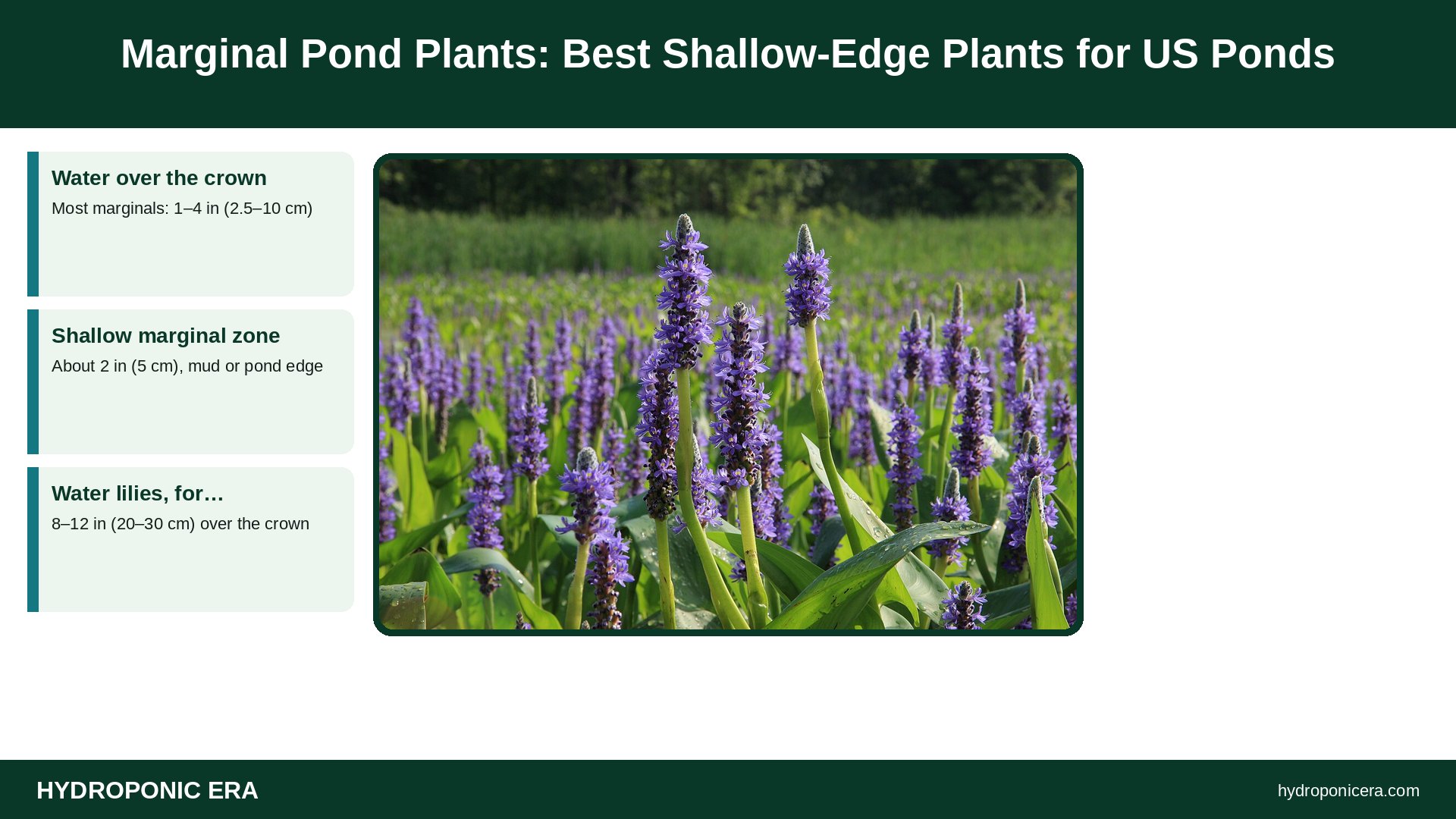
What Are Marginal Pond Plants?
Marginal pond plants are emergent plants that root in shallow water or saturated soil at the pond edge. Their crowns sit just under the surface, while their stems, leaves and flowers rise into the air. The Illinois Department of Natural Resources describes marginals that can be tucked among rocks at the edge and do well in a few inches of water.
Marginal pond plants soften the hard line of a liner, shade the shallow edges, give frogs and insects cover, and take up nutrients that would otherwise feed algae. Kansas State University’s water gardening guide notes that the more nutrients water plants use, the less algae can compete.
- Marginals: roots in shallow water, leaves above the surface.
- Floating plants: roots hang free in the water.
- Submerged plants: grow fully underwater and are often called oxygenators.
For full plans, see our guides to oxygenating pond plants and koi pond plants.
How Deep Should Marginals Sit?
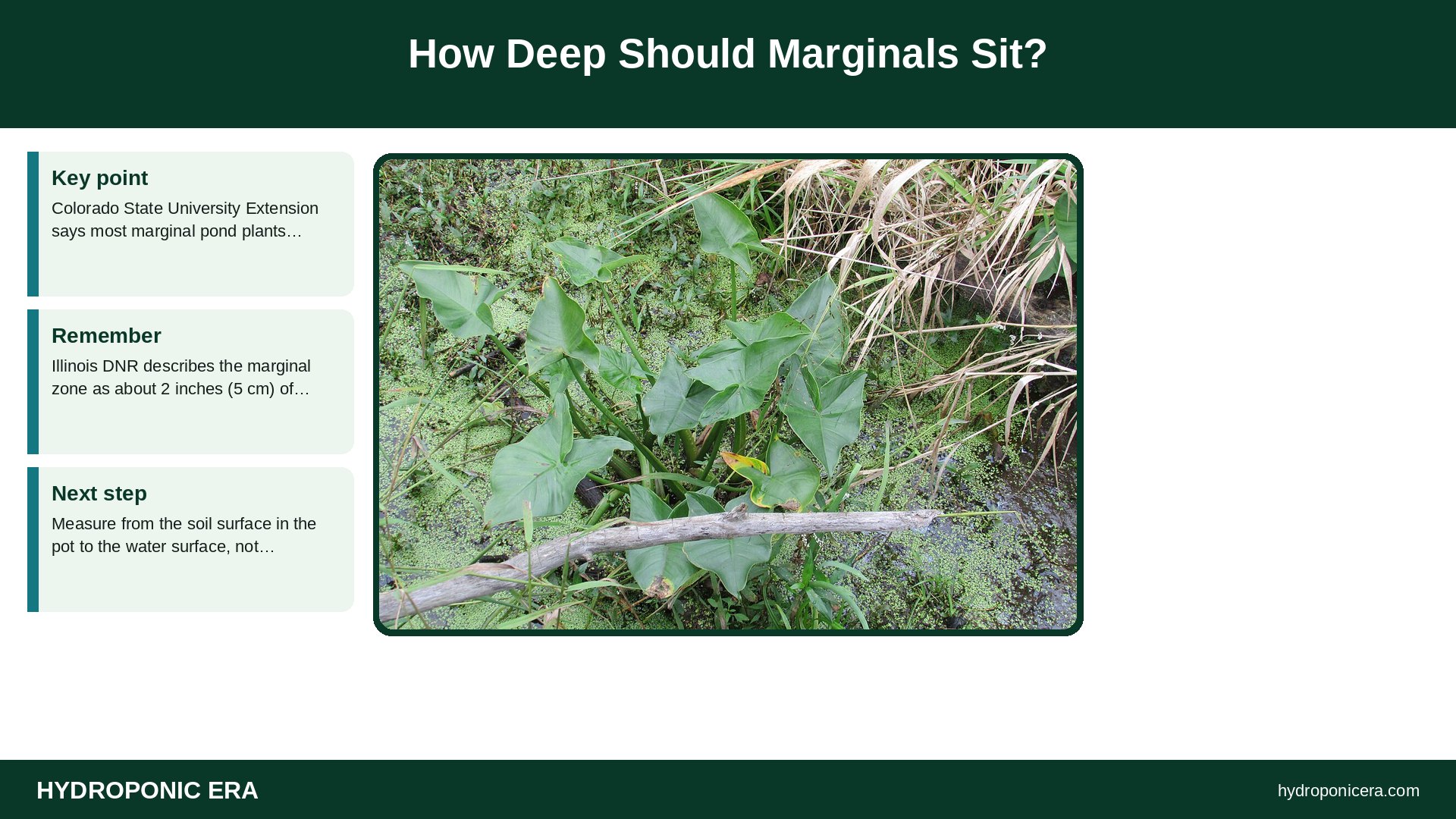
Shallow. Colorado State University Extension says most marginal pond plants grow best with 1 to 4 inches (2.5 to 10 cm) of water over the crown, compared with 8 to 12 inches (20 to 30 cm) for water lilies. Illinois DNR describes the marginal zone as about 2 inches (5 cm) of water, mud or the pond edge. Measure from the soil surface in the pot to the water surface, not from the pond bottom.
- Pot the plant in heavy clay loam, with the crown just above the soil.
- Use a pot about 12 inches (30 cm) across and 10 inches (25 cm) deep for most marginals.
- Firm the soil and add larger stones on top so fish cannot dig it out.
- Set the pot on a shelf so 1 to 4 inches (2.5 to 10 cm) of water covers the crown.
- Raise the pot on bricks if the shelf is too deep.
Colorado State warns against peat, perlite, bark or other light materials, which float out of the pot. Learn more in our pond depth guide.
Which Marginals Are Native to the US?
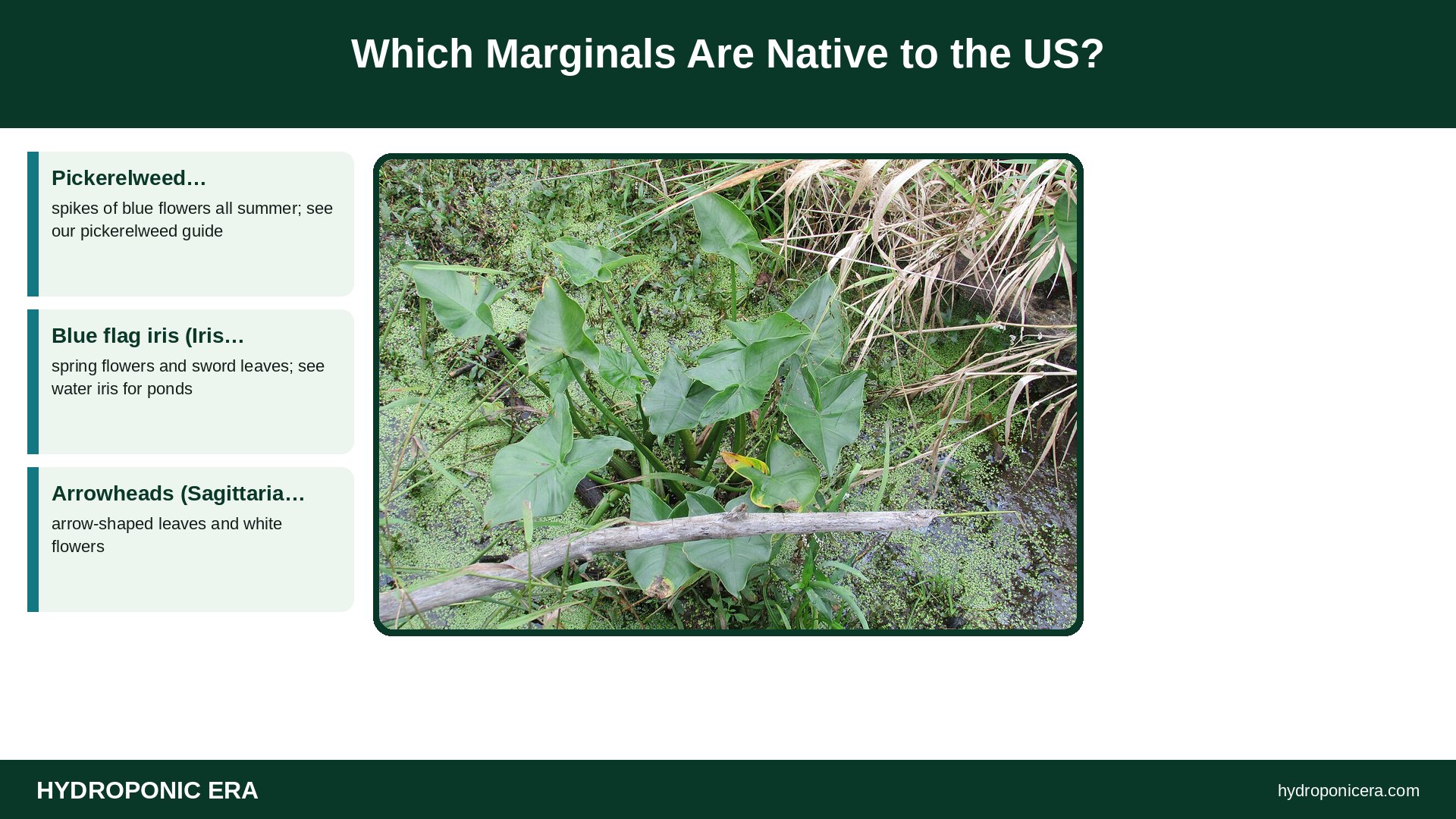
Many good marginal pond plants are native. The Illinois DNR pond plant list includes these shallow-water and emergent natives. Check your state’s native plant society for local species, and buy from nurseries that grow plants rather than collecting them from the wild.
- Pickerelweed (Pontederia cordata): spikes of blue flowers all summer; see our pickerelweed guide.
- Blue flag iris (Iris versicolor): spring flowers and sword leaves; see water iris for ponds.
- Arrowheads (Sagittaria spp.): arrow-shaped leaves and white flowers.
- Arrow arum (Peltandra virginica): large glossy leaves for shade.
- Small-flowered water plantain (Alisma subcordatum): airy white flowers.
- Rushes and sedges (Juncus and Carex spp.): grassy texture at the edge.
Common cattail is also on the list, but it spreads hard in small ponds; read cattails in water gardens before planting it.
How Do You Care for Marginal Pond Plants?
Give them sun, keep chemicals out and tidy them seasonally. Illinois DNR recommends full sun of at least six hours, says to avoid pesticides and chlorinated chemicals near water, and advises not fertilizing native plants. It also suggests pruning dying material monthly and removing decaying debris from the pond bottom in spring.
- Sun: at least 6 hours.
- Water level: top up in drought so crowns stay covered.
- Trim: remove yellowing leaves and spent flowers.
- Divide: split crowded pots every few years in spring.
Decaying leaves add to bottom sludge; our pond muck removal guide explains how to clear it.
What Happens to Marginal Pond Plants in Winter?
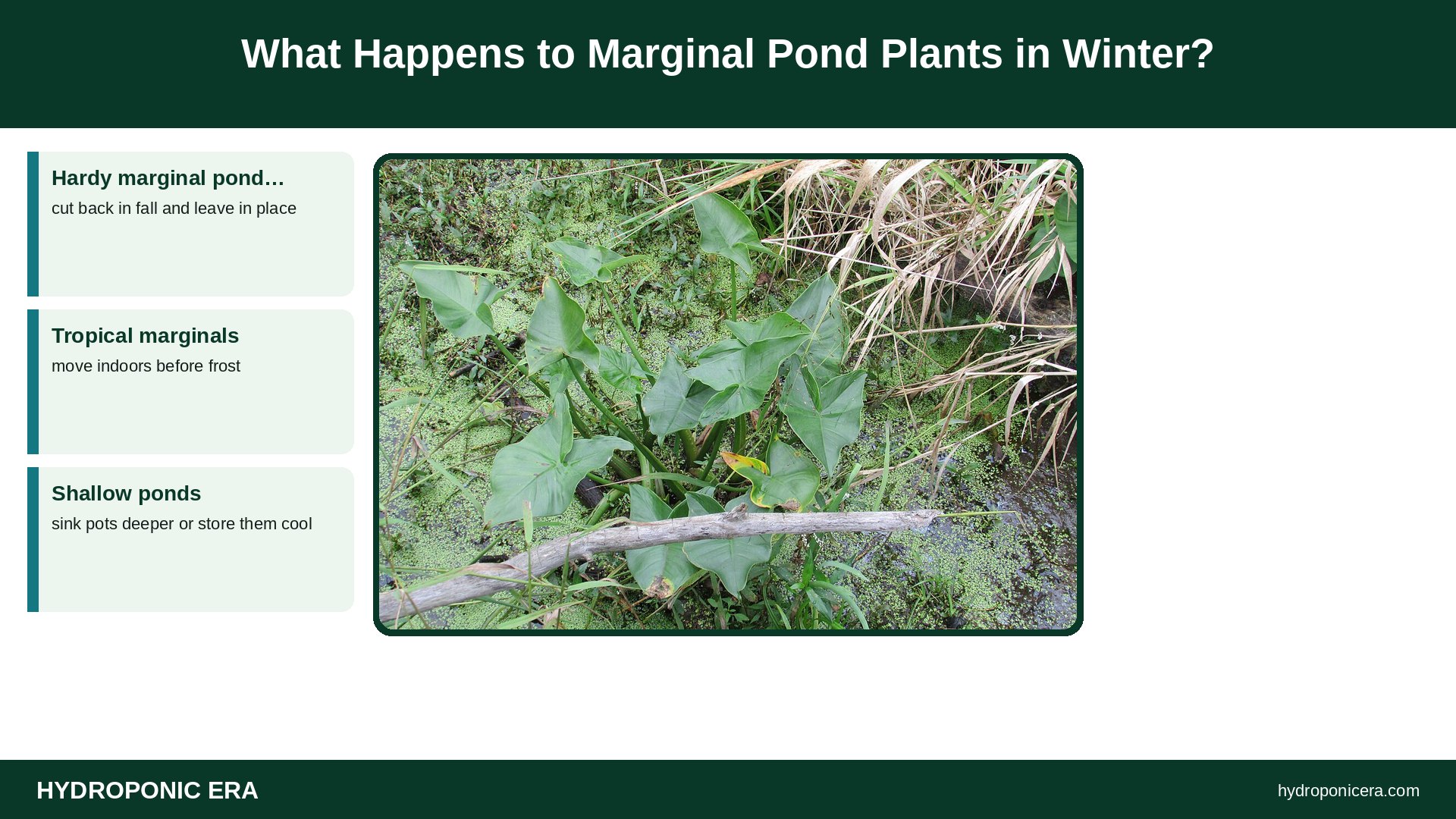
Hardy natives usually stay in the pond. Kansas State’s plant tables advise cutting many hardy marginals back in winter. Tropical marginals are different and must come indoors before frost. Illinois DNR notes that small manmade ponds may be too shallow to overwinter some plants, which can be brought indoors to die back and rest somewhere cool.
- Hardy marginal pond plants: cut back in fall and leave in place.
- Tropical marginals: move indoors before frost.
- Shallow ponds: sink pots deeper or store them cool.
For more winter steps, see winterizing a pond with fish and our bog garden guide.
FAQ About Marginal Pond Plants
How deep do marginal pond plants go?
Most do best with 1–4 in (2.5–10 cm) of water over the crown.
What soil should I use?
Heavy clay loam; avoid peat, perlite and bark.
Do marginals need fertilizer?
Illinois DNR advises not fertilizing native plants.
Which native marginals are easy?
Pickerelweed, blue flag iris and arrowheads are common choices.
Can marginals grow in shade?
They do best in at least 6 hours of sun.
Do I bring marginals inside in winter?
Only tropical ones; cut hardy ones back.
Sources
- Colorado State University Extension — Water Gardens: Planting Aquatic Plants
- Illinois Department of Natural Resources — Pond Requirements and Plant Lists
- Kansas State University Research and Extension — Water Gardening: Plants for the Water Garden (MF2912)
- Photo credits (Wikimedia Commons, edited with titles): Pontederia cordata 4 PP by Cephas (CC BY-SA 3.0); Broadleaf Arrowhead (Sagittaria latifolia) 7808 by Chris Light (CC BY-SA 4.0)